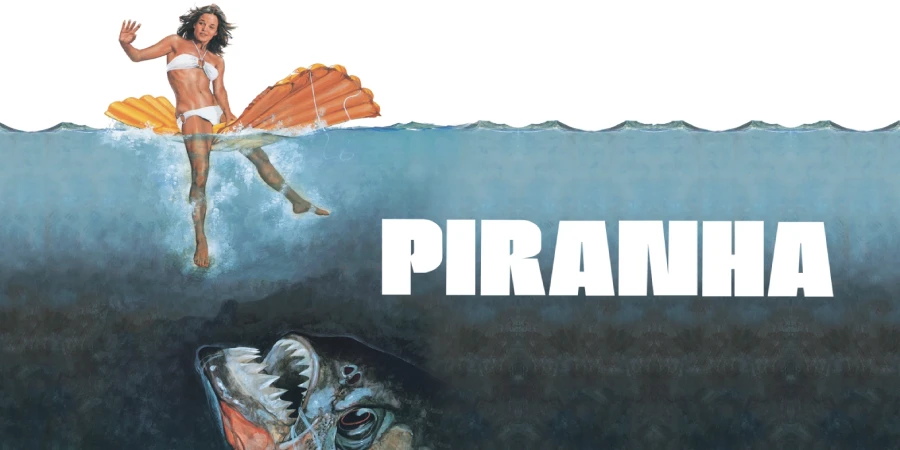

Roger Corman produced it on a shoestring budget, Joe Dante directed it with gleeful savagery, and Piranha (1978) somehow became one of the smartest, most entertaining B-movies ever made. This is not merely a Jaws knockoff; it is a sharp, self-aware creature feature that bites back at the military-industrial complex with genuine wit. Mutant fish tear through swimmers, summer campers, and government cover-ups with equal enthusiasm. Buckle up, because nothing in the water is safe.
Detailed Summary
Two Hikers Stumble Into Trouble
Two young hikers, Barbara and David, sneak onto a fenced-off military installation late at night. They spot an abandoned swimming pool and decide to take a dip. It is a bad decision, and they pay for it immediately; something in the water strips them to the bone within seconds.
Maggie McKeown Investigates
Maggie McKeown, a skip tracer hired to find the missing hikers, arrives in the rural hill country. She partners reluctantly with Paul Grogan, a hard-drinking, anti-social local who lives alone on a ruined property. Together, they push further into the restricted terrain looking for answers.
They reach the abandoned military base and find a disheveled scientist named Dr. Robert Hoak. Before Hoak can warn them, Maggie drains a large concrete holding tank, believing it might conceal evidence about the missing hikers. She is wrong; she has just released a genetically altered strain of piranha directly into the river system.
The Fish Head Downstream
Hoak, now essentially their prisoner, explains the horrible truth. He was part of a secret military program called Operation Razorteeth, which bred a strain of piranha capable of surviving in cold saltwater. The project was designed for use during the Vietnam War as a biological weapon against enemy waterways.
However, the war ended before the program launched, and the fish remained at the base, forgotten and increasingly dangerous. Now they are loose in a river that flows past a children’s summer camp and a newly opened resort. Paul realizes the clock is already ticking.
A Race Against the Current
Paul, Maggie, and Hoak rush downriver on a makeshift raft, desperately trying to warn anyone downstream. Meanwhile, the piranha swarm begins feeding immediately; a fisherman loses his life in a genuinely gruesome attack, and the kills escalate in speed and brutality.
Hoak attempts to distract the fish at one point and suffers a vicious attack himself, dying from his wounds shortly after. His death removes the group’s most knowledgeable guide, raising the stakes considerably. Paul and Maggie press on without him.
The Summer Camp Massacre
Paul’s young daughter, Suzie, attends the camp downstream. Paul knows she is in danger, and every minute of delay feels catastrophic. He and Maggie try to contact the camp by radio, but their warnings get dismissed or ignored.
The piranha reach the camp during an open-water swim event. Children and counselors scramble in panic as the fish tear through everyone in the water. Some kids escape to shore, but the sequence is brutal and does not sanitize the violence. It stands as the film’s most emotionally intense set piece.
Suzie survives by clinging to a floating platform, but the sequence makes clear that the piranha do not distinguish between adults and children. Consequently, the attack carries genuine horror rather than the comfortable safety net most genre films provide.
The Resort Opening Goes Terribly Wrong
Further downstream, a flashy resort called Lost River Lake is holding its grand opening. The owner, Buck Gardner, ignores all warnings about contamination because money and publicity take priority. Paul and Maggie arrive and try to shut down the water activities, but Gardner dismisses them.
Predictably, the piranha arrive during the resort’s big water festival. Guests, swimmers, and staff are attacked in a chaotic and bloody sequence. Gardner’s greed costs lives in a pointed commentary on corporate negligence. The film draws a direct, unmissable line between capitalism and carnage.
Government Interference
Throughout the film, a shady government operative named Desmondo (representing military interests) actively tries to suppress the story and block any official response. He threatens Maggie and attempts to discredit Paul. In addition, he pulls strings to prevent local authorities from taking the piranha threat seriously.
His obstruction functions as the film’s sharpest satirical edge. Joe Dante is not just making a monster movie; he is indicting the institutions that create monsters and then hide the evidence. Desmondo essentially becomes as dangerous as the fish themselves.


Movie Ending
Paul concludes that the only way to stop the piranha before they reach the ocean is to poison the river with toxic waste stored at an old, contaminated industrial facility along the riverbank. If the fish reach saltwater, they will spread along the entire coastline, and the military’s nightmare weapon will fulfill its original destructive potential.
Paul dives into the polluted, piranha-infested water and manually opens the waste pipes, flooding the river with enough toxic discharge to kill the swarm. He gets attacked repeatedly during this sequence, and the film does not shy away from showing the damage the fish inflict on him. It is a desperate, ugly act of heroism rather than a clean, cinematic triumph.
He survives, barely, pulled from the water in a badly wounded state. Maggie reaches him in time, and the immediate threat ends. The piranha swarm appears to be destroyed by the toxic outflow before reaching the sea.
However, the final moments introduce a deeply unsettling coda. A radio report confirms that some piranha may have survived and entered the ocean. The ending refuses to close the loop entirely, leaving the audience with the understanding that the threat has not been fully eliminated. This ambiguity serves the film’s satirical thesis perfectly: government-engineered catastrophes do not simply end when the credits roll.
Furthermore, Desmondo’s involvement throughout the film goes largely unpunished in any meaningful institutional sense. He walks away, the military program’s existence gets buried, and the public never fully learns the truth. For a 1978 drive-in creature feature, that is a remarkably cynical and honest conclusion.
Are There Post-Credits Scenes?
Piranha (1978) contains no post-credits scene. Once the film ends, it ends. No additional footage, no teaser, no sequel setup beyond the ominous radio broadcast woven into the closing moments of the film itself.
Type of Movie
Piranha occupies a delightful genre crossroads: it is a horror-comedy creature feature with genuine satirical ambitions. Joe Dante balances genuine scares with darkly comedic timing throughout, and the film never fully commits to pure horror without undercutting tension with wit.
In contrast to many of its contemporaries, it also functions as a political satire, targeting military secrecy, government cover-ups, and corporate greed. Tonally, it sits somewhere between exploitation cinema and smart genre filmmaking, which is precisely what makes it so rewatchable.
Cast
- Bradford Dillman – Paul Grogan
- Heather Menzies – Maggie McKeown
- Kevin McCarthy – Dr. Robert Hoak
- Keenan Wynn – Jack
- Dick Miller – Buck Gardner
- Barbara Steele – Dr. Mengers
- Belinda Balaski – Betsy
- Melody Thomas Scott – Laura
- Bruce Gordon – Desmondo
- Shannon Collins – Suzie Grogan
- Paul Bartel – Mr. Dumont
Film Music and Composer
Pino Donaggio composed the score for Piranha, bringing a tense, unsettling musical sensibility to the film. Donaggio was already building a strong reputation in genre cinema at this point, and his work here complements Dante’s direction effectively.
His score leans into strings and percussive bursts to heighten the attack sequences. Rather than mimicking John Williams’ iconic two-note motif from Jaws, Donaggio crafts something more chaotic and frenetic, matching the frenzied nature of a piranha swarm rather than a single lurking predator.


Filming Locations
Production took place primarily in Texas, with river sequences and outdoor scenes shot on location in the Hill Country region. The natural waterways and dense, overgrown riverbanks gave the film an authentic, isolated feeling that no studio backlot could replicate.
The remote, sun-baked landscape reinforces the story’s sense of institutional abandonment. These are places the government has forgotten about, or chosen to ignore, and the environment communicates that neglect visually. Practically speaking, the locations also kept the production budget manageable, which mattered enormously given Corman’s notoriously tight financial oversight.
Awards and Nominations
Piranha did not receive significant awards recognition from major industry bodies. It was a genre film made on a low budget, and awards circuits in 1978 were not particularly receptive to creature features with satirical overtones.
Behind the Scenes Insights
- Steven Spielberg reportedly screened Piranha before its release and praised it, calling it the best of the Jaws imitations. Coming from the director of the film it was imitating, that endorsement carried real weight.
- Roger Corman initially attempted to block the film’s release, arguing it was too similar to Jaws and could invite a lawsuit from Universal Pictures. Spielberg’s positive reaction reportedly helped defuse that concern.
- Joe Dante shot the piranha attack sequences using mechanical fish rigs and practical water effects, relying on rapid editing to create the illusion of a massive swarm.
- The film was shot quickly and cheaply, even by Corman’s standards. The tight schedule forced creative solutions that, in several cases, made the film more energetic and unpredictable.
- Writer John Sayles, who later became a celebrated independent filmmaker, wrote the screenplay. His script gave the film considerably more satirical intelligence than a typical drive-in creature feature.
- Dick Miller, a Corman regular, plays the resort owner Buck Gardner with gleeful, oblivious pomposity. Miller appeared in numerous Dante and Corman productions throughout his career.
Inspirations and References
Jaws (1975) is the obvious and openly acknowledged inspiration. Corman greenlit Piranha directly as a response to Jaws commercial dominance, seeking to capitalize on the public appetite for aquatic creature horror. John Sayles’ script, however, deliberately subverts the template rather than simply copying it.
The Operation Razorteeth concept draws on real Cold War anxieties about biological and chemical weapons programs. The U.S. military’s use of environmental and biological agents during the Vietnam era gave Sayles a factual foundation for his satire. Moreover, the film references Them! (1954) and other 1950s atomic-age monster movies as part of its genre DNA.
Notably, a television playing in the background of one scene shows footage from Creature from the Black Lagoon, a deliberate nod to the monster-movie tradition the film both belongs to and gently mocks.
Alternate Endings and Deleted Scenes
No widely documented alternate ending exists for the 1978 theatrical release of Piranha. The ambiguous conclusion with the radio report about surviving piranha appears to have been the intended ending from an early stage, consistent with John Sayles’ satirical goals for the screenplay.
Some footage from the production did not make the final cut, particularly involving character development scenes that were trimmed to maintain pacing. Specific details about deleted scenes have not been extensively documented in publicly available production materials, so further claims would move into speculation.
Book Adaptations and Differences
Piranha (1978) is not based on a novel or pre-existing literary source. John Sayles wrote an original screenplay for the film. A novelization was published to accompany the film’s release, which is the reverse of the adaptation process, meaning the book followed the movie rather than the other way around.



Memorable Scenes and Quotes
Key Scenes
- The opening night swim at the military base, where Barbara and David get devoured within seconds of entering the abandoned pool; a brutal, efficient cold open that sets the tone immediately.
- Maggie draining the holding tank, unknowingly releasing the piranha into the river system; a masterful scene of dramatic irony where the audience understands the catastrophe before the characters do.
- The summer camp attack sequence, which refuses to protect child characters from the carnage and consequently delivers the film’s most genuinely disturbing stretch of horror.
- Paul’s descent into the toxic water at the climax, where he takes prolonged, visible damage from the piranha while forcing open the waste pipes; unglamorous, painful heroism at its best.
- Buck Gardner ignoring every warning about the piranha while obsessing over his resort’s grand opening, a scene that plays as pure dark comedy right up until people start dying.
Iconic Quotes
- “They’re eating the guests, sir.” – a line that lands with pitch-perfect deadpan horror-comedy timing during the resort attack.
- “What are they? What are those things?” – Maggie’s panicked question during the first major attack, simple but effective in grounding the audience’s fear.
- Dr. Hoak’s explanation of Operation Razorteeth carries the film’s sharpest dialogue, as Sayles’ script gives the military program a chilling institutional logic that feels more frightening than the fish themselves.
Easter Eggs and Hidden Details
- A television in the background of one scene plays Creature from the Black Lagoon, a deliberate nod connecting Piranha to the classic Universal monster movie tradition.
- Joe Dante includes several visual homages to 1950s science fiction and horror films throughout, embedding Piranha within a longer genre lineage rather than positioning it purely as a Jaws spinoff.
- The name Operation Razorteeth itself functions as a satirical joke: a military project with a cartoonishly aggressive name that eventually produces real, uncontrollable carnage.
- Dick Miller’s character, Buck Gardner, mirrors the mayor of Amity from Jaws in function, prioritizing economic interests over public safety, but Dante and Sayles push the critique further by making Gardner even more obliviously venal.
- Several background extras in the resort sequence are production crew members, a common cost-saving practice in Corman productions that also gives those scenes an improvisational energy.
Trivia
- John Sayles went on to direct acclaimed independent films including Matewan (1987) and Eight Men Out (1988). His Piranha script is often cited as an early example of his ability to embed social commentary in genre frameworks.
- A remake, also titled Piranha, was released in 1995 for television, followed by Piranha 3D in 2010. Neither captured the satirical sharpness of the 1978 original.
- Joe Dante’s career as a director accelerated significantly after Piranha‘s success, leading to projects including The Howling (1981) and eventually Gremlins (1984).
- Roger Corman’s New World Pictures distributed the film, maintaining Corman’s remarkable run of producing profitable genre films throughout the 1970s.
- Heather Menzies, who plays Maggie, had previously appeared in The Sound of Music (1965) as one of the Von Trapp children, making her casting here a notable genre shift.
- The mechanical piranha props required constant maintenance during water shooting, as the saltwater and chlorine used on set degraded the materials rapidly.
- Kevin McCarthy, who plays Dr. Hoak, famously starred in Invasion of the Body Snatchers (1956), and his casting connects Piranha thematically to Cold War-era paranoia films.
Why Watch?
Piranha delivers everything a great creature feature should: genuine scares, sharp wit, and a satirical intelligence that elevates it far above its drive-in origins. John Sayles’ script and Joe Dante’s direction combine to produce something that still bites hard nearly five decades later. For fans of smart, self-aware genre cinema, this is essential viewing.
Director’s Other Movies
- Hollywood Boulevard (1976)
- The Howling (1981)
- Gremlins (1984)
- Explorers (1985)
- Innerspace (1987)
- The ‘Burbs (1989)
- Gremlins 2: The New Batch (1990)
- Matinee (1993)
- Small Soldiers (1998)
- Looney Tunes: Back in Action (2003)
- The Hole (2009)
Recommended Films for Fans
- Jaws (1975)
- The Howling (1981)
- Piranha (1995)
- Alligator (1980)
- Gremlins (1984)
- Tremors (1990)
- Humanoids from the Deep (1980)
- The Hills Have Eyes (1977)
- Slither (2006)
- Deep Blue Sea (1999)
- Piranha 3D (2010)