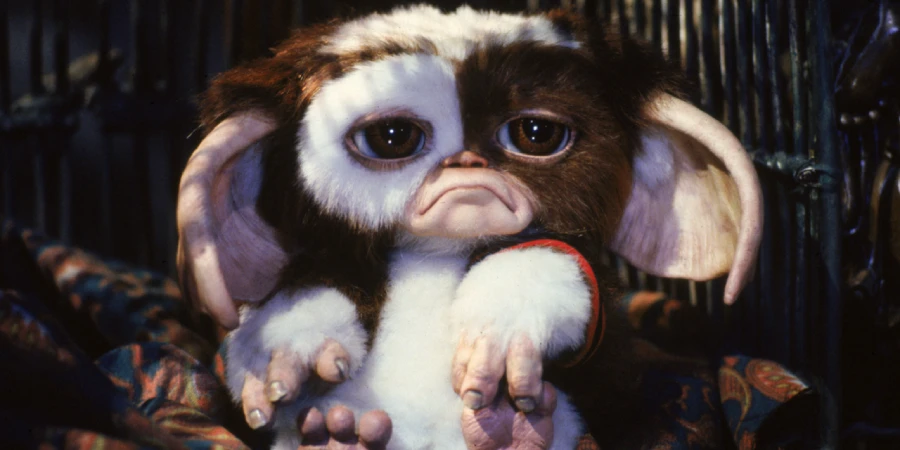

Few sequels have the audacity to mock their own existence while simultaneously being better than the original. Gremlins 2: The New Batch does exactly that, transforming what could have been a cheap cash-grab into a gleefully unhinged satire of Hollywood sequels, corporate America, and modern consumer culture. Director Joe Dante was handed a bigger budget and, crucially, creative freedom, and he used both to spectacular effect. What emerged in 1990 was one of the strangest, funniest, and most self-aware studio films ever made.
Detailed Summary
Saying Goodbye to Mr. Wing
The film opens in New York City, where the elderly Mr. Wing, the original owner of Mogwai, passes away. His small shop sits in the path of a massive development project controlled by the powerful media mogul Daniel Clamp. With Wing gone, his beloved Mogwai, Gizmo, is left alone and vulnerable.
Clamp’s representatives seize the building, and in the chaos, Gizmo escapes. He wanders through Manhattan before scientists from Clamp’s in-house research lab, Splice O’ Life, capture him. Gizmo ends up in a laboratory cage, frightened and alone.
Billy and Kate Arrive at Clamp Center
Billy Peltzer and his girlfriend Kate Beringer now live in New York and both work at Clamp Center, a gleaming, futuristic high-rise owned by the eccentric Daniel Clamp. Billy works as a designer; Kate works at the building’s information desk. Clamp Center functions as a self-contained universe, complete with its own shopping mall, restaurants, and cable television network.
Billy stumbles across Gizmo in the Splice O’ Life lab and tries to help him escape. However, a careless lab accident exposes Gizmo to water, spawning a new batch of Mogwai. These new creatures are immediately nastier, smarter, and far more menacing than their predecessors.
The New Mogwai and the Rules Get Broken Again
The new Mogwai, led by the instantly recognizable Mohawk, waste no time causing trouble. They manipulate lab staff, steal food after midnight, and generally behave like tiny furry sociopaths. Consequently, each of them cocoons and transforms into a full Gremlin with alarming speed.
Mohawk takes things further by consuming a spider-related genetic formula from the Splice O’ Life lab. As a result, he mutates into a horrifying spider-Gremlin hybrid, becoming the film’s primary physical threat. Meanwhile, the other Gremlins fan out across the building, accessing labs, a brain-enhancement formula, and even a television studio.
Clamp Center Under Siege
The Gremlins overrun Clamp Center floor by floor. One Gremlin drinks an intelligence-enhancing serum and becomes articulate, philosophical, and capable of full conversation. Another consumes a female hormone formula and transforms into a flirtatious, glamorous creature. A third drinks a bat DNA compound and gains the ability to fly.
Billy and Kate try to warn building management, but the chaos spreads too fast. Marla Bloodstone, a Clamp executive with a soft spot for Billy, attempts to help as the situation deteriorates. Daniel Clamp himself proves surprisingly reasonable and adaptable once he accepts that his building is actually full of monsters.
The Meta Interruption
In one of cinema’s most audacious fourth-wall breaks, the Gremlins actually invade the film projector mid-screening. Hulk Hogan (in the theatrical version) appears to threaten the Gremlins back onto the screen. For home video versions, the scene was cleverly reworked with the Gremlins attacking a VHS tape and John Wayne footage replacing the Hogan cameo.
This moment perfectly encapsulates the film’s entire philosophy: nothing is sacred, every convention is fair game, and Joe Dante is absolutely in on the joke.
Billy’s Plan to Stop the Gremlins
Billy devises a plan using the building’s electrical systems. He lures the Gremlins to the lobby atrium, where a sprinkler system could theoretically multiply them further. However, he realizes the key lies in the Electric Gremlin, a creature that absorbed an electricity serum and now exists as pure electrical energy flowing through the building’s wiring.
By channeling the Electric Gremlin through a lightning rod during a storm, Billy electrocutes the water-soaked Gremlins en masse. It is brutal, effective, and deeply satisfying. Most of the creatures die in this climax, including many of the film’s most memorable mutant variations.

Movie Ending
Mohawk, the spider-hybrid, survives the electrical massacre and corners Billy and Gizmo in the upper floors of Clamp Center. Gizmo, who has spent most of the film being tormented and terrified, finally reaches his breaking point. He fashions a tiny bow from a pencil and a rubber band, ignites a small flame, and fires a flaming arrow directly at Mohawk.
Mohawk bursts into flames and dies. It is Gizmo’s moment of complete, earned triumph, and the crowd-pleasing payoff works because the film has carefully built his suffering throughout. The little Mogwai goes from victim to hero in one perfectly timed beat.
In the aftermath, Daniel Clamp surveys the ruins of his beloved building and, in a characteristically eccentric response, immediately pivots to a new real estate vision. He plans to rebuild, naturally. Billy and Kate walk away from Clamp Center with Gizmo safely in tow.
Notably, Clamp gifts Billy and Kate a small house in the suburbs, echoing the kind of wholesome resolution you might expect from a fairy tale. Gizmo rides away with them, content and safe. The film ends on a warm, affectionate note that contrasts sharply with the anarchic madness that preceded it, which is entirely the point.
Furthermore, the closing moments circle back to the film’s satirical core: corporate excess gets destroyed, the little guy (literally) wins, and life moves on cheerfully regardless of the carnage.
Are There Post-Credits Scenes?
Gremlins 2: The New Batch does not include a post-credits scene. Once the credits roll, the film is finished. You can safely leave your seat without missing anything extra.
Type of Movie
Gremlins 2 occupies a genuinely unusual tonal space. It functions simultaneously as a horror comedy, a satirical farce, and a meta-textual deconstruction of Hollywood sequels and 1980s corporate culture. The horror elements are present but rarely played straight; almost every scare gets immediately undercut by a gag.
In contrast to the original film’s darker, more sincere tone, this sequel leans fully into absurdist comedy. Joe Dante’s sensibility runs throughout: affectionate toward genre films, deeply skeptical of authority, and always willing to let the joke go further than expected.
Cast
- Zach Galligan – Billy Peltzer
- Phoebe Cates – Kate Beringer
- John Glover – Daniel Clamp
- Robert Prosky – Grandpa Fred
- Robert Picardo – Forster
- Christopher Lee – Dr. Catheter
- Haviland Morris – Marla Bloodstone
- Dick Miller – Murray Futterman
- Jackie Joseph – Sheila Futterman
- Hulk Hogan – Himself (theatrical version)
- Tony Randall – Voice of the Brain Gremlin
- Frank Welker – Voice of Gizmo
Film Music and Composer
Jerry Goldsmith composed the score for Gremlins 2, reprising his work from the original film. Goldsmith was one of Hollywood’s most prolific and respected composers, with credits spanning decades across virtually every major genre. His ability to blend playful orchestral textures with genuine menace made him ideal for this material.
His score for the sequel leans more overtly comic than the first film’s music, matching Dante’s heightened tone. Goldsmith weaves Looney Tunes-style musical comedy into moments of chaos, which reinforces the film’s cartoonish sensibility. The Gizmo theme returns, warm and recognizable, providing emotional continuity across both films.
Filming Locations
Principal photography took place primarily on soundstages in Los Angeles. The massive Clamp Center interior sets were constructed specifically for the production, giving the filmmakers total control over the environment. This was essential for coordinating the elaborate puppet work and practical effects.
Some exterior shots used New York City locations to establish the urban setting convincingly. However, the bulk of the film’s action unfolds inside the artificial world of Clamp Center, which suits the story perfectly. A building that exists as its own hermetically sealed reality mirrors the film’s themes about corporate self-containment and excess.
Awards and Nominations
Gremlins 2: The New Batch did not receive significant awards recognition from major industry bodies. It performed modestly at the box office and earned appreciation primarily from critics and audiences who valued its satirical ambition, but awards attention largely passed it by.
Behind the Scenes Insights
- Joe Dante initially had little interest in making a sequel, but Warner Bros. gave him unusual creative freedom, which changed his mind entirely.
- Dante used the film explicitly as a vehicle for satire, targeting sequel culture, corporate media, and the original film’s own mythology.
- The Gremlin puppets were significantly upgraded for the sequel, with more articulation and a wider range of expressions than those used in the original.
- Christopher Lee was cast partly as a nod to his horror legacy; his presence as a mad scientist carried enormous genre weight.
- The film’s production team constructed extraordinarily elaborate sets to allow the Gremlins to interact convincingly with a believable large-scale environment.
- Rick Baker contributed to the creature design work on several of the mutant Gremlin variants.
- The theatrical and home video versions of the film differ in a specific scene, with Hulk Hogan replaced by footage of John Wayne for the VHS release.
- Dante deliberately packed the film with references to classic cinema, television, and pop culture, treating it as a giant love letter to entertainment history.
Inspirations and References
Joe Dante drew heavily from the tradition of Warner Bros. Looney Tunes cartoons, particularly the work of Chuck Jones. The sequel’s anarchic energy, willingness to break the fourth wall, and comedic escalation all reflect that Tex Avery and Jones-era sensibility. Interestingly, Chuck Jones himself appears briefly in the film as a cartoonist.
The film also satirizes Donald Trump-era New York real estate culture, with Daniel Clamp functioning as a thinly veiled composite of Trump and Ted Turner. Clamp’s cable television empire and obsession with vertical development mirror real anxieties about media consolidation in the late 1980s.
On a broader level, Dante engaged with the tradition of classic Universal monster movies, explicitly referencing Frankenstein, Dracula, and related films through the Grandpa Fred character’s horror hosting segments within Clamp’s cable network.
Alternate Endings and Deleted Scenes
No extensively documented alternate ending exists in the public record for Gremlins 2. Some additional material was trimmed during editing to maintain pacing, but Dante’s cut of the film largely reflects his original intent given the creative latitude Warner Bros. provided.
The most notable “alternate version” distinction involves the fourth-wall-breaking scene discussed above. The theatrical version featured Hulk Hogan addressing the Gremlins directly in a movie theater. For home video release, Dante and his team filmed a replacement sequence set within a VHS tape, with the Gremlins attacking the tape itself and classic footage substituting for the Hogan appearance. Both versions serve the same satirical purpose but work differently depending on the viewing format.
Book Adaptations and Differences
Gremlins 2: The New Batch is not based on a book. It is an original sequel screenplay written by Charles S. Haas, developed from the characters originally created by Chris Columbus for the first film. A novelization of the film was published to coincide with its release, but the film itself came first.
Memorable Scenes and Quotes
Key Scenes
- Gizmo fashioning a makeshift bow and arrow and destroying Mohawk with a flaming shot, his definitive hero moment.
- The Brain Gremlin delivering an eloquent, sardonic monologue about civilization to a terrified television interviewer.
- The fourth-wall break, in which the Gremlins invade the film itself and Hulk Hogan (or John Wayne footage) is invoked to restore order.
- Grandpa Fred, a failed horror host, finally getting his moment as a legitimate on-air journalist covering the Gremlin siege live.
- The Electric Gremlin dissolving into the building’s wiring system and becoming a creature of pure energy.
- Gizmo being tormented by Mohawk and the other Mogwai early in the film, establishing genuine audience sympathy before his triumphant reversal.
Iconic Quotes
- “We want… civilization.” (The Brain Gremlin, in his famous television interview)
- “Have a good day.” (Daniel Clamp, relentlessly cheerful amid escalating disaster)
- “I think this is what they call a ‘hostile work environment’.” (Kate, surveying the Gremlin chaos)
Easter Eggs and Hidden Details
- Chuck Jones, one of the fathers of the Looney Tunes cartoons that inspired the film’s tone, appears on screen as a Clamp Center cartoonist.
- Posters and artwork visible throughout Clamp Center reference various Warner Bros. properties and classic Hollywood films.
- The Clamp Channel, Clamp Center’s in-house cable network, broadcasts parody programs that spoof real television formats of the era.
- Dick Miller and Jackie Joseph reprise their roles as the Futtermans, continuing the running joke from the original film about Murray’s obsession with foreign manufacturing.
- A Bugs Bunny cartoon plays briefly on a monitor within Clamp Center, directly nodding to the Looney Tunes influence on the film’s style.
- The Brain Gremlin’s articulate manner and philosophical observations parody the idea of the “civilized monster,” a trope rooted in classic horror literature.
- Clamp’s character design and mannerisms contain specific visual and behavioral nods to real media moguls of the period, including his color-coded building management system.
Trivia
- Joe Dante has called Gremlins 2 the film he is most personally proud of from his career.
- The film was considered a disappointment at the box office upon release, earning less than the original despite its larger budget.
- Tony Randall voiced the Brain Gremlin, bringing a wit and elegance to the role that elevated it significantly beyond a simple monster character.
- The sequel features considerably more Gremlin variants than the original, with each mutant reflecting a specific lab formula consumed from Splice O’ Life.
- Warner Bros. gave Dante an unusually high degree of creative control partly because the studio believed the sequel was a guaranteed hit and did not scrutinize the script heavily.
- Over time, critical reassessment of Gremlins 2 has been almost entirely positive, with many now considering it superior to the original in terms of ambition and invention.
- The film contains what is arguably the most self-aware sequence in any major studio release of its era, predating later meta-horror films like Scream by several years.
Why Watch?
Gremlins 2 rewards viewers who want their blockbusters to have something sharp to say. It is riotously funny, visually inventive, and genuinely surprising even on repeat viewings. Moreover, it stands as a rare example of a studio sequel that actually surpasses its predecessor in creative ambition. Simply put, nothing else feels quite like it.
Director’s Other Movies
- Piranha (1978)
- The Howling (1981)
- Twilight Zone: The Movie (1983)
- Gremlins (1984)
- Explorers (1985)
- Innerspace (1987)
- The ‘Burbs (1989)
- Matinee (1993)
- Small Soldiers (1998)
- Looney Tunes: Back in Action (2003)
- The Hole (2009)
Recommended Films for Fans
- Gremlins (1984)
- Beetlejuice (1988)
- The ‘Burbs (1989)
- Matinee (1993)
- Small Soldiers (1998)
- Scream (1996)
- Scrooged (1988)
- Joe Dante’s Innerspace (1987)
- Mars Attacks! (1996)
- Critters (1986)