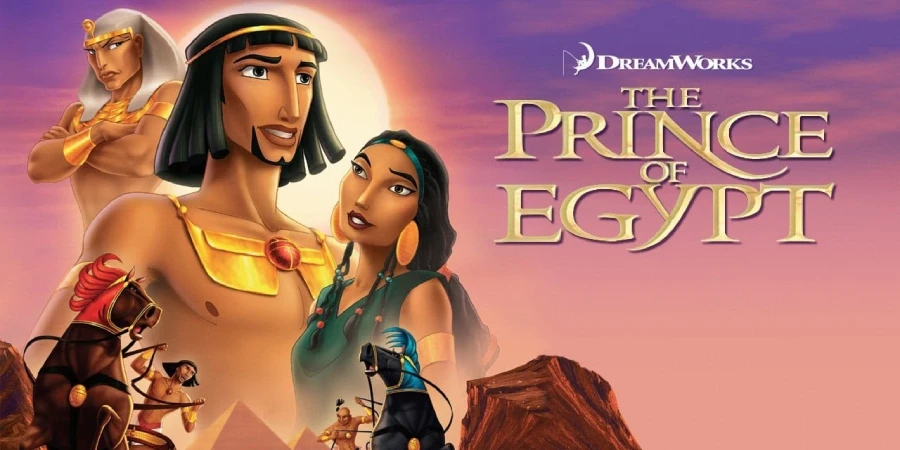

Few animated films dare to open with genocide. The Prince of Egypt drops viewers straight into the slaughter of Hebrew infants in ancient Egypt, and it never really lets you breathe after that. DreamWorks Animation’s 1998 debut feature remains one of the most ambitious, emotionally devastating, and visually stunning films ever made for a general audience. It also happens to be a musical, which somehow makes everything hit harder.
Detailed Summary
A Child Set Adrift
The film opens with Hebrew slaves laboring under the Egyptian sun, building monuments to Pharaoh Seti. Yocheved, a Hebrew mother, places her infant son in a papyrus basket and sends him into the Nile to save him from Seti’s decree ordering the death of all Hebrew male children. She and her older children, Miriam and Aaron, watch helplessly as the basket floats away.
The basket drifts through the palace waterways and lands at the feet of Queen Tuya. She adopts the child and names him Moses. Miriam, watching from the reeds, smiles and whispers a quiet prophecy over him.
Brothers and Princes
Moses grows into a carefree, charming young prince alongside his adoptive brother Rameses. Their bond is genuine and warm; the film spends real time establishing how much these two love each other. They race chariots through the city, accidentally destroy a temple under construction, and generally cause chaos together.
Seti reprimands Rameses for their recklessness but frames it entirely around Rameses’ future role as Pharaoh. Moses escapes blame, which quietly underlines the difference in their stakes. Rameses carries the weight of an empire; Moses carries nothing yet.
The Truth Beneath the Palace
During a night festival, Moses encounters Tzipporah, a Midianite woman brought as a gift to Rameses. She escapes into the palace and Moses chases her. In the process, Moses stumbles into a chamber and discovers a hieroglyphic mural depicting Seti’s massacre of the Hebrew children.
Seti confirms the truth when Moses confronts him. He frames the slaughter as a necessary act to keep Egypt stable, speaking about it with chilling calm. Moses cannot reconcile the father he loves with the man who ordered that horror.
The Killing Blow
Moses witnesses an Egyptian guard brutally beating an elderly Hebrew slave. He intervenes, strikes the guard, and accidentally kills him. Horrified and overwhelmed, Moses flees Egypt before Rameses can protect him or intervene.
Rameses, now Pharaoh following Seti’s death, orders that all records of Moses be erased. It is the Egyptian way of executing someone from history itself. Moses vanishes from the empire he once called home.
The Desert and a New Life
Moses stumbles through the desert nearly dead before he reaches Midian. He rescues Tzipporah’s sisters from harassment at a well, and Tzipporah’s father Jethro welcomes him warmly. Moses builds a life there, marries Tzipporah, and finds something close to peace as a shepherd.
However, peace does not last. Moses follows a wayward lamb up a mountain and encounters something impossible: a burning bush that does not consume itself. A voice speaks from it, identifying itself as the God of Abraham, Isaac, and Jacob.
The Burning Bush and the Call
God commands Moses to return to Egypt and free the Hebrew people. Moses resists fiercely. He argues that he is no one, that he cannot speak well, that no one will listen to him. God’s response is uncompromising: Moses will go, and God will be with him.
This sequence uses stunning visual effects, with the landscape rippling and transforming around Moses as the voice of God makes its presence undeniable. Moses returns to Midian changed, and Tzipporah chooses to go with him.
Return to Egypt
Moses and Tzipporah arrive in Egypt, where Moses reunites with Miriam and Aaron. Miriam is overjoyed; Aaron is skeptical and afraid. Moses seeks an audience with Rameses and demands the release of the Hebrew slaves.
Rameses refuses. Their reunion is loaded with grief on both sides. Moses still loves his brother; Rameses cannot understand why Moses has returned as an enemy rather than as family.
The Plagues Begin
Moses calls down the first plague, turning the Nile to blood. Rameses’ royal priests, Hotep and Huy, replicate the miracle through trickery, giving Rameses the excuse he needs to dismiss Moses entirely. Each refusal triggers a new plague.
Frogs, locusts, hail, fire, and darkness follow in escalating waves. The film presents these not as spectacle for its own sake but as evidence of a cosmic standoff between two brothers who once loved each other. Moreover, each plague chips away at Egypt’s pride and power in ways the priests cannot replicate or undo.
The Final and Most Terrible Plague
God warns Moses that one final plague is coming: the death of every firstborn in Egypt. Moses delivers the warning to Rameses, visibly agonized by what he knows is approaching. Rameses dismisses him one last time.
The Hebrews mark their doorposts with lamb’s blood. A spectral golden wind moves through Egypt in one of the film’s most haunting sequences, passing over Hebrew homes and entering Egyptian ones. Morning brings silence and devastation across the empire.

Movie Ending
Rameses, destroyed by grief over the death of his son, releases the Hebrew people. Moses leads an enormous multitude out of Egypt in a sequence that feels both triumphant and deeply sorrowful. Neither man celebrates. Both have lost something they can never recover.
Rameses recovers from his grief and replaces it with rage. He leads his army after the Hebrews, catching them at the edge of the Red Sea. Moses stretches his staff over the water, and God parts the sea in a breathtaking sequence where massive green-blue walls of water rise on either side of a dry seabed.
The Hebrews cross safely. As Rameses and his chariots charge into the parted sea, the waters collapse and the Egyptian army perishes. Rameses alone survives, left standing on the shore, staring at the aftermath. Moses looks back from the far bank. No words pass between them; the distance is now permanent.
Moses returns to the group and receives the Ten Commandments on Mount Sinai. The final image shows him descending from the mountain carrying the stone tablets, walking toward his people. It is a quiet, almost understated conclusion for a film that has just delivered catastrophe after catastrophe. In contrast to the grandeur of the parted sea, this ending chooses stillness, suggesting that the real work, building a people and a covenant, is only just beginning.
What makes the ending so powerful is that it refuses to let Moses feel like a victor. He is a man who watched his homeland destroyed and his brother broken. The liberation is real, but so is the cost. The Prince of Egypt trusts its audience to hold both feelings at once.
Are There Post-Credits Scenes?
No, The Prince of Egypt does not include any post-credits scenes. The film ends with Moses descending Sinai, and the credits roll without any additional footage. You can safely leave once the screen fades to black.
Type of Movie
The Prince of Egypt is an animated epic musical drama with strong elements of biblical epic filmmaking. Its tone balances genuine tragedy, brotherly warmth, awe-inspiring spectacle, and faith-driven narrative. This is not a children’s film in the dismissive sense; it operates with the weight and seriousness of adult drama.
The musical sequences feel organic rather than intrusive, largely because composer Hans Zimmer and lyricist Stephen Schwartz treat the songs as emotional punctuation rather than entertainment breaks. Consequently, the film’s tone never becomes inconsistent, even as it swings from genocide to comedy to divine revelation.
Cast
- Val Kilmer – Moses (speaking and singing voice)
- Ralph Fiennes – Rameses
- Michelle Pfeiffer – Tzipporah
- Sandra Bullock – Miriam
- Jeff Goldblum – Aaron
- Danny Glover – Jethro
- Patrick Stewart – Pharaoh Seti
- Helen Mirren – Queen Tuya
- Steve Martin – Hotep
- Martin Short – Huy
- Val Kilmer – also the voice of God
Film Music and Composer
Hans Zimmer composed the film’s score, delivering one of his most emotionally nuanced works. He incorporated authentic Middle Eastern and African instrumentation alongside a full orchestral palette, grounding the sound in something that feels geographically and spiritually specific. Zimmer won the Academy Award for Best Original Score for this film.
Lyricist and songwriter Stephen Schwartz wrote the songs, which include the iconic “Deliver Us,” the soaring “When You Believe,” and the comic villain number “Playing with the Big Boys.” Notably, Schwartz wrote versions of each song in multiple languages simultaneously to ensure the lyrics felt natural rather than directly translated. Mariah Carey and Whitney Houston performed “When You Believe” as a pop version for the end credits, which became a major hit.

Filming Locations
The Prince of Egypt is a fully animated film, so it has no traditional live-action filming locations. However, DreamWorks sent its animators and production designers on extensive research trips to Egypt to study the landscape, architecture, and light of the region firsthand. Those trips directly shaped the film’s visual palette and its sense of monumental scale.
The production also consulted with archaeologists and Egyptologists to inform the design of Pi-Ramesses and the palace interiors. In addition, animators studied the specific quality of desert light and the movement of sand to give the film’s environments a tactile, grounded authenticity.
Awards and Nominations
The Prince of Egypt won the Academy Award for Best Original Score, awarded to Hans Zimmer. “When You Believe” received an Academy Award nomination for Best Original Song. The film also received Golden Globe nominations and wide critical recognition at the time of its release.
Behind the Scenes Insights
- DreamWorks co-founder Jeffrey Katzenberg personally championed the project and pushed for it to be treated with the seriousness of a live-action epic rather than a conventional animated film.
- The production team consulted with over 600 religious leaders, scholars, and theologians from Jewish, Christian, and Muslim traditions to ensure respectful and thoughtful representation of the source material.
- Val Kilmer also voiced God in the film, a deliberate creative decision to suggest that God speaks to Moses in a voice Moses already knows and trusts: his own.
- Animators used a proprietary crowd simulation system called CAPS to render the enormous multitudes of Hebrews leaving Egypt, as hand-drawing every individual was impossible.
- The parting of the Red Sea sequence required years of development and involved a team dedicated almost exclusively to that single scene.
- Directors Brenda Chapman and Steve Hickner co-directed the film, with Chapman later going on to direct Brave at Pixar.
- Stephen Schwartz wrote the songs in multiple languages concurrently, not as translations but as parallel compositions, so each language version felt lyrically native.
Inspirations and References
The film draws its primary source material from the Book of Exodus in the Hebrew Bible (Old Testament). The production treated the biblical text as the foundational authority, supplemented by historical and archaeological research into ancient Egypt. Filmmakers were careful to present the story in a way that honored its sacred status across multiple faith traditions.
Cecil B. DeMille’s 1956 live-action epic The Ten Commandments is an obvious predecessor, and the DreamWorks team was aware of working in its shadow. However, the filmmakers deliberately chose to focus on the personal and brotherly relationship between Moses and Rameses as the emotional core, which distinguishes their version significantly from DeMille’s more overtly theatrical approach.
Alternate Endings and Deleted Scenes
No significantly documented alternate ending for The Prince of Egypt has been officially released or confirmed in detail. The production went through extensive story development, and early versions of the script apparently explored different emphases within the Moses-Rameses relationship, but specifics of those drafts are not widely documented.
Several production materials and concept art pieces reveal scenes that were developed but not included in the final film. For instance, earlier story reels reportedly included more scenes expanding Tzipporah’s Midianite family. The film’s development process was long and iterative, as the team was building DreamWorks Animation’s identity from the ground up alongside the project itself.
Book Adaptations and Differences
The Prince of Egypt is not based on a novel or book adaptation. It draws directly from the Book of Exodus as a primary text. The filmmakers made deliberate creative choices that diverge from or expand upon the biblical account.
Notably, the Bible does not explicitly confirm that Moses and Rameses were raised as brothers, though the adoption story in Exodus implies proximity to the royal family. The film also softens or omits several elements from Exodus, including Moses’ speech impediment and certain details of the plagues, to serve the dramatic and emotional pacing of the narrative.


Memorable Scenes and Quotes
Key Scenes
- The opening “Deliver Us” sequence, in which Hebrew slaves labor while Yocheved places the infant Moses into the Nile; it establishes the film’s emotional register immediately.
- The chariot race between Moses and Rameses, which shows the joy and recklessness of their brotherhood before everything breaks.
- Moses discovering the hieroglyphic mural depicting Seti’s massacre; the horror on his face as the full truth lands.
- The burning bush sequence, visually and aurally overwhelming, with the landscape warping around Moses as God speaks.
- The plagues montage, particularly the transition from one plague to the next, building dread without ever feeling repetitive.
- The death of the firstborn, rendered as a golden wind moving silently through Egypt while Hebrew families hold each other inside their marked homes.
- The parting of the Red Sea, a technically and artistically staggering sequence that still holds up against anything produced since.
- Rameses on the shore after the sea closes, alone and destroyed, staring at where his army used to be.
Iconic Quotes
- “Thus sayeth the Lord: Let my people go.” – Moses, delivering God’s demand to Rameses with full weight.
- “I will not be the weak link.” – Rameses, revealing the pressure and insecurity beneath his authority.
- “All I ever wanted was right here.” – Moses, to Rameses, in their final confrontation before the plagues fully destroy any hope of reconciliation.
- “Moses, I am your brother. I am your brother!” – Rameses, calling after Moses as he leaves Egypt the second time; one of the most heartbreaking moments in the film.
- “You are the morning and evening star.” – Seti to Rameses, a line that shows why Rameses needs validation so desperately.
Easter Eggs and Hidden Details
- During the hieroglyphic mural sequence, the art style deliberately shifts to resemble actual ancient Egyptian flat-figure painting, a visual grammar change that signals Moses is seeing the past in a different way than his present.
- Miriam watches Moses’ basket float away as a child, and her lips move in the prophecy she whispers over him; careful viewers can catch it as a subtle setup for her adult faith in him.
- During the plague of darkness, the shadow moves and consumes Egypt in a way that visually mirrors the golden death wind of the final plague, creating a visual rhyme between the two sequences.
- The burning bush fire contains faces and shapes within the flames if viewed carefully during the sequence, suggesting the overwhelming presence of the divine within a natural form.
- In the background of several palace scenes, hieroglyphics on the walls contain details that align with actual ancient Egyptian decorative conventions, reflecting the production’s research-heavy approach.
- Hotep and Huy, played by Steve Martin and Martin Short, are staged and animated with comedic physicality that echoes classic vaudeville double-act conventions, a deliberate tonal contrast to the film’s gravity.
Trivia
- The Prince of Egypt was DreamWorks Animation’s first traditionally animated feature film and the studio’s statement of intent as a serious competitor to Disney.
- Val Kilmer was cast as Moses partly because his voice had a specific quality the directors felt could carry both vulnerability and authority in equal measure.
- The film’s production budget was approximately 70 million dollars, making it one of the most expensive traditionally animated films made at that time.
- Whitney Houston and Mariah Carey reportedly recorded their vocals for “When You Believe” in separate sessions and never actually sang together in the same room.
- The film was released during the Disney Renaissance era, and its success proved that non-Disney animation studios could compete at the highest level of quality and ambition.
- Over 350 animators worked on the film at its peak production period.
- Ralph Fiennes, who voiced Rameses, had recently completed Schindler’s List and The English Patient; his casting brought an immediate sense of complex, wounded authority to the character.
- The film was given a PG rating, partly due to the depiction of the death of the firstborn, making it one of the heavier-toned PG-rated animated films of its era.
Why Watch?
The Prince of Egypt stands as proof that animation can carry the full emotional weight of tragedy, faith, and fraternal grief without softening any of it. Few films, animated or otherwise, build a relationship as convincing as Moses and Rameses and then have the courage to fully destroy it. Hans Zimmer’s score alone justifies the runtime. This is essential viewing.
Director’s Other Movies
- Brave (2012) – Brenda Chapman (co-director)
- Spirit: Stallion of the Cimarron (2002) – Steve Hickner (co-director)
Recommended Films for Fans
- The Ten Commandments (1956)
- The Lion King (1994)
- Joseph: King of Dreams (2000)
- Gladiator (2000)
- Ben-Hur (1959)
- Anastasia (1997)
- The Road to El Dorado (2000)