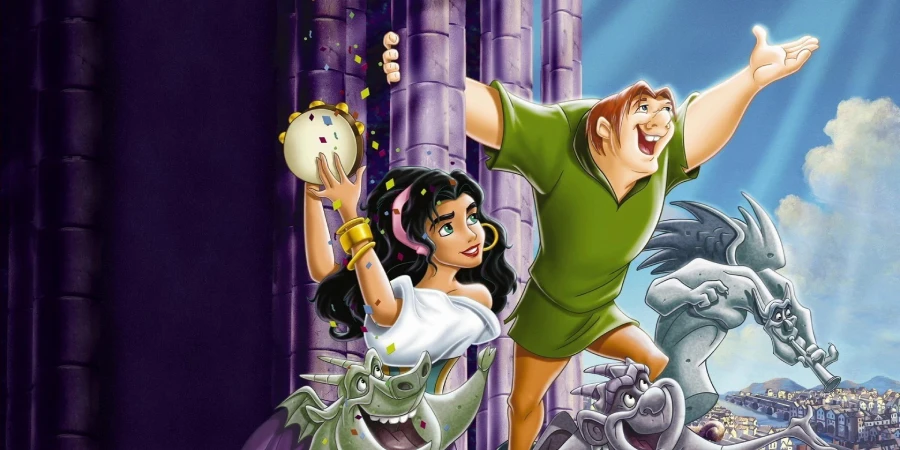

Disney took one of literature’s darkest novels and turned it into something bracingly ambitious: a children’s animated film that wrestles with lust, religious corruption, and genocide. The Hunchback of Notre Dame (1996) remains one of the studio’s most misunderstood and underappreciated achievements, a movie that dared to make its villain’s motivation outright sexual obsession while simultaneously selling toys at Burger King. It is stranger, bolder, and more emotionally complex than most people give it credit for.
Detailed Summary
The Prologue: Frollo’s Sin and Quasimodo’s Origin
Judge Claude Frollo opens the film as a man already deep in moral rot. He pursues a Romani woman through the streets of Paris, kills her on the steps of Notre Dame, and nearly throws her infant into a well before the cathedral’s archdeacon intervenes.
Forced to raise the deformed child as penance, Frollo names him Quasimodo, meaning “half-formed.” He locks the boy in Notre Dame’s bell tower, convincing him that the outside world is cruel and that only Frollo’s protection stands between him and mob violence. This lie becomes the story’s emotional foundation.
Life in the Bell Tower
Twenty years later, Quasimodo lives among the bells, talking to stone gargoyle companions he has named Victor, Hugo, and Laverne. He carves miniature wooden figures of Parisian citizens, watching a world he longs to join. His isolation feels genuinely painful rather than whimsical, which is a credit to the film’s tonal confidence.
Quasimodo secretly plans to attend the Feast of Fools, Paris’s annual carnival. His gargoyle friends encourage him, and he slips out of the tower against Frollo’s wishes. This small act of defiance sets the entire plot in motion.
The Feast of Fools and Esmeralda
At the festival, Quasimodo encounters Esmeralda, a Romani dancer whose performance captivates the crowd. He also notices Captain Phoebus, Frollo’s newly arrived captain of the guard, watching her. Both men are instantly drawn to her, though for very different reasons initially.
Quasimodo, wearing a mask, wins the “ugliest face” contest at the festival. When the crowd realizes his face is real, they turn on him, tying him to a wheel and pelting him with food. Esmeralda stands up for him publicly, defying Frollo directly and setting herself up as his primary target.
Frollo’s Obsession with Esmeralda
Frollo’s hatred of the Romani people is already intense, but Esmeralda’s defiance transforms it into something far more dangerous. He becomes sexually obsessed with her, a fact the film communicates with startling clarity in the villain song “Hellfire.” He frames his obsession as the devil’s temptation rather than his own moral failure, which makes him one of Disney’s most psychologically sophisticated antagonists.
Meanwhile, Esmeralda escapes Frollo’s soldiers inside Notre Dame and seeks sanctuary. Quasimodo, moved by her kindness to him at the festival, secretly helps her escape through the cathedral. Their friendship begins here, built on mutual outsider status.
Phoebus and the Growing Alliance
Phoebus quickly reveals himself to be a fundamentally decent man despite serving Frollo. He refuses to burn down a family’s home on Frollo’s orders, an act of defiance that costs him his position and nearly his life. Frollo shoots him with an arrow, and Esmeralda rescues him, hiding him in the bell tower with Quasimodo’s help.
Quasimodo realizes Esmeralda’s feelings lean toward Phoebus, and he processes this with quiet heartbreak. This subplot avoids easy resolution, which is one reason the film’s emotional register feels more mature than most of its Disney contemporaries.
The Court of Miracles
Esmeralda gives Quasimodo a woven band that functions as a map to the Court of Miracles, the hidden refuge of the Romani community. Quasimodo and Phoebus decode it together and find their way there. However, Frollo secretly follows them, using the two as unwitting guides to the location he has been hunting.
Frollo arrests the entire community, capturing Esmeralda in the process. Quasimodo, devastated by the role he inadvertently played, returns to the bell tower in despair. His naivete has caused catastrophic harm, which gives the film’s third act real dramatic weight.
Movie Ending
Frollo sentences Esmeralda to burn at the stake in the square outside Notre Dame. He offers her a final choice: accept him or burn. She spits in his face. Quasimodo, chained in the tower, watches the execution begin and finds something inside himself he has been suppressing for twenty years. He breaks free.
In a remarkable sequence, Quasimodo rescues Esmeralda and carries her to Notre Dame’s balcony, bellowing “Sanctuary!” to the crowd below. It is a raw, physically intense scene that transforms the outsider who spent the whole film asking for acceptance into someone who demands it on his own terms.
Frollo pursues them inside the cathedral. He corners Quasimodo on a gargoyle-lined ledge high above the city, finally dropping his pretense of righteousness and admitting he plans to destroy Esmeralda and Quasimodo both. He raises his sword and quotes scripture, but the gargoyle he stands on cracks beneath him. Frollo plunges into the molten copper below. His death is one of the most visually striking villain endings in Disney’s catalogue.
Phoebus catches Esmeralda as she falls. Quasimodo, seeing them reunited, gives them his blessing with quiet dignity rather than bitterness. He descends from Notre Dame and steps into the Paris streets for the first time as a free man. A young girl approaches him without fear and takes his hand. The crowd, which once mocked him, now cheers for him.
Crucially, Quasimodo does not get the girl. This decision, controversial among audiences expecting a traditional Disney romance, actually honors the character. His reward is belonging and freedom, not romantic love, which makes the ending simultaneously sadder and more honest than the standard formula.
Are There Post-Credits Scenes?
No. The Hunchback of Notre Dame contains no post-credits scene. Once the final song ends and the credits roll, the film is over. You can leave your seat without missing anything.
Type of Movie
The Hunchback of Notre Dame is an animated musical drama with strong elements of tragedy, romance, and social commentary. Its tone sits in unusual territory for Disney, leaning darker and more operatic than most of the studio’s output from the same era.
In contrast to lighter Disney fare like Aladdin, this film actively engages with themes of systemic persecution, religious hypocrisy, and self-worth. It carries a PG rating and earns it, not through violence alone but through genuine moral complexity.
Cast
- Tom Hulce – Quasimodo (voice)
- Demi Moore – Esmeralda (voice)
- Tony Jay – Judge Claude Frollo (voice)
- Kevin Kline – Captain Phoebus (voice)
- Jason Alexander – Hugo (voice)
- Charles Kimbrough – Victor (voice)
- Mary Wickes – Laverne (voice)
- David Ogden Stiers – Archdeacon (voice)
- Paul Kandel – Clopin (voice)
Film Music and Composer
Alan Menken composed the score, and Stephen Schwartz wrote the lyrics. Their collaboration produces one of the most dramatically ambitious soundtracks in the Disney Renaissance. Menken incorporates choral arrangements and organ-heavy orchestration that give the film a genuinely cathedral-like sonic atmosphere.
“Hellfire” stands as the score’s centerpiece, a baroque nightmare of guilt, desire, and self-delusion sung by Tony Jay with terrifying conviction. In addition, “The Bells of Notre Dame” sets up the story’s moral stakes within the first few minutes with a sophistication that rivals Broadway. “God Help the Outcasts” offers a quieter, more spiritually earnest counterpoint, sung by Esmeralda as a prayer for the marginalized rather than herself.
Filming Locations
The Hunchback of Notre Dame was produced entirely through traditional and early computer-assisted animation at Disney’s Florida studio in Orlando. No live-action location filming occurred. The visual team, however, conducted extensive research trips to Paris and specifically to Notre Dame Cathedral itself.
Animators studied the cathedral’s Gothic architecture, its gargoyles, its rose windows, and the surrounding medieval streetscape in detail. As a result, the film’s visual recreation of 15th-century Paris achieves a level of architectural specificity that grounds its fantasy elements in a recognizable physical world.
Awards and Nominations
The film earned two Golden Globe nominations, including Best Original Score and Best Original Song for “Someday.” Neither win came through, though Alan Menken had already accumulated significant awards recognition from earlier Disney projects.
Behind the Scenes Insights
- Directors Gary Trousdale and Kirk Wise previously directed Beauty and the Beast (1991), bringing experience with romantic tragedy and gothic atmosphere to this project.
- Demi Moore did not sing Esmeralda’s musical numbers; singer Heidi Mollenhauer performed the vocal parts while Moore handled all speaking dialogue.
- The production team built a large architectural model of Notre Dame Cathedral to help animators maintain consistent spatial relationships throughout the film.
- Tony Jay, the voice of Frollo, reportedly brought significant gravitas to “Hellfire” in a single recording session, delivering the performance largely as heard in the final film.
- Mary Wickes, the voice of Laverne, passed away before completing all her lines; Jane Withers finished the remaining recordings in her honor.
- The film’s crowd scenes during the Feast of Fools used early CAPS computer animation technology to render thousands of individual figures, building on techniques Disney developed for The Lion King.
Inspirations and References
The film adapts Notre-Dame de Paris by Victor Hugo, published in 1831. Hugo wrote the novel partly to draw public attention to the neglected state of Gothic architecture in France, particularly Notre Dame Cathedral itself. His campaign arguably helped save the building from demolition.
The Disney adaptation draws on Hugo’s central characters and setting while significantly softening the original’s brutal ending, in which Quasimodo, Esmeralda, and Frollo all die. Moreover, the film retains Hugo’s social critique of institutional hypocrisy and the persecution of marginalized communities, threading it through the musical structure rather than burying it.
Trousdale and Wise also referenced earlier cinematic adaptations, notably the 1939 version starring Charles Laughton as Quasimodo, when developing the visual language and emotional tone of their production.
Alternate Endings and Deleted Scenes
Early story development included a version where Quasimodo and Esmeralda end up together romantically, in closer alignment with audience expectations for a Disney feature. This was ultimately rejected in favor of the friendship-and-freedom resolution that made it into the final film.
Several deleted songs exist from various stages of production. One early villain song for Frollo had a different tone before “Hellfire” took its current form, leaning less explicitly into his sexual obsession. The Schwartz and Menken team revised the number substantially to give it the theological framing that makes the final version so distinctive.
Book Adaptations and Differences
Hugo’s novel is a far grimmer work than the film suggests. In Notre-Dame de Paris, Esmeralda is hanged, Frollo is thrown from the cathedral by Quasimodo, and Quasimodo himself eventually dies of grief beside Esmeralda’s corpse. Phoebus, meanwhile, is not a heroic figure in the novel; he is vain, selfish, and largely indifferent to Esmeralda’s fate.
The gargoyles Victor, Hugo, and Laverne have no equivalent in the novel. Disney added them as comic relief and as external voices for Quasimodo’s inner conflict. Furthermore, the novel’s Romani community is not portrayed with the political sympathy the film extends to them; the adaptation consciously updates this aspect to engage with contemporary conversations about ethnic persecution.
Memorable Scenes and Quotes
Key Scenes
- Frollo killing Quasimodo’s mother on the cathedral steps and nearly drowning the infant, setting the film’s moral stakes in its opening minutes.
- Quasimodo singing “Out There” from the bell tower, with Paris spreading below him in a breathtaking visual panorama.
- Frollo performing “Hellfire” before a fireplace, red-robed figures swirling around him as his obsession manifests visually.
- Esmeralda’s capture at the Court of Miracles, with Frollo stepping from the shadows to reveal he followed Quasimodo and Phoebus.
- Quasimodo breaking his chains and swinging down from Notre Dame to rescue Esmeralda from the burning pyre.
- Frollo falling from the cathedral ledge into the molten copper below, backlit by fire.
- The final scene, with a Parisian child taking Quasimodo’s hand and the crowd cheering as he walks among them freely.
Iconic Quotes
- “You are deformed, and you are ugly, and these are crimes for which the world shows little pity.” – Frollo to Quasimodo
- “It’s a miracle! He’s hideous!” – Crowd at the Feast of Fools
- “You can lie to yourself and your minions, you can claim that you haven’t a qualm, but you never can run from nor hide what you’ve done from the eyes, the very eyes of Notre Dame.” – Archdeacon to Frollo
- “I ask for nothing, I can get by, but I know so many less lucky than I.” – Esmeralda in “God Help the Outcasts”
- “Sanctuary! Sanctuary!” – Quasimodo
Easter Eggs and Hidden Details
- During the Feast of Fools sequence, Belle from Beauty and the Beast appears briefly in the crowd, walking through the Paris streets with a book under her arm.
- Pumba from The Lion King also appears in a crowd scene, carried on someone’s shoulders during the festival.
- The carpet from Aladdin appears briefly in a market scene during the city montage in “Out There.”
- The gargoyle names Victor, Hugo, and Laverne are a tribute to author Victor Hugo, with the “and Laverne” pairing being a nod to the comedy duo structure rather than a literary reference.
- Frollo’s robes shift subtly in color during “Hellfire,” moving from black toward deep red as his obsession takes visual form.
- Notre Dame’s rose window features prominently in several scenes and its design closely mirrors the actual north rose window of the real cathedral.
Trivia
- The Hunchback of Notre Dame was the most expensive traditionally animated Disney film produced up to that point in the studio’s history.
- The film grossed over 325 million dollars worldwide against a production budget of approximately 100 million dollars.
- Stephen Schwartz previously wrote the music for the Broadway musical Godspell and Pippin, bringing a theatrical sensibility to the Disney project that shaped its operatic tone.
- A stage musical adaptation of the film debuted in Berlin in 1999 before eventually coming to Broadway, featuring a considerably darker tone that moved even closer to Victor Hugo’s original novel.
- Tom Hulce, who voiced Quasimodo, is perhaps best known for playing Mozart in Amadeus (1984), a role that similarly required him to embody emotional extremes.
- The film was the final Disney feature to use hand-painted animation cels before the studio completed its full transition to digital ink and paint.
Why Watch?
“The Hunchback of Notre Dame” rewards adults who dismissed it as a children’s film. Its villain is genuinely frightening, its themes are unflinchingly relevant, and its score ranks among Disney’s finest work. Few animated films from any era tackle religious hypocrisy and social exclusion with this much nerve.
Director’s Other Movies
- Beauty and the Beast (1991)
- Atlantis: The Lost Empire (2001)
Recommended Films for Fans
- Beauty and the Beast (1991)
- The Prince of Egypt (1998)
- Mulan (1998)
- Anastasia (1997)
- Tarzan (1999)
- El Cid (1961)
- The Hunchback of Notre Dame (1982)