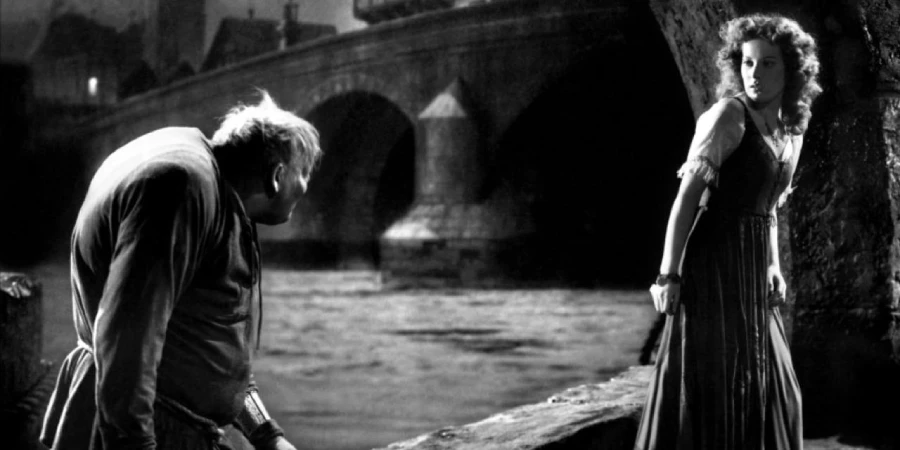

Few Hollywood adaptations dare to let tragedy breathe as fully as the 1939 version of The Hunchback of Notre Dame. This RKO production arrived at the end of Hollywood’s most legendary single year, yet it often gets overshadowed by the other classics released in 1939. Charles Laughton delivers one of cinema’s most physically and emotionally committed performances as Quasimodo, a man the world refuses to see as human. It is a film about cruelty, justice, and the devastating cost of living outside society’s mercy.
Detailed Summary
Paris in the Shadows: Setting the Stage
Paris in the late 15th century pulses with tension from the very first frames. A new printing press arrives in the city, and the authorities, particularly the political schemer Frollo, view it as a dangerous threat to established power.
Meanwhile, the Romani people living on the fringes of Parisian society face intensifying persecution. King Louis XI’s court is a nest of rivalry and moral compromise, and this poisoned atmosphere shapes every conflict that follows.
Quasimodo Meets the World, and the World Is Cruel
Quasimodo, the deaf and physically deformed bell-ringer of Notre Dame, ventures into the streets during the Festival of Fools. Crowds celebrate him as the ugliest man in Paris, crowning him King of Fools, but their laughter carries venom beneath it.
When the mood turns hostile, people attack him openly. Esmeralda, a young Romani dancer, steps forward and defends him, offering him water when he is publicly flogged. This single act of compassion completely reshapes Quasimodo’s understanding of human kindness.
Frollo’s Obsession and Esmeralda’s Danger
Frollo becomes dangerously obsessed with Esmeralda after witnessing her dance. His obsession masquerades as moral outrage, but it is rooted in a consuming and destructive desire he refuses to acknowledge honestly.
He manipulates Quasimodo and uses his political authority to hunt Esmeralda. In addition, Frollo orchestrates circumstances that leave her surrounded by enemies on multiple sides. She is a woman with no institutional protection, and Frollo knows exactly how to exploit that vulnerability.
Gringoire, Phoebus, and Competing Loyalties
The poet Gringoire stumbles into the Court of Miracles, the underground community where Romani people gather, and narrowly avoids death when Esmeralda agrees to a marriage of convenience to save him. This marriage carries no romantic weight for her; it simply spares his life.
Captain Phoebus, a charming soldier, captures Esmeralda’s genuine romantic interest. However, his loyalties are tangled between his attraction to her and his obligations to Frollo’s regime. His wavering costs Esmeralda enormously.
The Trap Closes
Frollo frames Esmeralda for the stabbing of Phoebus, a crime Frollo himself committed in a jealous rage. Consequently, she faces trial under a system entirely controlled by her persecutors. Her conviction is never really in doubt; justice is not the court’s actual goal.
Quasimodo watches her condemnation from Notre Dame with growing anguish. He has come to love her, not with possessive hunger like Frollo, but with a profound and selfless devotion. His love for her is the one genuinely pure thing in this entire story.
Sanctuary and the Storm
Just as authorities prepare to hang Esmeralda, Quasimodo swings down from Notre Dame on a rope and snatches her from the scaffold. He carries her inside the cathedral and shouts “Sanctuary!” to the crowd below. Notre Dame’s sacred protection temporarily shields her from Frollo’s reach.
Inside the cathedral, Quasimodo tends to Esmeralda with gentle care. He understands she does not love him romantically, but he asks for nothing in return. For once in his life, someone he cares for is safe, and he treats that responsibility with absolute seriousness.
Movie Ending
Frollo ultimately engineers an assault on Notre Dame itself, rallying a mob to breach the cathedral and seize Esmeralda. Quasimodo fights back ferociously, pouring molten lead down on the attackers and hurling massive beams from the towers. His defense of Notre Dame is both physically spectacular and emotionally raw.
During the chaos, Frollo slips inside the cathedral and finds Esmeralda. He offers her one final terrible choice: submit to him or face death. She refuses him completely and without hesitation. Frollo’s mask of righteousness falls away entirely in this moment; he is simply a man who wants to own another person.
Quasimodo catches Frollo dangling from the edge of Notre Dame after the confrontation turns violent. For a suspended, breathless moment, he could let him fall or pull him back. He chooses to save him, which makes what happens next even more devastating: Frollo’s gargoyle perch crumbles, and Frollo plunges to his death regardless. Quasimodo’s mercy changes nothing.
Esmeralda survives and leaves with Gringoire as the crowd below finally cheers for her freedom. Quasimodo watches from above, alone as always, but now openly weeping. He looks at the stone gargoyles beside him and asks, brokenly, why he was not made of stone like them. It is one of the most quietly devastating endings in classical Hollywood cinema, because it refuses any comfort. Quasimodo saved her, but he cannot follow her into the world she gets to inhabit.
The new printing press, mentioned throughout the film as a symbol of coming change, represents the hope that the world might slowly improve. However, that future offers nothing to Quasimodo personally. He remains behind, in the bells, alone. The film does not sentimentalize his sacrifice; it simply honors it.
Are There Post-Credits Scenes?
No. The Hunchback of Notre Dame (1939) contains no post-credits scenes of any kind. Post-credits sequences were not a Hollywood convention in this era. Once the final image fades, the film is complete.
Type of Movie
This film operates as a historical drama with strong elements of tragedy and social commentary. Its tone is dark, operatic, and deeply serious throughout.
On the surface it functions as a grand costume spectacle, but its true concern is persecution, institutional cruelty, and the dehumanization of outsiders. In contrast to lighter adventure films of the same period, this one never flinches from its bleaker implications.
Cast
- Charles Laughton – Quasimodo
- Maureen O’Hara – Esmeralda
- Cedric Hardwicke – Frollo
- Thomas Mitchell – Clopin
- Edmond O’Brien – Gringoire
- Alan Marshal – Phoebus
- Walter Hampden – The Archbishop
- Harry Davenport – King Louis XI
Film Music and Composer
Alfred Newman composed the score, and it ranks among his most ambitious work of that period. Newman was already one of Hollywood’s most respected composers by 1939, and his music for this film reflects his skill with large orchestral drama.
The score sweeps between grandeur and intimacy depending on what each scene requires. Notably, the music during the Festival of Fools sequence carries a deliberately grotesque, carnival energy that underscores the crowd’s cruelty. Newman understood that the music needed to comment on the action, not merely accompany it.

Filming Locations
Production took place almost entirely on studio lots, primarily at RKO. The production team constructed an enormous replica of Notre Dame Cathedral and the surrounding Parisian streets as physical sets.
Building the cathedral set required significant resources, and the scale of the construction was genuinely impressive for the era. Shooting on a controlled studio lot allowed director William Dieterle to manage the massive crowd sequences with greater precision than location work would have permitted. The artificial Paris feels appropriately theatrical, which suits the story’s heightened emotional register.
Awards and Nominations
The Hunchback of Notre Dame received two Academy Award nominations: one for Best Score (Alfred Newman) and one for Best Sound Recording. It did not win either award.
For a film of its ambition and scale, the awards recognition was modest. However, its reputation has grown considerably in the decades since its release, and critics now frequently cite it as one of the finest films of its celebrated year.
Behind the Scenes Insights
- Charles Laughton reportedly found the role of Quasimodo deeply personal, connecting the character’s experience of rejection to his own complicated relationship with his appearance and identity.
- Laughton’s prosthetic makeup required hours of application each day, and the physical demands of the role were genuinely grueling throughout production.
- The Hunchback of Notre Dame was one of the first major Hollywood roles for Maureen O’Hara, who had only recently arrived from Britain and Ireland.
- Director William Dieterle was known for his meticulous visual preparation; he frequently used detailed storyboards before they became standard industry practice.
- Crowd scenes involving hundreds of extras required extremely careful coordination on the massive cathedral set, and Dieterle managed them with a precision that impressed his crew.
- Producer Pandro S. Berman pushed for a production budget large enough to rival the major studio epics of the period, which was a significant commitment for RKO.
Inspirations and References
The film directly adapts Victor Hugo’s 1831 novel Notre-Dame de Paris, published in English under the title The Hunchback of Notre Dame. Hugo wrote the book partly as an argument for preserving medieval Gothic architecture, which faced demolition pressure in 19th-century France.
The screenplay by Sonya Levien and Bruno Frank drew from Hugo’s novel but also incorporated elements shaped by earlier stage and film adaptations of the same source material. Furthermore, the 1939 political climate in Europe clearly influenced the film’s emphasis on persecution, religious hypocrisy, and authoritarian cruelty, giving those themes a pointed contemporary urgency.
Alternate Endings and Deleted Scenes
No well-documented alternate endings or significant deleted scenes from this production have entered the public record. The film as released appears to represent Dieterle’s intended vision without major documented divergences.
Some sources suggest that the tonal balance between tragedy and hope in the ending involved discussion during production, but no concrete alternate cut is known to exist or survive.
Book Adaptations and Differences
Victor Hugo’s novel is considerably darker and more structurally complex than the film. In Hugo’s original, Esmeralda is hanged, and Quasimodo dies beside her skeleton years later after crawling into her tomb. The novel withholds even the qualified hope the film allows.
The 1939 film softens the ending by keeping Esmeralda alive and giving the story a gesture toward justice and change. In addition, the film streamlines several of Hugo’s subplots and reduces the prominence of Phoebus, who is a more fully developed and less admirable figure in the source novel.
Frollo’s character undergoes notable changes as well. Hugo’s Frollo is an archdeacon, and his theological context is central to his psychology. In contrast, the film redistributes his religious authority and political scheming somewhat differently to suit the narrative’s pacing.
Memorable Scenes and Quotes
Key Scenes
- Esmeralda offering water to a flogged Quasimodo in the public square, a gesture that redefines his entire understanding of human nature.
- Quasimodo swinging from Notre Dame to rescue Esmeralda from the scaffold while shouting “Sanctuary,” a sequence that electrifies the entire film.
- Frollo dangling from the cathedral while Quasimodo holds him, presenting a moment of devastating moral complexity before fate resolves it cruelly.
- Quasimodo weeping among the gargoyles and asking why he was not made of stone, one of classical Hollywood’s most quietly heartbreaking final images.
- The Festival of Fools sequence, where the crowd’s cruelty toward Quasimodo begins as mockery and escalates into genuine violence.
Iconic Quotes
- “Why was I not made of stone, like thee?” – Quasimodo, at the film’s close, speaking to the gargoyles of Notre Dame.
- “Sanctuary! Sanctuary!” – Quasimodo, carrying Esmeralda into Notre Dame Cathedral.
Easter Eggs and Hidden Details
- The arrival of the printing press at the film’s opening is not merely a historical detail; it functions as a recurring symbol of democratic knowledge challenging authoritarian control, threading through the entire narrative.
- Several of the gargoyle designs on the set closely reference actual medieval grotesques from the real Notre Dame, grounding the artificial set in authentic architectural history.
- Quasimodo’s deafness, caused by years of bell-ringing, carries a quiet symbolic irony: the instrument of his spiritual devotion is also the instrument of his physical isolation from the world.
- King Louis XI’s characterization as a cynical pragmatist reflects historical accounts of the actual French monarch, lending the court scenes a layer of grounded historical texture.
Trivia
- Charles Laughton played Quasimodo just five years after his Oscar-winning performance in The Private Life of Henry VIII, demonstrating his remarkable range across drastically different physical roles.
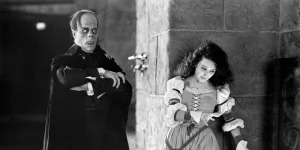
- The Hunchback of Notre Dame (1939) was not the first film adaptation of Hugo’s novel; a celebrated 1923 silent version starring Lon Chaney had already set a high bar for the material.
- Maureen O’Hara was only 19 years old during production, making her casting as the defiant and resourceful Esmeralda a genuinely bold choice by the studio.
- William Dieterle directed the film wearing his signature white gloves on set, a personal affectation he maintained throughout his career and which became something of a trademark.
- The film’s release in 1939 placed it in direct competition with an extraordinary roster of classics, including Gone with the Wind, The Wizard of Oz, and Stagecoach.
- Alfred Newman’s score for this film contributed to his eventual record of Academy Award nominations, cementing his status as one of Hollywood’s defining composers of the studio era.
Why Watch?
Charles Laughton’s performance alone justifies any viewer’s time, and the film surrounds him with genuine moral seriousness rarely attempted in mainstream Hollywood productions of any era. It confronts persecution, desire, and injustice without offering easy comfort. For anyone who considers classic cinema worth serious attention, this film rewards it fully.
Director’s Other Movies
- The Story of Louis Pasteur (1936)
- The Life of Emile Zola (1937)
- Juarez (1939)
- Dr. Ehrlich’s Magic Bullet (1940)
- Tennessee Johnson (1942)
- Elephant Walk (1954)
Recommended Films for Fans
- The Hunchback of Notre Dame (1923)
- Fury (1936)
- The Life of Emile Zola (1937)
- Les Miserables (1935)
- Jezebel (1938)
- The Phantom of the Opera (1943)