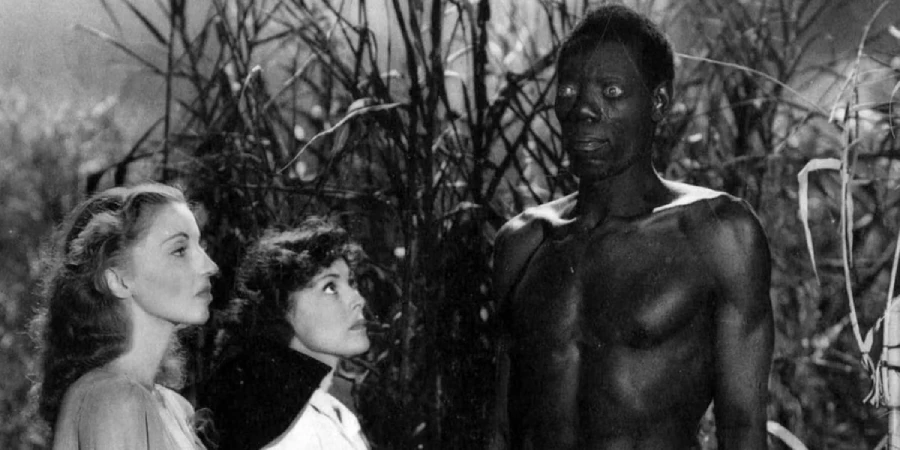

Few films from Hollywood’s golden age weaponize atmosphere as ruthlessly as this one. Jacques Tourneur’s I Walked with a Zombie drops a wide-eyed Canadian nurse into a Caribbean nightmare built from voodoo, colonial guilt, and a marriage gone catastrophically wrong. It plays like Charlotte Bronte’s Jane Eyre filtered through a fever dream, and it refuses to let you look away.
Detailed Summary
Betsy Connell Arrives in Saint Sebastian
Nurse Betsy Connell accepts a job on the fictional Caribbean island of Saint Sebastian, hired to care for Jessica Holland, the wife of plantation owner Paul Holland. Betsy arrives with romantic notions about the tropics, notions that Paul immediately dismantles with a cutting speech about how even the beauty around her is rooted in death and suffering.
Paul is cold, guarded, and deeply unhappy. However, Betsy is drawn to him almost immediately, setting up the emotional triangle that drives the entire film.
Meeting Jessica
Jessica Holland is not what Betsy expected. She moves through the Holland estate in a somnambulant state, silent and seemingly devoid of will or consciousness. Doctors have no satisfying explanation for her condition.
Betsy learns that Jessica suffered a fever that apparently destroyed her higher brain function. In contrast to the medical explanation, the island’s local population whispers something darker: that Jessica is a zombie.
The Holland Family Tensions
Paul shares the estate with his half-brother, Wesley Rand, and their mother, Mrs. Rand. Wesley is a bitter, heavy-drinking man who was once romantically involved with Jessica before Paul married her.
Consequently, the house seethes with resentment and grief. A local calypso singer, Sir Lancelot’s character, haunts the margins of scenes, singing pointed songs that expose the family’s dirty secrets to anyone willing to listen.
Betsy’s Growing Attachment to Paul
Betsy falls in love with Paul and decides she must cure Jessica, partly out of genuine compassion and partly to free Paul from his trapped marriage. Her determination drives the plot into increasingly dangerous territory.
She arranges insulin shock therapy for Jessica, hoping to jolt her back to awareness. Unfortunately, the treatment fails entirely.
The Walk Through the Cane Fields
In one of cinema’s most haunting sequences, Betsy leads Jessica through the sugarcane fields at night to reach the Houmfort, the local voodoo temple. She hopes the voodoo priests can cure what medicine cannot.
Wind moves through the cane. Shadows shift. A skeletal figure, Carrefour, a towering zombie guardian, blocks their path at one point but ultimately does not stop them. Tourneur stages this sequence with almost no dialogue, letting pure image and sound do the terrifying work.
The Voodoo Ceremony
At the Houmfort, Betsy and Jessica encounter a full voodoo ceremony in progress. The worshippers recognize Jessica immediately, and the scene reveals something shocking: Jessica appears to respond to voodoo ritual in ways she never responded to medical treatment.
Moreover, Betsy discovers that the voodoo bocor directing the ceremony wears a familiar face. Mrs. Rand, the family matriarch, has secretly integrated herself into the local voodoo practice.
And Mrs. Rand’s Confession
Mrs. Rand eventually confesses to a stunning act. She tells the authorities that she used voodoo to turn Jessica into a zombie, motivated by a desire to separate Jessica from Wesley and prevent further destruction of her family.
She claims she prayed to the voodoo god Damballa to take away Jessica’s will, and she believes her prayer worked. Whether this confession reflects supernatural truth or a guilt-ridden delusion remains one of the film’s most carefully preserved ambiguities.
Movie Ending
Wesley Rand, consumed by guilt and alcohol-fueled despair, walks into the Houmfort and takes matters into his own hands. He stabs Jessica with a spiked staff, ending her tormented half-existence.
Carrefour, the zombie guardian, then carries Jessica’s lifeless body into the sea. Wesley dies as well, apparently from the same confrontation, and both bodies wash up together on the shore.
Paul watches from the beach as the waves return what the island claimed. It is a tragic resolution that refuses to offer comfort to anyone. Betsy’s love for Paul survives, but it is now built on wreckage.
Notably, the film refuses to definitively answer its central question. We never learn with certainty whether Jessica was a zombie in any supernatural sense or simply a woman destroyed by illness and then mythologized by a community steeped in voodoo belief. Mrs. Rand’s confession adds another layer of uncertainty, since she may have sincerely believed she caused Jessica’s condition rather than actually causing it.
Furthermore, the ending implicates colonialism quietly but unmistakably. The Holland family’s suffering connects directly to their ancestors’ role in the slave trade, a history the calypso singer references throughout the film. Saint Sebastian’s pain is inherited, and no one escapes it cleanly.
Are There Post-Credits Scenes?
I Walked with a Zombie contains no post-credits scenes. It was made in 1943, decades before that convention existed. When the film ends, it ends completely.
Type of Movie
This film occupies a rare intersection of gothic horror, psychological drama, and romantic melodrama. It carries the structure of a classic gothic novel transplanted to a Caribbean setting, complete with a brooding estate, a mysterious woman, and a heroine navigating secrets.
In contrast to most horror films of its era, it relies almost entirely on suggestion and atmosphere rather than explicit monsters or gore. Its tone is melancholic, dreamlike, and genuinely unsettling in ways that many louder horror films fail to achieve.
Cast
- Frances Dee – Betsy Connell
- Tom Conway – Paul Holland
- James Ellison – Wesley Rand
- Edith Barrett – Mrs. Rand
- James Bell – Dr. Maxwell
- Christine Gordon – Jessica Holland
- Theresa Harris – Alma
- Sir Lancelot – Calypso Singer
- Darby Jones – Carrefour
Film Music and Composer
Roy Webb composed the score, working within the tight budgetary and stylistic constraints that producer Val Lewton imposed on all his productions. Webb was a prolific RKO composer who contributed to many of Lewton’s celebrated horror films during this period.
His score for this film leans heavily on sparse, atmospheric cues that amplify silence rather than fill it. The most memorable musical element, however, is the diegetic calypso singing by Sir Lancelot, which functions almost like a Greek chorus, commenting on the Holland family’s history and sins throughout the narrative.


Filming Locations
Principal photography took place on the RKO studio backlot in Hollywood. The production did not shoot on location in any actual Caribbean setting, which makes Tourneur’s atmospheric achievement all the more impressive.
Designer Albert S. D’Agostino and his team constructed the cane fields and estate sets with striking care. The limited sets actually served the film’s dreamlike tone, since stylized, slightly unreal spaces suit a story deliberately walking the line between hallucination and reality.
Awards and Nominations
I Walked with a Zombie did not receive significant awards recognition upon its original release. Over subsequent decades, however, critics and historians have consistently ranked it among the finest horror films ever produced in Hollywood.
Behind the Scenes Insights
- Producer Val Lewton famously received only a title from RKO and had to build a serious, atmospheric film around it, a challenge he met by structuring the story loosely on Jane Eyre.
- Director Jacques Tourneur and Lewton shared a philosophy that what the audience imagines is always scarier than anything shown on screen; the film puts this theory into practice at every turn.
- Actress Christine Gordon, playing Jessica, had to perform almost entirely through physical presence and blank expression, with no dialogue to carry her character.
- The towering figure of Darby Jones as Carrefour became one of the most iconic visual images in classic horror cinema, achieved with minimal makeup and maximum stillness.
- Lewton insisted on grounding the supernatural elements in ambiguity, which caused tension with RKO executives who wanted more conventional monster-movie thrills.
- Sir Lancelot’s calypso songs were written specifically to expose backstory in an unconventional and economical way, replacing scenes that might otherwise have required additional exposition.
Inspirations and References
The film draws its most direct structural inspiration from Charlotte Bronte’s novel Jane Eyre. Betsy maps onto Jane, Paul maps onto Rochester, and Jessica occupies the role of the madwoman in the attic, though here relocated to a tropical estate and reframed through the lens of Caribbean mythology.
Tourneur and Lewton also drew on genuine journalistic and anthropological writing about Haitian voodoo practice that circulated in American popular culture during the early twentieth century. Additionally, the film engages directly with the history of Caribbean slavery and colonialism in ways unusual for Hollywood productions of its era.
Alternate Endings and Deleted Scenes
No documented alternate endings or significant deleted scenes for I Walked with a Zombie appear in widely available production records. Val Lewton’s productions at RKO generally operated with tight scripts and limited shooting schedules, leaving little room for extensive alternative material.
Book Adaptations and Differences
I Walked with a Zombie is not directly adapted from a novel or short story. As noted, Val Lewton received only a title from RKO and constructed an original story from scratch, borrowing structural elements from Jane Eyre but not adapting it directly.


Memorable Scenes and Quotes
Key Scenes
- Betsy and Jessica’s nighttime walk through the sugarcane fields, arguably the most atmospheric sequence in Val Lewton’s entire body of work.
- Carrefour blocking the road in the darkness, his enormous still figure lit from below, representing pure dread without a single aggressive action.
- The voodoo ceremony at the Houmfort, where Jessica appears to respond to ritual drumming in a way she never responded to any medical intervention.
- Mrs. Rand’s confession, delivered with quiet devastation, in which she claims responsibility for turning her own daughter-in-law into a zombie.
- Carrefour carrying Jessica’s body into the sea, a final image of tragic, terrible beauty.
- Paul Holland’s opening speech to Betsy about the island, in which he reframes every beautiful thing she sees as evidence of suffering and death.
Iconic Quotes
- “Everything good dies here, even the stars.” (Paul Holland, establishing the film’s governing mood in a single line.)
- “Is it a bad thing to want to be alive?” (Betsy, articulating the film’s core tension between hope and resignation.)
Easter Eggs and Hidden Details
- The figurehead at the Holland estate gate depicts a chained African figure, a direct visual reference to the island’s slave trade history and a constant silent reminder of how the Holland family’s wealth originated.
- Sir Lancelot’s calypso songs contain specific plot information delivered in plain language, functioning as an ironic contrast to the secrecy and coded behavior of the white characters around him.
- Carrefour’s name references a voodoo concept directly: in Haitian Vodou tradition, Carrefour (or Kalfou) is a spirit associated with crossroads, night, and dark magic, making his role as a guardian of thresholds entirely deliberate.
- Tourneur frames several shots so that characters stand in doorways or thresholds, reinforcing the film’s sustained interest in liminal states and the boundary between life and death.
- Jessica’s white dress, worn throughout the film, carries deliberate ambiguity: it reads simultaneously as bridal innocence and as a burial shroud.
Trivia
- Val Lewton’s budget for the film was extremely modest; the production ran on a fraction of what major studio horror films of the same period cost.
- Jacques Tourneur would go on to direct Cat People (1942) and Out of the Past (1947), cementing his reputation across horror and film noir.
- Frances Dee was a well-established actress before this film; her performance here is notable for its warmth and grounded intelligence in a story that could easily have reduced its heroine to a passive observer.
- The film’s running time is approximately 69 minutes, making it one of the most efficiently constructed gothic horror films in Hollywood history.
- Darby Jones, who plays Carrefour, was cast largely because of his striking physical height and his ability to project menace through absolute stillness rather than action.
- Critics writing in subsequent decades have cited this film as a major influence on the atmospheric, suggestion-driven approach to horror that directors like Guillermo del Toro and Robert Eggers have championed.
Why Watch?
I Walked with a Zombie proves that restraint is its own form of terror. In under 70 minutes, it builds a world of genuine unease, moral complexity, and colonial reckoning that most horror films three times its length never approach. Tourneur and Lewton understood that shadows do more work than monsters ever could.
Director’s Other Movies
- Cat People (1942)
- The Leopard Man (1943)
- Experiment Perilous (1944)
- Out of the Past (1947)
- Berlin Express (1948)
- Stars in My Crown (1950)
- Curse of the Demon (1957)
Recommended Films for Fans
- Cat People (1942)
- The Body Snatcher (1945)
- Isle of the Dead (1945)
- Curse of the Demon (1957)
- The Innocents (1961)
- The Wicker Man (1973)
- The Witch (2015)
- His House (2020)