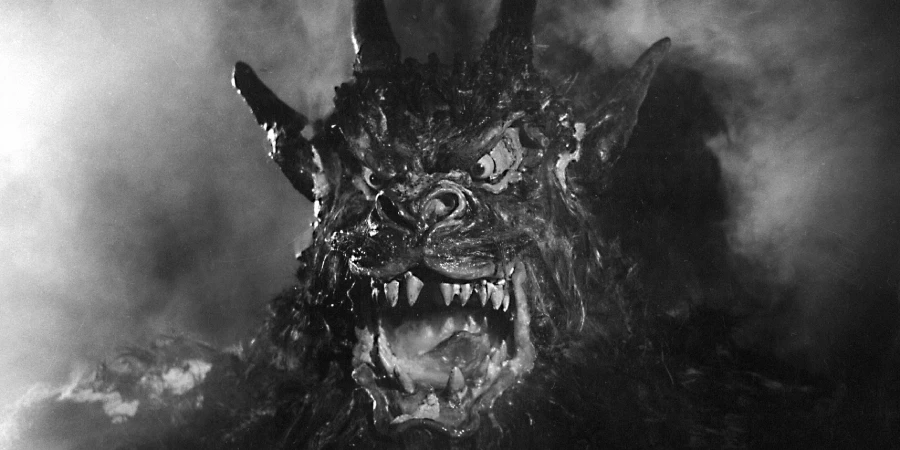

Few horror films from the 1950s have the nerve to show you the monster in the first five minutes and still scare you senseless by the finale. Curse of the Demon (also released as Night of the Demon) pulls exactly that trick, blending rational skepticism with creeping supernatural dread in a way that feels genuinely modern. Directed by Jacques Tourneur, it remains one of British horror’s finest achievements. It is a film that argues, quietly and terrifyingly, that some doors should stay firmly shut.
Detailed Summary
The Prologue: Harrington’s Fate
The film opens with Professor Henry Harrington driving frantically through the English countryside at night. He visits Julian Karswell, a wealthy occultist, and begs him to call off a curse. Karswell refuses, and Harrington drives home in a panic.
Outside his own house, a massive demonic creature materializes from the darkness and kills him. This opening is brutally efficient. It establishes the rules of the world before the protagonist even arrives on screen.
Dr. Holden Arrives in England
American psychologist Dr. John Holden flies to England to attend a paranormal research conference. He plans to debunk the work of Harrington, whose death he assumes was accidental. Holden is a committed skeptic, and the film treats his skepticism with genuine respect rather than mockery.
At the airport, he encounters Joanna Harrington, the niece of the dead professor. She is shaken and suspicious. However, Holden dismisses her fears and pushes forward with his investigation.
Meeting Karswell
Holden visits the British Museum to research Karswell’s cult. Interestingly, Karswell himself appears in the reading room and confronts Holden directly. He warns Holden to drop his investigation, citing genuine danger. Holden refuses.
During this encounter, Karswell slips a small piece of runic parchment into Holden’s papers. This parchment, as the film later reveals, is the physical mechanism of the curse. Whoever holds it will die within three days.
Karswell’s Estate and the Party
Holden visits Karswell’s rural estate, Lufford Hall, and finds a children’s party in progress. Karswell, played with unsettling charm by Niall MacGinnis, appears dressed as a jovial clown. The contrast between festivity and malevolence is deeply uncomfortable.
A sudden, unnatural windstorm sweeps through the estate grounds while Holden is walking outside. It chases him aggressively. This moment marks the film’s first suggestion that Holden’s rational worldview may not be sufficient protection.
The Haunting Escalates
Strange events begin accumulating around Holden. He sees a shadowy figure in his hotel corridor. Later, a séance conducted by a colleague introduces another layer of supernatural unease. Moreover, Holden starts finding evidence that the runic parchment carries genuine, measurable danger.
Joanna pushes Holden to take the threat seriously. She has found her late uncle’s notes, which detail Karswell’s methods and the curse’s mechanics. Holden resists, but the evidence mounts relentlessly.
The Parchment Problem
Holden eventually realizes he possesses the runic parchment. His internal conflict drives the middle section of the film. On one hand, he refuses to believe in curses; on the other, people around him keep dying.
He consults a hypnotist who helps a cursed patient recall terrifying visions. The session reveals that victims of Karswell’s curse experience escalating supernatural attacks before the demon finally claims them. Consequently, Holden begins to accept that something real and lethal is at work.
Closing In on Karswell
Holden and Joanna trace Karswell’s movements and discover he is planning to leave England by train. They deduce that their only hope is to return the parchment to Karswell before Holden’s deadline expires. However, passing the parchment back is no simple matter; Karswell must receive it without knowing, or the curse simply transfers back to the giver intentionally.
This creates a tense, almost thriller-like final act. Holden must outsmart a man who knows exactly what he is carrying and why.
Movie Ending
Holden boards a train to Southampton, where Karswell plans to sail to America. He finds Karswell in a compartment and engineers a situation where he can slip the parchment into Karswell’s belongings without the occultist noticing. After several tense near-misses, the parchment passes hands.
Karswell, now unknowingly carrying his own curse, steps off the train at a rural station. He reaches into his pocket and finds the parchment. Panic overtakes him immediately. He runs across the train tracks, screaming.
The demon materializes from the darkness in exactly the same way it appeared in the opening prologue. It kills Karswell violently. Holden and Joanna watch from the train window, shaken but alive.
What makes this ending so compelling is its moral ambiguity. Holden survives by using Karswell’s own weapon against him. He never fully confesses belief in the supernatural, yet his survival depended entirely on treating the curse as real. The film closes without resolving that contradiction, and that unresolved tension is precisely what makes it linger.
Furthermore, the ending loops back to the prologue with elegant symmetry. Harrington begged Karswell to lift the curse and failed. Holden, by contrast, acts rather than pleads. The film rewards agency, not supplication, which feels surprisingly modern for 1957.
Are There Post-Credits Scenes?
No, Curse of the Demon does not contain any post-credits scenes. Films of this era did not use that device. Once the demon claims Karswell and the screen fades to black, the film is entirely over.
Type of Movie
Curse of the Demon sits firmly in the supernatural horror genre, but it carries strong elements of psychological thriller and mystery. Tourneur keeps the tone restrained and genuinely eerie rather than sensational. In contrast to the lurid horror films emerging in Britain at the same time, this film favors dread over gore.
Its pacing is methodical and its atmosphere is thick. Audiences who appreciate slow-burn horror will find it deeply satisfying.
Cast
- Dana Andrews – Dr. John Holden
- Peggy Cummins – Joanna Harrington
- Niall MacGinnis – Julian Karswell
- Maurice Denham – Professor Henry Harrington
- Athene Seyler – Mrs. Karswell
- Liam Redmond – Professor Mark O’Brien
- Peter Elliott – Kumar
- Reginald Beckwith – Mr. Meek
Film Music and Composer
Clifton Parker composed the score for Curse of the Demon. Parker was a British composer with substantial experience in film, and his work here is admirably restrained. He avoids the bombastic orchestral stings common to horror films of the period.
Instead, Parker builds tension through low strings and subtle dissonance. The music surrounding the demon’s appearances is particularly effective, using tonal instability to suggest something fundamentally wrong with the world on screen.


Filming Locations
Production took place primarily in England. Bricket Wood in Hertfordshire served as a key outdoor location, providing the dense, atmospheric woodland that the film relies on heavily. The British Museum’s reading room also features, lending the investigation sequences an authentic institutional weight.
Shooting in actual English locations grounds the film’s supernatural elements in a recognizable reality. Tourneur understood that familiar settings make the uncanny far more unsettling than obviously artificial ones.
Awards and Nominations
Curse of the Demon did not receive major awards recognition during its initial release. However, its reputation has grown enormously over the decades, and critics and scholars now regularly cite it among the greatest horror films of the 1950s.
Behind the Scenes Insights
- Director Jacques Tourneur was reportedly opposed to showing the demon on screen, preferring to keep it unseen and let the audience’s imagination do the work.
- Producer Hal E. Chester overruled Tourneur and insisted on adding visible shots of the demon creature, which created significant tension between the two during production.
- Many critics and Tourneur himself felt the visible demon shots weakened the film’s carefully constructed atmosphere of ambiguity.
- Interestingly, some viewers argue the demon actually works precisely because it is so confidently bizarre, giving the film an almost dreamlike quality.
- Dana Andrews brought a weary, world-worn quality to Holden that was partly a product of his own personal struggles during this period of his career.
- The runic parchment prop was designed with reference to actual historical runic systems, giving it a visual authenticity that casual viewers may not consciously notice but likely feel.
Inspirations and References
Curse of the Demon is based on the short story Casting the Runes by M.R. James, published in 1911. James was arguably Britain’s greatest writer of ghost stories, and his work emphasizes quiet, scholarly protagonists encountering genuine supernatural menace. Screenwriter Charles Bennett adapted the story, expanding it significantly for the film.
James’s original story features a similar runic parchment mechanism and a skeptical investigator. The film retains the core premise while adding the American protagonist and a more explicitly visual horror register.
Alternate Endings and Deleted Scenes
No formally documented alternate endings exist for Curse of the Demon. The primary known dispute involves the demon’s visibility rather than the narrative conclusion. Tourneur’s preferred cut would have maintained ambiguity about whether the creature was real or imagined, but no confirmed version of that cut survives as a distinct release.
The American release titled Curse of the Demon ran shorter than the British release titled Night of the Demon. Several scenes were trimmed for the American market, making the British version the more complete and generally preferred cut among scholars and fans.
Book Adaptations and Differences
Curse of the Demon adapts M.R. James’s short story Casting the Runes. In James’s original, the protagonist is a British academic named Edward Dunning, not an American psychologist. The story is set entirely in England and maintains a much tighter, more intimate scope.
James’s version relies almost entirely on suggestion; the supernatural threat remains largely offstage. The film, by contrast, makes the demon physically visible and raises the dramatic stakes considerably. Moreover, Joanna Harrington does not appear in the original story, which lacks a central female character entirely.

Memorable Scenes and Quotes
Key Scenes
- The opening prologue, in which the demon materializes from darkness and kills Harrington, sets the film’s terrifying ground rules immediately.
- Karswell’s children’s party at Lufford Hall, where festive innocence and occult menace occupy the same physical space simultaneously.
- The windstorm on the estate grounds, which chases Holden with apparent intelligence and marks the first direct supernatural attack on him.
- The hypnosis session, during which a patient relives his cursed visions in genuinely disturbing detail.
- The train station finale, where Karswell realizes he holds the parchment and runs screaming to his death.
Iconic Quotes
- “It has begun.” – Karswell, delivering his warning with chilling calm.
- “Maybe it’s better not to know.” – Joanna, articulating the film’s central philosophical tension.
- Karswell’s explanation of the demon’s nature, in which he describes its punctuality with almost bureaucratic detachment, remains one of the most quietly chilling speeches in 1950s horror.
Easter Eggs and Hidden Details
- Tourneur frames several shots so that shadows precede the demon, visually suggesting the creature exists just outside rational perception before it fully enters the frame.
- Karswell’s clown costume at the children’s party mirrors his public persona as a benign eccentric, a deliberate visual metaphor for concealment beneath performance.
- The runic symbols on the parchment draw on genuine historical runic traditions, giving attentive viewers with knowledge of rune systems a small, unsettling layer of authenticity.
- Harrington’s frantic drive at the film’s opening mirrors Holden’s own desperate train journey at the climax, creating a structural echo that rewards viewers watching for a second time.
- Karswell’s home library, visible briefly during Holden’s visit, contains books whose spines suggest a collection that crosses orthodox scholarship with fringe occultism.
Trivia
- Night of the Demon is the title used in Britain; American distributors renamed it Curse of the Demon for the US release.
- Director Jacques Tourneur previously directed Cat People (1942) and I Walked with a Zombie (1943), establishing himself as a master of atmospheric, suggestion-based horror long before this film.
- Niall MacGinnis as Karswell is frequently cited by critics as one of the great underappreciated villain performances in classic horror cinema.
- M.R. James completed Casting the Runes in 1911, making the source material over four decades old by the time the film appeared.
- The demon suit used in the film was a large practical costume, consistent with the production’s commitment to in-camera effects rather than optical trickery.
- Peggy Cummins was already known for her electrifying performance in Gun Crazy (1950) before taking the role of Joanna Harrington.
Why Watch?
Curse of the Demon offers something genuinely rare: a horror film that respects both its skeptical protagonist and its supernatural premise equally. Tourneur’s command of atmosphere transforms rural England into a landscape of genuine menace. Furthermore, Niall MacGinnis gives a villain performance that is charming, witty, and deeply frightening all at once. Any serious fan of intelligent horror owes this film their full attention.
Director’s Other Movies
- Cat People (1942)
- I Walked with a Zombie (1943)
- The Leopard Man (1943)
- Out of the Past (1947)
- Berlin Express (1948)
- Stars in My Crown (1950)
Recommended Films for Fans
- The Innocents (1961)
- Cat People (1942)
- The Haunting (1963)
- Burn, Witch, Burn (1962)
- The Devil Rides Out (1968)
- Picnic at Hanging Rock (1975)
- The Wicker Man (1973)