
A woman who believes she will transform into a panther if she kisses a man is not your typical romantic obstacle. Cat People (1942) turns that premise into one of the most psychologically rich horror films ever made on a shoestring budget. Producer Val Lewton and director Jacques Tourneur understood something most horror filmmakers forget: what you do not see is far more frightening than what you do. This film proves that point with stunning, lasting efficiency.
Detailed Summary
Irena Meets Oliver at the Zoo
Serbian immigrant Irena Dubrovna sits sketching a black panther at the Central Park Zoo in New York City. Oliver Reed, an affable American ship designer, approaches her after she tosses a failed sketch into the panther’s cage. Their meeting is warm and oddly charged, setting up a romance built on fascination and unease from its very first moment.
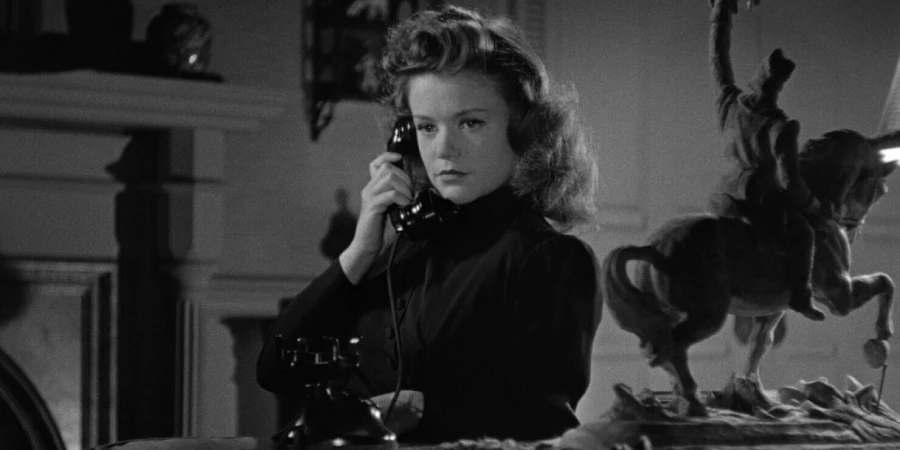
Irena invites Oliver up to her apartment, where he notices a curious statue: King John of Serbia on horseback, impaling a cat with his sword. She explains the folklore of her village, Sforzinda, where the women were believed to practice witchcraft and transform into great cats. Oliver finds it charming. Irena clearly does not.
Courtship, Marriage, and the Growing Fear
Oliver pursues Irena with genuine warmth, and she falls for him. However, she refuses to let him kiss her, terrified that passion or jealousy will trigger her transformation into a panther. They marry anyway, which immediately creates a marriage without physical intimacy.
Irena visits a psychiatrist, Dr. Louis Judd, at Oliver’s urging. Judd is skeptical of her fears and approaches her case with clinical detachment. He also, notably, begins to show a personal interest in her that goes beyond professional boundaries.
Meanwhile, Oliver grows emotionally closer to his colleague Alice Moore, who loves him quietly and openly. Irena senses this connection and her jealousy begins to simmer dangerously. Oliver’s kindness reads as neglect to a woman already wound tight with fear and longing.
The Swimming Pool Scene
Alice stays late at work and later goes for a swim alone at her building’s indoor pool. Irena follows her. What happens next ranks among the most brilliantly constructed suspense sequences in cinema history.
Alice hears something prowling in the darkness around the pool. Shadows move. Something breathes. She screams, pressing herself against the wall in the water, utterly terrified. When the lights finally come on, nothing is there. However, Alice’s robe is found shredded on a bench, torn by claws.
Tourneur never shows a panther. He shows shadows, suggests movement, and lets the audience’s imagination do the rest. Consequently, the scene hits harder than any creature effect could have managed on the film’s modest budget.
Irena Stalks Alice Through the Streets
In another masterfully built sequence, Alice walks home alone at night. She hears footsteps behind her. They stop when she stops. They resume when she resumes. Tension builds with each streetlight she passes, each shadow that stretches across the pavement.
A bus suddenly pulls up with a loud hydraulic hiss, breaking the silence. Alice jumps. So does the audience. On the other hand, nothing attacks her this time, and the ambiguity of what actually followed her remains unresolved and unsettling.
Oliver Chooses Alice and Confronts Irena
Oliver finally admits to Irena that he loves Alice and wants to separate. Irena takes this with a terrifying stillness. She visits Dr. Judd one final time, and he makes the fatal mistake of kissing her, apparently testing his theory that her fears are purely psychological.
Judd pays for that gamble with his life. Something attacks him in the darkness of his office. He manages to wound it with his sword cane before dying. A struggle clearly occurred, though Tourneur again keeps the transformation itself off screen.

Movie Ending
Irena, wounded from Judd’s sword cane, makes her way back to the zoo. Oliver and Alice are there, having been warned. Irena opens the panther’s cage and releases the animal. It is not entirely clear whether she does this to threaten them or to let the panther be free in some act of kinship or surrender.
The panther charges and is struck by a passing car. Irena collapses nearby and dies. Oliver and Alice find her body on the ground beside the dead panther. The final image leaves a deliberate question hanging: was Irena always just a deeply troubled woman, or did something genuinely supernatural lurk within her all along?
The film refuses to resolve that ambiguity cleanly, and that refusal is its greatest strength. Oliver’s final line, quoting a verse about those who walk in darkness, lands with quiet devastation. In contrast to the monster-movie conventions of the era, Cat People mourns its antagonist rather than celebrating her destruction. Irena is the most sympathetic figure in her own tragedy.
Alice and Oliver survive, but the ending offers no triumphant relief. It feels elegiac, even melancholy. Audiences curious about whether Irena truly transformed will find no definitive answer, and that is entirely the point: Lewton and Tourneur always kept the monster in the mind.
Are There Post-Credits Scenes?
Cat People (1942) has no post-credits scene. Films of this era did not employ that convention. When it ends, it ends, and the silence it leaves behind is part of the experience.
Type of Movie
Cat People is a psychological horror film with strong elements of film noir and melodrama. Its horror operates almost entirely through suggestion, atmosphere, and implication rather than explicit violence or creature effects.
In tone, the film is restrained, shadowy, and deeply melancholic. It treats its supernatural premise with genuine dramatic seriousness, which separates it sharply from the more theatrical monster movies of its time.
Cast
- Simone Simon – Irena Dubrovna Reed
- Kent Smith – Oliver Reed
- Tom Conway – Dr. Louis Judd
- Jane Randolph – Alice Moore
- Jack Holt – The Commodore
- Alan Napier – Doc Carver
Film Music and Composer
Roy Webb composed the score for Cat People. Webb worked extensively with producer Val Lewton across multiple RKO horror productions, developing a distinctive sound built on unease and restraint. His music rarely announces itself; instead, it creeps under scenes and amplifies dread without calling attention to its own presence.
Webb’s score mirrors Tourneur’s visual philosophy perfectly. Neither director nor composer overplays their hand. For instance, the swimming pool sequence uses near-silence as effectively as any musical cue, making the score’s absence its own kind of instrument.

Filming Locations
Cat People was filmed almost entirely on the RKO studio lot in Hollywood, California. Budget constraints meant that Tourneur and his team had to build New York City entirely from sets and controlled lighting. Remarkably, this limitation became a creative advantage.
Studio-bound filmmaking gave Tourneur complete control over shadows, light sources, and spatial depth. Every pool of darkness existed because the crew placed it there deliberately. As a result, the film’s world feels both real and stylized, grounded and dreamlike in equal measure.
The Central Park Zoo sequences used real zoo footage combined with studio sets. That blend of authentic animal footage and artificial environment reinforces the film’s central tension between the natural and the constructed, between instinct and civilization.
Awards and Nominations
Cat People was not a major awards contender during its release cycle. However, it proved to be a significant commercial success for RKO, earning far more than its modest budget and helping establish the Val Lewton production unit as a creative force within the studio system.
Behind the Scenes Insights
- Val Lewton reportedly received the title Cat People from RKO studio executives before any story existed; he then had to build a film around that title.
- Director Jacques Tourneur deliberately kept monster effects minimal, believing that suggestion was more effective than any rubber suit or creature prop the budget could afford.
- The famous bus scene, where the hydraulic hiss of a bus interrupts a suspense sequence, became so influential that this technique later acquired the name “the Lewton bus” in film criticism.
- Actress Simone Simon brought a genuine foreignness and fragility to Irena that grounded the supernatural premise in emotional reality.
- Cat People was made on a budget of approximately $134,000 and grossed close to $4 million, an extraordinary return that saved RKO considerable financial difficulty at the time.
- Lewton insisted on literary quality in his scripts and frequently clashed with studio executives who wanted more conventional horror spectacle.
Inspirations and References
Screenwriter DeWitt Bodeen drew loosely on Slavic folklore surrounding shapeshifting, witchcraft, and ancient curses. No single source text directly inspired the film, though the broader cultural mythology of werecat legends runs through its bones.
Lewton’s production unit generally favored literary and psychological source material over pulp sensationalism. In addition, the film’s treatment of female sexuality and repression clearly engages with ideas circulating in popular psychology during the early 1940s, particularly around Freudian concepts of neurosis and desire.
Alternate Endings and Deleted Scenes
No well-documented alternate endings or significant deleted scenes from Cat People (1942) appear in the historical record. The film was tightly controlled by Lewton, who treated his productions with unusual authorial consistency.
Given the film’s extremely low budget and short shooting schedule, extensive reshoots or alternate takes would have been a luxury the production simply could not afford. What audiences see essentially reflects the original intent.
Book Adaptations and Differences
Cat People is not based on a book. Screenwriter DeWitt Bodeen wrote an original screenplay specifically for this production, working within the parameters Lewton set after receiving the title from RKO executives.


Memorable Scenes and Quotes
Key Scenes
- Irena sketching the panther at the zoo while Oliver watches her; their first meeting establishes the film’s entire thematic tension in under two minutes.
- The swimming pool sequence, in which Alice cowers in the water while something unseen prowls the darkness around her, is widely regarded as one of the greatest suspense scenes in horror cinema.
- Alice walking home at night while footsteps follow her, climaxing with the sudden loud arrival of a bus in one of cinema’s most imitated shock-cut techniques.
- Dr. Judd kissing Irena in his office, triggering the attack that kills him, confirming in a single reckless moment that her fears carried real consequences.
- Irena opening the panther’s cage at the zoo and collapsing nearby as the animal charges, closing the film with ambiguity and sorrow rather than resolution.
Iconic Quotes
- “Even as fog continues to lie in the valleys, so does ancient sin cling to the low places, the depressions in the world consciousness.” (Oliver, quoting at the film’s close)
- “I like the shadows.” (Irena, early in the film, a line that doubles as both character revelation and thematic statement)
- “I believe you. I even believe in the possibility of things I cannot explain.” (Oliver to Irena, though his belief never quite extends far enough to save their marriage)
Easter Eggs and Hidden Details
- The statue of King John impaling a cat with his sword in Irena’s apartment reappears subtly in background shots throughout her scenes, functioning as a constant visual omen.
- Irena’s apartment is decorated with cat motifs throughout, most visible in the early scenes when Oliver first visits her home.
- Other women in a restaurant react to Irena with hissing and agitation, a moment easy to read as social anxiety but also functioning as a suggestion that animal instincts recognize her for what she is.
- The panther’s cage at the zoo, which opens the film and closes it, frames Irena’s entire arc as one of captivity and release.
- Dr. Judd carries a sword cane throughout the film; attentive viewers may notice it well before it becomes a plot-critical object in the final act.
Trivia
- The hydraulic hiss of a bus interrupting a suspense sequence gave rise to the term “the Lewton bus”, now used in film studies to describe any sudden, harmless shock that releases built-up tension.
- Cat People spawned a sequel, The Curse of the Cat People (1944), also produced by Lewton, though the follow-up focused far more on childhood fantasy than on horror.
- A remake directed by Paul Schrader was released in 1982, starring Nastassja Kinski; it took a considerably more explicit and erotic approach to the same premise.
- Despite its enormous commercial success, the film’s critical reputation was initially modest; its status as a classic grew steadily over subsequent decades.
- Simone Simon had previously worked in Hollywood in the 1930s with limited success; Cat People became the role that secured her lasting place in film history.
- Tourneur and Lewton completed the film in under three weeks of principal photography.
Why Watch?
Cat People (1942) is a masterclass in restraint, proving that shadow and sound can terrify more effectively than any visible monster. Moreover, Simone Simon’s performance gives the film genuine emotional weight that most horror pictures of its era entirely lack. Few films this short, this old, and this inexpensive have left a longer mark on cinema.
Director’s Other Movies
- I Walked with a Zombie (1943)
- The Leopard Man (1943)
- Out of the Past (1947)
- Stars in My Crown (1950)
- Circle of Danger (1951)
Recommended Films for Fans
- I Walked with a Zombie (1943)
- The Seventh Victim (1943)
- Curse of the Demon (1957)
- Repulsion (1965)
- The Innocents (1961)
- Cat People (1982)
- The Others (2001)