
Beneath the Paris Opera House lurks one of cinema’s most haunting figures, and the 1925 silent adaptation of The Phantom of the Opera brings him to life with a ferocity that still unsettles audiences a century later. Lon Chaney Sr. designed his own disfigurement makeup in secret, and the unmasking scene reportedly made viewers faint in theaters. This film did not merely adapt a beloved novel; it redefined what horror could achieve on screen.
Detailed Summary
The Opera House and Its Rumors
Paris’s grand opera house sits atop a labyrinth of cellars, underground lakes, and shadowy corridors. Workers whisper about a ghost who haunts the building, demanding tribute and controlling events from the darkness below.
New managers Moncharmin and Richard take over the opera house and dismiss the ghost stories as superstition. However, they will soon learn that dismissing the Phantom is a very costly mistake.
Christine and Raoul
Young soprano Christine Daae believes she receives secret vocal instruction from an angelic presence she cannot see. In reality, her mysterious teacher is Erik, the disfigured musical genius who lives beneath the opera house and has become obsessed with her.
Childhood sweetheart Raoul, Vicomte de Chagny, reconnects with Christine during her rise to prominence. Their budding romance immediately threatens Erik’s possessive hold over her.
Erik Reveals His Lair
Erik leads Christine blindfolded through secret passages and down to his underground domain. His lair features a grand pipe organ, ornate furnishings, and an eerie atmosphere of isolated grandeur that reflects both his brilliance and his loneliness.
Christine grows increasingly unnerved by her strange host. Curiosity overtakes her caution, and she reaches out to remove his mask while he sleeps at the organ.
The Unmasking
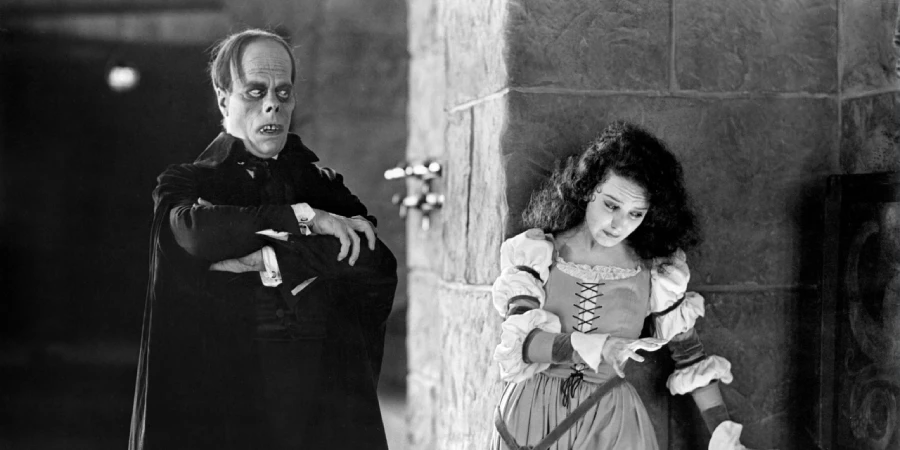
The unmasking scene remains one of silent cinema’s most iconic moments. Erik spins around and reveals a skull-like face with a sunken nose, hollow cheeks, and grotesque skin that Chaney constructed entirely himself using wire, putty, and careful paint application.
Erik erupts in fury at Christine’s intrusion. He seizes her, shakes her violently, then softens into a wounded vulnerability that makes him terrifying and pitiable in equal measure.
The Chandelier Crash
Angered by the opera management’s refusal to follow his demands, Erik cuts the rope supporting the opera house’s massive chandelier. It crashes into the audience below during a performance, causing chaos and real terror throughout the house.
This act of violence marks a turning point. Erik stops being merely a mysterious presence and becomes a genuinely dangerous threat to everyone around Christine.
The Bal Masque
A lavish masquerade ball fills the opera house with costumed guests. Erik appears dramatically on a staircase dressed as the Red Death, referencing Edgar Allan Poe’s famous story and announcing his power to the world in the most theatrical way imaginable.
Raoul and Christine secretly plot their escape during the festivities. Erik overhears their plans, and his rage intensifies into something truly dangerous.
Kidnapping and Underground Captivity
Erik kidnaps Christine and brings her back to his underground lair, determined to keep her with him permanently. He confesses his love with a desperate, overwhelming intensity that blends obsession with genuine anguish.
Christine, in contrast, remains frightened but also strangely moved by his vulnerability. She agrees to stay with him willingly if he releases Raoul and his brother, Philippe, unharmed.

Movie Ending
Erik agrees to Christine’s terms but has no intention of honoring them fully. He traps Raoul and Inspector Ledoux in a torture chamber below the lair, flooding it slowly while simultaneously rigging the opera house’s powder magazine with explosives. His grip on everyone he considers an enemy tightens to an almost impossible degree.
Christine, seeing Erik’s betrayal, kisses him on the forehead. This act of unexpected compassion momentarily disarms him, and she uses that moment to signal Raoul’s rescuers. Meanwhile, Persian secret agent The Daroga helps Raoul navigate the underground passages to find Christine and confront Erik directly.
Raoul survives. Christine escapes with him into the Paris streets. Erik, left utterly alone and stripped of his last hope for human connection, chooses not to detonate the explosives.
An enraged mob pursues Erik through the streets after he flees the opera house. He turns to face them one final time, opens his hand to reveal it is empty, and laughs. The crowd overwhelms him, and he dies. This ending carries enormous emotional weight: Erik never truly wanted destruction; he wanted love, and the world’s refusal to give him any sent him down a path that could only end in tragedy.
Consequently, the film refuses to cast Erik as a simple villain. His death feels like a release as much as a defeat, and audiences leave with an uncomfortable sympathy for a man who was monstrous in action but human in longing.
Are There Post-Credits Scenes?
No. The Phantom of the Opera (1925) contains no post-credits scenes. Post-credits sequences did not exist as a filmmaking convention during the silent era, and the film ends definitively with Erik’s death.
Type of Movie
This film sits firmly in the horror and Gothic romance genres. Its tone blends dread, melodrama, and dark beauty in a way that feels operatic in every sense of the word.
For its era, it pushed the boundaries of what horror could look like. In contrast to later slasher-style horror, the fear here comes from atmosphere, obsession, and the tragedy of a brilliant mind locked inside a monstrous face.
Cast
- Lon Chaney – Erik, the Phantom
- Mary Philbin – Christine Daae
- Norman Kerry – Raoul, Vicomte de Chagny
- Arthur Edmund Carewe – The Daroga (Ledoux)
- Gibson Gowland – Simon Buquet
- John Sainpolis – Philippe de Chagny
- Snitz Edwards – Florine Papillon’s Manager
- Mary Fabian – Sorelli
Film Music and Composer
Silent films relied on live musical accompaniment rather than a recorded score, and this film was no exception during its original run. Organists and orchestras performed music alongside the picture, often drawing on operatic classics to match the setting.
For the 1925 release, Gustav Hinrichs arranged a score that incorporated passages from Charles Gounod’s opera Faust, which features prominently within the film’s plot. This choice added a layer of thematic resonance, since Faust is literally performed on screen during key scenes.
Notably, a two-strip Technicolor sequence was included for the Bal Masque scene, making this one of the early films to feature partial color photography. Musical accompaniment for that sequence often reflected its heightened, theatrical visual character.



Filming Locations
Production took place primarily at Universal Studios in Hollywood, California. The studio constructed elaborate sets representing the Paris Opera House, including sweeping staircases, grand performance halls, and the underground labyrinth below.
The massive opera house set became one of the most expensive ever built in Hollywood at that time. In addition, the set proved so impressive and durable that Universal kept it standing for decades after production wrapped, reusing it in other films.
Shooting on a studio backlot rather than on location in Paris gave the production complete creative control over the underground sequences. As a result, director Rupert Julian could design environments that felt genuinely unreal and nightmarish in ways no real location could have provided.
Awards and Nominations
The Academy of Motion Picture Arts and Sciences did not exist when this film released in 1925, so no Oscar consideration was possible. Nevertheless, the film’s legacy has earned it a place in the National Film Registry of the Library of Congress, where it was preserved as a culturally significant work.
Behind the Scenes Insights
- Lon Chaney kept his makeup design for Erik completely secret during production, refusing to let anyone see him in full costume before the unmasking scene was filmed.
- Chaney reportedly used a painful combination of wire, fish skin, and putty to achieve Erik’s skull-like appearance; the prosthetics caused him physical discomfort during filming.
- Director Rupert Julian clashed repeatedly with Chaney on set, and the working relationship was reportedly tense throughout production.
- Edward Sedgwick, a different director, took over reshoots for certain scenes after conflicts between Julian and the studio escalated.
- The film went through significant re-editing between its 1925 premiere and its wider 1929 re-release, with some comedic elements added in the later version to soften the horror.
- Mary Philbin’s reaction to the unmasking was reportedly genuine shock; some accounts suggest Chaney deliberately withheld the full makeup reveal until the cameras were rolling.
- The opera house set cost over 500,000 dollars to construct, an enormous sum for the period.
Inspirations and References
The film directly adapts Gaston Leroux’s 1910 serialized novel Le Fantôme de l’Opéra, which was itself inspired by legends and rumors surrounding the real Paris Opera House, the Palais Garnier. Leroux worked as a journalist and wove real architectural details of the building into his fiction.
The Red Death sequence draws explicitly from Edgar Allan Poe’s short story The Masque of the Red Death. Erik adopting this costume speaks directly to his self-mythology as a figure of death and inevitability.
Furthermore, Leroux’s novel drew on Gothic literary tradition stretching back through Mary Shelley and Victor Hugo, particularly Hugo’s interest in outcasts who exist at the margins of society. Erik shares clear thematic DNA with Quasimodo from The Hunchback of Notre-Dame.
Alternate Endings and Deleted Scenes
The film’s production history includes notable changes between versions. An earlier cut featured a different ending in which Erik escapes rather than dying at the hands of a mob, which altered the film’s emotional conclusion significantly.
The 1929 re-release added a partial synchronized sound track and re-edited sequences, including the insertion of lighter comedic scenes that most critics and fans consider detrimental to the film’s tone. Many of these added scenes disrupted the pacing of the horror.
Some early screenings used a version with a slightly different sequence of events in the underground lair. Consequently, several alternate cuts of this film circulate among archivists and film historians, making definitive comparison of all versions a complex scholarly undertaking.
Book Adaptations and Differences
The film adapts Gaston Leroux’s novel Le Fantôme de l’Opéra fairly closely in its broad strokes, but several elements shift between page and screen. In the novel, Erik’s backstory receives much greater detail, including his origins in Persia and his work as an architect and magician.
The film condenses or omits much of this background, keeping Erik mysterious rather than explained. In contrast, Leroux’s novel ultimately invites more sympathy for Erik by showing exactly how his life brought him to this point.
Additionally, the character known in the film as The Daroga is more fully developed in the novel, where his history with Erik in Persia adds meaningful context to their complex relationship. The film reduces him largely to a plot device.

Memorable Scenes and Quotes
Key Scenes
- The Unmasking: Christine pulls Erik’s mask from behind while he sleeps at the organ, and he spins to reveal his terrifying face in what remains one of cinema history’s most shocking reveals.
- The Chandelier Crash: Erik severs the rope and sends the massive chandelier plummeting into the audience, an act of violence that shifts the film’s tension from eerie to genuinely dangerous.
- The Red Death Appearance: Erik descends a grand staircase in a crimson costume and skull mask at the masquerade ball, commanding every eye in the room with theatrical menace.
- The Rooftop Conversation: Raoul and Christine meet secretly atop the opera house to plan their escape, unaware that Erik listens from the shadows below.
- Erik’s Final Moment: He opens his hand to show the pursuing mob it is empty, laughs, and is overwhelmed in a scene that is both defiant and devastatingly sad.
Iconic Quotes
- “Feast your eyes, glut your soul on my accursed ugliness!” (Erik, following the unmasking, in one of the film’s most famous intertitles)
- “I am the Phantom.” (Erik, during his confrontation with Christine in the lair)
Easter Eggs and Hidden Details
- The opera performed within the film is Faust by Gounod, a story about a man who makes a pact with a demonic figure; this mirrors Erik’s own deal with Christine, giving up her freedom in exchange for artistic greatness.
- The architecture of the on-screen opera house closely mirrors the actual Palais Garnier in Paris, including the famous grand staircase, adding visual authenticity to the studio-built set.
- Erik’s costume at the masquerade ball references Poe by name in the intertitles, making the literary allusion explicit rather than subtle.
- Certain angles in the underground lair sequences frame Erik so that shadows obscure half his face even before the unmasking, visually foreshadowing the horror to come.
- The Technicolor sequence for the Bal Masque stands out precisely because the rest of the film is black and white; the sudden burst of color makes the Red Death’s entrance feel supernatural and overwhelming.
Trivia
- This was not the first film adaptation of Leroux’s novel; a 1916 version also existed, though it is largely lost.
- Lon Chaney became famous as “The Man of a Thousand Faces” because of transformative roles like this one, achieved entirely through his own makeup artistry rather than elaborate prosthetics technology.
- The film’s opera house set at Universal Studios survived for decades and was reportedly still in use as late as the 1970s.
- Universal considered this film one of its most prestigious productions of the silent era, spending heavily on sets and costumes.
- Mary Philbin was only in her early twenties during production, and the role of Christine became one of her most enduring performances.
- The Library of Congress selected the film for preservation in the National Film Registry in 1998, recognizing its cultural and historical importance.
- Multiple conflicting prints of the film exist, with different scene orders and ending variants, making it genuinely difficult to establish a single definitive version.
Why Watch?
Lon Chaney’s performance alone justifies the viewing; his Erik is a force of nature, terrifying and heartbreaking in the same breath. Furthermore, the film represents silent cinema at its most ambitious and emotionally complex. No other version of this story, including the famous stage musical, matches the raw, unsettling power of watching that mask come off for the very first time.
Director’s Other Movies
- The Merry-Go-Round (1923)
- The Brass Bullet (1918)
- The Kaiser, the Beast of Berlin (1918)
Recommended Films for Fans
- The Hunchback of Notre Dame (1923)
- Nosferatu (1922)
- The Cabinet of Dr. Caligari (1920)
- London After Midnight (1927)
- Dr. Jekyll and Mr. Hyde (1920)
- The Golem (1920)