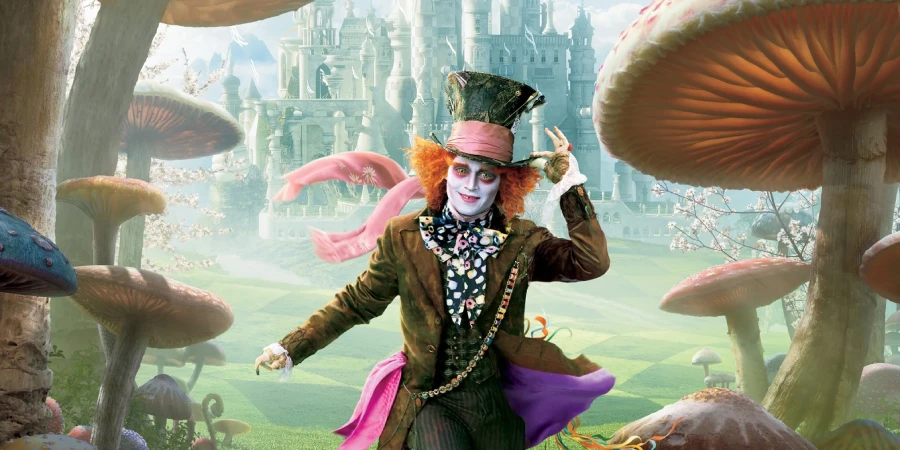

Tim Burton’s Alice in Wonderland (2010) is not a retelling of Lewis Carroll’s classic story; it is a sequel dressed up as a remake, and that distinction makes all the difference. Burton trades Carroll’s dreamlike, consequence-free whimsy for a full-blown fantasy war epic, complete with armies, prophecies, and a reluctant hero who must choose her own fate. Mia Wasikowska carries the film with quiet intensity, anchoring its visual excess in genuine emotional stakes. This is Wonderland with teeth.
Detailed Summary
Alice’s Restless Life Above Ground
We meet Alice Kingsleigh as a young woman of nineteen, plagued by recurring nightmares about a strange underground world filled with talking animals and a terrifying creature. Her late father believed in impossible things, and Alice clearly inherited that restless, unconventional mind. However, her world above ground offers her little room for it.
At a garden party, Alice realizes she is about to be proposed to by the dull and socially suitable Hamish Ascot. She spots a white rabbit in a waistcoat and bolts, following him across the estate. Consequently, she tumbles down a rabbit hole and falls into a world she has visited before, though she cannot remember it.
Arriving in Underland
Alice lands in Underland, a name the film carefully distinguishes from “Wonderland,” which is simply what Alice misheard as a child. She encounters familiar faces: the White Rabbit, the Dodo, Tweedledee and Tweedledum, and a caterpillar named Absolem. Everyone debates whether she is the right Alice, the one foretold by prophecy.
A scroll called the Oraculum depicts every day in Underland’s history. It shows a champion slaying the Jabberwocky on a day called Frabjous Day. Moreover, the illustrated champion looks very much like Alice.
The Red Queen’s Reign of Terror
Iracebeth, the Red Queen, rules Underland through fear and grotesque cruelty. Her enormous, artificially enlarged head sits atop a small body, and her courtiers secretly stuff their faces and bodies with padding to make her feel normal. She keeps the Jabberwocky as her personal weapon of mass destruction.
Her soldiers, led by the sinister Stayne (the Knave of Hearts), hunt Alice across Underland on the Red Queen’s orders. Alice is captured and brought to the Red Queen’s castle, where she hides her true identity.
The Mad Hatter and the Resistance
Tarrant Hightopp, better known as the Mad Hatter, rescues Alice before her capture and brings her toward the White Queen‘s territory. Johnny Depp plays the Hatter as a deeply traumatized figure, oscillating between manic warmth and cold, dangerous fury. His Hightop clan was massacred by the Red Queen’s forces, and that grief sits just beneath his eccentricity.
Stayne eventually captures the Hatter, forcing Alice to proceed toward the Red Queen’s castle alone. She infiltrates it by claiming to be a “Um” from Umbridge, a stranger from the outside world, and the Red Queen takes a liking to her.
Inside the Red Queen’s Court
Alice navigates the court carefully, befriending the White Rabbit and learning the layout of the castle. She discovers the Vorpal Sword, the only weapon capable of killing the Jabberwocky, locked away inside the castle. In addition, she finds the Hatter imprisoned in the dungeon and helps arrange his escape.
Meanwhile, the Cheshire Cat manipulates events with his usual fluid self-interest, technically saving the Hatter’s life by briefly wearing his hat during an execution. The escape sequence is chaotic and fun, with Alice riding an oversized dog like a horse through the castle grounds.
Choosing to Fight
Alice reaches the White Queen’s pale, ethereal castle. Actress Anne Hathaway plays the White Queen as an almost comically serene pacifist, someone incapable of harming any living creature but perfectly willing to let others do it for her. Alice still refuses to accept that she is the foretold champion.
Absolem the caterpillar, now spinning his cocoon, finally tells Alice that she is “not hardly Alice” but that she must decide who she is. That quiet moment pushes her toward self-acceptance. On Frabjous Day, Alice finally declares that she will fight.
Movie Ending
On Frabjous Day, both armies assemble on a giant chessboard battlefield. Alice dons armor, retrieves the Vorpal Sword, and faces the Jabberwocky directly. The creature is massive, articulate, and voiced with cold menace by Christopher Lee. It tries to shake her resolve by suggesting she is dreaming, but Alice recites six impossible things to herself and drives the Vorpal Sword through its neck.
With the Jabberwocky dead, the Red Queen’s power collapses immediately. The White Queen banishes Iracebeth and Stayne to a remote location for eternity, a punishment arguably worse than execution. Notably, Stayne then tries to kill the Red Queen, and she responds with genuine fury; their toxic relationship ends in mutual exile rather than reconciliation.
Using the Jabberwocky’s blood, Alice brews a potion that allows her to return to the real world. She rises out of the rabbit hole into the garden party, where Hamish is still waiting with his ring. Calm and certain, she refuses his proposal, then moves through the crowd confronting the expectations that have been placed on her.
Addressing Hamish’s mother, she explains that she cannot marry without love. To a gossiping relative, she bluntly reveals that his affair is no secret. Turning to Lord Ascot—her father’s former partner—she declares her intention to continue her father’s trade route to China. Rather than resisting, he agrees, impressed by her resolve. With that, Alice sets out for the Far East as an apprentice, determined to build a life on her own terms.
In the final scene, a blue butterfly lands gently on her finger as she stands at the ship’s bow. She recognizes it as Absolem, now transformed, and smiles. The film closes on that quiet image: a woman who chose her own path, accompanied by the guide who always believed in her.
Are There Post-Credits Scenes?
Alice in Wonderland (2010) contains no post-credits scenes. Once the credits roll, the film is complete. You can safely leave your seat or close your streaming app without missing anything additional.
Type of Movie
This film occupies the crossroads of fantasy adventure and coming-of-age drama. Burton leans heavily into dark fantasy visuals while keeping the emotional core focused on identity and self-determination. In contrast to the whimsical, plotless tone of Carroll’s original books, this film functions as a structured hero’s journey.
Its tone shifts frequently, ranging from gothic menace to broad comedy, sometimes within the same scene. Overall, it targets family audiences while carrying enough darkness and thematic weight to engage older viewers.
Cast
- Mia Wasikowska – Alice Kingsleigh
- Johnny Depp – Tarrant Hightopp / The Mad Hatter
- Helena Bonham Carter – Iracebeth / The Red Queen
- Anne Hathaway – Mirana / The White Queen
- Crispin Glover – Stayne / The Knave of Hearts
- Matt Lucas – Tweedledee and Tweedledum
- Stephen Fry – The Cheshire Cat (voice)
- Alan Rickman – Absolem the Caterpillar (voice)
- Christopher Lee – The Jabberwocky (voice)
- Michael Sheen – The White Rabbit (voice)
- Timothy Spall – Bayard the Bloodhound (voice)
- Barbara Windsor – The Dormouse (voice)
Film Music and Composer
Danny Elfman composed the score, continuing his long and celebrated collaboration with Tim Burton. Elfman brings his signature blend of orchestral grandeur and circus-like menace to Underland, making the world feel both magical and slightly threatening at all times.
Notable tracks include the main theme, which layers choral voices over rolling strings to create something simultaneously childlike and ominous. Avril Lavigne contributed the end-credits song Alice, a pop-rock number that Burton reportedly championed personally. Elfman has scored the majority of Burton’s films dating back to Pee-wee’s Big Adventure in 1985, making their partnership one of Hollywood’s most enduring director-composer relationships.
Filming Locations
Principal photography took place largely on soundstages in the United Kingdom, with extensive use of green screen to construct Underland digitally. However, several key outdoor scenes used real British countryside locations to give Alice’s above-ground world a grounded, period-accurate feel.
Antony House in Cornwall served as the Ascot estate, providing the grand garden-party setting that opens and closes Alice’s real-world story. Its manicured grounds and Georgian architecture reinforce the suffocating propriety Alice spends the film escaping. The contrast between that ordered world and the anarchic digital Underland is central to the film’s visual argument.
Awards and Nominations
Alice in Wonderland won two Academy Awards: Best Art Direction and Best Costume Design. Colleen Atwood, who designed the costumes, has collaborated with Burton across many films, and her work here is genuinely spectacular.
Furthermore, the film received a third Oscar nomination for Best Visual Effects. It also received multiple BAFTA nominations, including Best Production Design. Given its visual ambition, the awards focus on craft categories is entirely appropriate.
Behind the Scenes Insights
- Tim Burton wanted to make a film that functioned as a true sequel to Alice’s childhood visits rather than a straight adaptation of Carroll’s books.
- Mia Wasikowska beat out a large number of other actresses for the role of Alice, with Burton drawn to her understated screen presence.
- Helena Bonham Carter wore prosthetic headgear on set to approximate her enlarged head, but the final effect relied heavily on digital enlargement in post-production.
- Crispin Glover’s Stayne was filmed with Glover at his natural height, then digitally extended in post-production to make the character unnaturally tall and willowy.
- Johnny Depp developed two distinct accents for the Hatter: a softer, warmer one for his calmer moments and a sharp, almost Scottish-sounding one when the character’s grief and rage surfaced.
- Burton reportedly encouraged his actors to avoid watching or referencing previous screen adaptations of the material to keep performances fresh.
- The film shot entirely in 2D and was converted to 3D in post-production, a decision that drew significant criticism from viewers and cinematographers who felt the conversion was noticeably inferior to native 3D photography.
Inspirations and References
The film draws primarily from two Lewis Carroll works: Alice’s Adventures in Wonderland (1865) and its sequel Through the Looking-Glass, and What Alice Found There (1871). Both the Jabberwocky and the Vorpal Sword come directly from Carroll’s poem Jabberwocky, published within Through the Looking-Glass.
Screenwriter Linda Woolverton structured the narrative as a hero’s journey, drawing on Joseph Campbell’s archetypal framework to give Carroll’s episodic source material a beginning, middle, and end. The chess imagery of the final battle references Through the Looking-Glass directly, in which Underland operates as a giant chess game.
Burton’s visual approach also references the original John Tenniel illustrations from the Carroll books, particularly in character design choices like the Hatter’s oversized hat and the Red Queen’s distorted proportions.
Alternate Endings and Deleted Scenes
No significantly different theatrical alternate ending has been publicly confirmed for this film. However, deleted and extended scenes appeared on home video releases, offering additional moments with supporting characters in the Red Queen’s court.
Some extended sequences gave more screen time to the Hatter’s backstory and his relationship with his destroyed clan, deepening Depp’s performance context. These scenes were cut to maintain pacing rather than due to any narrative problem with the content itself.
Book Adaptations and Differences
As noted above, the film adapts elements from both Alice’s Adventures in Wonderland and Through the Looking-Glass. However, it departs significantly from both books in terms of structure and tone. Carroll’s originals have no real plot; they are essentially a series of bizarre vignettes connected by Alice walking through a strange world.
Burton and Woolverton imposed a linear narrative arc and a prophecy-driven plot structure entirely absent from Carroll’s writing. Characters like Stayne and the formalized war between the Red and White Queens are original inventions for the film. In addition, Carroll’s Alice is a child; making her a nineteen-year-old navigating adult social pressures fundamentally changes the story’s meaning and emotional register.
The Oraculum scroll is a film-original invention that conveniently gives the story its central tension. Carroll never wrote anything resembling a chosen-one prophecy, so that entire framework belongs to Woolverton’s screenplay.
Memorable Scenes and Quotes
Key Scenes
- Alice following the White Rabbit and tumbling down the rabbit hole, floating past surreal household objects in a visually inventive fall sequence.
- The Hatter’s rescue of Alice from Stayne’s soldiers, leading to a frantic escape through the forest on the back of the Cheshire Cat.
- Alice infiltrating the Red Queen’s castle and riding a monstrous, oversized dog through the grounds during the Hatter’s escape.
- Absolem telling Alice she is “not hardly Alice” as he prepares to enter his cocoon, a quiet scene that carries the film’s thematic weight.
- Alice reciting six impossible things to herself while fighting the Jabberwocky, then beheading the creature in a single definitive stroke.
- Alice turning down Hamish’s marriage proposal and methodically dismantling every social expectation placed on her in the film’s final garden sequence.
Iconic Quotes
- “You’re not the same as you were before. You were much more… muchier. You’ve lost your muchness.” (The Mad Hatter to Alice)
- “From the moment I fell down that rabbit hole I’ve been told what I must do and who I must be. I’ve been shrunk, stretched, scratched, and stuffed into a teapot. I believe I’ve had enough of being told what to do.” (Alice)
- “Sometimes I’ve believed as many as six impossible things before breakfast.” (The Mad Hatter, quoting the White Queen; Alice repeats it during the battle)
- “Off with their heads!” (The Red Queen, the film’s most recognizable recurring line)
- “You’re entirely bonkers. But I’ll tell you a secret: all the best people are.” (The Mad Hatter to Alice)
Easter Eggs and Hidden Details
- The Oraculum scroll, when examined closely in freeze-frame, depicts small illustrated versions of events from earlier in the film, functioning as a visual timeline of Underland’s entire history.
- Absolem’s transformation into a blue butterfly at the film’s end directly mirrors the traditional symbolic meaning of the butterfly as a figure of transformation and rebirth, reinforcing Alice’s completed personal journey.
- The Red Queen’s court members secretly wear padding to enlarge their features, reflecting Carroll’s theme of absurd social performance; it is a visual metaphor for how people distort themselves to please those in power.
- The chess-board battlefield directly references the chess-game structure of Through the Looking-Glass, in which characters are literally chess pieces moving across a giant board.
- Johnny Depp’s two distinct vocal registers for the Hatter have been interpreted by some viewers as a nod to dissociative behavior, suggesting the character carries genuine psychological trauma from the massacre of his clan.
- The film’s title card appears relatively late in the opening sequence, after Alice has already begun following the rabbit, placing the audience inside the story before formally naming it.
Trivia
- Alice in Wonderland became one of the highest-grossing films of that year, earning over one billion dollars worldwide at the box office.
- It was one of the first major studio films to be converted from 2D to 3D in post-production, contributing to a broader industry trend that followed in subsequent years.
- Alan Rickman, who voiced Absolem, reportedly recorded his dialogue separately from the other cast members, as was common for voice roles in live-action films of this type.
- Linda Woolverton became the first woman to write a billion-dollar-grossing live-action film with this screenplay.
- Burton and Depp had already collaborated on several films before this one, including Edward Scissorhands, Ed Wood, Sleepy Hollow, Charlie and the Chocolate Factory, and Sweeney Todd: The Demon Barber of Fleet Street.
- Helena Bonham Carter and Tim Burton were a real-life couple during production, making the Red Queen’s theatrical menace something of a curious casting dynamic.
- A sequel, Alice Through the Looking Glass, was released in 2016, though Burton did not direct it; James Bobin took over for that film.
Why Watch?
Burton’s Alice in Wonderland delivers one of the most visually inventive fantasy worlds put on screen in the 2000s, with a cast that commits fully to its glorious weirdness. Its feminist core, a young woman refusing every box society builds for her, gives the spectacle genuine emotional stakes. For fans of dark fantasy, Carroll’s world, or simply great production design, this film earns its place.
Director’s Other Movies
- Pee-wee’s Big Adventure (1985)
- Beetlejuice (1988)
- Batman (1989)
- Edward Scissorhands (1990)
- Batman Returns (1992)
- Ed Wood (1994)
- Sleepy Hollow (1999)
- Big Fish (2003)
- Charlie and the Chocolate Factory (2005)
- Sweeney Todd: The Demon Barber of Fleet Street (2007)
- Dark Shadows (2012)
- Big Eyes (2014)
- Dumbo (2019)
Recommended Films for Fans
- Pan’s Labyrinth (2006)
- Charlie and the Chocolate Factory (2005)
- Coraline (2009)
- Oz the Great and Powerful (2013)
- Snow White and the Huntsman (2012)
- Labyrinth (1986)
- Stardust (2007)
- The Chronicles of Narnia: The Lion, the Witch and the Wardrobe (2005)
- MirrorMask (2005)
- Beetlejuice (1988)