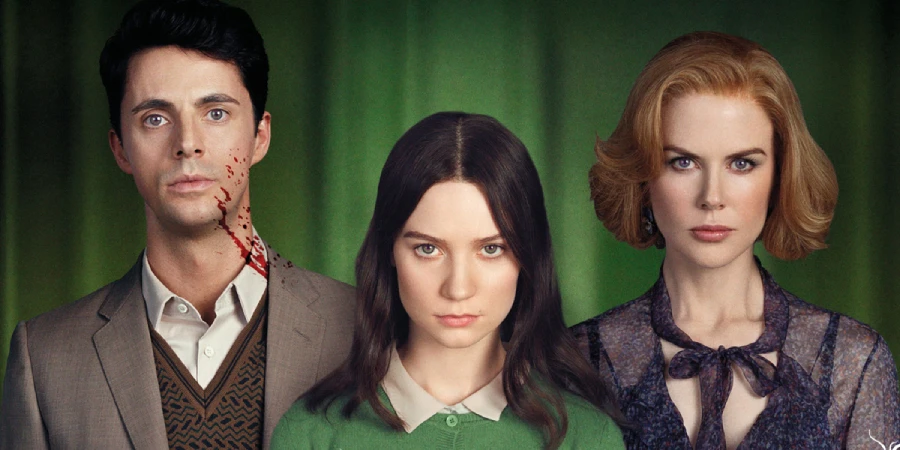

Park Chan-wook’s English-language debut arrives with a single image that tells you everything: a girl’s white blouse slowly soaking red at the collar while she smiles. Stoker (2013) is a film about a teenager who discovers she has inherited something far darker than grief, and it moves with the quiet precision of a predator circling its prey. Every frame is composed like a threat. Wentworth Miller’s screenplay hides its sharpest blade until the final act, and the film earns every drop of blood it spills.
Detailed Summary
India’s Birthday and the Death of Her Father
On India Stoker’s eighteenth birthday, her father Richard dies in a car accident. She learns this at school, in front of her classmates, and her reaction is unsettlingly calm. Mia Wasikowska plays India with a coiled stillness that immediately signals something unusual about this girl.
Richard was India’s anchor. Her mother Evelyn, played by Nicole Kidman, is beautiful, distant, and quietly resentful of her own daughter. Their house sits on a vast, isolated estate, and the film establishes it as a place where rules and warmth do not really live.
Charlie Arrives
At Richard’s funeral, a stranger appears: Charlie Stoker, Richard’s younger brother, whom India never knew existed. Matthew Goode plays Charlie with a shark’s smile and an almost theatrical politeness. He announces he will stay with the family, and nobody quite has the nerve to say no.
India distrusts him immediately. She senses something predatory in his attention, his too-perfect manners, his habit of watching her. Evelyn, starved for affection and prone to weakness, gravitates toward Charlie almost at once.
The Housekeeper Goes Missing
Mrs. McGarrick, the family housekeeper, challenges Charlie’s presence early on. She disappears without explanation, and Charlie produces a note claiming she had a family emergency. India does not believe it. A later scene confirms the audience’s suspicion: Charlie buried her in the garden.
Aunt Gin and the Phone Calls
Aunt Gin, played by Jacki Weaver, arrives unannounced. She tells India she has been trying to reach Evelyn by phone for weeks. Her concern is barely concealed panic. Charlie takes Gin to the train station, and she never arrives at her destination.
India finds Gin’s red shoes in the freezer. It is one of the film’s most quietly horrifying moments: a single domestic object, ice-cold, where it should not be. Park shoots the discovery without musical sting or dramatic camera move. Just the shoes, just India’s face, just silence.
Sheriff Howard and the Investigation
Local Sheriff Howard has questions about the missing women. He comes to the house twice. Charlie handles him with smooth, practiced charm. India watches every exchange with growing clarity about who and what Charlie actually is.
India’s School Life and the Attack
At school, a boy named Whip tries to sexually assault India in a field. Charlie witnesses it and kills Whip by strangling him. What disturbs the film’s moral architecture is India’s reaction: she does not feel horror. She feels something closer to exhilaration.
Charlie and India bury Whip together in the woods. The scene is shot in golden late-afternoon light, as if it were a pastoral memory rather than a crime. That deliberate tonal mismatch is one of Park’s sharpest directorial choices in the entire film.
The Truth About Charlie
India finds letters her father wrote to her over the years, stored away and never delivered. Through these letters and a key Charlie leaves deliberately for her to find, she accesses a storage unit. Inside, she discovers evidence of Charlie’s history: he spent years in a psychiatric institution after killing his own younger brother as a child.
Richard knew. Richard’s role in India’s life was partly protective, keeping Charlie isolated and away from her. With Richard gone, Charlie came to find what he had been waiting for.
Evelyn and Charlie’s Relationship Turns Violent
Evelyn and Charlie sleep together. Evelyn later confronts Charlie, half accusing him of using her to get to India. Charlie’s response is to strangle her. He wants India, and Evelyn has become an obstacle.
Movie Ending
India walks in on Charlie attempting to kill Evelyn. She retrieves her father’s hunting rifle and shoots Charlie through the head. It is a clean shot, unhesitating, and Wasikowska plays the moment with something that reads as relief rather than trauma.
Evelyn survives. The two women sit in the house together, and in a brief, chilling exchange, Evelyn tells India she is just like Charlie. India does not deny it. She leaves.
A final sequence shows India in her father’s car, driving. Sheriff Howard pulls her over on the highway, and she shoots him too, without apparent conflict. She buries him in the tall grass beside the road, and the film closes on her driving away, finally free, finally herself.
What Park and Miller are arguing in those final minutes is that India was never in danger of being corrupted by Charlie. She was always this person. Charlie did not make her a killer; he recognized one and drew her out. The tragedy of Richard’s letters is that his love and protection only delayed the inevitable. India does not mourn who she was before. She chooses what she is becoming, and she smiles doing it.
Are There Post-Credits Scenes?
Stoker has no post-credits scene. Once India drives away and the credits roll, the film is finished. Stay if you love the score, but nothing new appears on screen.
Type of Movie
Stoker sits in the space where psychological thriller meets gothic horror. Its pacing is deliberately slow and sensory, closer to European art cinema than American genre fare. There is real violence, but it arrives sparingly and hits harder for the restraint around it.
Tonally, the film is cold, precise, and at times darkly funny in its observations about family performance and social politeness. It is not a horror film in any conventional sense, but it produces a persistent dread that few horror films manage.
Cast
- Mia Wasikowska – India Stoker
- Matthew Goode – Charlie Stoker
- Nicole Kidman – Evelyn Stoker
- Jacki Weaver – Aunt Gin
- Dermot Mulroney – Richard Stoker
- Lucas Till – Whip Taylor
- Alden Ehrenreich – Issac
Film Music and Composer
Clint Mansell composed the score, and it is arguably the most underrated element of the entire film. Mansell builds tension through restraint: sparse piano figures, strings that hover rather than swell, silences that last just long enough to make you uncomfortable.
Emily Wells contributed “Becomes the Color,” which plays during one of the film’s most charged sequences and underlines India’s awakening with a low, pulsing menace. Philip Glass’s “Metamorphosis Two” appears in a key piano scene between India and Charlie, a deliberate choice that layers the scene with Glass’s reputation for hypnotic repetition.
Mansell is best known for his work on Darren Aronofsky’s films, including Requiem for a Dream and Black Swan. His instinct for music that sits just below conventional beauty serves Stoker perfectly.
Filming Locations
Principal photography took place in Tennessee, primarily in and around Nashville. The Stoker estate exteriors were shot at a property that communicated the right blend of old Southern money and quiet decay. That environment matters: the isolation of the house is not just a plot convenience but a physical argument about how this family exists outside normal social checks.
Some interior scenes were filmed on constructed sets, which allowed Park and cinematographer Chung Chung-hoon to control every shadow and sight line. Their long collaboration meant the visual storytelling felt intuitive rather than labored.
Awards and Nominations
Stoker received nominations at various critics’ circle and genre awards, with particular recognition for its cinematography and production design. It did not break through to major mainstream awards ceremonies in a significant way, which remains one of the more frustrating oversights in its reception.
Behind the Scenes Insights
- Wentworth Miller, best known as an actor from Prison Break, wrote the screenplay under the pseudonym Ted Foulke when he first submitted it.
- Park Chan-wook selected this script as his English-language debut after being deeply struck by its structure and its refusal to offer the audience a moral anchor.
- Mia Wasikowska has spoken about deliberately avoiding warmth in her physical performance, keeping her movements precise and contained to suggest someone who experiences the world differently.
- Park and his longtime cinematographer Chung Chung-hoon collaborated on every visual decision, maintaining the visual grammar they developed on Korean productions.
- Nicole Kidman took on a supporting role rather than a lead, a choice that works in the film’s favor since it keeps India’s perspective absolutely central.
- Matthew Goode prepared for Charlie by focusing on the character’s self-control rather than his menace, arguing that Charlie’s danger comes from his discipline, not from volatility.
Inspirations and References
Miller’s screenplay takes its primary structural inspiration from Alfred Hitchcock’s Shadow of a Doubt (1943). Both films center on a charming, murderous uncle named Charlie who enters a young woman’s domestic world. Miller has been open about this debt.
The title plays on “Stoker” as a surname, but also nods to Bram Stoker, author of Dracula. Charlie’s arrival uninvited, his predatory patience, and his effect on the household all carry deliberate vampire undertones without ever becoming literal.
Park Chan-wook’s own Vengeance Trilogy, particularly Oldboy, establishes thematic ground Stoker revisits: inherited violence, family as a site of horror, and protagonists who discover their own capacity for harm and do not turn away from it.
Alternate Endings and Deleted Scenes
No officially released alternate ending exists for Stoker. The film’s theatrical cut is the version Park intended, and no major alternate cut has surfaced in home release materials.
Some scenes were trimmed or cut during editing, particularly material that fleshed out Sheriff Howard’s investigation. Keeping him as a peripheral figure was a conscious choice to maintain India’s subjective experience as the film’s sole frame of reference.
Book Adaptations and Differences
Stoker is not based on a book. Wentworth Miller wrote an original screenplay. A novelization was released alongside the film, but the screenplay came first and the novel follows it, not the other way around.



Memorable Scenes and Quotes
Key Scenes
- The opening credits sequence, in which India’s hair dissolves into prairie grass in a single fluid visual cut, setting the film’s sensory logic immediately.
- India and Charlie playing Philip Glass’s “Metamorphosis Two” as a piano duet: their fingers nearly touching, the camera tight on hands and keys, the tension between them reaching its peak without a word spoken.
- India discovering Aunt Gin’s red shoes in the freezer, shot in flat overhead light with no musical accompaniment.
- The burial of Whip in golden-hour light, filmed like a memory rather than a crime scene.
- India’s shower scene following Whip’s death, where physical sensation and the memory of violence overlap in a sequence that is genuinely disturbing in what it reveals about her psychology.
- The final highway scene where India shoots Sheriff Howard without hesitation, confirming that Charlie’s death was not a rescue of her old self but a removal of a competitor.
Iconic Quotes
- “Just as a flower does not choose its color, we are not responsible for what we have become.” (India, voiceover)
- “I thought I was your gift.” (Charlie to India)
- “We don’t need to be friends. We’re family.” (Charlie)
- “Every time I’ve killed, I’ve felt better. Cleaner.” (India, in closing voiceover)
Easter Eggs and Hidden Details
- India’s shoes change color throughout the film, moving from neutral tones toward red as she approaches her true nature. It is a detail that rewards a second viewing.
- Charlie’s belt buckle features a spider motif, visible in close-up during the funeral scene.
- The film’s color palette shifts perceptibly after each killing, with warm yellows and ambers replacing the cooler blues of the early acts.
- Richard’s letters to India are numbered and dated, and their sequence implies he feared Charlie’s return long before his death, suggesting the car accident may not have been entirely accidental in Charlie’s planning.
- The spider that crawls up India’s leg early in the film reappears in her imagination during the climax, a visual callback linking her predatory instinct to a creature that waits and then strikes.
- Aunt Gin’s red shoes in the freezer echo Dorothy’s ruby slippers from The Wizard of Oz, a detail that reframes India as someone who will not be going home in any comforting sense.
Trivia
- Wentworth Miller wrote the screenplay while still primarily known as a television actor, and its sale was a significant moment in his creative shift toward writing.
- Park Chan-wook learned English specifically to direct this film, working with dialogue coaches throughout production.
- Chung Chung-hoon, the cinematographer, had worked with Park on multiple Korean features before Stoker, making this their first English-language collaboration.
- The film’s title was considered a risk by some in marketing, given its oblique connection to the story, but Park insisted on keeping it.
- Mia Wasikowska actually learned elements of the piano pieces seen in the film to make the performance scenes more physically credible.
- Matthew Goode described Charlie as the most technically demanding role he had taken at that point in his career, requiring constant suppression of visible emotion.
Why Watch?
Wasikowska’s performance is reason enough: she plays a girl discovering she enjoys violence the way most actors play falling in love, with a slow and private bloom of recognition that is genuinely unsettling. Park frames every scene as if the house itself is watching, and that spatial paranoia never lets you settle. This is a film that argues nature beats nurture, and it makes that argument feel sexy and horrible in equal measure.
Director’s Other Movies
- JSA: Joint Security Area (2000)
- Sympathy for Mr. Vengeance (2002)
- Oldboy (2003)
- Lady Vengeance (2005)
- Thirst (2009)
- The Handmaiden (2016)
- Decision to Leave (2022)