
Kim Jee-woon’s 2003 film opens with a girl sitting alone in a psychiatric ward, her hair lank, her eyes fixed on nothing. That single image carries more dread than most horror movies manage in their entire runtime. A Tale of Two Sisters is a film built on grief so heavy it fractures reality, and it asks you to trust it before it earns that trust, which is a gamble it wins. Stick with its slow unraveling and you get one of the sharpest, most psychologically layered horror films South Korea has ever produced.
Detailed Summary
Su-mi Returns Home
After a stay in a psychiatric institution, Su-mi returns to her family’s remote lake house with her younger sister Su-yeon. Their father Moo-hyeon receives them warmly, but the atmosphere turns cold immediately. Their stepmother Eun-joo makes no effort to hide her disdain for the girls, particularly Su-yeon.
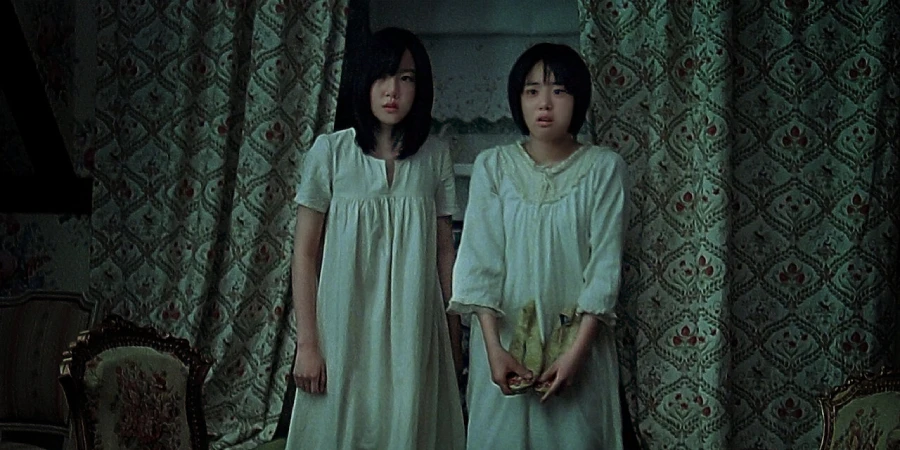
Kim Jee-woon shoots the house itself as a character. Its deep reds, moss greens, and lacquered wood surfaces feel beautiful and suffocating at once. Every hallway seems slightly too long.
Tension Builds in the House
Eun-joo singles out Su-yeon for cruelty, locking her in a wardrobe and physically intimidating her. Su-mi fights back against the stepmother with bristling hostility. Their father watches passively, refusing to intervene, which is arguably the film’s most quietly damning character detail.
A dinner party scene introduces neighbors whose visit goes grotesquely wrong. One of the women suffers a violent convulsion, clawing at something beneath the kitchen sink. She screams that something grabbed her arm. No one else sees anything.
The Ghost Under the Sink
Su-mi begins to sense something in the house beyond Eun-joo’s cruelty. A figure appears in her bedroom at night, pale, hair falling across its face. Su-mi also hears sounds from a wardrobe and finds blood seeping from beneath it.
Su-yeon grows more withdrawn. Her fragility feels physical, the way she flinches, the way she barely speaks. The film frames her as a victim trapped between a hostile stepmother and a house that seems genuinely haunted.
The Stepmother’s Violence
Eun-joo’s behavior crosses into something uglier. Su-mi confronts her father directly, accusing him of ignoring the abuse. He deflects. Su-mi demands he choose between them and Eun-joo, and he refuses to engage.
Su-yeon’s condition deteriorates. She appears more ghost-like herself, barely present at the dinner table, flinching at shadows. Su-mi’s protectiveness intensifies into something almost fierce.
The Wardrobe and the Truth
Su-mi finds Su-yeon’s lifeless body, apparently stuffed into the wardrobe, apparently killed by Eun-joo’s negligence during an earlier incident. This moment hits like a wall. Then the film pulls the rug entirely.
Su-yeon has been dead the whole time. Su-mi’s mind has been generating her sister’s presence as a coping mechanism. There is only one girl in this house, not two. Everything we have watched Su-mi interact with as Su-yeon was a dissociative construction.
Su-mi’s Second Personality
Here is where the architecture of the film reveals itself. Su-mi has been cycling between her own identity and a second personality modeled on Eun-joo. When “Eun-joo” appeared abusive toward Su-yeon, it was Su-mi in an altered state, acting out her own rage and guilt.
Their real stepmother, the actual Eun-joo, is a fragile, frightened woman who found Su-yeon trapped under a heavy wardrobe during a prior accident and failed to act in time to save her. Su-mi cannot absorb this truth, so her mind has rewritten Eun-joo as a monster.
What Really Happened
The backstory arrives in fragments. Su-mi and Su-yeon’s biological mother was mentally ill. She hanged herself, and when she fell, she brought a wardrobe down on top of Su-yeon. Su-yeon could not free herself. Eun-joo arrived, saw the scene, and froze. She did not help. Su-yeon died beneath the wardrobe.
Eun-joo’s passivity killed Su-yeon as surely as any active violence would have. Su-mi, who was not present in time to save her sister, has carried that guilt and turned it inward, then outward, in a full psychotic break.

Movie Ending
Su-mi’s grip on her constructed reality collapses completely in the final act. She returns to the psychiatric ward, and the film circles back to where it opened. That girl staring at nothing is Su-mi, sitting with the full weight of what happened.
Back at the house, the actual Eun-joo is alone, and the film makes clear that the ghost haunting the property is real, not a projection of Su-mi’s mind. Su-yeon’s spirit is still there. Eun-joo sees it. The ghost does not forgive her.
Eun-joo’s final scene is the most unsettling payoff in the film. She sits in the house, wrecked and terrified, confronted by the supernatural consequence of her cowardice. Kim Jee-woon frames it with muted colors and a stillness that feels worse than any jump scare. Su-yeon’s ghost does not rage; it simply appears, and Eun-joo shatters.
What makes the ending land so hard is that it refuses comfort on every level. Su-mi is institutionalized. Their father is absent in any meaningful sense. Eun-joo is left haunted by a guilt she can never undo. Nobody recovers. Nobody gets a clean slate. Grief in this film does not resolve; it just takes different shapes.
Are There Post-Credits Scenes?
No. A Tale of Two Sisters has no post-credits scene. Once the credits roll, the film is done with you. Given how heavy the ending lands, that silence feels appropriate.
Type of Movie
A Tale of Two Sisters is a psychological horror film with strong elements of Gothic drama and family tragedy. Its horror is almost entirely psychological and atmospheric rather than gore-driven. Think slow dread, unreliable narration, and emotional devastation over cheap scares.
Tonally, it sits closer to grief study than genre exercise. The supernatural elements are real within the film’s logic, but they serve emotional and thematic functions rather than existing for pure fright.
Cast
- Im Soo-jung – Su-mi
- Moon Geun-young – Su-yeon
- Yum Jung-ah – Eun-joo
- Kim Kap-su – Moo-hyeon (the father)
Film Music and Composer
Lee Byung-woo composed the score. His work here is one of the most underrated elements of the film. He uses sparse piano lines and low string drones to keep the audience in a state of low-level unease without ever announcing itself as “horror music.”
A recurring piano motif threads through Su-mi’s quieter scenes and returns in slightly distorted form when her reality fractures. It is a subtle structural choice that rewards attention.


Filming Locations
The film shot primarily at a single location: a house in the Gapyeong area of South Korea, near a lake. Kim Jee-woon had the house purpose-built for the production, which explains how completely it functions as a character.
Every room has a slightly different color palette, and the contrast between the warm, lacquered interiors and the cold grey lake outside creates a visual tension that mirrors Su-mi’s fractured psychology. You feel enclosed even when the film cuts to water and sky.
Awards and Nominations
A Tale of Two Sisters performed well at the Grand Bell Awards in South Korea, where it received nominations including recognition for Yum Jung-ah’s performance. It became a significant commercial and critical success in South Korea and gained international attention on the festival circuit.
Behind the Scenes Insights
- Kim Jee-woon has cited his desire to make a film rooted in emotional trauma rather than conventional horror plotting as the core motivation for the project.
- Yum Jung-ah prepared extensively for her dual-nature role, as she needed to carry both the monster version and the broken real-world version of Eun-joo without tipping audiences off.
- The house set was constructed specifically for the film and designed so that every room could be shot from multiple angles without breaking the sense of spatial confinement.
- Moon Geun-young shot her later scenes with minimal direction on certain physical details, allowing her to make Su-yeon’s ghostly quality feel organic rather than performed.
- Kim Jee-woon reportedly screened classic European art horror for his crew during pre-production to establish the film’s visual grammar.
Inspirations and References
Kim Jee-woon drew from a Korean folk tale called Janghwa Hongryeon jeon, which translates loosely as The Story of Janghwa and Hongryeon. This Joseon-era tale involves two sisters, a cruel stepmother, and supernatural revenge following unjust deaths. Su-mi and Su-yeon’s names directly echo the sisters in that original story.
The film also draws from a tradition of Gothic family horror, where the domestic space becomes the site of psychological and supernatural collapse. Roman Polanski’s work, particularly Repulsion, is a plausible reference point for how Kim uses confined spaces to externalize a character’s mental state.
Alternate Endings and Deleted Scenes
No officially confirmed alternate ending or significant body of deleted scenes has been made public for A Tale of Two Sisters. Kim Jee-woon has not released a director’s cut with substantially different content.
Given how precisely the film’s structure was engineered, it is hard to imagine a substantially different ending that would serve the story. The circular return to the institution is structurally necessary.
Book Adaptations and Differences
A Tale of Two Sisters is not based on a book. It draws from the Korean folk tale Janghwa Hongryeon jeon, but that source is a traditional story, not a novelization. Kim Jee-woon wrote the screenplay himself, adapting the folk tale’s emotional skeleton into an entirely original psychological structure.
An American remake titled The Uninvited was released in 2009. It softens and simplifies the psychological complexity considerably, and it is not worth your time if you have already seen the original.


Memorable Scenes and Quotes
Key Scenes
- The dinner party convulsion: a neighbor claws at her arm, screaming about something grabbing her beneath the kitchen sink, while the rest of the table watches in horror. The camera stays wide, letting the chaos unfold without cutting away.
- The wardrobe reveal: blood seeping beneath a closed wardrobe door, Su-mi approaching slowly, the sound design dropping to almost nothing before the discovery hits.
- Su-mi cycling into the Eun-joo personality: a scene where she stands at the kitchen sink, her reflection slightly wrong, her posture shifting into someone else’s. It is the clearest visual signal that there are not two women in this conflict.
- The ghost confronting Eun-joo in the final act: Su-yeon appearing without fanfare, hair wet, moving with that specific stillness that Korean horror does so well. Eun-joo’s breakdown feels genuinely pitiful rather than satisfying.
- Su-mi and Su-yeon lying together in bed early in the film: warm, tender, shot in amber light. Knowing what we know by the end, this scene becomes devastating in retrospect.
Iconic Quotes
- “There’s something I want to ask you. But I’m afraid you’ll be shocked.” Su-mi to her father, a line that carries more weight once you understand what she actually knows and cannot say.
- “A girl who can’t even take care of herself.” Eun-joo’s dismissal of Su-yeon, which in the film’s full context becomes one of the most tragic lines in the script.
Easter Eggs and Hidden Details
- Su-mi and Su-yeon’s names are phonetic echoes of the sisters in the source folk tale, Janghwa (Rose) and Hongryeon (Lotus), maintaining the floral, paired symbolism.
- Early scenes show Su-mi occasionally pausing mid-sentence, as if her train of thought broke. On rewatch, these pauses mark the moments her personality is fragmenting.
- The wardrobe appears in multiple scenes before it becomes plot-relevant, always framed slightly off-center, drawing the eye without explanation.
- Eun-joo’s clothing in the “monster” version Su-mi imagines is consistently darker and more formal than what the real Eun-joo wears, a visual code for which version of the character we are watching.
- Su-yeon is almost never shown eating. On first watch this reads as withdrawal; on second watch, it is a clue that she is not physically present in the way living people are.
- A painting on the wall of the house depicts two women near water, an early nod to the film’s folk tale roots that most viewers miss on first viewing.
Trivia
- A Tale of Two Sisters was the first Korean horror film to receive a wide theatrical release in the United States.
- The American remake The Uninvited (2009) was directed by the Guard Brothers and starred Emily Browning and Elizabeth Banks.
- Kim Jee-woon wrote the screenplay over several years, treating the psychological structure as a puzzle that needed to be solved before photography could begin.
- Im Soo-jung had to convey two distinct psychological states in the same body across the film, a performance challenge she has described as physically exhausting.
- The folk tale Janghwa Hongryeon jeon has been adapted for Korean film and television multiple times across the twentieth century; Kim Jee-woon’s version is the most internationally recognized.
- Despite its complex narrative structure, the film was a significant box office success in South Korea upon release.
Why Watch?
Im Soo-jung carries this film on her back, playing a character whose grief has eaten her sense of self entirely, and she does it without a single moment of visible calculation. Kim Jee-woon builds his horror out of a family’s specific, localized pain rather than generic supernatural machinery, which makes every scare feel personal rather than decorative. If you want proof that psychological horror can hit harder than anything with gore, this film delivers it scene by scene.
Director’s Other Movies
- The Foul King (2000)
- A Bittersweet Life (2005)
- The Good, the Bad, the Weird (2008)
- I Saw the Devil (2010)
- The Last Stand (2013)
- Age of Shadows (2016)
Recommended Films for Fans
- Oldboy (2003)
- The Wailing (2016)
- Repulsion (1965)
- The Others (2001)
- Hereditary (2018)
- Audition (1999)
- Suspiria (1977)
- Black Swan (2010)