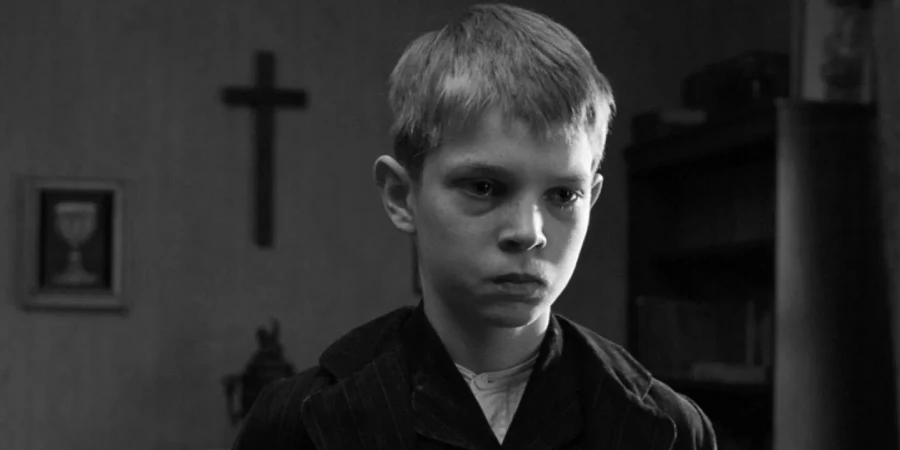

Michael Haneke shot The White Ribbon in razor-sharp black and white, and that visual choice tells you everything about his intentions before a single character opens their mouth. This is a film about a village that looks clean, orderly, and God-fearing, while something genuinely monstrous festers beneath every whitewashed surface.
Set in a small German Protestant village on the eve of World War One, it asks a question that still has no comfortable answer: where does evil come from, and who teaches children to become its future agents?
Detailed Summary
The Village and Its Tensions
A nameless narrator, now an old man, recounts events from his youth in the fictional village of Eichwald, sometime around 1913 and 1914. He was the local schoolteacher at the time, and he frames the story with careful, measured distance. His retrospective voice creates an unsettling gap between what he observed and what he could never quite prove.
Eichwald is rigidly hierarchical. A Baron owns the land. A Pastor rules spiritual life with an iron theological hand. A Doctor holds medical authority. Farmers and peasants occupy the lowest rungs, and everyone knows their place. On the surface, it functions. Underneath, it corrodes.
The First Incident: The Doctor’s Wire
A trip wire strung between two trees sends the village Doctor crashing from his horse. His injuries are serious. Nobody claims responsibility. Nobody saw anything. The deliberate placement of the wire signals that this is not an accident, and Haneke gives us no villain to point at, just a community suddenly aware that violence has entered its geometry.
The Steward’s Son and the Cabbage Field
A farmer’s wife falls through a rotted floor in the Baron’s property and dies. Her son, Karli, and her oldest boy, Rudi, harbor visible rage toward the Baron and his estate. The grief is raw, the injustice obvious, and the social power structure ensures nothing will be done about it. Haneke frames this as the film’s first explicit study in powerlessness and its consequences.
The Pastor and His Children
Among the film’s most disturbing figures is the Pastor, played by Burghart Klaussner with chilling propriety. He punishes his children, Klara and Martin, for minor infractions with ritualistic severity. He ties a white ribbon around their arms as a reminder of purity and innocence they must strive to maintain. His eldest son Martin secretly mutilates himself. Klara kills the Pastor’s prized bird with a pair of scissors. These are not small details; they are a portrait of psychological violence reproducing itself.
The Baron’s Son Attacked
The Baron’s young son is abducted, beaten, and left tied to a sawmill in a degrading position, with wounds clearly inflicted with a cane. He survives but is traumatized. No perpetrator surfaces. Suspicion spreads through the village like fog, touching nearly every household. Haneke refuses to provide a detective’s tidy solution, which is precisely the point.
The Doctor and the Midwife
One of the film’s most quietly horrifying subplots involves the Doctor and his widowed midwife, Eva. He conducts a sexual relationship with her and speaks to her with contempt that curdles into outright cruelty. When he leaves for a period, he tells her things about herself that no person should say to another. This subplot does not connect directly to the central mystery, but it deepens the film’s argument that domination and humiliation are the village’s true operating system.
Feige, the Disabled Boy
Feige, the mentally disabled son of the midwife, is found tied to a high platform in the forest, his eyes nearly destroyed. He has clearly been attacked with deliberate intention. A note near him suggests the perpetrators wanted to make him “see,” referencing a biblical passage about blindness and sin. This attack carries a theological malice that points toward children who have absorbed their parents’ religious vocabulary and weaponized it.
The Schoolteacher and Eva
Amidst the accumulating horror, the young schoolteacher pursues a gentle courtship with Eva, the midwife’s daughter. Their relationship is one of the film’s few genuinely warm threads, though even it sits inside an awkward power structure given their age difference. Haneke uses their courtship to remind viewers that ordinary life presses on alongside atrocity, which is one of the film’s most unsettling formal arguments.
The Pastor’s Infant Son
The Pastor’s youngest child, Willi, is discovered at the top of a tall sawmill structure in a state of clear danger. Nothing conclusively identifies who placed him there. Willi is unharmed, but the implication is overwhelming: someone among the village children arranged this as a message or a warning. Haneke keeps the camera cold and observational throughout, never editorializing with music or close-up reaction shots.
The Schoolteacher’s Suspicion
After gathering enough circumstantial evidence, the schoolteacher concludes that the Pastor’s children, and possibly other children from the village’s most religiously strict households, are responsible for the string of violent incidents. He confronts the Pastor directly. The Pastor dismisses him without engaging the substance of the accusation, and the scene ends with no resolution, no confession, no vindication.
Movie Ending
Archduke Franz Ferdinand is assassinated. Word reaches Eichwald, and the village prepares to observe a solemn church service. The schoolteacher, still holding his suspicion about the children, decides to go to the local authorities before the service takes place.
He never gets the chance. Before he can act, he is transferred out of the village. The war arrives, and its arrival functions as a collective erasure: every unresolved crime, every unanswered question, every broken child gets swallowed by the vastness of what comes next. No arrest happens. No confession surfaces. No authority figure investigates seriously.
The narrator, speaking from decades later, admits he cannot confirm his suspicions. He acknowledges the possibility that he was wrong. Haneke builds this ambiguity into the film’s structure deliberately, and it is the single most intellectually honest choice in a film full of them. A neat resolution would betray everything The White Ribbon is arguing.
What the film leaves behind is a generation of children raised under authoritarian religious repression, public shaming, and institutionalized cruelty, stepping directly into a century that will need exactly that psychological profile in enormous numbers. Haneke does not spell this out. He trusts you to feel the arithmetic.
That final church scene, with the children sitting in pews, faces blank and luminous in Haneke’s high-contrast black and white, is the closest thing to a thesis statement the film offers. They look innocent. That is the horror.
Are There Post-Credits Scenes?
There are no post-credits scenes. The White Ribbon ends and offers you silence, which is exactly what it deserves.
Type of Movie
The White Ribbon is a period mystery drama, though calling it a mystery undersells how thoroughly Haneke subverts that genre’s expectations. It operates more accurately as a sociological horror film, one that locates dread not in the supernatural but in human institutions, specifically the family, the church, and the class structure.
Tone throughout is austere, deliberate, and deeply uncomfortable. Haneke never scores a scene for emotional effect. He withholds catharsis as a conscious artistic strategy, and it works better here than in almost any of his other films.
Cast
- Christian Friedel – The Schoolteacher (narrator as a young man)
- Ernst Jacobi – The Schoolteacher (narrator as an old man, voice)
- Burghart Klaussner – The Pastor
- Ulrich Tukur – The Baron
- Josef Bierbichler – The Steward
- Maria-Victoria Dragus – Klara, the Pastor’s daughter
- Leonie Benesch – Eva, the midwife’s daughter
- Rainer Bock – The Doctor
- Susanne Lothar – The Midwife
- Roxane Duran – Anna
- Enno Trebs – Georg, the Baron’s tutor
Film Music and Composer
The White Ribbon uses virtually no original score. Haneke made the deliberate choice to strip away underscore almost entirely, relying instead on diegetic sound: church organ, a recorder played by a child, ambient village noise. This absence of manipulative music is one of the film’s most rigorous formal decisions.
Where music appears, it arrives from within the world of the film itself. A child practicing an instrument, hymns sung in church. Haneke refuses to tell audiences how to feel, so he removes the emotional cue that cinema most often exploits to do exactly that.

Filming Locations
Principal photography took place in Germany and Romania, primarily in rural villages that retained authentic period architecture from the early twentieth century. Romanian locations provided the kind of untouched agricultural landscape that German locations no longer offered in sufficient quantity.
Cinematographer Christian Berger shot the film in color and converted it to black and white in post-production, a technical choice that gave Haneke far greater control over contrast, shadow depth, and the luminosity of skin tones than traditional black and white film stock would have allowed. The result looks both historically plausible and slightly unreal, which matches the film’s psychological register exactly.
The physical spaces matter enormously. Cramped farmhouses, a severe church interior, wide flat fields with nowhere to hide: the geography communicates the suffocation of village life without a single line of dialogue.
Awards and Nominations
The White Ribbon won the Palme d’Or at the 2009 Cannes Film Festival, which remains one of the most deserved wins of that decade. It received Academy Award nominations for Best Foreign Language Film and Best Cinematography, and won the Golden Globe for Best Foreign Language Film.
Christian Berger’s cinematography received widespread critical recognition, and the film swept numerous European film awards including prizes from the European Film Academy.
Behind the Scenes Insights
- Haneke spent years developing the project and conducted extensive historical research into pre-war German Protestant village life before writing the screenplay.
- Casting the child actors required an unusually long process. Haneke needed children who could project blankness, not performed innocence, and he auditioned hundreds of candidates across Germany and Austria.
- Maria-Victoria Dragus, who plays Klara, was making her feature film debut. Her performance, which communicates repressed violence through posture and eye contact rather than dialogue, is one of the film’s genuinely unsettling achievements.
- Haneke reportedly kept child actors separated from scenes of violence or distressing content during production, working carefully with their guardians throughout.
- Christian Berger developed a specific post-production workflow to achieve the precise black and white rendering Haneke wanted, calibrating contrast values scene by scene rather than applying a single blanket conversion.
- The film was a German, Austrian, French, and Italian co-production, which allowed Haneke the budget and creative freedom to shoot across multiple countries.
Inspirations and References
Haneke has cited the historical reality of authoritarian child-rearing practices in early twentieth century Protestant Germany as a primary source. Scholars such as Alice Miller, whose work examined the psychological damage inflicted by rigid disciplinary systems on children, informed his thinking about how fascism finds its foot soldiers not on battlefields but in nurseries.
The film engages directly with a documented strand of German pedagogy from the period: the belief that children must have their will broken early to become morally upright adults. Books promoting this philosophy circulated widely in Wilhelmine Germany, and Haneke frames the village as a microcosm of that ideology in action.
Haneke has also spoken about the film as a meditation on the origins of politically motivated violence in general, not exclusively German fascism. He resists any reading that treats it purely as a historical allegory, preferring it to function as an open structure that implicates many societies and many eras.
Alternate Endings and Deleted Scenes
No alternate endings or significant deleted scenes from The White Ribbon have been made public. Haneke is known for treating his final cuts as definitive statements, and he has not released extended versions or alternative cuts of this film.
Given how precisely constructed the film’s ambiguity is, an alternate ending would almost certainly undermine its central argument. A resolved version, one where the guilty children are exposed and punished, would be a fundamentally different and far lesser film.
Book Adaptations and Differences
The White Ribbon is an original screenplay written by Michael Haneke. It is not based on a novel or existing literary source. A novelization was published alongside the film’s release, but the screenplay came first.

Memorable Scenes and Quotes
Key Scenes
- The wire across the path: A clean, quiet shot of a country lane. The Doctor rides confidently into frame. His horse trips. He falls hard. Haneke cuts without lingering, denying the viewer any cathartic horror beat.
- The Pastor ties the ribbon: Klara and Martin stand before their father while he winds the white ribbon around their arms with methodical calm. He speaks about purity. His voice never raises. The ribbon looks tight enough to hurt.
- The schoolteacher confronts the Pastor: Christian Friedel sits across from Burghart Klaussner, lays out his case carefully, and watches it dissolve against the Pastor’s impenetrable social authority. Klaussner barely blinks. It is the film’s most precise portrait of how institutions protect themselves.
- Feige discovered at the platform: A long shot of the forest structure, then a slow approach. What has been done to Feige’s eyes registers in the reaction of the adults who find him rather than in any graphic close-up. Haneke uses restraint here to make the horror worse, not better.
- The final church scene: Children in pews. White collars. Still faces. The camera moves across them slowly. No score plays. You understand that these are the people who will grow up to serve the coming century faithfully.
Iconic Quotes
- “I don’t know if the story I want to tell you is entirely true. Some of it I only know from hearsay… but I think it must be told.” (The Narrator, opening the film)
- “The white ribbon should be a symbol of purity and innocence, which you children seem to have forgotten.” (The Pastor, to his children)
- “Why are you telling me this? You have no proof.” (The Pastor, dismissing the schoolteacher)
Easter Eggs and Hidden Details
- The white ribbons the Pastor forces his children to wear mirror actual disciplinary customs documented in certain strict Protestant households of the era, giving the film’s most symbolic image a grounding in historical fact.
- Haneke frames the Doctor’s house consistently with more visual depth and shadow than the Pastor’s house, which he lights with flat, cold clarity. The visual grammar quietly suggests that darkness can inhabit brightness just as comfortably as shadow.
- The sawmill appears in multiple incidents across the film. Haneke uses it as a recurring spatial motif, a place where the village’s industrial machinery and its violence share the same geography.
- The old narrator’s voice occasionally hesitates or qualifies his statements with phrases like “I believe” or “as far as I could tell.” Haneke embeds the film’s central epistemological argument directly into the grammatical texture of the narration.
- Several of the children who appear as background figures in crowd scenes are given no dialogue or named role, yet Haneke consistently frames them in the foreground of shots where violent incidents are being discussed by adults. Their placement is compositionally deliberate.
Trivia
- The White Ribbon runs approximately two hours and twenty-four minutes, making it one of Haneke’s longest films.
- Haneke was in his late sixties when the film was released, and he has described it as the project he spent the longest time preparing of any in his career.
- Christian Friedel, who plays the young schoolteacher, went on to appear in Amon Göth and other significant European productions, building a career partly on the reputation this film gave him.
- The film’s German title is Das weiße Band, with the subtitle Eine deutsche Kindergeschichte, which translates roughly as “A German Children’s Story.” That subtitle, stripped from most international releases, sharpens the film’s historical specificity considerably.
- Haneke shot the film in Germany and Romania but deliberately avoided any location that had visible modern infrastructure, requiring significant production effort to maintain period authenticity.
- Despite its austere style and nearly two and a half hour runtime, the film performed strongly in art house markets across Europe and North America.
- Burghart Klaussner, who plays the Pastor, researched historical Protestant preaching styles and body language extensively to prepare for the role.
Why Watch?
Haneke frames collective evil not as ideology but as domestic habit, and watching him construct that argument through children’s faces and church interiors rather than political speeches is genuinely arresting. Burghart Klaussner’s Pastor is the film’s most frightening character precisely because he believes every word he says. If you want to understand how ordinary, God-fearing people enable atrocity, this film makes that case with more intellectual rigor than most history books manage.
Director’s Other Movies
- The Seventh Continent (1989)
- Benny’s Video (1992)
- 71 Fragments of a Chronology of Chance (1994)
- Funny Games (1997)
- Code Unknown (2000)
- The Piano Teacher (2001)
- Time of the Wolf (2003)
- Cache (2005)
- Funny Games (2007)
- Amour (2012)
- Happy End (2017)
Recommended Films for Fans
- Au revoir les enfants (1987)
- Cache (2005)
- Ida (2013)
- Son of Saul (2015)
- Funny Games (1997)
- The Tin Drum (1979)
- Dogville (2003)
- A Separation (2011)
- The Zone of Interest (2023)