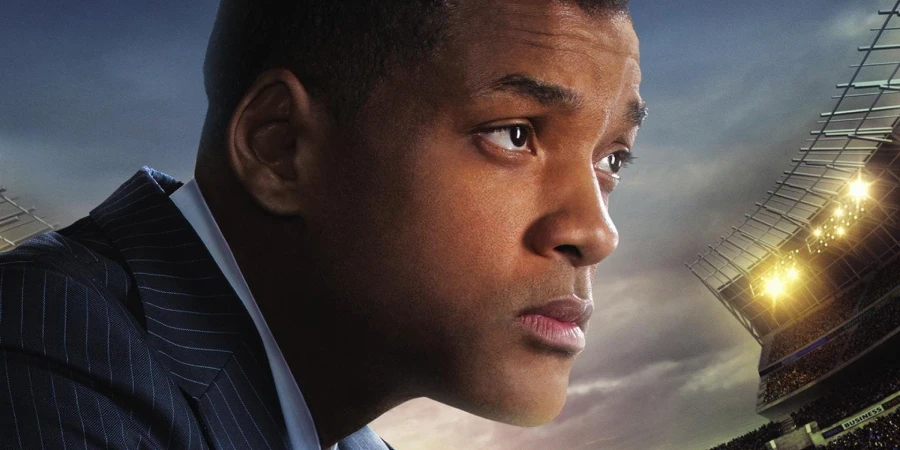

Will Smith once said he almost turned down the role that would earn him his first Oscar nomination in years, and after watching Concussion, that decision seems almost criminal. This 2015 drama tells the true story of Dr. Bennet Omalu, a Nigerian-born forensic pathologist who took on the NFL and changed how the world understands brain trauma in athletes. Director Peter Landesman crafts a film that feels less like a sports movie and more like a medical thriller with a conscience.
Detailed Summary
Introducing Dr. Bennet Omalu
We meet Dr. Bennet Omalu working as a forensic pathologist in Pittsburgh’s medical examiner’s office. He is meticulous, deeply religious, and socially unconventional. His colleagues find him quirky; his boss, Dr. Cyril Wecht, finds him invaluable.
Omalu narrates his own life story at the start, describing himself as someone who speaks to the dead and gives them a voice. This framing device immediately establishes the film’s thematic core: the moral obligation to tell the truth, no matter the cost. It also signals that this is a deeply personal story, not just a procedural one.
Mike Webster and the Autopsy That Changed Everything
In 2002, legendary Pittsburgh Steelers center Mike Webster dies alone, broken, and homeless. His death shocks the city, but the official cause seems straightforward to most. Omalu, however, refuses to accept a surface-level explanation.
Omalu performs Webster’s autopsy and notices something troubling. Webster’s brain looks normal on the surface, yet the man spent his final years in severe mental decline, pulling out his own teeth and gluing them back in. Consequently, Omalu invests his own money to run additional tests on brain tissue samples.
What he finds rewrites medical history. He discovers a buildup of tau protein throughout Webster’s brain, a condition caused by repeated traumatic impacts. He names it Chronic Traumatic Encephalopathy, or CTE.
Publishing the Findings and Early Resistance
Omalu publishes his findings in the journal Neurosurgery, expecting scientific dialogue. Instead, the NFL responds by demanding the paper be retracted. Their medical committee dismisses his work and attacks his credentials publicly.
This institutional pushback shakes Omalu but does not silence him. He finds an unlikely ally in Dr. Julian Bailes, a former NFL team physician who has grown uneasy about the league’s handling of player health. Their partnership adds credibility and momentum to Omalu’s cause.
Personal Life and Arrival of Prema
Meanwhile, Omalu’s personal world brightens. A fellow Nigerian immigrant named Prema Mutiso moves into his home as a boarder, and the two fall in love. Their relationship gives the film its emotional warmth and grounds Omalu’s crusade in human stakes rather than pure ideology.
Prema becomes pregnant, which raises the personal danger of Omalu’s public battle to a new level. He is no longer fighting just for science; he is fighting for his family’s future in America.
More Deaths, More Evidence
A second former NFL player, Terry Long, dies by suicide. Omalu performs the autopsy and again finds CTE. Then Andre Waters, another former player, also dies by suicide. Each case strengthens Omalu’s evidence and deepens his conviction.
However, each new finding also intensifies the NFL’s efforts to discredit him. The league wielded enormous political and financial influence throughout this period, and Omalu began to feel its weight pressing down on every aspect of his professional life.
Threats, Intimidation, and Personal Tragedy
Federal agents visit Omalu’s home under the pretense of unrelated matters, suggesting surveillance and intimidation. His mentor, Dr. Wecht, faces federal indictment on corruption charges, a development the film implies may be partly connected to the political pressure surrounding the CTE story.
Prema suffers a miscarriage, which Omalu interprets as a direct consequence of the stress the NFL battle has placed on his family. This moment is the film’s emotional low point, and Smith plays it with raw, quiet devastation.
The Decision to Leave Pittsburgh
Omalu and Prema decide they cannot stay in Pittsburgh, a city where the Steelers are practically a religion. He accepts a position as chief medical examiner in San Joaquin County, California. The move represents both retreat and survival.
Yet Omalu does not abandon the fight. He continues to advocate for CTE research and player safety from his new position, determined to ensure his findings reach the public no matter where he lives.

Movie Ending
As public awareness of CTE grows, the NFL faces mounting pressure from Congress, the media, and former players’ families. Omalu testifies and continues to speak publicly, and the league’s wall of denial begins to crack. For the first time, the organization acknowledges a link between football and brain disease, a concession that felt almost unthinkable when Omalu first published his work.
The film closes with text cards explaining the real outcomes. Omalu became a United States citizen, a moment the film presents with genuine emotional weight given everything he sacrificed for his adopted country. Moreover, the NFL eventually established a fund to compensate former players suffering from CTE-related conditions.
Prema gives birth to a healthy daughter. This quiet domestic detail carries enormous symbolic force: Omalu’s perseverance ultimately produced something lasting and life-affirming. On the other hand, the film is careful not to oversell victory; the text cards note that the NFL continued to dispute aspects of the research even as it paid out settlements.
The final image is of Omalu jogging through a California landscape, alive and free. It is a deliberately modest ending for a man who took on one of the most powerful sports organizations in the world. The film wants you to sit with the ambiguity: he won, but the game goes on.
Are There Post-Credits Scenes?
Concussion contains no post-credits scenes. Once the closing text cards finish, the film is done. You can safely leave the theater or stop the stream without missing anything additional.
Type of Movie
Concussion is a biographical drama with strong elements of a medical thriller and institutional conspiracy narrative. Its tone is serious and measured throughout, favoring quiet tension over loud confrontation. This is not an action film; it is a film about moral courage in an unglamorous setting.
In contrast to typical sports dramas, this film spends almost no time celebrating athletic achievement. Football exists in the background as a looming, destructive force rather than a source of inspiration. That inversion gives the film its distinctive, unsettling energy.
Cast
- Will Smith – Dr. Bennet Omalu
- Alec Baldwin – Dr. Julian Bailes
- Albert Brooks – Dr. Cyril Wecht
- Gugu Mbatha-Raw – Prema Mutiso
- David Morse – Mike Webster
- Arliss Howard – Dr. Joseph Maroon
- Paul Reiser – Dr. Steven DeKosky
- Luke Wilson – Roger Goodell
- Adewale Akinnuoye-Agbaje – John Mutu
Film Music and Composer
James Newton Howard composed the score for Concussion. His work here is restrained and purposeful, favoring piano-driven melodies and sparse orchestration over dramatic swells. The music supports the film’s cerebral, low-key tone without overwhelming it.
Howard is one of Hollywood’s most respected composers, with credits spanning across decades and genres. His score for Concussion reflects his ability to serve the story quietly, letting the emotional weight of the narrative do most of the heavy lifting.


Filming Locations
Concussion was primarily filmed in Pittsburgh, Pennsylvania, which is both the real-life setting of the story and a visually compelling backdrop. The city’s industrial character and its deep cultural identity with football reinforce the film’s central tension. Shooting on location gave the production an authenticity that a studio recreation could not have matched.
Some additional scenes were filmed in other parts of Pennsylvania and in California, corresponding to the later sections of the story when Omalu relocates. Furthermore, the production’s use of real Pittsburgh landmarks grounds the story in a specific, recognizable world rather than a generic American city.
Awards and Nominations
Will Smith received a Golden Globe nomination for Best Actor in a Drama for his performance. The film also received attention from various critics’ circles, though it did not secure major wins at the top award ceremonies.
Behind the Scenes Insights
- Will Smith met with the real Dr. Bennet Omalu extensively to prepare for the role, studying his mannerisms, accent, and philosophical outlook.
- Director Peter Landesman had previously written a long-form investigative article for GQ magazine on the CTE story, which served as a foundation for the screenplay.
- Gugu Mbatha-Raw learned details about Nigerian immigrant culture and worked closely with the production to portray Prema authentically.
- The NFL reportedly declined to cooperate with the production, which the filmmakers acknowledged affected certain aspects of depicting league operations.
- Will Smith reportedly immersed himself deeply in the role, to the point where cast members noted he rarely broke character on set.
- David Morse, who plays Mike Webster, physically transformed for the role, losing significant weight to portray Webster’s deteriorated final state.
Inspirations and References
Concussion draws directly from the real life of Dr. Bennet Omalu and the documented history of CTE research. Peter Landesman’s own investigative journalism on the subject shaped much of the screenplay’s structure and specific details.
The film also references the broader cultural history of the NFL’s handling of player health, drawing on congressional testimony, published scientific papers, and reporting by journalists who covered the CTE controversy. In addition, the character of Omalu as an immigrant outsider holding America accountable to its own ideals carries echoes of classic immigrant narrative traditions in American literature and film.
Alternate Endings and Deleted Scenes
No officially confirmed alternate endings or significant deleted scenes from Concussion have been widely documented or released. The home video release does not appear to include notable cut content. As a result, this is one of those productions where the theatrical cut appears to be the definitive and only widely available version.
Book Adaptations and Differences
Concussion is not based on a book. It draws from Landesman’s journalism and from documented real-world events. However, the real Bennet Omalu later wrote and published work about his experiences, including a book titled Truth Doesn’t Have a Side, which came after the film’s release and offers his own perspective on how accurately his story was portrayed.
Omalu himself noted that some of the film’s dramatic details were composites or simplifications. Specifically, the timeline of certain events and some interpersonal dynamics were adjusted for narrative clarity and pacing.


Memorable Scenes and Quotes
Key Scenes
- Omalu performs Mike Webster’s autopsy and begins to realize something far deeper is wrong, setting the entire story in motion.
- Omalu sits alone in his lab, talking to Webster’s brain tissue samples as if having a conversation with the dead man, a scene that perfectly illustrates his character.
- Dr. Wecht reads Omalu’s CTE findings for the first time and reacts with stunned recognition of how significant the discovery truly is.
- Omalu tells Prema about the NFL’s retaliation and admits he is frightened, stripping away his composed exterior for the first and most affecting time.
- The miscarriage scene, shot with deliberate quietness, hits harder than any loud confrontation in the film.
- Omalu takes his oath of American citizenship in the final act, a moment that lands with full emotional force given everything he has endured.
Iconic Quotes
- “I studied in America, I trained in America, I became a doctor in America. This is my America too.” – Dr. Bennet Omalu
- “Tell the truth. Tell the truth. Tell the truth.” – Dr. Bennet Omalu
- “You’re going to war with a corporation that has 20 million people on a weekly basis who need their product as much as they need oxygen.” – Dr. Julian Bailes
- “God did not intend for us to play football.” – Dr. Bennet Omalu
Easter Eggs and Hidden Details
- Several background details in Omalu’s office reference real published scientific papers on brain trauma, adding documentary texture to the set design.
- Omalu’s habit of narrating his own story directly to camera subtly mirrors the way he narrates his autopsy findings, linking his personal and professional voices.
- The film uses Pittsburgh’s iconic bridges repeatedly as visual motifs, perhaps suggesting the connections Omalu tries to build between science, institutions, and human lives.
- Attentive viewers will notice that the NFL is almost never shown in close-up; league officials are frequently framed from a distance or partially obscured, a visual choice that emphasizes institutional opacity.
- Mike Webster’s belongings, shown during the autopsy intake, include items that correspond to documented real-world reports about his final years living in his truck.
Trivia
- The real Dr. Bennet Omalu holds multiple advanced degrees in medicine and public health, a detail the film references but does not fully enumerate.
- Will Smith adopted a Nigerian accent for the role, working with a dialect coach to make the performance as authentic as possible.
- Peter Landesman had never directed a major feature film before Concussion; his background was in investigative journalism and writing.
- The film was produced by Ridley Scott and his company, Scott Free Productions, adding significant production muscle to the project.
- Sony Pictures released the film on Christmas Day 2015, a slot typically reserved for awards-season prestige productions.
- Some former NFL players and their families publicly praised the film for bringing mainstream attention to the CTE crisis.
- The league’s settlement with thousands of former players over brain injuries was finalized around the same time the film was in production, giving the story an unusual current-events urgency.
Why Watch?
Will Smith delivers one of his most restrained and genuinely moving performances, and the film’s subject remains urgently relevant. Concussion works both as a gripping procedural and as a meditation on integrity, immigration, and institutional power. For anyone who cares about truth-telling in science or storytelling, this film earns its time.
Director’s Other Movies
- Trade (2007)
- Parkland (2013)