
The Freshman (1990) pulls off something genuinely audacious: it convinces Marlon Brando to essentially parody his own iconic role from The Godfather, and the result is one of the sharpest, most self-aware comedies of its era. Andrew Bergman’s film wraps a smart satire of organized crime, academia, and American excess inside a warmly absurdist story. It never announces how clever it is, which makes it even cleverer.
Detailed Summary
Clark Kellogg Arrives in New York
Clark Kellogg, a wide-eyed film student from Vermont, arrives in New York City to attend New York University’s film school. Within minutes of stepping off the bus, a fast-talking schemer named Steve Bushak steals his bags, luggage, and nearly every dollar he owns.
Clark, desperate and broke, tracks Steve down. Instead of a confrontation, Steve more or less befriends him out of guilt and points him toward a job opportunity.
Meeting Carmine Sabatini
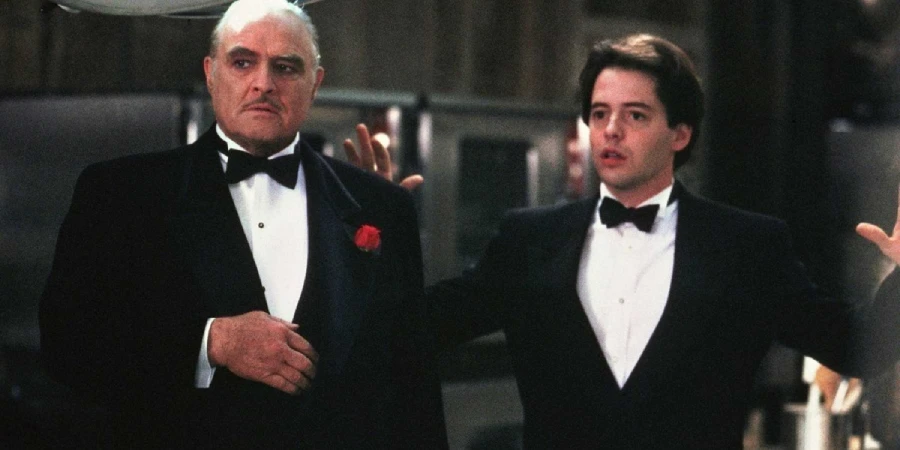
Steve takes Clark to meet Carmine Sabatini, a powerful and soft-spoken man who runs an import business out of a social club. Carmine, played by Marlon Brando, is a near-perfect echo of Vito Corleone in mannerism, speech, and presence. The film never pretends otherwise; it leans into the resemblance with gleeful confidence.
Carmine takes an immediate liking to Clark. He offers him a job as a delivery courier, and Clark, having no other options, accepts without asking too many questions.
The First Delivery
Clark’s first assignment involves transporting a live Komodo dragon through New York City. He manages the task, however bizarre it proves, and successfully delivers the animal. In addition, he begins to realize that Carmine’s operation is far stranger and more elaborate than a simple import business.
Carmine rewards Clark generously and treats him almost like a surrogate son. Clark starts to feel simultaneously flattered and deeply unsettled.
Film School and Victor Ray
Meanwhile, Clark navigates his film studies under the pompous and self-important Professor Arthur Fleeber, played by Paul Benedict. Fleeber lectures students with theatrical grandeur while showing little genuine insight. He becomes a recurring figure of gentle academic satire throughout the film.
Clark also crosses paths with Victor Ray, a slick and shady character connected to Carmine’s world. Victor operates in the background, managing logistics for operations Clark does not yet fully understand.
Tina Sabatini and a Romantic Subplot
Carmine’s daughter, Tina Sabatini, enters Clark’s life and the two develop a budding romantic connection. Tina is warm and self-possessed, and she clearly enjoys Clark’s naive sincerity. However, Clark remains acutely aware that romancing the boss’s daughter carries obvious risks.
The Gourmet Club Revelation
Clark gradually uncovers the true purpose of Carmine’s exotic animal imports. Carmine runs a secretive and enormously expensive dining club called the Gourmet Club, where extraordinarily wealthy clients pay staggering sums to eat endangered and exotic animals. The Komodo dragon Clark delivered was, in fact, destined for the dinner table.
This revelation reframes everything Clark has experienced. Suddenly his role as a courier carries serious legal and ethical weight.
Clark Gets Pulled Deeper
As Clark becomes more entangled in Carmine’s world, he struggles to find a way out without offending or betraying a man who treats him with genuine affection. Carmine’s kindness makes the situation more complicated, not less. For instance, Carmine arranges for Clark’s stolen money to be returned and his academic situation to be smoothed over.
Steve Bushak, meanwhile, continues to drift in and out of the story, equal parts comic relief and catalyst for further trouble.
The Dinner Event Approaches
Preparations for the Gourmet Club’s next dinner accelerate. Clark learns that the featured dish will be a Komodo dragon, presented live before being prepared for the assembled guests. Federal agents, meanwhile, have begun circling Carmine’s operation and are looking for an opening to intervene.
Clark finds himself caught between loyalty to Carmine, fear of legal consequences, and his own moral objections to the whole enterprise.
Movie Ending
Everything converges at the Gourmet Club’s grand dinner, held in an opulent setting with a roster of fabulously wealthy and morally flexible guests. Federal agents move in before the meal reaches its centerpiece moment. Consequently, the dinner collapses into chaos and arrests.
Carmine, however, navigates the situation with characteristic calm. In a twist that delivers the film’s sharpest satirical punch, Carmine reveals that the entire Gourmet Club operation was, in fact, an FBI sting. He has been working as a government informant, using the club to lure and expose wealthy criminals willing to pay for illegal delicacies. The exotic animals were never actually eaten.
Clark, stunned and relieved in equal measure, walks away clean. His involvement, though naive and legally borderline, never crossed a line serious enough to bring charges. Moreover, his relationship with Tina apparently survives the chaos intact.
Professor Fleeber, in a darkly funny coda, turns out to be among the Gourmet Club’s paying customers. His arrest neatly skewers the pretensions of academic elitism. The film closes on a note that is simultaneously warm and sardonic, suggesting that in America, the absurd and the corrupt are never far apart.
The ending works because it refuses to punish Clark harshly for his willful naivety, yet it does not let the world around him off the hook. Brando’s final scenes carry a sly warmth that makes the Corleone echo feel earned rather than exploitative.
Are There Post-Credits Scenes?
The Freshman does not include any post-credits scenes. Once the film ends, it ends completely. No additional footage or bonus scenes follow the closing credits.
Type of Movie
The Freshman is a crime comedy with strong satirical undercurrents. Its tone balances absurdist humor with genuine warmth, never tipping into outright farce. In contrast to harder crime comedies of the era, it keeps its edges soft and its characters fundamentally sympathetic.
The film also functions as a light coming-of-age story, filtered through a lens of cheerful surrealism. It trusts its audience to appreciate the joke without explaining it repeatedly.
Cast
- Marlon Brando – Carmine Sabatini
- Matthew Broderick – Clark Kellogg
- Bruno Kirby – Steve Bushak
- Penelope Ann Miller – Tina Sabatini
- Frank Whaley – Steve Bushak’s associate (Dwight Armstrong)
- Jon Polito – Victor Ray
- Paul Benedict – Professor Arthur Fleeber
- Richard Gant – Chuck Greenwald
- Maximilian Schell – Larry London
Film Music and Composer
David Newman composed the score for The Freshman. Newman, a member of the prolific Newman musical family, had built a solid reputation for comedy scores by this point in his career. His work here matches the film’s tone: playful, slightly caper-ish, and never overdone.
The score leans on light orchestration to complement the film’s absurdist rhythms without overwhelming them. It stays largely in the background, which suits a film where the performances carry most of the comic weight.
Filming Locations
Principal photography took place primarily in New York City, grounding the story in a genuinely urban environment. New York’s density and variety serve the film well; the city feels like a place where exotic animal couriers and fake mob bosses could plausibly operate without attracting much attention.
Some scenes also filmed in Toronto, Canada, a common production choice for films of this budget range in the early 1990s. The Canadian locations stand in for parts of New York without obvious disruption to the film’s visual continuity.
Awards and Nominations
The Freshman did not receive major awards recognition. Critics responded warmly, particularly to Brando’s performance, but the film did not generate significant awards traction during its release cycle.
Behind the Scenes Insights
- Marlon Brando initially publicly criticized the film during production, telling a reporter that it was terrible and that he regretted taking the role. He later retracted those statements and called the finished film one of his favorites.
- Director Andrew Bergman reportedly handled Brando’s on-set unpredictability with considerable patience, accommodating the actor’s famously unconventional working methods.
- Matthew Broderick reportedly found working opposite Brando both thrilling and nerve-wracking, given the generational and legendary gap between the two performers.
- Bruno Kirby delivered much of his performance through improvisation, bringing natural, fast-talking energy to Steve Bushak that scripted dialogue alone may not have captured.
- Brando wore an earpiece on set so that crew members could feed him lines, a technique he used frequently during this period of his career.
Inspirations and References
The most obvious and intentional reference point is The Godfather (1972). Brando’s Carmine Sabatini is an explicit comic echo of Vito Corleone, and the film invites audiences to enjoy that echo rather than treating it as a coincidence. In addition, several visual and tonal cues deliberately recall Francis Ford Coppola’s film.
Beyond that central reference, the film draws on a tradition of fish-out-of-water comedies in which an innocent protagonist stumbles into a criminal world too strange to be frightening. Andrew Bergman’s script also reflects his longstanding interest in American cultural excess and the absurdity hiding beneath respectable surfaces.
Alternate Endings and Deleted Scenes
No officially documented alternate endings or significant deleted scenes from The Freshman appear in the public record. Bergman has discussed the challenges of the production, but no alternative version of the film’s conclusion has surfaced through home video releases or interviews.
Book Adaptations and Differences
The Freshman is not based on a book or any prior literary source. Andrew Bergman wrote the original screenplay directly for the screen. Therefore, no source material comparison applies here.

Memorable Scenes and Quotes
Key Scenes
- Carmine’s introduction: Brando enters the film slowly and quietly, and the camera lingers just long enough to let audiences absorb the full Corleone parallel before the comedy kicks in.
- The Komodo dragon delivery: Clark navigating New York City with a live Komodo dragon on a leash is both visually absurd and surprisingly charming.
- The Gourmet Club dinner: The sequence where the assembled wealthy guests await their exotic meal, only to be surrounded by federal agents, earns the film’s biggest laugh through sheer tonal control.
- Professor Fleeber’s arrest: Discovering that the pompous academic is a paying Gourmet Club customer pays off his entire arc with a single perfectly timed reveal.
- Carmine on the ice rink: A memorably surreal scene in which Brando ice skates with unnerving grace while discussing business, demonstrating the film’s gift for unexpected absurdism.
Iconic Quotes
- “I am literally in show business.” – Carmine Sabatini, delivering the line with complete sincerity while surrounded by evidence to the contrary.
- “You look just like me when I was your age.” – Carmine to Clark, a line that functions simultaneously as warmth and as mild threat.
- “This is a once-in-a-lifetime experience.” – Various characters applying this phrase to situations that are, frankly, deeply questionable.
Easter Eggs and Hidden Details
- Several of Carmine’s mannerisms, including his soft vocal delivery and the way he holds his hands during conversation, directly mirror Brando’s own physicality from The Godfather, functioning as an internal performance homage.
- The social club setting where Carmine operates visually echoes similar spaces in The Godfather, with deliberately familiar lighting and layout choices.
- Professor Fleeber’s pompous film lectures contain references to classic cinema that subtly comment on the film’s own self-aware relationship with movie history.
- Background extras in the Gourmet Club dinner sequence include figures dressed in ways that suggest old-money establishment wealth, quietly satirizing a specific class of American cultural gatekeepers.
Trivia
- Brando’s public criticism of the film while it was still in production created a minor media controversy, with some outlets speculating it might damage the movie’s release prospects.
- Andrew Bergman had previously written the screenplay for Blazing Saddles (1974), which explains his comfort with comedy that operates on multiple satirical levels simultaneously.
- The live Komodo dragon used in the film required extensive animal safety coordination on set, and crew members reportedly treated its scenes with considerable caution.
- Maximilian Schell, a respected dramatic actor and Oscar winner, took his role partly as a deliberate departure from his serious screen persona.
- Brando’s use of an earpiece for line prompting was an open secret on set, and some of his most naturalistic-sounding exchanges reportedly came directly from this method.
Why Watch?
Few comedies of its era pull off what The Freshman manages: genuine warmth, sharp satire, and a career-highlight comic performance from one of cinema’s most serious actors. Brando’s willingness to mock his own legend gives the film an energy no amount of clever writing could manufacture alone. It rewards patient viewers who appreciate humor that trusts its audience completely.
Director’s Other Movies
- So Fine (1981)
- Fletch (1985)
- The In-Laws (2003)
- Honeymoon in Vegas (1992)
- It Could Happen to You (1994)
Recommended Films for Fans
- The Godfather (1972)
- Midnight Run (1988)
- Get Shorty (1995)
- The In-Laws (1979)
- Grosse Pointe Blank (1997)
- Analyze This (1999)
- Fletch (1985)