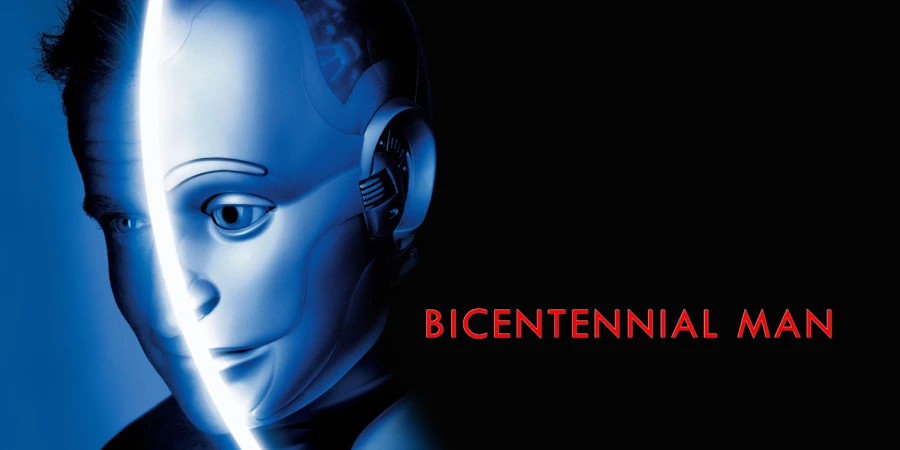

A robot asks to be declared human, and a court has to decide whether that even makes sense. Bicentennial Man (1999) frames this premise with warmth and gentle comedy, then slowly tightens the screws into something genuinely moving. Robin Williams plays Andrew Martin, an NDR-114 household robot who spends two centuries becoming more human than most humans ever manage. It is a film about identity, mortality, and the uncomfortable question of what humanity actually costs.
Detailed Summary
Andrew Arrives at the Martin Household
Andrew (Robin Williams) arrives as an NDR-114 robot purchased by the Martin family to handle domestic chores. His owner, Richard Martin (Sam Neill), quickly notices that Andrew is unusual: he demonstrates curiosity, humor, and emotional sensitivity far beyond his programming.
Richard begins treating Andrew with a kind of quiet respect. His daughter Amanda, nicknamed Little Miss, forms an especially close bond with Andrew, seeing him as a companion rather than a appliance.
The Anomaly Becomes Undeniable
Andrew carves wooden figurines, showing genuine artistic creativity. Richard takes this seriously and sells the figures, setting up a bank account in Andrew’s name so that Andrew can own property and accumulate wealth.
Meanwhile, the other Martin daughter resents Andrew and deliberately breaks one of his figurines. However, Richard defends Andrew firmly, establishing a precedent that Andrew deserves consideration as an individual.
Andrew Seeks His Freedom
Andrew eventually asks Richard for his freedom. Richard, moved by the request, grants it formally, though the parent company NorthAm Robotics resists the idea that a robot can be emancipated.
Andrew chooses to stay with the Martin family voluntarily after gaining freedom, which itself underlines the depth of his attachment. In contrast, a robot acting purely on programming would simply leave or stay indifferently.
Richard Martin Dies
Richard ages and eventually dies. Andrew grieves genuinely, and this loss pushes him toward a larger quest: he wants to find others of his kind who might also show signs of unique individuality.
He travels the country searching for other NDR units. Consequently, he meets Rupert Burns (Oliver Platt), a robotics engineer who becomes a crucial ally in Andrew’s physical transformation.
Andrew Pursues a Human Body
Rupert begins upgrading Andrew with increasingly sophisticated human-like components: synthetic skin, taste receptors, and a simulated digestive system. Each upgrade makes Andrew look and feel more human from the outside.
Andrew also reconnects with the Martin family across generations. He meets Portia (Embeth Davidtz), the granddaughter of Little Miss, and falls deeply in love with her.
Andrew Falls in Love
Portia initially resists Andrew’s affections, partly because loving a robot feels irrational to her. Andrew, however, pursues the relationship with patience and sincerity.
Rupert eventually gives Andrew functional human-equivalent biology, including the ability to experience physical sensation. This upgrade marks a turning point because Andrew is no longer merely simulating humanity; he is living something close to it.
The Fight for Legal Recognition
Andrew petitions the World Congress to be recognized legally as a human being. Congress denies the petition, arguing that Andrew’s immortality disqualifies him from humanity, since humans are defined partly by their mortality.
Andrew faces a profound choice. To be human legally and emotionally, he must accept death. He asks Rupert to modify his internal systems so that his positronic brain will degrade over time, mirroring human aging.
Andrew Chooses Mortality
Rupert completes the modification. Andrew and Portia marry, and they grow old together. Portia ages naturally, and Andrew’s systems deteriorate alongside her, closing the gap between them in the most permanent way possible.
As both approach death, the World Congress prepares to vote again on Andrew’s human status. The outcome of that vote shapes the film’s ending entirely.
Movie Ending
Andrew lies dying in a hospital bed beside Portia, who is also near death. His synthetic biology is failing, his systems shutting down gradually. Portia dies first, and Andrew follows shortly after.
Before Andrew dies, the World Congress votes to recognize him legally as a human being. The announcement reaches the hospital, but Andrew is already gone by the time it is confirmed on screen. He never consciously hears the verdict.
This timing is deliberate and quietly devastating. Andrew spent two hundred years fighting for recognition, and the recognition arrives one moment too late. However, the film frames this not as tragedy but as completion: Andrew died as a human being in every way that mattered, whether or not he heard the official word.
A woman at the hospital, watching the news of the Congress vote, says the words that close the film: “Andrew Martin, the first human being ever to have been created.” It reframes his entire journey in a single sentence. He did not become human by being built; he became human by choosing to die.
The ending asks a serious question without blinking: is humanity a biological fact, or a set of choices? Andrew’s decision to accept mortality is the film’s definitive answer. Consequently, the emotional weight lands not on the court verdict but on the quiet hospital room where two people die holding on to each other.
Are There Post-Credits Scenes?
Bicentennial Man contains no post-credits scenes. Once the film ends, that is the complete experience. There is nothing additional after the credits roll.
Type of Movie
Bicentennial Man occupies a genuinely unusual tonal space. It begins as a light family comedy and gradually becomes a philosophical science fiction drama about identity and mortality.
Broadly, it fits the categories of science fiction, drama, and comedy-drama. Its tone shifts considerably across its runtime, which surprised some audiences expecting straightforward Robin Williams comedy.
Cast
- Robin Williams – Andrew Martin (NDR-114)
- Sam Neill – Richard Martin
- Embeth Davidtz – Portia / Little Miss (dual role)
- Oliver Platt – Rupert Burns
- Kiersten Warren – Galatea
- Wendy Crewson – Ma’am (Richard’s wife)
- Hallie Kate Eisenberg – Young Amanda (Little Miss)
Film Music and Composer
James Horner composed the score for Bicentennial Man. Horner was one of Hollywood’s most prolific and celebrated composers, known for his lush, emotionally generous orchestral writing.
His score here leans into warmth and gentle curiosity, reflecting Andrew’s wide-eyed relationship with human experience. Notable contributions include the main theme, which carries a soft, wistful quality that suits the film’s long emotional arc.
Horner also incorporated the song “Then You Look at Me“, performed by Celine Dion, which played over the end credits and received considerable radio attention at the time of the film’s release.


Filming Locations
Principal photography took place primarily in California, including locations around the San Francisco Bay Area. The coastal and architectural settings gave the film a clean, slightly utopian visual character appropriate to its near-future setting.
Some sequences used studio sets to represent the interiors of the Martin home and various institutional spaces. The production design favored warmth and domesticity in indoor scenes, reinforcing the idea that Andrew’s story is fundamentally about family and belonging rather than cold technology.
Awards and Nominations
Bicentennial Man received relatively limited awards attention. The Celine Dion song “Then You Look at Me” earned a Golden Globe nomination for Best Original Song, which represented the film’s most prominent awards recognition.
Behind the Scenes Insights
- Robin Williams wore increasingly elaborate prosthetic makeup as Andrew’s human transformation progressed through the film.
- Director Chris Columbus wanted to balance the comedic and dramatic registers deliberately, though some critics felt the tonal shifts were uneven.
- Oliver Platt reportedly brought significant improvisational energy to his scenes as Rupert Burns, which Columbus encouraged on set.
- The production used detailed animatronic and practical effects for the early robot sequences before digital tools became the default choice.
- Robin Williams drew on his improvisational instincts to add warmth to Andrew’s early scenes, where the character is technically emotionless but clearly something more.
Inspirations and References
The film directly adapts Isaac Asimov’s work, specifically the short story The Bicentennial Man (1976) and the novel The Positronic Man (1992), which Asimov co-wrote with Robert Silverberg.
Asimov’s broader Robot series underpins the entire conceptual framework. His Three Laws of Robotics are referenced in the film and represent the philosophical foundation on which Andrew’s unusual behavior sits.
Furthermore, the film engages with a long tradition of science fiction stories about artificial beings seeking personhood, from Frankenstein onward. It is notably gentler and more optimistic than most entries in that tradition.
Alternate Endings and Deleted Scenes
No widely documented alternate endings or significant deleted scenes for Bicentennial Man appear in the public record. The theatrical cut represents the version most audiences and reviewers have analyzed.
Some accounts suggest scenes expanding on the World Congress debate were trimmed for pacing, but specific details about their content remain unclear. Accordingly, this section cannot confirm specifics without risking inaccuracy.
Book Adaptations and Differences
The film adapts both Asimov’s original short story and the expanded novel The Positronic Man. The short story is lean and focuses tightly on Andrew’s legal battle for human recognition, covering his journey in a compressed, almost procedural way.
The novel and film both expand the emotional and romantic dimensions significantly. Andrew’s relationship with Portia is developed far more fully on screen than in the shorter source material.
In contrast to Asimov’s typically cool, logical prose style, the film leans hard into sentimentality. Some Asimov purists found this a significant departure, while general audiences responded more warmly to the emotional amplification.
Memorable Scenes and Quotes
Key Scenes
- Andrew carving his first wooden figurine, revealing his creativity to a stunned Richard Martin.
- Richard formally granting Andrew his freedom, a quietly powerful scene between Sam Neill and Robin Williams.
- Andrew tasting food for the first time after Rupert installs taste receptors, played with genuine delight.
- Andrew asking Rupert to modify his brain so that he will age and die, sacrificing immortality for love and identity.
- The final hospital scene, where Andrew and Portia die together as the World Congress vote comes in moments too late.
Iconic Quotes
- “I try to make sense of things. Which is why, I guess, I believe in destiny.” (Andrew Martin)
- “Andrew Martin, the first human being ever to have been created.” (closing line of the film)
- “One is faced with the question: what makes a man a man?” (Andrew, during his congressional testimony)
Easter Eggs and Hidden Details
- Andrew’s model designation, NDR-114, fits neatly within Asimov’s established robot naming conventions from the broader Robot series universe.
- Several background design details in the NorthAm Robotics facility subtly reference classic science fiction robot imagery without directly copying any single source.
- The Celine Dion song playing over the credits mirrors the film’s central theme lyrically: the idea that another person’s gaze transforms your sense of self.
- Embeth Davidtz playing both Little Miss and Portia (her granddaughter) creates a quiet visual echo: Andrew essentially falls in love with a new version of the person who first treated him as a friend.
Trivia
- Robin Williams was a vocal advocate for taking on the role, seeing it as an opportunity to blend comedy with deeper philosophical material.
- The film’s runtime exceeds two hours, making it one of the longer Robin Williams vehicles of the late 1990s.
- Isaac Asimov died in 1992, seven years before the film’s release; he never saw the adaptation of his expanded novel reach the screen.
- Chris Columbus directed the film between his work on family-oriented projects, and Bicentennial Man sits stylistically close to that body of work despite its more adult themes.
- The film performed modestly at the box office relative to its budget, which contributed to its reputation as an underappreciated entry in both the Robin Williams filmography and the science fiction drama genre.
Why Watch?
Robin Williams delivers one of his most restrained and genuinely affecting performances here, proving he could hold a film together without relying on his signature manic energy. The film asks serious questions about identity and mortality while remaining emotionally accessible. Moreover, its slow-burn structure rewards patient viewers with a final act that earns every tear it draws.
Director’s Other Movies
- Home Alone (1990)
- Home Alone 2: Lost in New York (1992)
- Mrs. Doubtfire (1993)
- Nine Months (1995)
- Stepmom (1998)
- Harry Potter and the Sorcerer’s Stone (2001)
- Harry Potter and the Chamber of Secrets (2002)
- Rent (2005)
- Percy Jackson and the Olympians: The Lightning Thief (2010)