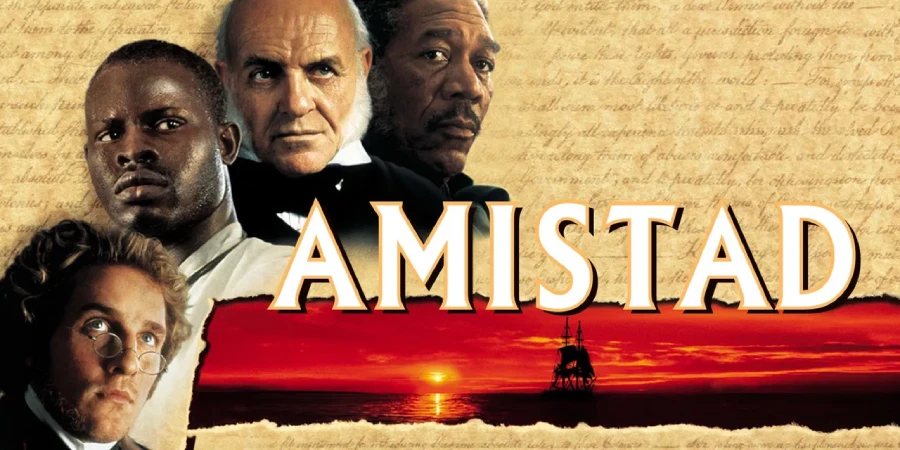

Steven Spielberg set out to make a courtroom drama and accidentally made one of the most quietly devastating films of his career. Amistad opens not with legal arguments but with blood, splinter, and salt water, as a man named Scinqué tears a rusted bolt from the hull of a ship with his bare hands and leads a revolt that will echo across two continents.
This 1997 film is based on a real 1839 incident that put the question of human freedom on trial in American courts, and Spielberg refuses to let the audience get comfortable for a single frame. Djimon Hounsou’s performance alone is worth the price of admission.
Detailed Summary
The Revolt Aboard La Amistad
In 1839, a group of captive Africans aboard the Spanish schooner La Amistad breaks free from their chains. Sengbe Pieh, known in the film as Singueh or Siqueh (rendered as Siqueh in various prints, most commonly Cinque), leads the uprising with brutal efficiency. Men die. The sea is chaos.
Cinque spares two Spanish navigators, Ruiz and Montez, ordering them to sail the ship back toward Africa. The Spaniards sail east by day and north by night, eventually steering the ship toward the United States. It is an act of deliberate deception that sets the entire legal nightmare in motion.
Captured Off the American Coast
A U.S. Navy vessel intercepts La Amistad near Long Island. American authorities arrest the Africans on charges of murder and piracy. Ruiz and Montez insist the Africans are Spanish property, not free people.
Two young naval officers, Lieutenant Thomas Gedney and Lieutenant Richard Meade, claim salvage rights over the ship and its “cargo,” hoping to profit from the seizure. This greed complicates the legal landscape immediately. Everyone wants a piece of the case for their own reasons.
The Legal Battle Begins
Abolitionist Lewis Tappan, played by Stellan Skarsgard, and newspaper editor Theodore Joadson, played by Morgan Freeman, push to defend the Africans in court. They recruit a young, inexperienced property lawyer named Roger Sherman Baldwin, played by Matthew McConaughey. Baldwin is a curious choice by the abolitionists, who initially want a firebrand orator, and the film takes pleasure in watching him grow into the role.
Baldwin’s legal strategy is simple and radical: if he can prove the Africans were born free in Africa and were never legally enslaved under Spanish law, they cannot be treated as property. He focuses on paperwork, which frustrates Tappan, who wants a moral crusade. This tension between strategy and symbolism runs through the entire film.
Cinque in Court and in Memory
Cinque cannot speak English, and the film refuses to give him subtitled speeches early on. His isolation is visual and physical. He paces his cell, re-enacts his experiences for anyone who will watch, and makes clear that he is not a symbol but a man who wants to go home.
The discovery of James Covey, a sailor who speaks the Mende language, cracks the communication barrier open. Cinque finally tells his full story: his capture in Sierra Leone, the nightmare of the Middle Passage, and the revolt. His account of the slave ship Tecora becomes the emotional center of the film.
The Horror of the Middle Passage
Spielberg does not relegate the Middle Passage to suggestion. He shows it directly. Captives chained below decks, starvation, disease, and the film’s most shattering moment: more than fifty Africans thrown overboard in chains to drown, because the ship’s captain needed to collect insurance money rather than feed people he could no longer sell.
Cinque watches. He cannot stop it. The camera holds on his face and on the bodies sinking into blue-black water. It is the kind of sequence that makes talking about “entertainment” feel briefly absurd.
Political Interference from the White House
President Martin Van Buren, played by Nigel Hawthorne, faces enormous pressure. Spain demands the return of the Africans. Southern slave-owning states threaten political chaos if any precedent of African freedom is set. A young Spanish queen, Isabella II, writes formally to request the prisoners.
Van Buren’s administration manipulates the courts, reassigning a sympathetic judge and replacing him with a younger, more pliable one. Baldwin wins the initial case anyway. Van Buren appeals immediately, kicking the case up to the Supreme Court.
John Quincy Adams Enters
The abolitionists know they need someone extraordinary for the Supreme Court. They approach John Quincy Adams, the former president, now a congressman in his seventies. Anthony Hopkins plays Adams as a man fueled by irritability and principle in roughly equal measure.
Adams is reluctant. He is old, he tells them. He has not argued a case in years. But Cinque visits him, and Adams shows him his garden, explaining that the tallest tree survived because it has the deepest roots. This scene does a great deal of work with very little dialogue.
The Supreme Court Argument
Adams delivers a long, winding argument before the Supreme Court that the film wisely lets Hopkins perform without interruption. He invokes the founding fathers, questions the meaning of liberty, and asks what kind of nation America intends to be. It is genuinely stirring, and Hopkins earns every second of it.
He also asks the court to consider what John Adams, his own father, would have said. Invoking family to make a legal and moral point feels almost too personal, and that is precisely what makes it land. The Supreme Court rules in favor of the Africans.
Movie Ending
Cinque and the surviving Africans win their freedom. A private fundraising effort finances their return voyage to Sierra Leone. Cinque sails home, but the film does not let that feel like a clean triumph. A title card informs the audience that he returned to find his village destroyed, his family taken, and his homeland engulfed in a slave trade he could not stop.
The film ends on that note deliberately. Steven Spielberg refuses the comfortable resolution that a lesser film would grab. Cinque is free in a legal sense, but what he finds at home is grief. Freedom and justice, the film argues, are not the same thing, and American courts cannot deliver what was truly taken from him.
Roger Baldwin disappears quietly from the narrative after his Supreme Court victory, which is an interesting choice. John Quincy Adams gets the spotlight at the end, and the film’s final image belongs to the legal and political world rather than to Cinque. Some critics read this as the film’s major flaw, and it is hard to entirely disagree. A story about African men that ends on the face of an old white American politician is a choice worth interrogating.
The Amistad itself is returned to Spain, and the two Spanish navigators face no meaningful punishment. History wins some rounds and loses others. The film knows this and says so plainly.
Are There Post-Credits Scenes?
Amistad has no post-credits scenes. There is nothing after the titles. Spielberg was not in the habit of hiding bonus content at the end of his dramas, and this film is no exception.
Type of Movie
Amistad is a historical legal drama. Its tone shifts between courtroom procedural and brutal historical epic, and it never fully settles into either mode. That restlessness is both a strength and an occasional source of tonal unevenness.
It carries a serious, prestige-drama weight throughout. There are moments of genuine warmth and even dark humor, but the film never loses sight of the horror at its foundation.
Cast
- Djimon Hounsou – Cinque
- Anthony Hopkins – John Quincy Adams
- Matthew McConaughey – Roger Sherman Baldwin
- Morgan Freeman – Theodore Joadson
- Stellan Skarsgard – Lewis Tappan
- Nigel Hawthorne – President Martin Van Buren
- David Paymer – Secretary of State John Forsyth
- Pete Postlethwaite – William S. Holabird
- Chiwetel Ejiofor – James Covey
- Jeremy Northam – Judge Coglin
- Arliss Howard – John C. Calhoun
Film Music and Composer
John Williams composed the score, which leans heavily on African choral voices and percussion to anchor the film in Cinque’s world rather than in the American courtroom. This was a deliberate decision to avoid scoring the film purely from a Western classical perspective.
The opening revolt sequence uses almost no underscore at all, letting violence speak without musical amplification. Williams understood that restraint was the right call there. The choral passages during the Middle Passage sequence are genuinely harrowing.
Williams received an Academy Award nomination for the score, and you can hear him working in a mode quite different from his blockbuster work with Spielberg. It is one of the more underrated collaborations between the two.

Filming Locations
Production shot primarily in Connecticut and Rhode Island, using period-accurate courtroom settings and harbor locations to represent the 1839 New Haven and New York scenes. Mystic Seaport in Connecticut, home to one of the finest collections of historic vessels in the country, provided essential nautical atmosphere.
Some scenes were shot in Puerto Rico to capture the Caribbean-adjacent visual quality needed for the ship sequences. Period reconstruction required significant set building on top of the location work. The claustrophobic below-decks footage was shot on purpose-built sets designed to feel physically oppressive.
Awards and Nominations
Amistad received four Academy Award nominations, including Best Supporting Actor for Anthony Hopkins, Best Cinematography for Janusz Kaminski, Best Costume Design, and Best Original Dramatic Score for John Williams. It did not win in any category.
Djimon Hounsou received a Golden Globe nomination for Best Supporting Actor. The film’s relative lack of awards recognition remains a point of frustration for many fans of the picture.
Behind the Scenes Insights
- Djimon Hounsou, born in Benin, West Africa, was largely unknown to American audiences before this film. Spielberg cast him after an extensive search for someone who could carry scenes without English dialogue.
- Anthony Hopkins wrote his own version of the Supreme Court speech before seeing the screenplay’s version, wanting to feel the argument from the inside rather than learn it from the outside.
- Chiwetel Ejiofor, then very young and still early in his career, was cast as James Covey. His scenes with Hounsou crackle with an authenticity that the film badly needed.
- Spielberg reportedly consulted extensively with historians and descendants of the original Amistad Africans during pre-production.
- The Middle Passage sequence required weeks of underwater filming and physical preparation from the cast members involved.
- John Williams recorded African singers and percussionists separately, later layering them into the orchestral score rather than blending them into a generic “world music” pastiche.
- Some members of the production team expressed concern that depicting the drowning of chained Africans so graphically would alienate audiences. Spielberg insisted on keeping it.
Inspirations and References
The film draws directly from the historical record of the United States v. The Amistad case, one of the most significant legal events in American pre-Civil War history. The real Sengbe Pieh did lead the revolt, was defended in American courts, and did eventually return to Sierra Leone.
Spielberg and screenwriter David Franzoni also drew on Howard Jones’s 1987 book Mutiny on the Amistad: The Saga of a Slave Revolt and Its Impact on American Abolition, Law, and Diplomacy. Jones’s research provided much of the legal and political scaffolding for the screenplay.
The film consciously references the broader tradition of American abolitionist literature and the philosophical debates that preceded the Civil War. Adams’s speech in particular echoes real documents from the period.
Alternate Endings and Deleted Scenes
No officially released alternate ending exists for Amistad. Spielberg has not released a director’s cut with substantially different conclusions.
Some extended scenes from the legal proceedings were trimmed during editing to tighten the courtroom sequences, according to production reports. Franzoni’s original screenplay reportedly contained additional scenes developing Theodore Joadson’s character, which were cut. This is a genuine loss: Morgan Freeman is excellent in a role that the film ultimately underserves.
Book Adaptations and Differences
Amistad is not a direct adaptation of a single book. David Franzoni’s screenplay draws from multiple historical sources, primarily Howard Jones’s Mutiny on the Amistad.
A novelization of the film was published to coincide with the release, written by Alex Pate. It follows the film’s plot closely rather than departing from it. Separately, Deborah Willis compiled a companion photo book tied to the film’s release.
Jones’s original academic history goes deeper into the legal technicalities and the diplomatic fallout with Spain and Britain than the film does. The film compresses years of legal maneuvering into a more streamlined narrative, which is understandable but costs some complexity.

Memorable Scenes and Quotes
Key Scenes
- The opening revolt: filmed with frantic handheld energy, rain-soaked and nearly wordless. Cinque wrenches himself free in close-up, and the violence that follows is not glorified. It is desperate.
- The Middle Passage flashback: bodies packed below decks, the slow drowning of chained captives thrown overboard. Kaminski lights the underwater shots with an almost supernatural blue. It is the film’s most shattering sequence.
- Cinque’s courtroom outburst: he stands, repeating “Give us free” over and over until the entire room has to contend with him as a human being rather than a legal abstraction. Hounsou does this with his whole body.
- Adams’s garden conversation with Cinque: two men who cannot speak the same language sit together among plants. Hopkins communicates with his hands and eyes. It is the quietest scene in the film and possibly the best one.
- Adams’s Supreme Court speech: Hopkins does not play it as a grand performance. He plays it as an old man who is genuinely angry and refuses to stop talking. That choice makes it work.
Iconic Quotes
- “Give us free.” (Cinque, repeated in the courtroom, the film’s most repeated and most quoted line)
- “I have spent the last few months of my life arguing with, talking to, and thinking about you. You have caused me to question things I have not questioned in some time.” (Adams to Cinque)
- “The natural state of mankind is instead, I would argue our proper condition, is freedom.” (Adams before the Supreme Court)
- “We’re about to bring a case before the highest court in our land. We are going to win.” (Baldwin)
Easter Eggs and Hidden Details
- The production design team reportedly included authentic Mende tribal objects in the background of certain prison scenes, visible but never commented on by the script.
- Kaminski’s lighting in the courtroom scenes uses natural window light as the primary source, deliberately evoking period portrait paintings of the era rather than conventional movie lighting.
- The Spanish navigators are shown reading a specific page of a ledger that, if paused and examined, contains names matching some of the historical Amistad captives.
- John Quincy Adams’s actual speeches and letters are echoed in the words Franzoni wrote for Hopkins, with some phrases borrowed almost verbatim from historical documents.
- The American flag appears in nearly every courtroom scene but is almost never centered in the frame. It hovers at the edge of shots, present but unable to deliver on its promise. Whether intentional or not, it reads as pointed commentary.
Trivia
- Djimon Hounsou learned English specifically to communicate with the crew during production, as he spoke French and Fon as his primary languages.
- The real Sengbe Pieh is believed to have eventually worked as an interpreter in Sierra Leone after his return to Africa.
- Anthony Hopkins holds the distinction of playing two American presidents in his career: John Quincy Adams here and Richard Nixon in Oliver Stone’s Nixon two years earlier.
- The film was released during a period of significant cultural conversation about American slavery, partially fueled by ongoing debates about reparations and Confederate monuments.
- Spielberg chose to present the African characters speaking Mende without subtitles for long stretches early in the film, forcing Western audiences to share something of Cinque’s disorientation.
- The La Amistad was a real two-masted schooner. A full-scale replica was later built and still sails today as a floating museum and educational vessel.
- Morgan Freeman’s character, Theodore Joadson, is fictional. He was invented as a composite to give the abolitionist perspective a speaking role in the drama.
Why Watch?
Hounsou’s performance justifies every minute. He communicates fury, grief, and dignity without sharing a language with most of the cast, and there is a specific moment when he stands in the courtroom and simply repeats “Give us free” until the room has to acknowledge him, which cuts through every legal abstraction the film has built up. Amistad is not a comfortable film, and Spielberg knows exactly where to point the camera when comfort would be a lie.
Director’s Other Movies
- Duel (1971)
- Jaws (1975)
- Close Encounters of the Third Kind (1977)
- Raiders of the Lost Ark (1981)
- E.T. the Extra-Terrestrial (1982)
- The Color Purple (1985)
- Schindler’s List (1993)
- Jurassic Park (1993)
- Saving Private Ryan (1998)
- Minority Report (2002)
- Catch Me If You Can (2002)
- Munich (2005)
- Lincoln (2012)
- Bridge of Spies (2015)
- The Post (2017)
- West Side Story (2021)
- The Fabelmans (2022)
Recommended Films for Fans
- 12 Years a Slave (2013)
- Django Unchained (2012)
- Roots (1977)
- Glory (1989)
- Belle (2013)
- Lincoln (2012)
- Beloved (1998)
- The Birth of a Nation (2016)
- Harriet (2019)
- Selma (2014)