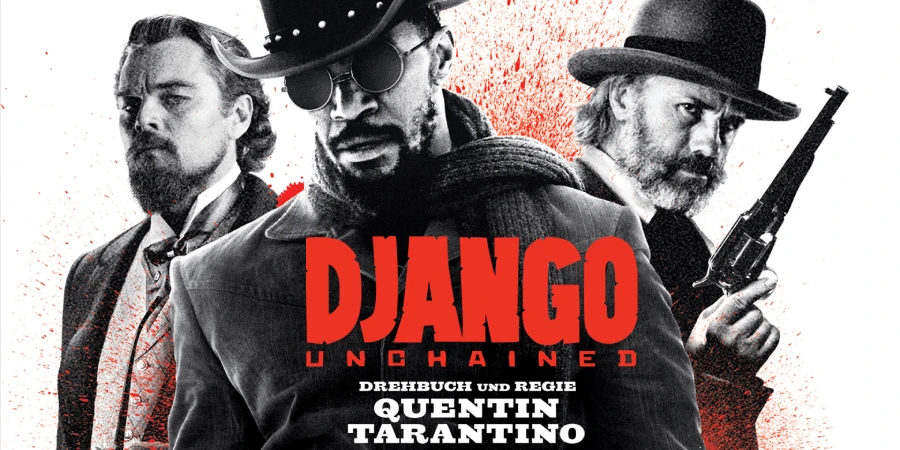

Quentin Tarantino opens his antebellum revenge fantasy with chained Black men trudging through a Texas winter, and within five minutes he has shot two slave traders dead in slow motion to a spaghetti western guitar riff. That tonal declaration tells you everything.
Django Unchained is a film with a point to make and absolutely no interest in making it quietly. Jamie Foxx plays Django, a freed slave who rides across the South in 1858 to rescue his wife from a Mississippi plantation, and the film gives him every ounce of dignity and lethality the genre can muster.
Detailed Summary
Django Meets Dr. King Schultz
Dr. King Schultz, played by Christoph Waltz, is a German bounty hunter who disguises himself as a traveling dentist. He needs Django to identify three brothers he is hunting, so he buys Django’s freedom on the road outside Daughtrey, Texas. Right away, the two men have a strange chemistry: one is a fastidious European gentleman, the other is a man who has been whipped, chained, and sold.
Schultz kills the escort marshals without hesitation and hands Django a horse. That image, a Black man on horseback in the antebellum South, is framed like a western hero shot, and Tarantino holds it just long enough for the audience to feel its weight.
The Brittle Brothers and the First Hunt
Django and Schultz track down the Brittle Brothers at a plantation called Carrucan. Django recognizes them immediately. He shoots Big John Brittle in the back before the man can whip a slave woman, then beats him with his own whip before finishing him off.
It is one of the film’s most satisfying reversals. The framing is wide, the sound design deliberately amplifies the crack of leather, and Foxx plays the moment with cold fury rather than catharsis. Schultz watches from a distance, visibly impressed.
The Winter Partnership
Schultz offers Django a deal: work through winter as his bounty hunting partner, then Schultz will help him find and free his wife, Broomhilda von Shaft. Django agrees. Their winter montage is brisk and funny, showing Django becoming a natural at the trade.
Tarantino uses this section to develop a genuine friendship between the two men without sanitizing the world around them. Every town they ride into bristles with racial hostility that Django navigates with growing confidence.
The Road to Candyland
Broomhilda is owned by Calvin J. Candie, a Francophile plantation owner in Mississippi who runs Candyland, one of the most brutal plantations in the region. Candie forces enslaved men to fight each other to the death in a practice called Mandingo fighting.
Schultz devises a plan: pose as a wealthy buyer interested in Mandingo fighters to get close to Candie, then negotiate separately to purchase Broomhilda. Django will pose as a free Black slaver, a role that forces him to witness horrors without reacting.
Meeting Calvin Candie
Leonardo DiCaprio plays Candie as a man who has never been told no. He is charming, childlike in his enthusiasms, and casually monstrous. The dinner table scene where he cracks open a skull to lecture his guests on phrenology is the film’s most unsettling stretch, played with DiCaprio grinning over a bone saw.
Candie surrounds himself with enslaved people he has conditioned into loyalty. His head house slave, Stephen, played by Samuel L. Jackson, is the most dangerous person in the room despite appearing the most subservient.
Stephen Uncovers the Plan
Stephen is sharp enough to notice that Django looks at Broomhilda with recognition. He whispers his suspicion to Candie, who forces a confrontation at the dinner table. Candie drops his pleasant facade and demands an inflated price for Broomhilda, threatening to have her killed if Schultz refuses.
Schultz pays. He despises himself for it. Walking out of Candyland, he cannot bring himself to shake Candie’s hand, and that refusal triggers the film’s explosive third act.
The Candyland Massacre
Schultz shoots Candie in the chest at point blank range. Candie’s bodyguard immediately shoots Schultz dead. Django opens fire on everyone in the room, kills most of Candie’s men, but surrenders when Broomhilda is threatened at gunpoint.
Django is captured, stripped, and prepared to be shipped to a mine. He talks his way out of it by posing as a member of a mining company bounty hunter crew, using the paperwork of dead men to negotiate his own release.
Movie Ending
Django rides back to Candyland alone. He shoots two remaining plantation hands and walks through the house picking off Candie’s remaining enforcers. Every kill is deliberate. Tarantino frames each one with the grammar of a classic western showdown: wide shots, slow reloads, Django’s silhouette against the white columns of the plantation house.
Stephen, now hysterical with rage and grief over Candie’s death, screams at Django from the staircase. Django shoots him in both kneecaps and leaves him in the house. He then blows up the entire building with kegs of gunpowder, and the last shot of Stephen is him crawling through fire before the explosion swallows him whole.
Django rides out with Broomhilda. She watches Candyland burn behind them. Tarantino cuts to a wide shot of the two on horseback, framed against the night sky, then lets them ride off into the dark together.
What makes this ending land is that it refuses to soften anything. Django does not spare Stephen out of mercy. He does not make a speech. The plantation does not symbolically crumble; Django manually blows it up because the film insists on agency over metaphor. Stephen’s drawn-out death is deliberately uncomfortable, a reminder that the film takes the collaboration of oppression seriously as a target of its rage.
Broomhilda gets the final look at the fire, and that detail matters. She has been tortured, sold, and branded, and Tarantino gives her the sight of its destruction rather than cutting away before she can witness it.
Are There Post-Credits Scenes?
Django Unchained has no post-credits scene. Once Django and Broomhilda ride off, the film is done. You can leave when the credits roll.
Type of Movie
Django Unchained is a revisionist western with heavy blaxploitation influences and pitch-black comedy woven through its two hours and forty-five minutes. Tarantino also draws from the spaghetti western tradition, particularly the Italian “Zapata westerns” that used the frontier to comment on political oppression.
The tone swings hard between comedy and violence, sometimes within the same scene. That is intentional and occasionally destabilizing. It demands an active, not passive, viewing experience.
Cast
- Jamie Foxx – Django Freeman
- Christoph Waltz – Dr. King Schultz
- Leonardo DiCaprio – Calvin J. Candie
- Kerry Washington – Broomhilda von Shaft
- Samuel L. Jackson – Stephen
- Walton Goggins – Billy Crash
- Don Johnson – Big Daddy
- James Remar – Butch Pooch / Ace Speck
- Dennis Christopher – Leonide Moguy
- Franco Nero – Amerigo Vassepi
- Quentin Tarantino – Australasian mining company guard
Film Music and Composer
Django Unchained does not have a single composer. Tarantino assembled its soundtrack the way he always does: by raiding existing recordings across decades and genres. He pulls from Ennio Morricone’s spaghetti western scores, soul music, hip-hop, and original pieces commissioned specifically for the film.
Ennio Morricone contributed new recordings, including “Ancora Qui,” sung by Elisa. John Legend recorded “Who Did That to You” for the film’s climactic stretch. The use of Rick Ross’s “100 Black Coffins” over an early montage announces immediately that Tarantino is not interested in period authenticity for its own sake.
The most effective music cue in the film might be the quietest one: Jim Croce’s “I Got a Name” plays as Django rides freely for the first time on horseback. It is a slightly corny choice that somehow works completely, because Foxx sells the joy on his face.
Filming Locations
Principal photography took place in Wyoming and California, with some additional shooting in Louisiana. The snowy mountain vistas in the early sequences were filmed around the Jackson Hole area of Wyoming, giving the film a legitimately grand western scale.
For Candyland itself, production used Evergreen Plantation in Louisiana, a real antebellum estate. That choice carries its own discomfort. Shooting a film about slavery on a plantation that still stands is a deliberate provocation, not a neutral location decision.
The California terrain doubled for parts of Texas. Tarantino shoots it wide and golden, honoring the visual tradition of westerns while placing Black characters at the center of a landscape that genre historically erased them from.
Awards and Nominations
Django Unchained won two Academy Awards: Best Original Screenplay for Quentin Tarantino and Best Supporting Actor for Christoph Waltz. It received additional nominations including Best Picture and Best Cinematography for Robert Richardson.
Waltz winning for Schultz is deserved. The performance is precise, warm, and funny without ever losing its edge. DiCaprio receiving no nomination for Candie remains one of the more baffling Oscar oversights of that decade.
Behind the Scenes Insights
- Leonardo DiCaprio reportedly struggled with Calvin Candie’s use of racial slurs during rehearsals. Samuel L. Jackson reportedly told him to “just say it” and helped him push through the discomfort.
- During the dinner table scene, DiCaprio accidentally smashed a glass with his hand and cut himself badly. He kept going, and Tarantino kept the take. The blood on Kerry Washington’s face in subsequent shots is real.
- Tarantino originally planned to play a larger role in the film before trimming his own part to a smaller cameo as a mining company guard.
- Will Smith was reportedly considered for the role of Django before Jamie Foxx was cast. Foxx’s physicality and chemistry with Waltz during auditions clinched it.
- Franco Nero, who played the original Django in Sergio Corbucci’s 1966 film, appears in a cameo and exchanges the name “Django” with Foxx in an explicit nod to the film’s source of inspiration.
- Tarantino researched the film extensively by reading books on slavery in the antebellum South, including academic histories of slave resistance.
Inspirations and References
The most direct inspiration is Sergio Corbucci’s Django from 1966, a spaghetti western that Tarantino has cited as one of his favorite films. Corbucci’s original is bleak, violent, and politically sharp, and Django Unchained borrows its title character’s name and attitude rather than its plot.
Tarantino also drew from the blaxploitation tradition of the 1970s, especially films that centered Black protagonists seeking revenge against corrupt white power structures. The character of Broomhilda references German mythology, specifically the Brunhilde of the Nibelungen cycle, a warrior woman imprisoned by fire until a hero rescues her. Schultz explains this to Django directly, framing their mission as an American slave’s version of a European legend.
The Mandingo fighting subplot draws from Mandingo, the 1975 film that depicted antebellum plantation life with graphic and controversial explicitness. Tarantino has acknowledged it as an influence on how he approached the ugliness of Candyland.
Alternate Endings and Deleted Scenes
Tarantino is known for shooting with excess footage, and Django Unchained is no exception. Several scenes were extended or cut entirely from the theatrical release.
An alternate version of the Candyland climax was shot with slightly different staging for Django’s final confrontation with Candie’s men. A longer cut of the film reportedly existed, running significantly past the theatrical runtime, though Tarantino shaped the final edit himself.
Some deleted material reportedly expanded Broomhilda’s perspective, giving Kerry Washington more screen time. That footage has not been officially released. Its absence is the film’s most significant structural weakness: Washington gives a committed performance in a role that the script underserves.
Book Adaptations and Differences
Django Unchained is not based on a book. It is an original screenplay by Quentin Tarantino. A comic book adaptation of the screenplay was published, but that came after the film rather than serving as its source.
Memorable Scenes and Quotes
Key Scenes
- The opening chain gang sequence: Django walks in shackles through a winter night while “Django” by Luis Bacalov plays on the soundtrack. Tarantino cuts from the title card to Schultz’s wagon with perfect rhythm.
- The Brittle Brothers confrontation: Django whips Big John with his own strap before shooting him. Foxx plays it cold and deliberate, with zero theatrics.
- The skull and phrenology scene: DiCaprio cracks open a skull at the dinner table, running his finger along the bone while lecturing about racial science. It is designed to be unwatchable in the best way.
- Schultz shoots Candie: After paying for Broomhilda and enduring Candie’s handshake demand, Schultz pulls his derringer and fires. It costs him everything, and Waltz plays the moment as a man who simply could not do otherwise.
- Django blows up Candyland: The plantation explodes in a fireball as Django and Broomhilda watch. Tarantino shoots it as spectacle without apology.
- The KKK bag scene: Candie’s men argue about their poorly cut hood bags before a raid, unable to see through the eyeholes. It is the funniest scene in the film and punctures any romance around vigilante terror.
Iconic Quotes
- “The D is silent.” Django, introducing himself.
- “I’m curious what makes you such a poor observer of the human condition.” Schultz to a marshal.
- “You silver-tongued devil, you.” Candie to Schultz, before the deal collapses.
- “Calvin Candie, you had my curiosity. Now you have my attention.” Django during the tense negotiation.
- “I count six shots, cowboy.” Django before his final rampage.
Easter Eggs and Hidden Details
- The character Broomhilda von Shaft shares a surname with Shaft, the 1971 blaxploitation film. Tarantino is implying she is a direct ancestor of John Shaft.
- Franco Nero’s cameo is a deliberate passing-of-the-torch moment. The original Django from the 1966 film literally confirms the new Django’s name on screen.
- The name “Django” itself was borrowed directly from Corbucci’s 1966 film, which in turn likely named its character after the jazz guitarist Django Reinhardt.
- Schultz’s wagon has a giant tooth on top that bobs as it rolls. That tooth shows up in blink-and-miss-it background shots throughout the early sequences.
- The bag debate among the Klan members is reportedly based on real historical accounts of disorganized Klan activity, including poorly constructed disguises.
- Candie’s plantation is named Candyland, a word that sounds cheerful and innocent, which is precisely why Tarantino chose it as a name for a hell.
Trivia
- Quentin Tarantino wrote the role of Schultz with Christoph Waltz specifically in mind after working with him on Inglourious Basterds.
- The word “Django” is spoken over 110 times throughout the film, making it one of the most frequently spoken character names in Tarantino’s filmography.
- Jamie Foxx trained extensively in horseback riding for the role and performed many of his own riding scenes.
- Don Johnson’s character, Big Daddy, wears a white plantation suit throughout his scenes, a visual shorthand that Tarantino uses completely unironically.
- The film was shot by cinematographer Robert Richardson, who has collaborated with Tarantino on multiple films.
- Tarantino’s cameo ends badly for his character: Django blows him up. It reads like the director punishing himself for inserting himself into the story.
- The screenplay won the Writers Guild Award in addition to the Academy Award, making it one of the most decorated original screenplays of 2012.
Why Watch?
Watch it for the forty-minute stretch at Candyland, where DiCaprio and Jackson build a double act so precise and so frightening that every other performer in the room visibly sharpens just by proximity. Foxx holding Django’s composure while witnessing atrocities he cannot react to is some of the most controlled screen acting of his career. Tarantino uses genre pleasure as a delivery mechanism for genuine moral fury, and that combination is rarer than it looks.
Director’s Other Movies
- Reservoir Dogs (1992)
- Pulp Fiction (1994)
- Jackie Brown (1997)
- Kill Bill: Volume 1 (2003)
- Kill Bill: Volume 2 (2004)
- Death Proof (2007)
- Inglourious Basterds (2009)
- The Hateful Eight (2015)
- Once Upon a Time in Hollywood (2019)
Recommended Films for Fans
- Django (1966)
- Inglourious Basterds (2009)
- Shaft (1971)
- The Good, the Bad and the Ugly (1966)
- Mandingo (1975)
- 12 Years a Slave (2013)
- Emancipation (2022)
- Blazing Saddles (1974)
- True Grit (2010)
- Pulp Fiction (1994)