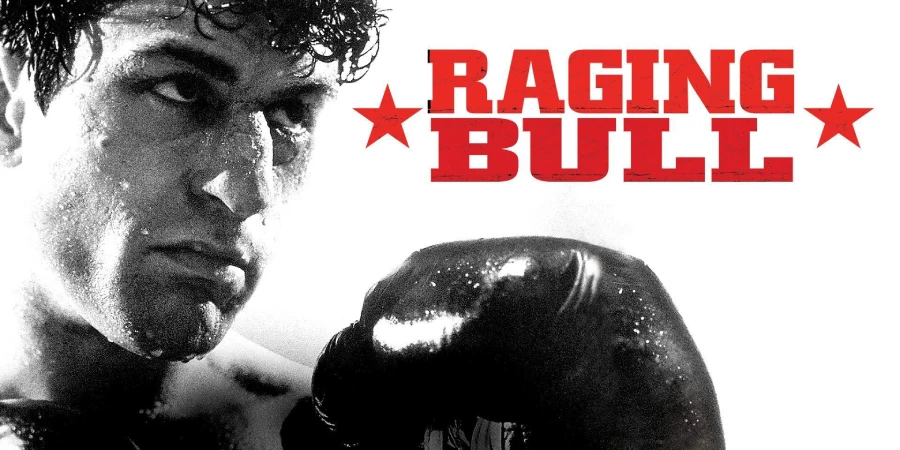

Few films dare to make their protagonist this relentlessly unlikable. Raging Bull strips away every romantic notion of the sports hero and replaces it with something raw, ugly, and uncomfortably honest. Martin Scorsese turned a boxer’s self-destruction into one of cinema’s greatest achievements, and the film has never stopped punching. This is a movie that demands your attention even as it repels your sympathy.
Detailed Summary
Opening: The Aging Jake La Motta
The film opens in 1964 with a heavyset, middle-aged Jake La Motta rehearsing a stand-up comedy routine in a dingy dressing room. This flash-forward immediately signals what Jake has become: a bloated, self-parodying shadow of his former self. Scorsese then pulls us back to the beginning.
The Bronx Middleweight and His Demons
In 1941, a young Jake fights in the Bronx, raw and ferocious. His rage inside the ring mirrors his rage outside it, and we quickly understand that boxing is both his gift and his prison. His brother Joey, played by Joe Pesci, manages his career and serves as his closest confidant.
Jake’s first marriage is already crumbling. He channels his frustration inward and outward in equal measure, picking fights over nothing and brooding over everything. His temper is not a personality quirk; it is his entire identity.
Vickie and the Jealous Obsession
Jake spots a teenage girl named Vickie at a community pool and becomes instantly fixated. He pursues her despite being married, and she eventually becomes his second wife. Cathy Moriarty plays Vickie with a calm, almost eerie composure that contrasts sharply with Jake’s volatility.
Jake’s jealousy around Vickie consumes him entirely. He interrogates her constantly, accuses her of sleeping with other men, and treats her more like property than a partner. His paranoia extends even to Joey, whom he later physically attacks after convincing himself they had an affair.
The Championship Pursuit and the Mob Connection
Jake refuses to cooperate with the mob, which costs him title shots for years. However, he eventually compromises, agreeing to throw a fight against Billy Fox in 1947 in exchange for a shot at the middleweight title. The thrown fight is almost embarrassing in how obviously fake it looks, and the boxing commission briefly suspends him.
Consequently, Jake does get his title opportunity. In 1949, he defeats Marcel Cerdan for the World Middleweight Championship. It should feel triumphant, but Scorsese films it with an odd hollowness, as though even victory cannot fill whatever is missing inside Jake.
The Decline: Weight, Paranoia, and Violence
After winning the title, Jake defends it several times. Meanwhile, his personal life deteriorates further. His abuse of Vickie escalates, his relationship with Joey fractures irreparably after the assault, and his weight becomes increasingly difficult to manage between fights.
His series of brutal bouts with Sugar Ray Robinson defines his career. Jake loses to Robinson twice and beats him once, but it is their final fight in 1951 that breaks him physically. Robinson batters Jake mercilessly, yet Jake refuses to go down, almost daring Robinson to kill him. Jake loses the title that night.
The Retirement and the Strip Club Years
Jake retires from boxing and moves to Miami, where he opens a nightclub. He eats his way to an enormous weight, seemingly trying to bury his former self under layers of flesh. Vickie eventually leaves him, and he drifts further from any recognizable version of his past.
His club gets him into legal trouble. Authorities arrest him for introducing underage girls to men at the establishment, and he ends up in jail briefly. In a genuinely harrowing scene, Jake slams his head and fists against his cell wall, howling in despair. It is one of the most visceral breakdowns in American cinema.
Movie Ending
Jake gets out of jail and returns to New York, broke and alone. He tries to reconnect with Joey, but Joey wants nothing to do with him. Their brief encounter on the street carries enormous weight; Joey walks away, and Jake watches the closest relationship of his life disappear for good.
Back in that dingy dressing room from the opening, the now-obese Jake rehearses his comedy routine. He recites passages from On the Waterfront, including the famous “I coulda been a contender” speech. Robert De Niro delivers these lines with a complicated mixture of self-awareness and delusion, making the scene both funny and devastating.
Scorsese then cuts to a title card: a passage from the Gospel of John, specifically the story of the blind man healed by Jesus, which includes the line “I once was blind and now I can see.” The implication is deliberately ambiguous. Has Jake genuinely achieved some form of self-awareness, or is this ironic? Most viewers and critics read it as a tentative, fragile gesture toward redemption rather than a triumphant arrival. Jake pumps himself up in the mirror before going on stage, repeating “I’m the boss” to his reflection. It is a heartbreaking performance of bravado from a man with nothing left to prove and no one left to prove it to.
Ultimately, the ending refuses easy resolution. Jake never truly changes; he just runs out of people to hurt and places to fall. The film closes with him walking out to perform, and we never see the audience’s reaction. Scorsese denies us the satisfaction of knowing whether anyone still cares.
Are There Post-Credits Scenes?
Raging Bull contains no post-credits scenes whatsoever. After the Gospel of John title card and a dedication to Scorsese’s film teacher Haig Manoogian, the credits roll in silence. There is nothing waiting for you at the end.
Type of Movie
Raging Bull is a biographical drama, though it operates more like a character study than a conventional biopic. Its tone is relentlessly bleak, occasionally punctuated by dark humor that makes the bleakness sting more sharply. In addition, the film functions as a meditation on masculinity, jealousy, and self-destruction.
It is not a sports film in any traditional sense. Scorsese uses boxing as a visual and psychological metaphor rather than a competitive narrative. The film sits comfortably alongside other works of American New Wave cinema in its refusal to comfort or reassure the audience.
Cast
- Robert De Niro – Jake La Motta
- Joe Pesci – Joey La Motta
- Cathy Moriarty – Vickie La Motta
- Frank Vincent – Salvy Batts
- Nicholas Colasanto – Tommy Como
- Theresa Saldana – Lenora La Motta (Jake’s first wife)
- Mario Gallo – Mario
- Frank Adonis – Patsy
Film Music and Composer
Raging Bull does not rely on a traditional orchestral score. Instead, Robbie Robertson served as music supervisor, and the film uses pre-existing classical and operatic pieces alongside period-appropriate popular music. Pietro Mascagni’s Intermezzo from Cavalleria Rusticana opens the film and immediately establishes a mournful, operatic register.
This choice of source music over composed score was deliberate and effective. The operatic selections lend Jake’s story a tragic grandeur that a conventional Hollywood score might have undercut. Moreover, the contrast between the gorgeous music and the brutal imagery creates a persistent, unsettling tension throughout.

Filming Locations
Principal photography took place largely in New York City, specifically in the Bronx, which grounds the film in authentic working-class geography. Scorsese and cinematographer Michael Chapman shot the exterior street scenes to capture the gritty texture of postwar New York neighborhoods. For instance, the community pool where Jake first sees Vickie was shot in the Bronx.
The boxing sequences used studio-built rings designed to give Scorsese complete control over lighting and camera placement. This decision proved crucial, as the ring scenes required extreme close-ups, slow-motion photography, and unusual angles that location shooting would have made impossible. Miami sequences capture the garish, sun-bleached atmosphere of Jake’s later years.
Awards and Nominations
Raging Bull received eight Academy Award nominations, winning two: Best Actor for Robert De Niro and Best Film Editing for Thelma Schoonmaker. Other nominations included Best Picture, Best Director for Scorsese, Best Supporting Actor for Pesci, and Best Supporting Actress for Moriarty.
The film’s loss of Best Picture to Ordinary People remains one of the most debated Oscar decisions in history. In contrast to its lukewarm initial box office, Raging Bull has since accumulated enormous critical prestige, regularly appearing on lists of the greatest films ever made.
Behind the Scenes Insights
- Robert De Niro gained approximately 60 pounds to play the older Jake La Motta, famously eating his way through Italy and France. He trained extensively with the real La Motta for the fight sequences, reaching a level of skill that impressed professional boxing trainers.
- Martin Scorsese has stated that he made the film during a deeply troubled period in his personal life, and he approached it as something he needed to make rather than a calculated career move.
- Joe Pesci was relatively unknown before this film. Scorsese and De Niro spotted him in a minor film and cast him largely on instinct.
- Cathy Moriarty was also a newcomer, just 19 years old during filming. De Niro reportedly found her and brought her to Scorsese’s attention.
- Scorsese shot the film in black and white partly for aesthetic reasons and partly because he felt color footage from the era would eventually degrade in archives. He wanted the film to have a timeless quality.
- The boxing sequences took weeks to shoot and involved extensive rehearsal. Michael Chapman’s camera work inside the ring required custom-built equipment to achieve the desired intimacy.
- Production reportedly paused so De Niro could gain the necessary weight for the later sequences. The cast and crew essentially waited for him to complete his physical transformation.
Inspirations and References
Raging Bull is based on Jake La Motta’s autobiography, Raging Bull: My Story, which he co-wrote with Joseph Carter and Peter Savage and published in 1970. La Motta was a real middleweight champion whose career and personal life supplied the raw material for the film. However, Scorsese and screenwriters Paul Schrader and Mardik Martin shaped the material significantly.
Paul Schrader’s screenplay draws on his broader thematic obsessions with guilt, punishment, and male isolation, themes visible in his earlier work on Taxi Driver. The film also carries echoes of classic Hollywood boxing films and gangster pictures, though it consciously subverts their conventions. In addition, Scorsese’s Catholic upbringing informs the film’s persistent undercurrent of sin and possible redemption.
Alternate Endings and Deleted Scenes
No major alternate ending for Raging Bull has entered the public record. Scorsese has discussed cutting material during post-production, but the specific scenes removed have not been thoroughly documented or released in any widely available form. The film does not have a notable extended or director’s cut.
Given the film’s tight, focused structure, it is likely that excised material simply did not serve the stripped-down approach Scorsese pursued. The theatrical cut runs approximately 129 minutes and reflects the final, definitive version of the film.
Book Adaptations and Differences
Raging Bull is based on La Motta’s memoir, Raging Bull: My Story. The book covers the broad strokes of his career and his troubled personal relationships, but the memoir reads more as a self-justifying account than a ruthless self-examination. Scorsese and Schrader amplified the darkness considerably.
On the other hand, the film removes much of the memoir’s defensive tone and replaces it with a more unflinching gaze. Certain events are condensed or reordered for dramatic impact. Notably, the film is far less interested in boxing strategy or career detail than the book, focusing instead on psychological deterioration.
Memorable Scenes and Quotes
Key Scenes
- The opening slow-motion training sequence: Jake shadowboxes alone in the ring while Mascagni’s Intermezzo plays, establishing the film’s entire visual and emotional tone before a word of dialogue is spoken.
- The Sugar Ray Robinson final fight: Jake absorbs catastrophic punishment and refuses to fall, leaning against the ropes and screaming at Robinson that he never knocked him down. It is equal parts heroism and madness.
- The jail cell breakdown: A destroyed, imprisoned Jake slams himself against the concrete wall and weeps. De Niro’s performance here is almost unbearable to watch.
- Joey’s beating of Salvy: A sudden, shocking outburst of violence in a nightclub that illustrates how the La Motta family normalizes brutality.
- Jake confronting Joey about Vickie: Jake attacks his own brother in the street based on paranoid suspicion, marking the permanent destruction of their relationship.
- The “I coulda been a contender” mirror rehearsal: Jake recites the famous On the Waterfront lines to himself backstage, collapsing the distance between Jake La Motta and Marlon Brando’s Terry Malloy.
Iconic Quotes
- “I’ve done a lot of bad things, Joey. Maybe it’s coming back to me.”
- “I’m not an animal! You treat me like an animal!”
- “You never got me down, Ray. You never got me down.”
- “Go ahead, hit me. I’m not gonna move.” (spoken by Jake to Robinson in the final fight)
- Jake’s recitation of the On the Waterfront speech: “It wasn’t him, Charley, it was you.”
Easter Eggs and Hidden Details
- Scorsese himself appears briefly as a stagehand backstage at the Copacabana, a small cameo he has included in several of his films.
- The title card quoting the Gospel of John at the end directly echoes the spiritual themes Scorsese embedded throughout: blindness, sight, and possible grace.
- The black-and-white cinematography occasionally shifts in grain and contrast between scenes, subtly reflecting Jake’s deteriorating mental and emotional state rather than maintaining a consistent visual style.
- Home movie footage used within the film has a deliberately different texture from the rest, simulating the look of actual amateur 8mm film from the late 1940s and early 1950s.
- The use of slow motion in the boxing ring is not consistent; Scorsese deploys it selectively to signal moments of psychological significance rather than just physical drama.
- Several exterior Bronx locations used in the film were authentic period streets that had changed relatively little since the 1940s, lending the film a documentary-like accuracy in its environment.
Trivia
- Robert De Niro is widely reported to have fought in several amateur boxing exhibitions during his training period, holding his own against professional-level opponents.
- The real Jake La Motta visited the set and reportedly approved of De Niro’s portrayal, though he had complex feelings about the film’s unflinching depiction of his behavior.
- Scorsese shot the film in black and white over the objections of studio executives at United Artists, who feared audiences would reject it. He insisted, and the choice became one of the film’s most celebrated qualities.
- Thelma Schoonmaker’s editing was groundbreaking in the way it treated time within the fight sequences, using rhythm and pace as expressive tools rather than purely functional cuts.
- The film was shot mostly in sequence, which helped De Niro manage the physical transformation required between the younger and older versions of Jake.
- Joe Pesci improvised a significant amount of his dialogue with De Niro, and many of their most naturalistic exchanges were not scripted in their final form.
- Despite its current legendary status, Raging Bull performed modestly at the box office upon its initial release. Critical reassessment elevated it to its current position over the following decades.
Why Watch?
Raging Bull is simply one of the best-made American films of the twentieth century, and no serious cinema fan should skip it. De Niro’s performance sets a benchmark that actors still reference. Moreover, Scorsese’s visual language here is so precise and purposeful that every frame rewards close attention. It is demanding, sometimes brutal viewing, but it pays back everything you put in.
Director’s Other Movies
- Mean Streets (1973)
- Alice Doesn’t Live Here Anymore (1974)
- Taxi Driver (1976)
- The Last Waltz (1978)
- The King of Comedy (1982)
- Goodfellas (1990)
- Cape Fear (1991)
- Casino (1995)
- Gangs of New York (2002)
- The Aviator (2004)
- The Departed (2006)
- Shutter Island (2010)
- The Wolf of Wall Street (2013)
- Silence (2016)
- The Irishman (2019)
- Killers of the Flower Moon (2023)