
A young Arab man enters a French prison with nothing, and leaves as a criminal mastermind. A Prophet, directed by Jacques Audiard, is one of the most gripping crime dramas ever made, a film that treats its audience as intelligent adults and never flinches from the brutal logic of its world. Malik El Djebena’s rise from terrified, illiterate teenager to calculated power broker is as compelling as anything the gangster genre has ever produced. This is the film that proved French cinema could rival Hollywood at its own game.
Detailed Summary
Malik Arrives at Brécourt Prison
Malik El Djebena (Tahar Rahim) arrives at the fictional Brécourt Prison as an 19-year-old with no money, no connections, and no real criminal experience. He is quickly overwhelmed by the social geography of the prison, where Corsican and Arab inmates occupy opposing power structures. Nobody claims him, and as a result, he becomes a target from the very first day.
Correction officers confiscate his shoes. Other inmates rob him of almost everything else. He is visibly alone, and Audiard holds on that loneliness without sentimentality.
César Luciani Takes Notice
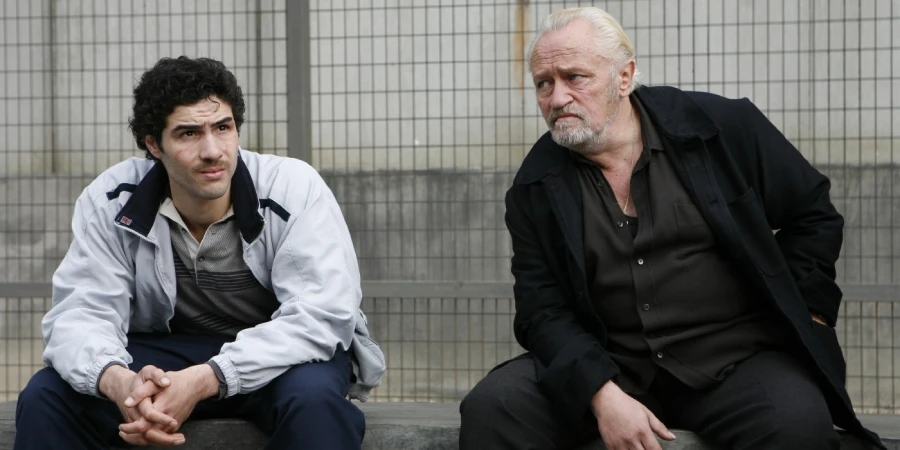
César Luciani (Niels Arestrup), the aging godfather of the Corsican gang inside Brécourt, identifies Malik as a potential tool. He runs the prison from within, bribing guards and managing criminal operations on the outside through a network of loyal soldiers. However, his power is slowly eroding, and he needs leverage.
César approaches Malik with a proposition: kill a fellow Arab inmate named Reyeb, who is scheduled to testify against a Corsican associate. In exchange, Malik will receive protection. Refusing means death.
The Murder of Reyeb
Malik agrees, and the film dedicates a long, excruciating sequence to the preparation and execution of the murder. He hides a razor blade in his mouth and seduces Reyeb into a false sense of trust. When the moment arrives, Malik slashes Reyeb’s throat in a desperate, messy act that is nothing like movie violence.
Reyeb does not die instantly. Malik holds him down on a prison bunk, watching him bleed out, and the horror on Malik’s face communicates everything. Afterward, Reyeb’s ghost begins to appear to Malik throughout the film, a recurring supernatural element Audiard uses with great restraint.
Life Under César
Malik becomes César’s errand boy, cleaning, fetching, and absorbing constant humiliation. César calls him a bicot, a French racial slur, and treats him as subhuman. Despite this, Malik watches and learns constantly, quietly absorbing how power operates inside the prison.
Malik befriends Ryad (Adel Bencherif), another Arab inmate, and this friendship becomes a moral anchor throughout the film. Meanwhile, Malik secretly teaches himself to read. Every small act of self-improvement carries enormous weight given his circumstances.
Day Releases and the Outside World
César arranges for Malik to receive day-release permissions, using him as a courier and messenger for Corsican business on the outside. Malik travels to Marseille and begins making connections of his own, separate from César’s knowledge. He observes, he listens, and he starts building a parallel operation.
On one of these trips, Malik reconnects with contacts in the Arab criminal world, specifically with a Moroccan drug network. Furthermore, he begins to see that César’s empire is far less secure than it appears. The Corsicans are losing influence, and Malik is positioning himself to fill that vacuum.
The Corsican Power Struggle
César faces increasing pressure from both rival Corsicans and Italian organized crime. His authority inside Brécourt weakens as several of his key lieutenants are transferred or released. Consequently, he relies on Malik more heavily, which inadvertently gives Malik more freedom and more knowledge.
Malik handles a crucial negotiation between César and a Corsican boss named Jordi. He manages it skillfully, demonstrating an instinct for diplomacy and strategy that surprises even himself. In contrast to the helpless boy who arrived in prison, this Malik is composed and calculating.
Ryad’s Release and the Drug Business
Ryad is released from prison, and Malik uses him as a partner in establishing a drug distribution network outside. Malik supplies product, Ryad handles the street-level operation, and the profits flow back to Malik. This business is entirely Malik’s own, invisible to César.
Tragedy strikes when Ryad is killed, a consequence of the dangerous territory they operate in. Malik grieves genuinely, but he does not stop. He simply absorbs the loss and continues building.
César’s Fall and Malik’s Ascent
As César’s Corsican network collapses around him, Malik strategically distances himself. Several Corsican gangsters are arrested. Others are murdered. César, once untouchable, becomes isolated and desperate. Notably, the man who once held absolute power over Malik now needs Malik more than Malik needs him.
Malik engineers the final stages of his takeover with cold precision. He does not dramatically betray César; instead, he simply allows circumstances to consume the old man while he steps forward to fill the space. This restraint is what makes Malik so formidable and so unsettling.


Movie Ending
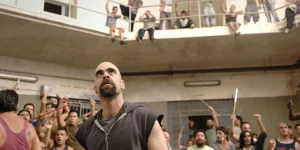
César is finally released from prison, stripped of his power and his network. He expects Malik to honor their relationship and provide for him on the outside. Instead, Malik meets him at the prison gates and offers virtually nothing. The king walks free into a kingdom that no longer exists.
Malik, on the other hand, walks out of Brécourt to find a convoy of cars waiting for him, driven by men loyal to his operation. He has built an organization from scratch, inside a prison, while serving his sentence. In contrast to his arrival, he leaves as a man of real criminal consequence.
Reyeb’s ghost makes one final appearance in the film’s closing moments. Its presence is not triumphant; it is a reminder that Malik’s rise is built on a murder he never fully escapes. Audiard refuses to celebrate what Malik has become, even as he makes it impossible not to admire the journey.
Audiences frequently ask whether Malik is ultimately a hero or a villain. A Prophet refuses to answer that question. He is a product of every system that failed him, shaped by a prison that offered only two choices: dominate or be dominated. His survival is undeniable; its moral cost is equally undeniable.
Are There Post-Credits Scenes?
A Prophet contains no post-credits scenes. Once the film ends, it ends completely. Audiard leaves no loose threads and offers no epilogue beyond what the final frames already communicate.
Type of Movie
A Prophet is a crime drama with elements of a prison film and a rise-of-power narrative. Its tone is relentlessly realistic, closer to documentary naturalism than genre stylization. Violence, when it arrives, feels ugly and consequential rather than choreographed.
There is also a subtle thread of magical realism woven through the film, specifically through Reyeb’s ghost. However, Audiard keeps this element minimal, using it as an emotional and moral device rather than a supernatural genre shift.
Cast
- Tahar Rahim – Malik El Djebena
- Niels Arestrup – César Luciani
- Adel Bencherif – Ryad
- Reda Kateb – Jordi
- Hichem Yacoubi – Reyeb
- Jean-Philippe Ricci – Vettori
- Gilles Cohen – Professor Bastié
Film Music and Composer
Alexandre Desplat composed the score for A Prophet. His work here is notably restrained, favoring sparse, rhythmic pieces over traditional cinematic swells. The music never telegraphs emotion; instead, it underscores the film’s atmosphere of tension and quiet menace.
Desplat is one of the most decorated composers in contemporary cinema, with credits ranging from The Grand Budapest Hotel to The Shape of Water. His collaboration with Audiard on this film demonstrates how effectively a minimal score can amplify a story without overwhelming it.

Filming Locations
Principal photography took place at a real decommissioned prison in France. Audiard and his crew chose practical locations to ground the film’s world in authentic texture. Shooting in an actual correctional facility gave the production design a credibility that purpose-built sets rarely achieve.
Sequences set outside the prison were filmed in and around Marseille and other parts of southern France. These exterior locations contrast meaningfully with the claustrophobic interior of the prison, reinforcing the visual and emotional distance between Malik’s two worlds.
Awards and Nominations
A Prophet earned extraordinary recognition on the international awards circuit. It won the Grand Prix at the Cannes Film Festival in 2009, a prestigious recognition that immediately elevated its global profile.
Additionally, the film received a nomination for the Academy Award for Best Foreign Language Film. It also won the César Award for Best Film, among numerous other César wins including Best Director for Audiard and Best Actor for Rahim. Few French films of its era collected such widespread critical acclaim.
Behind the Scenes Insights
- Tahar Rahim had minimal film experience before landing the lead role; Audiard took a significant risk on an unknown actor, and it paid off completely.
- Niels Arestrup won the César Award for Best Supporting Actor for his performance as César; he had previously worked with Audiard on A Beat That My Heart Skipped and A Prophet deepened their creative partnership.
- Audiard conducted extensive research into French prison life, consulting with criminologists, former inmates, and prison staff to build an accurate portrait of the institution.
- Many of the non-speaking extras in the prison sequences were actual former prisoners, contributing to the film’s texture of realism.
- Audiard rewrote portions of the script during production, adjusting scenes based on what he observed during rehearsals with Rahim.
- The razor-blade murder scene required multiple rehearsals and careful choreography; achieving its raw, chaotic quality while keeping it safe for the actors was a significant production challenge.
Inspirations and References
Audiard has cited classic American gangster cinema as a broad influence, particularly films about self-made criminal figures rising through institutional hierarchies. However, his approach consciously departs from the romanticization common to that tradition. A Prophet examines power without glamorizing it.
The film also draws on a long tradition of French prison literature and sociology. Audiard was interested in the specific dynamics of race and identity within the French penal system, particularly how incarceration shapes and reshapes ethnic and cultural allegiances.
Some critics have compared Malik’s arc to that of classical literary protagonists who build themselves through adversity. The self-education subplot, specifically Malik learning to read while incarcerated, carries strong echoes of classic stories about literacy as liberation and power.
Alternate Endings and Deleted Scenes
No officially released alternate ending or significant body of deleted scenes has been made publicly available for A Prophet. Audiard has not publicly discussed major sequences cut from the final film. In contrast to many contemporary releases, this film arrived without an extended cut or director’s cut edition featuring additional material.
Book Adaptations and Differences
A Prophet is not based on a book. Jacques Audiard developed the film from a screenplay written by himself, Thomas Bidegain, Abdel Raouf Dafri, and Nicolas Peufaillit. The story is original, though it draws on real social conditions within the French prison system.



Memorable Scenes and Quotes
Key Scenes
- Malik’s arrival at Brécourt, stripped of his belongings and visibly terrified, establishes the film’s stakes with complete economy.
- The murder of Reyeb is one of the most viscerally uncomfortable scenes in modern cinema; messy, prolonged, and deeply human in its horror.
- Reyeb’s ghost appearing in the passenger seat of Malik’s car during a day release, accompanied by deer on a foggy road, is hauntingly strange and deeply memorable.
- César calling Malik a racial slur repeatedly while Malik silently absorbs it captures the entire power dynamic of their relationship in miniature.
- The final shot of Malik exiting the prison to a waiting convoy of cars communicates his transformation completely, without a single word of dialogue.
Iconic Quotes
- “You don’t even know how to read.” César, dismissing Malik early in the film, a line the film eventually turns into its greatest irony.
- “I’m nobody’s dog.” Malik, asserting his independence at a pivotal moment in the third act.
Easter Eggs and Hidden Details
- Reyeb’s ghost appears subtly in several scenes before Malik consciously acknowledges it; rewatching the film reveals moments audiences typically miss on a first viewing.
- The deer on the foggy road during Malik’s prophetic vision appear to foreshadow later events in the narrative, lending the film its title a literal dimension.
- Malik’s gradual improvement in grooming and clothing across the film is a deliberate visual shorthand for his rise in status; costume changes are used as chapter markers.
- César’s deteriorating physical appearance mirrors his declining power; Audiard stages their scenes together so that Malik gradually occupies more visual authority in the frame.
- Background prisoners in early scenes sometimes reappear in later scenes in visibly different roles within the prison hierarchy, rewarding attentive viewers.
Trivia
- Tahar Rahim had to learn Corsican dialect for several scenes, adding another layer of complexity to an already demanding performance.
- A Prophet was selected as the French entry for the Academy Award for Best Foreign Language Film and received a full nomination.
- Director Jacques Audiard is the son of legendary French screenwriter Michel Audiard, a giant of classic French cinema.
- Niels Arestrup is actually French-born, despite his Corsican character’s deep regional identity; his performance required extensive dialect and behavioral research.
- The film runs approximately 155 minutes, yet consistently appears on lists of films that feel shorter than their runtime, a testament to Audiard’s pacing.
- A Prophet sits in the top tier of many professional critics’ lists of the best films of the 2000s decade.
Why Watch?
A Prophet is simply one of the finest crime films made in the past thirty years. It delivers a protagonist whose intelligence and resilience you root for, even as the film quietly demands you reckon with what his success costs. Tahar Rahim’s performance alone justifies the watch; the rest of the film gives him a world worthy of his talents.
Director’s Other Movies
- See How They Fall (1994)
- A Self-Made Hero (1996)
- Read My Lips (2001)
- A Beat That My Heart Skipped (2005)
- Rust and Bone (2012)
- Dheepan (2015)
- A Sister (2018)
- Paris, 13th District (2021)
- Emilia Pérez (2024)
Recommended Films for Fans
- Mesrine: Killer Instinct (2008)
- Scarface (1983)
- Hunger (2008)
- City of God (2002)
- The Godfather (1972)
- Cell 211 (2009)
- Bronson (2008)
- Eastern Promises (2007)
- La Haine (1995)