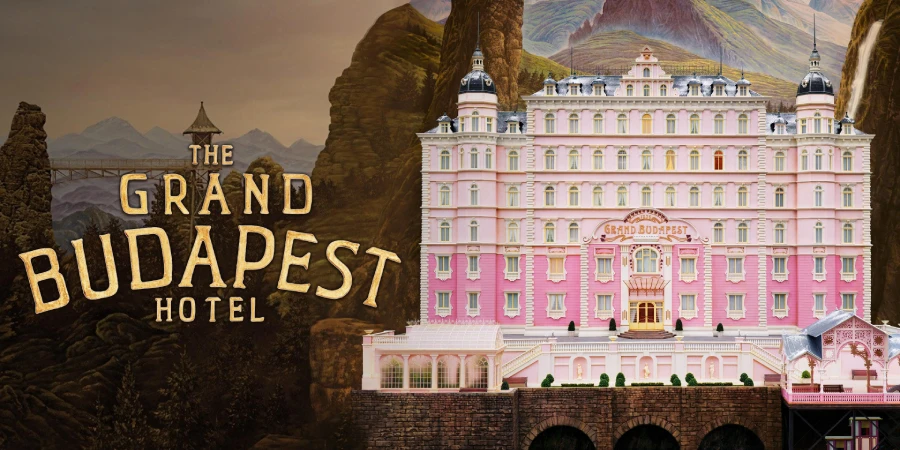

Wes Anderson does not make movies so much as he constructs elaborate, hand-painted worlds where grief hides behind pastel wallpaper and comedy lives next door to tragedy. The Grand Budapest Hotel is arguably his most ambitious construction: a film nested inside a film inside a film, set in a fictional European country on the brink of fascism, anchored by a concierge who treats the art of hospitality as a moral philosophy. It is funny, melancholy, and surprisingly violent, often all within the same scene.
Detailed Summary
A Story Within a Story Within a Story
Anderson opens with a layered framing device that gives the film much of its emotional weight. A young girl visits a statue of a famous author in the present day, reads his book, and we cut to that author (Tom Wilkinson) speaking directly to camera in 1985.
He explains that the story he is about to tell came from a chance encounter. We then cut to 1968, where a young writer (Jude Law) meets the aged Zero Moustafa (F. Murray Abraham) at the crumbling Grand Budapest Hotel in the fictional Republic of Zubrowka.
Zero agrees to tell his story over dinner. The film’s main narrative, set in the 1930s, begins from there. Anderson shoots each time period in a different aspect ratio, a subtle but elegant way of signaling where you are in the story.
Monsieur Gustave and the Young Lobby Boy
Monsieur Gustave H. (Ralph Fiennes) runs the Grand Budapest Hotel with obsessive, theatrical precision. He memorizes guest preferences, recites poetry unprompted, and maintains intimate relationships with a rotating cast of elderly, wealthy female guests.
Young Zero Moustafa (Tony Revolori) arrives as the new lobby boy, eager and earnest. Gustave takes him under his wing immediately, treating him as both apprentice and, gradually, as something close to a son.
Their dynamic forms the emotional spine of the film. Gustave is performative and pompous on the surface, yet he demonstrates genuine loyalty and warmth toward Zero in ways that become increasingly clear as the plot darkens.
Madame D. and the Stolen Painting
Madame Céline Villeneuve Desgoffe-und-Taxis, known as Madame D. (Tilda Swinton, almost unrecognizable under heavy aging makeup), is one of Gustave’s most devoted elderly admirers. She visits the hotel, clearly anxious and frightened, before departing.
Shortly after, she dies under suspicious circumstances. Gustave and Zero travel to her estate for the reading of her will, where a bombshell lands: Madame D. has left Gustave a priceless painting called “Boy with Apple.”
Her son Dmitri Desgoffe-und-Taxis (Adrien Brody) is furious. He controls the family and views Gustave as a scheming opportunist. Before Gustave can secure the painting, Dmitri frames him for Madame D.’s murder.
Prison, Escape, and the Society of the Crossed Keys
Gustave lands in Checkpoint 19 Criminal Internment Camp, a bleak stone prison that Anderson renders with his signature visual precision. Rather than despair, Gustave immediately starts networking with his fellow inmates, led by Ludwig (Harvey Keitel).
He organizes a daring escape through a tunnel the prisoners have been secretly digging. The escape sequence is genuinely tense and playful at once, staged like a miniature heist film.
Meanwhile, Zero calls on the Society of the Crossed Keys, a secret network of hotel concierges across Europe. Each member, played by a different Wes Anderson regular in a brief cameo, helps move Gustave and Zero across the continent.
Agatha, Intrigue, and a Very Dangerous Lawyer
Zero’s girlfriend, Agatha (Saoirse Ronan), works as a baker and carries a distinctive birthmark shaped like Mexico on her cheek. She is clever, calm under pressure, and deeply in love with Zero.
Agatha becomes central to the plot when she infiltrates the Desgoffe-und-Taxis estate to retrieve “Boy with Apple.” She replaces the original with a copy, a sequence involving considerable acrobatic daring inside a museum.
Dmitri has hired J.G. Jopling (Willem Dafoe), a leather-clad assassin with filed teeth, to eliminate anyone who threatens his inheritance. Jopling picks off Madame D.’s lawyer and other inconvenient parties with cheerful brutality.
The Truth About Madame D.’s Death
Gustave and Zero eventually learn that Madame D. did not die of natural causes. Dmitri had her poisoned to prevent her from changing her will further in Gustave’s favor. This transforms the story from a caper into something with genuine moral stakes.
A second will surfaces, one that Madame D. prepared in secret. It leaves the entirety of her vast estate to Gustave, making the painting almost irrelevant by comparison.
Movie Ending
Gustave, Zero, and Agatha find themselves cornered in a cable car station high in the snowy mountains of Zubrowka. Jopling closes in, and for a moment it seems genuinely hopeless. Then, with precise comic timing, a group of militia officers loyal to the Society of the Crossed Keys arrives and throws Jopling off the mountain.
Gustave is vindicated. He inherits Madame D.’s entire fortune and, in a moment of spontaneous generosity, shares it with Zero. Their friendship, tested by everything the plot could throw at it, emerges intact.
However, the film does not let happiness linger. Shortly after, fascist forces formally take over Zubrowka. Soldiers stop their train, and Gustave instinctively steps forward to shield Zero, whose refugee status makes him a target. For a brief moment Gustave’s intervention saves the situation. On a second stop, however, different soldiers are less amenable. Gustave is shot and killed, an abrupt and brutal end for a man who spent his life adding grace to the world.
Zero inherits everything. He later buys the Grand Budapest Hotel himself, not for profit, but because it was the place where he knew Gustave and where he fell in love with Agatha. Agatha herself, we learn from the older Zero speaking to the young writer in 1968, died young from a fever along with their infant child.
This revelation reframes every warm moment we have seen between Zero and Agatha. Zero keeps the hotel as a monument to vanished love and vanished people. Anderson frames the entire film as an act of grief dressed up in pink and purple. Gustave’s world was already disappearing before the guns arrived; the fascists simply finished the job.
Notably, the young writer eventually publishes the story. We return to the present-day girl at the statue, completing the outermost frame. Loss ripples forward through time, but so does the story that preserves it.
Are There Post-Credits Scenes?
The Grand Budapest Hotel does not include any post-credits scenes. Anderson closes the film within its final framing device and offers no additional footage once the credits roll. You can safely leave when the credits begin.
Type of Movie
On paper, this is a comedy-mystery-adventure, but those labels only capture part of what Anderson is doing. Tonally, the film operates as a tragicomedy, using slapstick, wit, and gorgeous production design to smuggle in a deeply melancholy meditation on loss, civilization, and the people who try to maintain beauty in a world sliding toward violence.
In contrast to Anderson’s earlier, lighter work, this film carries a genuine emotional gut punch. It earns its tears precisely because it makes you laugh so hard first.
Cast
- Ralph Fiennes – Monsieur Gustave H.
- Tony Revolori – Young Zero Moustafa
- F. Murray Abraham – Older Zero Moustafa
- Saoirse Ronan – Agatha
- Adrien Brody – Dmitri Desgoffe-und-Taxis
- Willem Dafoe – J.G. Jopling
- Tilda Swinton – Madame D.
- Tom Wilkinson – Older Writer
- Jude Law – Young Writer
- Bill Murray – M. Ivan
- Edward Norton – Henckels
- Jeff Goldblum – Deputy Kovacs
- Harvey Keitel – Ludwig
- Mathieu Amalric – Serge X.
- Owen Wilson – M. Chuck
- Bob Balaban – M. Martin
- Jason Schwartzman – M. Jean
Film Music and Composer
Alexandre Desplat composed the score, earning himself an Academy Award for his work here. Desplat built the music around Eastern European folk instruments, including the balalaika and the cimbalom, giving Zubrowka a sound that feels simultaneously invented and deeply familiar.
Notable tracks include the propulsive Mr. Moustafa and the wistful A Gust of Wind, which underscores the film’s more tender moments. Desplat’s score shifts effortlessly between chase-film energy and quiet sorrow, mirroring Anderson’s own tonal range.
Desplat is a prolific French composer with credits including The King’s Speech and multiple collaborations with Anderson. His ability to evoke a specific, imagined geography through instrumentation alone is one of the score’s great achievements.


Filming Locations
Production primarily took place in Görlitz, Germany, a city straddling the German-Polish border. Anderson used the historic Görlitz department store building, known locally as the Kaufhaus, as the interior of the Grand Budapest Hotel. Its ornate, slightly faded grandeur suited the film’s aesthetic perfectly.
Exterior mountain sequences were filmed in the Saxony region and at various ski resorts in Germany. The snowy, isolated landscapes reinforce the sense of a Europe being slowly strangled by political forces beyond any individual’s control.
Anderson also used miniature models extensively for the hotel exteriors, the cable cars, and certain vehicle sequences. This deliberate artificiality is not a budget compromise; it is a statement about the nature of storytelling and memory. What we see is always a reconstruction.
Awards and Nominations
The Grand Budapest Hotel received nine Academy Award nominations and won four: Best Original Screenplay (Wes Anderson), Best Original Score (Alexandre Desplat), Best Costume Design (Milena Canonero), and Best Production Design.
Furthermore, it won the Silver Bear Grand Jury Prize at the Berlin International Film Festival. At the Golden Globes, it won Best Motion Picture in the Musical or Comedy category. It remains one of Anderson’s most decorated films.
Behind the Scenes Insights
- Ralph Fiennes had never appeared in a Wes Anderson film before this project. Anderson wrote the role of Gustave specifically with Fiennes in mind after imagining how his particular brand of controlled intensity could power a comedic performance.
- Tony Revolori beat out many more experienced actors for the role of young Zero. Anderson favored his natural restraint and quiet emotional presence, which provides the perfect counterbalance to Fiennes’ flamboyance.
- Anderson required actors to deliver their lines at a specific, slightly heightened pace. Several cast members noted that adapting to his rhythm took deliberate practice before it became natural on set.
- Tilda Swinton spent hours in prosthetic and makeup application each day to play the elderly Madame D., a character who appears on screen for a relatively brief time.
- Anderson storyboarded the entire film in extraordinary detail before shooting began, a practice consistent across his career. Very little was improvised on set.
- The production built practical sets inside the Görlitz department store rather than relying entirely on digital environments, giving actors a genuinely lived-in space to perform within.
- Willem Dafoe performed many of his own physical comedy moments as Jopling, leaning into the character’s almost cartoonish menace with evident enthusiasm.
Inspirations and References
Anderson has cited the Austrian writer Stefan Zweig as the primary inspiration for the film’s world and tone. Zweig’s memoirs and novellas, particularly The World of Yesterday, capture the experience of a cultured, cosmopolitan Europe erased by fascism and war. That sense of irreversible loss permeates the film.
Visually, Anderson drew on the aesthetics of central European grand hotels from the early twentieth century, places where elaborate social rituals persisted even as the political ground shifted beneath them. Moreover, the film’s use of a nested narrative structure echoes Zweig’s own storytelling habits.
Anderson also referenced the tradition of Viennese operetta and the films of Ernst Lubitsch, whose sophisticated comedies often balanced charm and darkness in similar proportions. Lubitsch’s influence is visible in the film’s pacing and its treatment of villainy as almost theatrical.
Alternate Endings and Deleted Scenes
Anderson has not released a director’s cut or a widely documented set of deleted scenes for The Grand Budapest Hotel. As a filmmaker who storyboards obsessively, he tends to arrive on set with a very fixed vision, which limits the volume of material cut in post-production.
No alternate ending has been publicly discussed or released. Given how precisely the film’s emotional arc depends on its final revelations about Agatha and Gustave, it is difficult to imagine Anderson seriously entertaining a different conclusion.
Book Adaptations and Differences
The Grand Budapest Hotel is not based on any single book or source text. It is an original screenplay written by Wes Anderson, with a story credit shared with Hugo Guinness. Anderson drew thematic and atmospheric inspiration from Stefan Zweig’s writings, but no specific Zweig work served as a direct source for the plot.
A tie-in book, The Wes Anderson Collection: The Grand Budapest Hotel, was published alongside the film. It documents the production process rather than telling the story; it is a companion piece, not an adaptation.
Memorable Scenes and Quotes
Key Scenes
- Gustave and Zero’s first conversation in the hotel corridor, where Gustave immediately tests and assesses his new lobby boy with rapid-fire questions.
- Madame D.’s will reading, where the revelation of Gustave’s inheritance detonates the entire plot and Dmitri’s fury fills the room.
- The prison escape sequence through the tunnel, combining genuine tension with perfectly timed physical comedy.
- Agatha’s infiltration of the museum to swap “Boy with Apple,” a miniature heist sequence full of visual invention.
- Gustave stepping forward on the train to shield Zero from soldiers, the moment where his character moves from entertaining to genuinely heroic.
- The final dinner scene between older Zero and the young writer, where Zero explains why he kept the declining hotel alive.
- Jopling’s extended pursuit through the mountain snow, played as action-comedy before turning abruptly lethal.
Iconic Quotes
- “You see, there are still faint glimmers of civilization left in this barbaric slaughterhouse that was once known as humanity.” (Monsieur Gustave H.)
- “I go to bed with all my friends.” (Monsieur Gustave H., matter-of-factly)
- “She was dynamite in the sack, by the way.” (Monsieur Gustave H., on Madame D.)
- “Take your hands off my Lobby Boy!” (Monsieur Gustave H.)
- “Keep your hands off my lobby boy.” (Zero, echoing Gustave in the film’s most touching callback)
- “The plot thickens, as they say.” (Monsieur Gustave H.)
Easter Eggs and Hidden Details
- Each time period in the film uses a different aspect ratio: 1.33:1 for the 1930s sections, 1.85:1 for 1968, and 1.78:1 for the modern framing. Anderson embeds film history into the format itself.
- Gustave’s signature perfume, “L’Air de Panache,” is referenced multiple times and becomes a subtle motif for his entire worldview: style as survival.
- The painting “Boy with Apple” was created specifically for the film by British artist Michael Taylor, designed to convincingly resemble a Renaissance masterwork.
- Several of the Society of the Crossed Keys members appear only briefly, but Anderson gives each a distinct visual identity and national character, rewarding attentive viewers.
- Agatha’s Mexico-shaped birthmark is a nod to the Anderson tradition of marking beloved characters with unusual, affectionate physical details.
- The hotel’s pink color was a deliberate choice to evoke both luxury and fragility, a color associated with elegance that also reads as deeply vulnerable against the grey encroachments of war.
- Anderson hides references to Stefan Zweig in the production design, including books and documents visible in background shots that echo Zweig’s titles and world.
- Zero’s name itself carries weight: he arrives with nothing, as a refugee with no documents, and his name reflects his position in the world before Gustave redefines his place in it.
Trivia
- Ralph Fiennes had previously been known primarily for dramatic and villainous roles. His comic timing in this film surprised many critics and opened up a new dimension of his screen persona.
- Anderson wrote Agatha’s role specifically for Saoirse Ronan after being impressed by her precision and intelligence as a performer.
- The film’s fictional country, Zubrowka, shares its name with a brand of Polish bison-grass vodka, a small joke that Anderson has never publicly confirmed as intentional.
- Alexandre Desplat completed the score in an unusually short time, reportedly driven by genuine enthusiasm for the material and his ongoing creative partnership with Anderson.
- Anderson maintained that every actor, regardless of how small their role, received the same detailed briefing on Zubrowka’s history and culture to ensure consistency across performances.
- The film’s production design team built a fully functional pastry counter for the Mendl’s bakery scenes, complete with actual confections matching the elaborate pink boxes seen on screen.
- Edward Norton’s character, Inspector Henckels, is revealed at the end to have been a child guest at the Grand Budapest, connecting the authority of the present to the warmth of the past in a single quiet detail.
Why Watch?
The Grand Budapest Hotel rewards viewers who want both a great time and a genuine emotional experience. Fiennes delivers a career-best comedic performance while Anderson constructs his most visually inventive and thematically rich world to date. Beneath all the pastel whimsy sits a serious, tender argument for beauty and decency in the face of barbarism. Few films manage to be this funny and this heartbreaking simultaneously.
Director’s Other Movies
- Bottle Rocket (1996)
- Rushmore (1998)
- The Royal Tenenbaums (2001)
- The Life Aquatic with Steve Zissou (2004)
- The Darjeeling Limited (2007)
- Fantastic Mr. Fox (2009)
- Moonrise Kingdom (2012)
- Isle of Dogs (2018)
- The French Dispatch (2021)
- Asteroid City (2023)
- The Wonderful Story of Henry Sugar (Short 2023)
Recommended Films for Fans
- Moonrise Kingdom (2012)
- The Royal Tenenbaums (2001)
- Amelie (2001)
- Midnight in Paris (2011)
- The Artist (2011)
- Hugo (2011)
- Gosford Park (2001)
- In Bruges (2008)
- The Crimson Petal and the White (2011)
- Knives Out (2019)