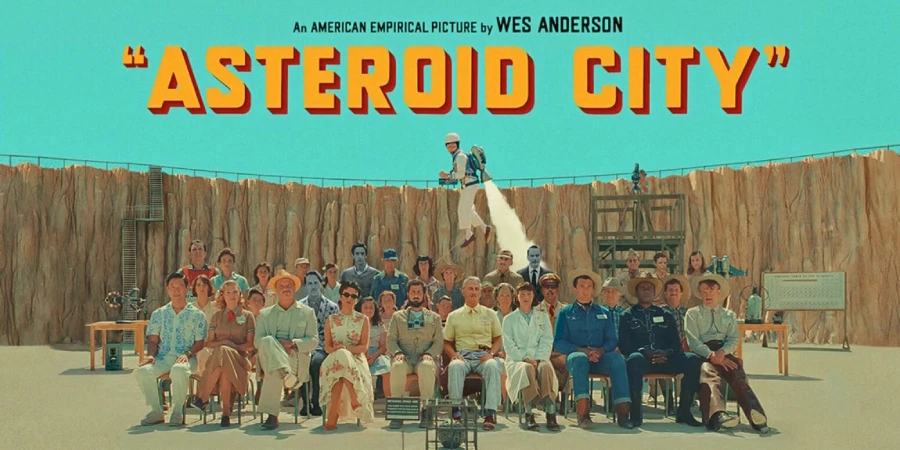

Wes Anderson does not make movies so much as he constructs elaborate puzzles and dares you to find the missing piece. Asteroid City is his most aggressively meta work yet, a film that essentially argues the act of storytelling matters more than the story itself. It wraps a grief-soaked drama inside a fake television documentary inside a fictional stage play, and somehow keeps all three plates spinning without dropping a single one. If you walked out confused, you were paying exactly the right kind of attention.
Detailed Summary
The Outer Frame: A Television Program
The film opens in black and white, presenting itself as a 1950s television broadcast hosted by a journalist played by Bryan Cranston. This program claims to document the creation of a fictional play called Asteroid City, written by an unnamed playwright. The framing device immediately signals that Anderson is not interested in giving you a straightforward story.
Throughout the film, this television layer interrupts the inner narrative. It introduces the cast and creative team behind the play, offering staged interviews and rehearsal footage. However, these interruptions are not distractions; they are the point.
The Play Within the Film: Asteroid City, USA
Inside the television broadcast lives the actual play, presented in color and in Anderson’s signature widescreen format. Set in a fictional desert town called Asteroid City in 1955, the story follows a group of people stranded there after witnessing an extraordinary event. A junior stargazer competition has drawn families, scientists, and reporters to this remote location.
Auggie Steenbeck, played by Jason Schwartzman, arrives with his four children. He is a war photographer still processing the recent death of his wife. His father-in-law, played by Tom Hanks, drives out to help, largely because Auggie cannot bring himself to tell his kids their mother is gone.
The Alien Arrives
During the stargazer competition, an alien spacecraft lands at the crater. A single alien emerges, briefly examines the meteorite at the center of town, and then disappears back into the sky. This happens quickly, almost casually, as if Anderson is deliberately deflating the spectacle. Consequently, the moment lands with more surreal weight than any blockbuster alien arrival scene.
The government immediately quarantines the town. Nobody can leave. Military personnel, led by a general played by Jeffrey Wright, lock down the entire area under strict orders. The stranded visitors, including a famous actress named Midge Campbell played by Scarlett Johansson, must simply wait.
Auggie and Midge
Auggie and Midge begin talking across their adjoining motel courtyard. A fragile, tentative romance forms between them. Both carry emotional damage; Midge is dealing with her own unnamed personal crisis. Their conversations are tender, stilted, and genuinely moving in a way that sneaks up on you.
Auggie finally tells his children that their mother has died. He confesses he kept the secret because he did not know how to deliver that kind of grief. Moreover, the scene reframes everything that came before it, adding retroactive emotional weight to his exhausted, disconnected behavior throughout.
The Playwright’s Crisis
Back in the television frame, we learn the playwright behind Asteroid City has died before the broadcast airs. His writing teacher, played by Edward Norton, steps in to explain and interpret the work. Meanwhile, the actor playing Auggie, referred to in this layer as Jones Hall, struggles to connect with the material.
Jones Hall seeks out his acting teacher, played by Willem Dafoe, for guidance. He cannot understand what the play means. His teacher gives him the central piece of advice of the entire film: you will never understand it, so just keep telling the story anyway.
The Quarantine Continues
Life inside the quarantine settles into a strange routine. Children conduct experiments. Adults drift into odd conversational orbits. A group of cowboys keeps appearing on the ridge above town, functioning almost like a Greek chorus. The military refuses to explain when or whether the quarantine will lift.
The alien returns briefly, stealing the meteorite again. The government recovers it. Scientists debate its significance. In contrast to the enormous stakes this scenario should carry, everyone treats the situation with a kind of weary pragmatism. That tonal choice is central to what Anderson is doing.
Auggie’s Breakdown and the Dream Sequence
Auggie experiences a kind of emotional breakdown, shown in a striking visual sequence where he steps outside the frame of the play itself. He looks directly into the void between the television program and the stage drama. Notably, this is the film’s most explicit moment of meta-commentary, where grief and narrative confusion literally merge.
His children, meanwhile, seem to be processing loss more effectively than he is. They run experiments, form bonds with other children at the competition, and display a resilience that quietly shames their father. Anderson frames them with warmth but without sentimentality.


Movie Ending
Federal authorities eventually lift the quarantine without explanation. Everyone returns to their cars and drives away. No resolution about the alien arrives; no government transparency follows. Auggie and Midge share a final exchange across the courtyard that is warm but deliberately incomplete. They do not get a tidy romantic conclusion, and Anderson refuses to give the audience one either.
Back in the television frame, Jones Hall sits with his confusion. His teacher’s instruction, to keep telling the story even without understanding it, functions as the film’s thesis. Storytelling, Anderson argues, does not require resolution. It requires repetition, commitment, and presence.
The final moments cycle back through images from the film: the crater, the motel, the desert sky. A title card repeats the line, “You can’t wake up if you don’t fall asleep.” This phrase appears multiple times throughout the film, spoken by different characters in different contexts. By the end, it reads as a statement about grief, about creative process, and about the impossibility of closure. Furthermore, it lands differently each time you encounter it, which is the entire point.
What the ending ultimately communicates is that meaning does not live inside the alien encounter or the quarantine or the romance. It lives in the act of gathering people together and telling the story again. Auggie never fully heals. Jones Hall never fully understands his role. However, both keep moving, and Anderson suggests that might be enough.
Are There Post-Credits Scenes?
Asteroid City does not include any post-credits scenes. Once the final title cards appear, the film is over. You are free to sit with your confusion immediately.
Type of Movie
Asteroid City is a meta-comedy drama with science fiction elements. Its tone is melancholic, deadpan, and visually hypnotic. Anderson leans into absurdism throughout, but genuine emotional grief anchors the film beneath its layers of irony.
In contrast to Anderson’s more whimsical works, this one feels more preoccupied with mortality and incomprehension. It rewards patient, attentive viewers who are comfortable sitting with ambiguity.
Cast
- Jason Schwartzman – Auggie Steenbeck / Jones Hall
- Scarlett Johansson – Midge Campbell
- Tom Hanks – Stanley Zak
- Jeffrey Wright – General Gibson
- Tilda Swinton – Dr. Hickenlooper
- Bryan Cranston – The Host
- Edward Norton – Conrad Earp (the playwright’s teacher)
- Adrien Brody – Schubert Green (the director)
- Liev Schreiber – Montana
- Hope Davis – Sandy Borden
- Stephen Park – Jerry
- Rupert Friend – Montana’s brother
- Maya Hawke – June Douglas
- Steve Carell – Motel Manager
- Matt Dillon – Hank
- Willem Dafoe – Saltzburg Keitel (acting teacher)
- Hong Chau – Polly Green
- Margot Robbie – Actress (brief appearance in television frame)
Film Music and Composer
Alexandre Desplat composed the score for Asteroid City. Desplat has collaborated with Anderson on multiple films, and their working relationship produces music that feels like a character rather than a backdrop. His work here blends sparse, dry desert textures with period-appropriate orchestration.
The score mirrors the film’s emotional restraint. It never swells dramatically; instead, it nudges. Desplat uses woodwinds and light percussion to create a sense of anxious stillness that suits the quarantine setting perfectly.
Period songs also feature throughout, reinforcing the 1950s atmosphere of the inner narrative. The musical choices feel curated with Anderson’s typical obsessive precision.



Filming Locations
Anderson shot Asteroid City primarily in Spain, specifically in the desert landscapes of Chinchon and the surrounding areas near Madrid. These locations provided the flat, arid, otherworldly terrain that the fictional American Southwest setting required. Notably, Anderson needed a real desert that felt artificial, and the Spanish landscape delivered that paradox beautifully.
Studio work complemented the location shooting. The television frame sequences required controlled, black-and-white studio environments that reinforced their artificiality. Together, the practical locations and studio work create a layered visual texture that supports the film’s nested-narrative structure.
Awards and Nominations
Asteroid City received nominations at several awards bodies following its premiere at the Cannes Film Festival in 2023, where it screened in competition. However, it did not secure major wins at the top-tier ceremonies. Critical reception was divided, which perhaps reflected how deliberately the film resists conventional reward.
Behind the Scenes Insights
- Anderson wrote the screenplay while also developing it as a conceptual exercise in nested storytelling, reportedly fascinated by the idea of a story that interrogates its own existence.
- Jason Schwartzman has described the experience of playing two versions of the same character simultaneously as genuinely disorienting in a productive way.
- The production built a full practical desert town set, with Anderson insisting on physical construction rather than digital environments wherever possible.
- Many cast members spent only a few days on set due to the anthology-style structure of the screenplay, yet the ensemble feels unified because of Anderson’s tight directorial control.
- Tom Hanks joined an Anderson film for the first time with this project, a notable addition to a director known for his recurring repertory company.
- Anderson used anamorphic lenses for the color sequences and a different aspect ratio for the black-and-white television frame, visually reinforcing the distinction between narrative layers.
Inspirations and References
Anderson has cited mid-century American theater as a primary inspiration, particularly the work of playwrights who embedded existential questions inside domestic drama. The television broadcast framing references the early days of American network television, when live drama and documentary programming shared a format.
The 1950s atomic age anxiety runs throughout the film, with the alien and the military quarantine functioning as clear metaphors for Cold War paranoia and government secrecy. In addition, the desert setting evokes the nuclear testing sites of the American Southwest, adding another layer of historical resonance.
Visually, Anderson draws on the work of Edward Hopper and mid-century American commercial illustration. The flat light, geometric compositions, and isolated figures all recall Hopper’s paintings of lonely American spaces.
Alternate Endings and Deleted Scenes
No officially confirmed deleted scenes or alternate endings for Asteroid City have been released or documented in detail. Anderson is famously precise in pre-production, which tends to reduce significant on-set deviation from the screenplay. As a result, major cut content is rarely part of the public conversation around his films.
Book Adaptations and Differences
Asteroid City is not based on any book, novel, or pre-existing literary property. Anderson wrote the original screenplay specifically for this film. Therefore, no source material comparison applies here.



Memorable Scenes and Quotes
Key Scenes
- The alien’s arrival at the crater: brief, unhurried, and staged with almost comic nonchalance, making it one of the most quietly surreal alien encounters in recent cinema.
- Auggie finally telling his children about their mother’s death, a scene that lands with genuine emotional force despite the film’s ornate structural distance.
- Jones Hall stepping outside the frame of the play, standing in the void between narrative layers, as the film’s meta-commentary becomes literal and visual.
- Midge performing an emotional scene for her film while Auggie watches from across the courtyard, the two of them connecting through the act of witnessing performance.
- The acting teacher’s lesson to Jones Hall, where the advice “just keep telling the story” becomes the film’s thematic spine.
- The cowboys on the ridge, appearing and disappearing throughout like a Greek chorus nobody asked for and everyone needed.
Iconic Quotes
- “You can’t wake up if you don’t fall asleep.” (repeated throughout the film by multiple characters)
- “I’m not sure I understand the play.” / “Doesn’t matter. Just keep telling the story.” (Jones Hall and his acting teacher)
- “We witnessed something extraordinary.” (Auggie, about both the alien and his grief)
Easter Eggs and Hidden Details
- The crater at the center of Asteroid City visually echoes the shape of a camera aperture, a subtle nod to the film’s preoccupation with framing and perspective.
- Color temperatures shift slightly each time the narrative moves between layers, a detail that rewards viewers watching on calibrated screens.
- The motel’s room numbers follow a non-sequential pattern that has prompted fan theories about a hidden structural code within the screenplay.
- Background extras in the television frame sequences include figures dressed in costumes that belong to the inner play’s world, blurring the boundary between layers.
- The alien’s design deliberately echoes 1950s science fiction B-movie aesthetics, reinforcing the film’s engagement with period mythology around UFOs and government cover-ups.
- Several book titles visible on shelves in the television frame segments reference real mid-century American playwrights and theorists of drama.
Trivia
- Asteroid City premiered at the Cannes Film Festival in May 2023, Anderson’s most high-profile festival premiere in years.
- Tom Hanks had never worked with Anderson before this film, making his appearance a widely noted event among Anderson’s fanbase.
- Anderson cast Margot Robbie in a small role during a period when she was one of the most in-demand actors in Hollywood, reflecting his ability to attract enormous talent for brief appearances.
- The film runs approximately 105 minutes, making it one of Anderson’s shorter features despite its structural complexity.
- Anderson reportedly described the film to collaborators as being about “the inexplicability of grief,” though that description does not appear in any official marketing materials.
- The black-and-white television segments were shot on separate days from the color sequences, reinforcing the psychological and tonal separation between narrative layers for the cast.
- Alexandre Desplat has scored multiple Anderson films, making him one of the director’s most consistent creative partners alongside cinematographer Robert Yeoman.
Why Watch?
Few films in recent memory ask this much of their audience while also giving this much back. Asteroid City is Anderson at his most formally ambitious, using grief and alienation as raw material for something genuinely original. If you have ever felt the impossible distance between what happened and what it means, this film speaks directly to that experience.
Director’s Other Movies
- Bottle Rocket (1996)
- Rushmore (1998)
- The Royal Tenenbaums (2001)
- The Life Aquatic with Steve Zissou (2004)
- The Darjeeling Limited (2007)
- Fantastic Mr. Fox (2009)
- Moonrise Kingdom (2012)
- The Grand Budapest Hotel (2014)
- Isle of Dogs (2018)
- The French Dispatch (2021)
- The Wonderful Story of Henry Sugar (Short 2023)