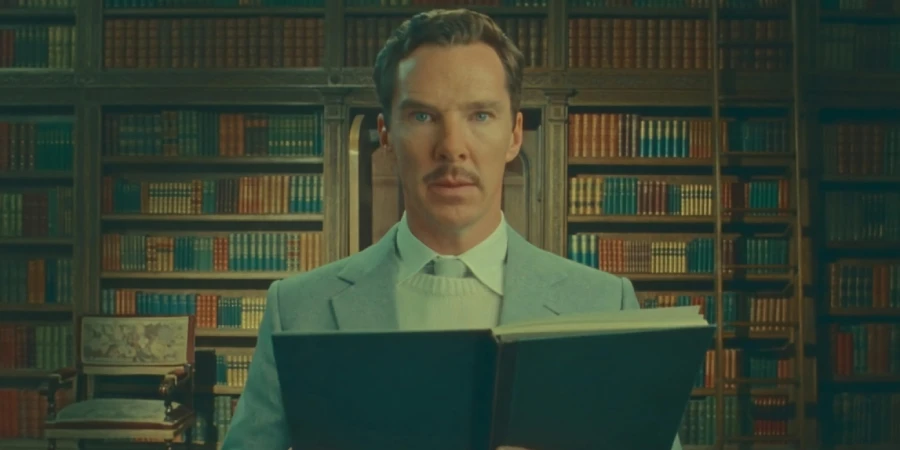

Wes Anderson adapts Roald Dahl with such precise, theatrical audacity that The Wonderful Story of Henry Sugar feels less like a film and more like a magic trick performed in plain sight. Running just 37 minutes, this 2023 Netflix short packs the emotional weight of a feature. Anderson leans fully into self-aware storytelling, letting actors narrate their own actions while playing them out simultaneously. It is a bold, joyful, and surprisingly moving piece of cinema.
Detailed Summary
The Frame: Roald Dahl Introduces His Own Story
Benedict Cumberbatch plays Roald Dahl, who sits at his writing desk and addresses the audience directly. He narrates the setup with calm, slightly mischievous authority. In addition, the production design immediately signals Anderson’s signature world: pastel colors, flat staging, and theatrical artifice on full display.
Dahl explains that what follows is a true story, or at least a story he believes to be true. This framing device is crucial. It plants a seed of wonder that the entire film works hard to cultivate.
Henry Sugar: A Man of Privilege and Boredom
Benedict Cumberbatch then doubles as Henry Sugar himself, a wealthy, idle man with no real purpose. Henry lives a comfortable life funded by inherited money. He fills his days with gambling, socializing, and general aimlessness.
Henry stumbles upon a notebook at a friend’s country house. Inside, a doctor named Zeb has recorded a remarkable account. That account changes everything.
The Doctor’s Account: Imdad Khan and the Power of Sight
Dev Patel plays Dr. Zeb, who narrates his own past experience in person. Zeb recounts meeting a street performer in India named Imdad Khan, played by Ben Kingsley. Imdad could see without using his eyes, a skill he had developed through years of intense yogic meditation.
Imdad demonstrates his ability by reading a playing card held behind his head. Zeb is stunned. He records everything Imdad tells him about the training process, which involves extreme focus, breathing exercises, and decades of discipline.
Imdad Khan’s Origin Story
Imdad explains how he spent years studying under a great yogi. He practiced seeing through solid objects by training his mind and body to a near-supernatural state. Consequently, he developed genuine x-ray-like vision, which he eventually used not for enlightenment but for modest street performance.
There is a melancholy thread running through Imdad’s story. He achieved something extraordinary and then used it for very little. Anderson presents this without judgment, but the implication hangs in the air.
Henry Trains Himself
Henry reads Zeb’s notebook obsessively. He immediately recognizes an opportunity to cheat at cards. For three years, Henry trains in secret, following Imdad’s methods with single-minded dedication.
This section shows Henry’s transformation from a hollow, bored man into someone capable of genuine discipline. However, his motivation at this stage remains entirely selfish. He wants money, not wisdom.
Henry Hits the Casinos
Henry takes his new ability to casinos around the world and wins enormous sums of money. He cheats systematically, seeing through the backs of playing cards with ease. Casino staff grow suspicious, but Henry always moves on before they can catch him.
A turning point arrives when Henry wins a massive sum and feels nothing. The thrill he expected never comes. He sits alone with his winnings and confronts a profound emptiness.
The Shift: Giving It All Away
Henry decides to donate all his winnings to charity. He sets up orphanages across the world, funding them anonymously with his casino earnings. Moreover, he continues gambling, cycling his winnings continuously into charitable causes.
Henry adopts a series of disguises to avoid casino bans and continues his one-man redistribution scheme. He never stops. He gives away millions over the course of his life.

Movie Ending
Henry Sugar spends decades traveling the world, winning and giving, until his body finally gives out. He dies alone, still in disguise, still in the process of giving. There is no deathbed scene loaded with sentiment; Anderson keeps it brief and matter-of-fact, which makes it hit harder.
Dahl steps back in to close the frame. He sits at his desk again and reflects on what Henry’s life ultimately meant. The story returns full circle to its narrator, and the theatrical structure snaps shut with satisfying elegance.
What makes the ending resonate is the quiet irony at its heart. Henry started by learning to see through things literally, and finished by seeing through the things that had blinded him: wealth, vanity, and purposelessness. Furthermore, his transformation required no dramatic catalyst, just a notebook and three years of stubborn effort.
Anderson does not let the ending become sentimental or overwrought. Henry is not a saint; the film never claims he is. Nonetheless, his life, once redirected, becomes genuinely meaningful, and the film earns its emotional payoff without manipulating the audience to get there.
Are There Post-Credits Scenes?
The Wonderful Story of Henry Sugar contains no post-credits scene. Given its short runtime and self-contained theatrical structure, this is entirely appropriate. Once the final frame closes, the film is simply done.
Type of Movie
This is a literary fantasy drama with strong comedic undertones. Anderson blends whimsy, formalism, and genuine emotional depth into a package that resists easy genre labeling. In contrast to most fantasy films, the magical elements here feel grounded and human-scaled.
Tonally, it sits somewhere between a stage play, a storybook, and a philosophical fable. It is warm but never saccharine. Audiences who love theatrical storytelling will feel immediately at home.
Cast
- Benedict Cumberbatch – Roald Dahl / Henry Sugar
- Dev Patel – Dr. Zeb
- Ben Kingsley – Imdad Khan
- Richard Ayoade – John Winston
Film Music and Composer
Alexandre Desplat composed the score, continuing his long and fruitful collaboration with Wes Anderson. His work here is playful and precise, perfectly mirroring Anderson’s visual rhythm. Desplat favors light, ticking, clockwork-like arrangements that suit the film’s theatrical artifice.
Notably, the music never overwhelms the dialogue-heavy narration. It functions more like punctuation than underscore. Desplat understands Anderson’s world well enough to know when to step back.


Filming Locations
The Wonderful Story of Henry Sugar was filmed almost entirely on studio sets, consistent with Anderson’s broader approach on his Dahl adaptations. Physical locations give way entirely to constructed, painted environments. As a result, the film achieves a storybook unreality that suits Dahl’s material perfectly.
This deliberate artificiality reinforces the meta-theatrical storytelling. Nothing pretends to be real. Everything is openly constructed, and that honesty becomes part of the film’s charm.
Awards and Nominations
The Wonderful Story of Henry Sugar won the Academy Award for Best Live Action Short Film at the 96th Academy Awards. It also received a BAFTA nomination in a corresponding category. For a short film, its awards attention was significant and well-deserved.
Behind the Scenes Insights
- Wes Anderson adapted all four Roald Dahl short films released on Netflix around the same time, treating them as a connected artistic project rather than standalone pieces.
- Benedict Cumberbatch plays two distinct roles, Dahl and Henry Sugar, without changing costume in a traditional sense; the shift is conveyed almost entirely through posture and tone.
- Anderson insisted on highly theatrical staging, with actors delivering lines directly to camera and sets changing visibly mid-scene.
- Ben Kingsley researched yogic meditation practices to bring authenticity to Imdad Khan’s sequences.
- Dev Patel described the filming style as unlike anything he had done before, comparing it to performing inside a living pop-up book.
Inspirations and References
The film adapts Roald Dahl’s short story of the same name, originally published in his 1977 collection The Wonderful Story of Henry Sugar and Six More. Dahl presented the story as factual, claiming Henry Sugar was a real person. Anderson preserves this ambiguity faithfully.
Dahl’s story itself draws on real traditions of yogic discipline and meditation. The figure of Imdad Khan, however, is fictional. Anderson adds no new inspirations beyond the source material; the film trusts Dahl’s original vision completely.
Alternate Endings and Deleted Scenes
No alternate endings or officially confirmed deleted scenes from The Wonderful Story of Henry Sugar have been made public. Given Anderson’s reputation for meticulous pre-production, significant deviation from his shooting script during editing would be surprising. What audiences see almost certainly reflects his original intention.
Book Adaptations and Differences
Anderson’s adaptation is strikingly faithful to Dahl’s original short story. Rather than opening the narrative up into cinematic spectacle, Anderson doubles down on the literary quality of the source. He uses direct narration drawn closely from Dahl’s own prose.
One notable difference is the self-referential casting of Cumberbatch as Dahl himself, which makes the frame story more visually dynamic than it is on the page. Otherwise, Anderson changes very little. This fidelity is a creative choice, not a limitation.

Memorable Scenes and Quotes
Key Scenes
- Imdad Khan’s demonstration of sightless vision, reading a card held behind his head while Dr. Zeb watches in stunned silence.
- Henry sitting alone with his enormous casino winnings, realizing the victory feels completely hollow.
- Henry’s montage of disguises as he moves from casino to casino across the globe, systematically winning and donating.
- Dahl closing the frame at his writing desk, reflecting on Henry’s life with quiet admiration.
- The three-year training sequence, condensed into a precise, rhythmically edited passage that captures obsession without glamorizing it.
Iconic Quotes
- “I am going to give it all away.” Henry Sugar, arriving at his central revelation with no fanfare.
- “He had learned to see. Not just with his eyes.” Dahl, closing the story with characteristic economy.
Easter Eggs and Hidden Details
- The notebook Dr. Zeb writes in closely resembles notebooks associated with Dahl’s own personal writing habits, a subtle visual nod to the author’s real life.
- Set dressings shift mid-scene without cuts, a technique Anderson uses throughout to keep the audience aware they are watching a constructed fiction.
- Cumberbatch’s posture as Dahl is notably more relaxed than his posture as Henry Sugar, a physical detail that helps audiences track the dual role without confusion.
- The card suits visible during Henry’s casino scenes are precisely choreographed to reflect the specific games Dahl describes in the source text.
Trivia
- This short was released on Netflix alongside three other Wes Anderson adaptations of Dahl stories: The Swan, The Rat Catcher, and Poison.
- At 37 minutes, it is the longest of the four Anderson-Dahl Netflix shorts.
- Anderson and Dahl’s estate worked closely together on all four productions, ensuring fidelity to the original texts.
- Benedict Cumberbatch won significant critical praise for his ability to differentiate two roles without relying on heavy makeup or costume changes.
- Alexandre Desplat has now scored multiple Wes Anderson films, making him one of Anderson’s most consistent creative collaborators.
Why Watch?
Few films this short pack this much craft, wit, and genuine feeling into a single viewing. Anderson and Dahl together make a combination that rewards both casual viewers and film students. For anyone curious about what cinema can do when it fully commits to its own theatrical nature, this short is essential viewing.
Director’s Other Movies
- Bottle Rocket (1996)
- Rushmore (1998)
- The Royal Tenenbaums (2001)
- The Life Aquatic with Steve Zissou (2004)
- The Darjeeling Limited (2007)
- Fantastic Mr. Fox (2009)
- Moonrise Kingdom (2012)
- The Grand Budapest Hotel (2014)
- Isle of Dogs (2018)
- The French Dispatch (2021)
- Asteroid City (2023)