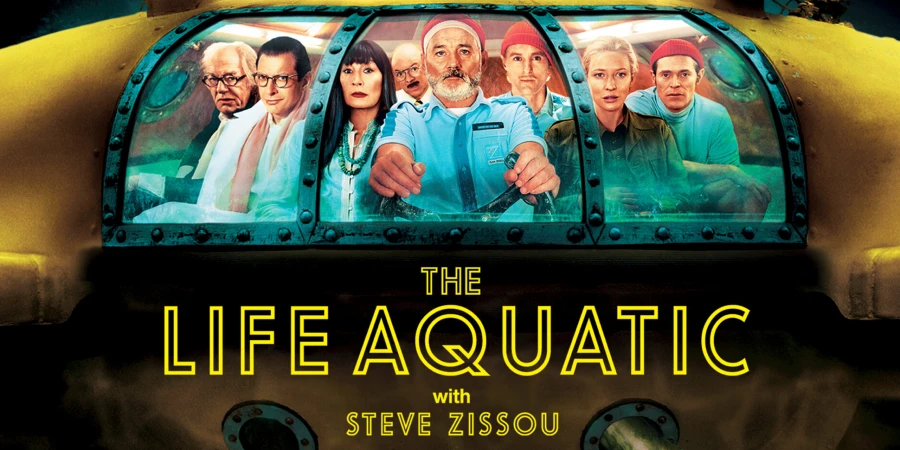

Wes Anderson made a film about grief, fatherhood, and revenge, then dressed it up in matching jumpsuits and sent everyone onto a boat. The Life Aquatic with Steve Zissou is one of his most divisive works, yet also one of his most emotionally raw. Beneath the pastel colors and deadpan humor, a genuinely aching story about loss and identity quietly runs the whole show. It deserves far more credit than it typically receives.
Detailed Summary
A Legend Introduced at His Lowest Point
Steve Zissou, played by Bill Murray, is a Jacques Cousteau-style oceanographer whose career has clearly seen better days. We meet him at a film premiere where his latest documentary receives a lukewarm reception. His best friend and diving partner, Esteban du Plantier, has just been killed by a mysterious creature Steve calls the Jaguar Shark.
Steve announces, at a press conference, that his next expedition will hunt and kill the Jaguar Shark in revenge. Most people question whether the shark even exists. However, Steve commits to the mission with the conviction of a man who has nothing left to lose.
Ned Plimpton Arrives
A young Kentucky air safety inspector named Ned Plimpton, played by Owen Wilson, approaches Steve after the premiere. Ned believes Steve is his father. Steve is not immediately welcoming, but he allows Ned to join the crew of his vessel, the Belafonte.
Steve’s estranged wife, Eleanor, played by Anjelica Huston, co-finances the expeditions and tolerates Steve’s ego with weary dignity. She is, in many ways, the most competent person on the boat. Meanwhile, Steve’s rival, the polished and well-funded Alistair Hennessey, played by Jeff Goldblum, lurks as a constant source of professional humiliation.
Jane Winslett-Richardson and the Crew
A pregnant journalist named Jane Winslett-Richardson, played by Cate Blanchett, boards the Belafonte to write a profile on Steve. Both Steve and Ned develop feelings for her, which creates a quietly uncomfortable love triangle. Jane is sharp and observant, and her reporting instincts bring an outsider’s clarity to the circus around her.
The crew of the Belafonte is a wonderfully eccentric ensemble. Klaus, played by Willem Dafoe, is Steve’s fiercely loyal German crew member who resents Ned’s arrival with barely concealed jealousy. In addition, there is a Filipino intern named Pele who performs David Bowie songs on acoustic guitar, entirely in Portuguese.
The Expedition Begins and Falls Apart
Steve’s funding is precarious, his equipment is outdated, and his documentary crew films everything with the detached eye of people witnessing a slow disaster. The expedition heads toward the area where Esteban died. Tensions rise between Steve and nearly everyone aboard.
At one point, Steve and his crew board Alistair Hennessey’s far superior research vessel, which ends in an awkward and slightly humiliating encounter. Consequently, Steve’s insecurities deepen. He genuinely cares about his work, but his ego consistently sabotages his relationships.
Pirates, Kidnapping, and Chaos
The expedition takes a violent turn when Filipino pirates attack and kidnap several crew members, including Alistair Hennessey. Steve mounts a rescue operation that is equal parts heroic and absurd. He and a small team storm the pirates’ island compound in a sequence that plays like a low-budget action film staged by someone who has never actually done anything like this before.
Notably, the rescue succeeds, and Steve earns a moment of genuine respect from Alistair. It is a brief thaw in their rivalry, though it does not last long. The sequence also reveals that Steve, for all his bluster, will act decisively when people he cares about are in danger.
Ned’s Paternity and Emotional Core
A DNA test confirms that Steve is indeed Ned’s biological father. Steve quietly accepts this, though he struggles to express warmth in any conventional way. Their relationship develops slowly through shared activities and Steve’s awkward attempts at mentorship.
Ned genuinely admires Steve and wants his approval. Steve, for his part, seems to recognize in Ned a chance at a relationship he never properly built with anyone. However, the film refuses to let sentiment become easy.
The Death of Ned
Near the film’s climax, the helicopter carrying Ned and some crew members crashes into the sea. Ned does not survive. His death hits the film like a punch, arriving without warning and without dramatic preparation.
Steve loses the son he only just found. As a result, the revenge mission against the Jaguar Shark takes on an even heavier weight. Grief upon grief now defines Steve’s emotional state.


Movie Ending
Steve and the remaining crew descend in their small submarine to the deep-sea trench where the Jaguar Shark lives. They find it: a massive, luminescent, genuinely beautiful creature gliding through the dark water. Steve does not kill it.
He simply watches. His crew watches. Everyone sits in silence, looking at this extraordinary animal that killed his best friend. Steve quietly says it is the most beautiful thing he has ever seen. The moment carries enormous emotional weight, arriving with no fanfare and no swelling musical crescendo.
In that submarine, Steve’s grief, his obsession, and his career all converge. He came for revenge and instead found something closer to acceptance. Furthermore, the scene reframes the entire film: Steve was never really about the science or the documentaries. He was searching for meaning, and the shark, alive and magnificent, gives him something a dead shark never could.
Back on the surface, the crew gathers on the Belafonte. Steve, overwhelmed, falls asleep surrounded by his team. Klaus finally drops his resentment and holds Steve’s hand. Eleanor watches with quiet understanding. Jane, who has developed a genuine affection for Steve, is also present.
The film closes on Steve walking through a crowd of admirers and fans at a dock. Children in matching jumpsuits run alongside him. On the other hand, this is not a triumphant finale; it is something more melancholy and true. Steve Zissou has survived his grief, just barely, and the world moves on around him whether he is ready or not.
Are There Post-Credits Scenes?
The Life Aquatic with Steve Zissou contains no post-credits scenes. Once the credits roll, the film is done. You can safely leave without missing anything.
Type of Movie
This film occupies a genuinely unusual tonal space. It is officially a comedy-drama, but that label barely covers what Anderson is doing here. Dry humor, visual absurdism, and deep emotional sadness all coexist in the same scenes.
In contrast to Anderson’s lighter works, this one leans harder into loss and failure. Fans of quirky, melancholy filmmaking will feel at home. Those expecting a straightforward comedy may find it disorienting, which is, frankly, part of the point.
Cast
- Bill Murray – Steve Zissou
- Owen Wilson – Ned Plimpton
- Cate Blanchett – Jane Winslett-Richardson
- Anjelica Huston – Eleanor Zissou
- Willem Dafoe – Klaus Daimler
- Jeff Goldblum – Alistair Hennessey
- Michael Gambon – Oseary Drakoulias
- Bud Cort – Bill Ubell
- Seu Jorge – Pele dos Santos
- Noah Taylor – Vladimir Wolodarsky
- Robyn Cohen – Anne-Mary Aldabreze
- Waris Ahluwalia – Vikram Ray
Film Music and Composer
Mark Mothersbaugh, longtime collaborator with Wes Anderson, composed the score. His work here blends orchestral whimsy with genuine melancholy, perfectly matching Anderson’s visual language. Mothersbaugh co-founded the band Devo, and his background in avant-garde pop clearly informs his film scoring sensibility.
Perhaps the most distinctive musical element, however, is not the score itself but Seu Jorge‘s acoustic Portuguese-language Bowie covers. Jorge performs songs including Life on Mars, Rebel Rebel, and Ziggy Stardust in stripped-down acoustic arrangements throughout the film. These performances function almost as a parallel emotional commentary on the story.
David Bowie himself reportedly loved what Jorge did with his songs. A separate album of Jorge’s Bowie covers from the film was released alongside the soundtrack. Both releases reward repeated listening.


Filming Locations
Much of the film was shot in Italy, primarily around the coastal areas of Cinecittà Studios in Rome, where Anderson constructed a cross-section of the Belafonte as a working set. This allowed the famous dollhouse-style side-on shots showing multiple rooms of the ship simultaneously. Anderson’s architectural obsession with symmetry and contained worlds found a perfect canvas here.
Outdoor ocean sequences were filmed along the Italian coastline and at various Mediterranean locations. The warm, slightly faded light of southern Europe gives the film its distinctive golden-tinged visual texture. Furthermore, shooting in Italy allowed Anderson to draw on a certain European art-film atmosphere that suits the mock-documentary framing of Steve’s world.
Awards and Nominations
The Life Aquatic with Steve Zissou received limited awards attention upon release. It earned some recognition for its visual and costume design within industry circles, but no major Oscar nominations. Critics were divided at the time, and the awards conversation largely passed it by.
Behind the Scenes Insights
- Wes Anderson and co-writer Noah Baumbach developed the script together, with Baumbach helping to ground some of the more emotionally direct material.
- Anderson built a full cross-section of the Belafonte at Cinecittà, allowing the camera to glide between rooms in a single take during key scenes.
- Bill Murray reportedly brought significant personal investment to the role, channeling genuine emotions about loss and aging into Steve’s quieter moments.
- Seu Jorge was cast partly because Anderson heard his music and immediately wanted those Portuguese Bowie covers woven into the film’s fabric.
- Many of the sea creatures in the film, including the Jaguar Shark, were created using stop-motion animation by Henry Selick‘s team, giving them a deliberately handmade, slightly unreal quality.
- Anderson reportedly screened Jacques Cousteau documentaries extensively during pre-production to capture the specific visual language and rhythm of that style of filmmaking.
- Willem Dafoe has spoken about enjoying the physical specificity of Klaus, particularly the character’s almost childlike emotional directness beneath the tough exterior.
Inspirations and References
The most direct inspiration is Jacques-Yves Cousteau, the legendary French oceanographer and documentary filmmaker. Steve Zissou’s jumpsuit, his vessel, his team structure, and his documentary style all directly reference Cousteau’s real-world persona and work. Anderson has confirmed this influence openly.
Beyond Cousteau, the film draws on a tradition of European art cinema, particularly films about aging male artists confronting irrelevance. There are also clear thematic connections to stories about failed fathers and the desperate human need to construct a legacy. Co-writer Baumbach brought a sharper, more personal edge to these themes.
Alternate Endings and Deleted Scenes
No officially released alternate endings exist for The Life Aquatic. Anderson is famously precise about his films, and major structural changes rarely surface in his productions. The DVD release included some additional material, but nothing that fundamentally reframes the story.
Some scenes featuring the ensemble crew received less screen time in the final cut than originally planned. However, specific deleted scenes have not been widely publicized or released in detailed form.
Book Adaptations and Differences
The Life Aquatic with Steve Zissou is not based on any book. It is an original screenplay written by Wes Anderson and Noah Baumbach. No source novel or prior text exists to compare it against.



Memorable Scenes and Quotes
Key Scenes
- Steve announces his revenge expedition at the press conference, delivering the news with the flat affect of a man reading a grocery list.
- The side-scrolling tour of the Belafonte cross-section reveals every crew member in their room simultaneously, one of Anderson’s most visually inventive sequences.
- Steve and his team storm the pirates’ compound in a chaotic, low-fi action sequence scored to one of Seu Jorge’s Bowie covers.
- Ned’s helicopter crashes into the sea; the scene arrives without warning and leaves the audience genuinely shaken.
- Steve and his crew encounter the Jaguar Shark in the deep-sea submarine, sitting in silence as the enormous creature drifts past in bioluminescent beauty.
- Klaus finally takes Steve’s hand on the Belafonte, a small gesture that lands with surprising emotional force after his arc of jealousy and loyalty.
Iconic Quotes
- “I’m going to find it and I’m going to destroy it. I don’t know how yet. Possibly with dynamite.” (Steve, on the Jaguar Shark)
- “This is an adventure.” (Steve, repeatedly, in varying tones of conviction and exhaustion)
- “I’ve never seen a bond taken out on a man’s safety before.” (Jane, with characteristic deadpan precision)
- “Son of a bitch, I’m sick of these dolphins.” (Steve, in a line that perfectly captures his exhausted relationship with the natural world he supposedly champions)
Easter Eggs and Hidden Details
- Nearly every sea creature shown in the film, including crabs, sharks, and fish, features a Team Zissou logo painted or tagged onto it, implying Steve has catalogued them all.
- The color red appears obsessively throughout: the Zissou team wears red beanie hats, the Belafonte is trimmed in red, and small red accents appear in nearly every frame.
- Seu Jorge’s character Pele is almost always present in background shots, playing guitar quietly, even in scenes where his presence is not narratively relevant.
- The name Hennessey for Jeff Goldblum’s character is a subtle nod to the cognac brand, playing into the character’s sleek, well-financed image.
- Steve’s bond company stooge, Bill Ubell, appears in increasingly desperate states of dishevelment as the expedition deteriorates, mirroring the mission’s financial collapse visually.
- Many of the fictional documentary clips shown within the film deliberately mimic the actual visual style and pacing of Cousteau Society productions from the 1960s and 1970s.
Trivia
- Seu Jorge performed his Portuguese David Bowie covers live on set between takes, keeping the atmosphere loose and musical during production.
- Anderson and Baumbach have credited their collaboration on this script as a creative partnership where each pushed the other toward more emotional honesty.
- The Jaguar Shark was brought to life using stop-motion animation, a deliberate stylistic choice to give it a mythological, slightly unreal quality rather than a photorealistic one.
- Bill Murray was deeply involved in shaping Steve’s physicality and emotional register, drawing on his own feelings about mortality and creative legacy.
- A companion album titled The Life Aquatic Studio Sessions Featuring Seu Jorge was released, containing all of his Bowie cover performances from the film and additional tracks.
- Anderson shot the film in the 2.35:1 anamorphic widescreen format, giving it a cinematic scope that contrasts with the intimacy of many scenes.
- The fictional in-world documentary style allowed Anderson to include fake awards plaques and fabricated career retrospectives in Steve’s environment, deepening the character’s world.
Why Watch?
The Life Aquatic with Steve Zissou rewards patience and repeat viewing in ways few comedies can claim. Beneath its absurdist surface, it delivers a genuinely moving meditation on grief, failure, and fatherhood. Bill Murray gives one of his finest performances, and the submarine scene alone justifies the entire runtime.
Director’s Other Movies
- Bottle Rocket (1996)
- Rushmore (1998)
- The Royal Tenenbaums (2001)
- The Darjeeling Limited (2007)
- Fantastic Mr. Fox (2009)
- Moonrise Kingdom (2012)
- The Grand Budapest Hotel (2014)
- Isle of Dogs (2018)
- The French Dispatch (2021)
- Asteroid City (2023)