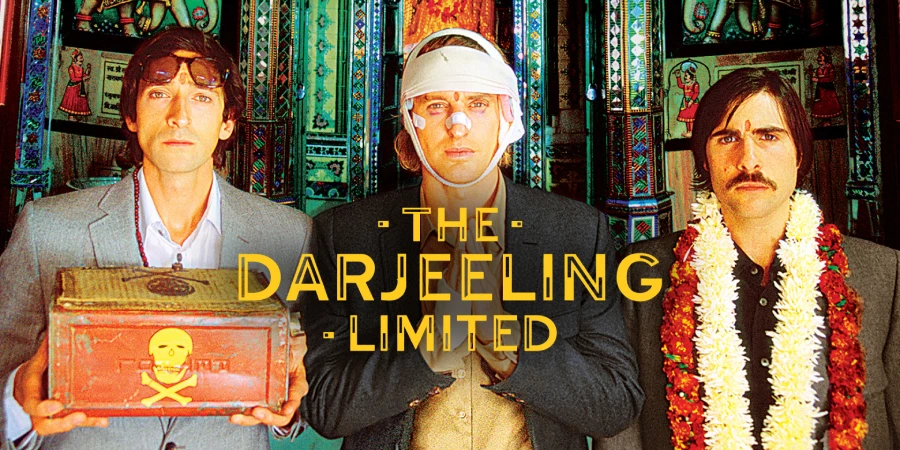

Three brothers board a train in India, draped in Louis Vuitton luggage and unresolved grief, and somehow that sentence perfectly captures Wes Anderson‘s The Darjeeling Limited. This 2007 film is equal parts road movie, family drama, and spiritual farce, wrapped in Anderson’s signature symmetrical aesthetic. It asks whether people can genuinely change or whether they simply carry their baggage, literally and otherwise, from one destination to the next. Spoilers follow, and they are plentiful.
Detailed Summary
The Opening Short: Hotel Chevalier
The Darjeeling Limited screened alongside a short film called Hotel Chevalier, directed by Anderson and set in Paris. Jack Whitman (played by Jason Schwartzman) hides in a hotel room, nursing a broken heart, when his unnamed ex-girlfriend arrives.
She is played by Natalie Portman, and their encounter is tender, melancholy, and laced with unspoken history. This short establishes Jack’s emotional wounds before the main feature begins, giving audiences crucial context for his character’s detachment.
The Race to the Train
The Darjeeling Limited opens with a businessman, played by Bill Murray, sprinting through a chaotic Indian street trying to catch a moving train. He fails. Francis Whitman (played by Owen Wilson), his head wrapped in bandages from a recent motorcycle accident, boards that same train instead.
This brief, wordless scene functions as a thematic overture. It signals that this story belongs to those who catch the train, not those left behind, and it introduces the film’s central tension between momentum and being stuck.
The Brothers Reunite
Francis has orchestrated this entire train journey across India, insisting his two brothers join him for a “spiritual journey.” Peter Whitman (Adrien Brody) is about to become a father and is visibly terrified by that fact. Jack is still emotionally paralyzed by his ex-girlfriend.
Francis has laminated itineraries, scheduled activities, and purchased identical luggage for all three brothers. His controlling behavior masks something far more fragile, a man genuinely frightened he almost died and desperate to force a familial reconnection.
Rituals, Arguments, and a Cobra
On the train, the brothers bicker constantly. Peter has taken their late father’s belt, sunglasses, and car, which infuriates Francis. Jack refuses to stop calling his ex, played briefly via speakerphone in tense, painful exchanges.
Meanwhile, Francis keeps referring to a mysterious “surprise” awaiting them at the end of the journey. The brothers participate in half-hearted spiritual exercises, visit a temple, and generally fail to achieve the enlightenment Francis has scheduled for them. At one point, a venomous cobra escapes in their train compartment, adding physical chaos to the emotional kind.
The River Tragedy
This is the scene that cracks the film wide open. The brothers stop near a river where they witness three young local boys struggling against a fierce current. They dive in immediately, without hesitation.
Two boys survive. The youngest, named Itu, does not. Peter carries Itu’s small body from the water, and the image is devastating. Consequently, this moment of genuine selfless action stands in stark contrast to every petty squabble that preceded it.
The Funeral and the Village
Itu’s father invites the three brothers to the funeral. They participate respectfully, sitting among the grieving family in a village that has no reason to welcome them but does anyway. In addition, the ceremony quietly mirrors their own unprocessed grief over their father’s death.
Peter places his father’s belt around Itu’s small wrist during the burial. It is a moment of profound, unscripted letting-go, the first time anyone in this film actually releases something they have been holding too tightly.
Ejected from the Train
Following the river incident, the railway expels the brothers from The Darjeeling Limited for various accumulated transgressions, including the cobra. They find themselves stranded in the middle of the Indian countryside, surrounded by their many matching suitcases.
Francis finally reveals the “surprise”: he has arranged for them to visit their mother, Patricia Whitman (Anjelica Huston), who abandoned the family to run a convent in the Himalayan foothills. The revelation lands like a second punch after the river scene.
The Mother
Patricia is warm but fundamentally elusive. She feeds them, shelters them, and then tells them she is leaving before dawn to go on a tiger hunt, clearly prioritizing yet another escape over her sons. Francis, Peter, and Jack each react differently, but none of them get the maternal reunion they quietly hoped for.
She leaves before sunrise, as promised. However, her absence here resonates differently than it did at their father’s funeral, because by now the brothers have started to process loss rather than simply react to it.
Movie Ending
Back at a train station, the brothers sprint to catch a new train, abandoning their mountains of luggage on the platform. Each bag represents something specific: Peter’s inherited objects, Jack’s emotional armor, Francis’s controlling itineraries. As a result, dropping the luggage is not merely a practical decision; it is the film’s central metaphor paying off in a single kinetic image.
They board the train. No tearful reconciliation speech, no tidy resolution, no moment where anyone announces they have changed. Anderson trusts the audience to recognize that people rarely change through declarations; they change through small, accumulated actions.
Francis removes his bandages in a brief, quiet shot. His physical wound has healed, and the gesture implies, without belaboring the point, that something internal has shifted too. Peter has begun to accept impending fatherhood rather than flee from it. Jack has, for perhaps the first time, stopped calling his ex.
The train carries them forward. Their father’s death, their mother’s absence, Itu’s drowning, all of it remains unresolved in the way real grief remains unresolved. Notably, the film’s power lies precisely in that refusal to wrap things up. They are still broken, still flawed, but they are moving, and for these three brothers, that is genuinely enough.
Are There Post-Credits Scenes?
The Darjeeling Limited contains no post-credits scene. Once the train departs and the credits roll, the film is finished. Anderson does not use the format for additional material here.
Type of Movie
The Darjeeling Limited occupies a tonal space that is genuinely difficult to categorize. It functions as a comedy-drama, or more precisely, a dramedy, leaning heavily into melancholy without abandoning wit.
It also qualifies as a road movie and a family drama. Anderson filters all of it through his distinctive deadpan aesthetic, which creates an emotional distance that paradoxically makes the film’s genuine gut-punches land harder.
Cast
- Owen Wilson – Francis Whitman
- Adrien Brody – Peter Whitman
- Jason Schwartzman – Jack Whitman
- Anjelica Huston – Patricia Whitman
- Bill Murray – The Businessman (uncredited cameo)
- Natalie Portman – Jack’s Ex-Girlfriend (in Hotel Chevalier)
- Waris Ahluwalia – Chief Steward Victor Dhingra
- Amara Karan – Rita, the train stewardess
- Irfan Khan – Itu’s Father
Film Music and Composer
The Darjeeling Limited does not feature an original orchestral score in the traditional sense. Instead, Anderson curated a soundtrack built primarily around classic Merchant Ivory-era Indian film music and pre-existing tracks.
Much of the music comes from films scored by Satyajit Ray, the legendary Bengali filmmaker. Anderson licensed tracks from Ray’s films, including Pather Panchali and others from the Apu Trilogy, weaving them throughout the journey. Moreover, the choice pays direct homage to Ray’s influence on Anderson’s visual and emotional sensibilities.
The soundtrack also includes tracks from other Indian films of the 1960s and 1970s, creating a sonic landscape that feels both nostalgic and slightly displaced, much like the brothers themselves.
Filming Locations
Production took place almost entirely in Rajasthan, India. Anderson and his team built a functional train set on an actual moving train, shooting scenes on the Rajasthan railway system. This practical approach grounds the film’s heightened visual style in genuine geography.
Specific locations in Rajasthan provided the desert landscapes, village settings, and river sequences. The Himalayan foothills sequence, where Patricia lives in her convent, was also shot in India. Furthermore, these real locations give Anderson’s characteristically artificial visual world an unexpected, dusty authenticity.
Hotel Chevalier was shot in Paris, at the Hotel Raphael. That Parisian prologue, in contrast to the vibrant chaos of India, establishes Jack’s emotional stasis through its claustrophobic, deliberately sterile hotel room setting.
Awards and Nominations
The Darjeeling Limited received limited major awards attention upon release. It screened at the Venice Film Festival in 2007 but did not win major prizes there.
Behind the Scenes Insights
- Wes Anderson wrote the screenplay with Jason Schwartzman and Roman Coppola, and the three of them based elements of it on a trip they took together through India.
- Owen Wilson co-wrote the script while also suffering through a difficult personal period in his own life, which some observers feel adds an unscripted rawness to his performance as Francis.
- Anderson had a functional, fully operational train car built to his specifications so that the interiors could be shot on a real moving train, using natural light through the windows.
- Adrien Brody had not previously worked with Anderson, making him the newcomer to what was already a familiar ensemble of Anderson regulars.
- All eleven pieces of matching luggage used in the film were actually designed by the real Louis Vuitton company, in collaboration with Anderson, as a genuine limited-edition set.
- Anderson scouted locations in India extensively before writing the script, meaning the actual landscape directly shaped the narrative rather than serving it after the fact.
Inspirations and References
Anderson has cited Satyajit Ray as a primary influence on this film, particularly Ray’s Apu Trilogy. The use of Ray’s music is a direct and deliberate tribute to that lineage. Furthermore, the film’s emotional interest in family grief and spiritual searching echoes Ray’s humanist style.
The Merchant Ivory tradition of filming in India, particularly the films of James Ivory and producer Ismail Merchant, also provides a clear cultural backdrop. Anderson engages with and gently subverts the “Westerner abroad in India” cinematic tradition that those films helped establish.
Thematically, the film draws on classic journey narratives and pilgrimage literature, where physical travel becomes a vehicle for internal transformation. However, Anderson consistently undercuts easy spiritual resolution, keeping the film honest about how rarely travel actually fixes people.
Alternate Endings and Deleted Scenes
No officially documented alternate ending or substantial deleted scenes package has been widely released for The Darjeeling Limited. Anderson is known for meticulous pre-production planning, which generally limits the volume of unused material.
Some footage from the Indian location shoot did not make the final cut, but Anderson has not publicly discussed specific deleted scenes in detail. As a result, no alternate-ending information with confirmed details is available to report here.
Book Adaptations and Differences
The Darjeeling Limited is not based on a book or any previously existing source material. Anderson, Schwartzman, and Roman Coppola wrote the original screenplay together, drawing on personal experiences rather than adapting another work.


Memorable Scenes and Quotes
Key Scenes
- Bill Murray’s silent sprint and failure to board the train, setting the film’s tone in under two minutes without a single line of dialogue.
- The river rescue sequence, in which the brothers act instinctively and heroically, only to lose the youngest boy, shifting the film’s emotional register entirely.
- Peter placing his late father’s belt around Itu’s wrist at the funeral, a wordless act of release that functions as the film’s emotional turning point.
- Patricia serving her sons dinner, then calmly announcing she will leave before they wake, delivering abandonment again in the most ordinary possible way.
- The three brothers abandoning their luggage on the platform and sprinting for their train, the film’s most visually and thematically satisfying moment.
- Francis removing his bandages on the train, a quiet, private act that closes the film’s central wound motif.
Iconic Quotes
- “I want us to be brothers again, like we used to be, like before everything went wrong.” (Francis Whitman)
- “I love him too, but I’m going to kill him.” (Francis, about Peter, capturing the entire film’s tone in one sentence)
- “Maybe we could express ourselves more.” (Jack, in the film’s understated plea for emotional honesty)
- “I didn’t make it to the funeral.” (Patricia Whitman, a line that carries enormous weight given everything that follows)
Easter Eggs and Hidden Details
- The eleven pieces of Whitman brothers’ luggage are covered in patches and stickers that, on close inspection, reference their travels and their late father’s belongings, building a visual biography of the family’s history.
- Bill Murray’s opening cameo directly mirrors a scene structure from Anderson’s earlier film Rushmore, where characters physically race toward something they ultimately cannot reach.
- Francis’s bandages remain on for nearly the entire film, and their presence tracks his psychological state: he removes them only after the journey has genuinely worked something through.
- The train itself, The Darjeeling Limited, shares its name with a real historical railway line in India, the Darjeeling Himalayan Railway, a UNESCO World Heritage Site.
- Jack’s short story, which he reads aloud briefly, is transparently autobiographical and closely mirrors events from Hotel Chevalier, a nod to Anderson’s interest in artists who cannibalize their own emotional lives.
- Peter wears their father’s prescription sunglasses throughout the film, a visual shorthand for a son literally trying to see the world through his father’s eyes.
Trivia
- Anderson, Schwartzman, and Roman Coppola each wrote their respective character’s scenes based partly on their own experiences, giving each brother a slightly distinct authorial voice within the script.
- Hotel Chevalier was initially available as a free iTunes download before the film’s theatrical release, an unusual distribution strategy for 2007.
- Some theatrical screenings presented Hotel Chevalier before the main feature; others did not, creating different viewing experiences for different audiences.
- Irfan Khan, who plays Itu’s father, was already a significant figure in Indian cinema and later became internationally known through films such as Slumdog Millionaire and Life of Pi.
- Anderson has described the film as partly about inherited objects and what people do with the things left behind by someone who has died.
- The production worked closely with Indian communities during filming, and Anderson has spoken about the importance of portraying India with specificity rather than as a generic exotic backdrop.
Why Watch?
The Darjeeling Limited rewards patient viewers with one of Anderson’s most emotionally honest explorations of grief, brotherhood, and the stubborn human need to run away. Its visual beauty is immediate, but its emotional intelligence sneaks up on you. For anyone who has ever tried to fix a relationship by changing the scenery, this film will feel uncomfortably familiar.
Director’s Other Movies
- Bottle Rocket (1996)
- Rushmore (1998)
- The Royal Tenenbaums (2001)
- The Life Aquatic with Steve Zissou (2004)
- Fantastic Mr. Fox (2009)
- Moonrise Kingdom (2012)
- The Grand Budapest Hotel (2014)
- Isle of Dogs (2018)
- The French Dispatch (2021)
- Asteroid City (2023)