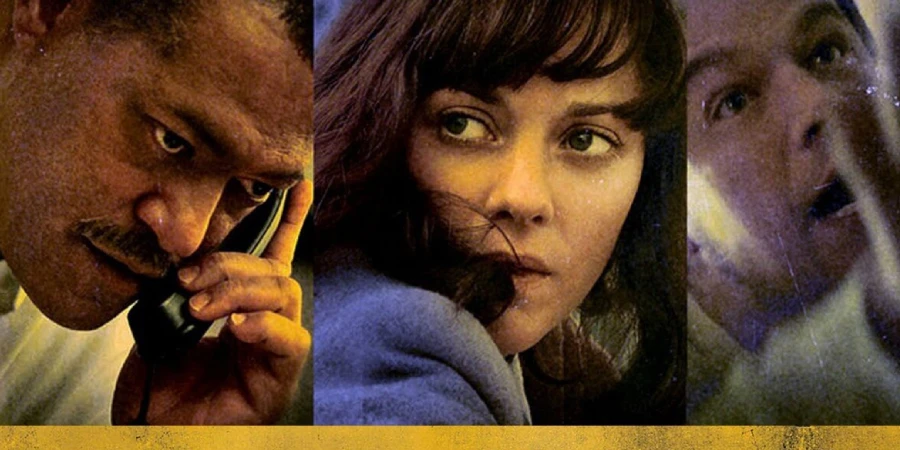

A woman coughs in a casino in Hong Kong, and within days, civilization starts unraveling at the seams. Contagion (2011) is one of those rare films that doubles as a public health lecture and a genuinely gripping thriller, and director Steven Soderbergh pulls off that balancing act with terrifying precision. Every surface, every handshake, every shared breath becomes a threat. This film will change the way you touch your own face.
Detailed Summary
Day 2: Beth Emhoff Returns Home
The film opens not on Day 1, but on Day 2, a deliberately unsettling choice. We see Beth Emhoff (Gwyneth Paltrow) in a Chicago airport, looking pale, coughing, handling credit cards and peanuts at a bar. She travels home to Minneapolis, where she reunites with her husband Mitch (Matt Damon) and their young son Clark.
Within hours, Beth collapses and dies after suffering a violent seizure. Clark dies shortly after. Mitch, somehow, tests immune to the virus. From here, the story fractures into multiple parallel threads, each tracking a different response to the emerging outbreak.
The MEV-1 Virus Spreads Globally
Meanwhile, cases surface simultaneously in Hong Kong, London, and Tokyo. Dr. Erin Mears (Kate Winslet), a CDC Epidemic Intelligence Officer, travels to Minneapolis to trace the outbreak’s origins. She methodically interviews Mitch, constructs contact maps, and documents how quickly MEV-1 is spreading through casual contact.
Soderbergh keeps the science grounded. The film introduces the concept of R0 (the basic reproduction number), explaining that MEV-1 has an R0 of 2, meaning each infected person infects two more. That number compounds terrifyingly fast.
The WHO and CDC Mobilize
Dr. Ellis Cheever (Laurence Fishburne) leads the CDC’s response from Atlanta. He coordinates with Dr. Leonora Orantes (Marion Cotillard) of the World Health Organization, who travels to Hong Kong to trace patient zero. Bureaucracy, politics, and fear complicate every decision at the institutional level.
Cheever makes a personal mistake: he warns his wife to leave Chicago before the city goes into quarantine. That private tip later becomes a scandal, threatening both his credibility and the public’s trust in official institutions.
Alan Krumwiede and the Misinformation Angle
Alan Krumwiede (Jude Law), a freelance blogger and conspiracy theorist, emerges as one of the film’s most chilling figures. He claims that a homeopathic remedy called Forsythia cures MEV-1, faking his own illness and recovery to drive traffic and financial gain. His online reach grows exponentially as public panic replaces rational thinking.
Krumwiede represents a very specific kind of danger: the charismatic spreader of misinformation who profits from catastrophe. Soderbergh clearly positions him as a villain equal in destructiveness to the virus itself. His arc resonates with uncomfortable relevance.
Dr. Mears Becomes a Victim
In a brutal and emotionally gutting turn, Dr. Mears contracts MEV-1 herself. She collapses in a Minneapolis parking lot and ends up in a makeshift field hospital, lying on a cot surrounded by other dying patients. Her final scene, alone, cold, covered by a metallic emergency blanket, is one of the film’s most devastating moments.
Her death underscores that no character is safe in this film. Soderbergh refuses to protect anyone behind the armor of star power or narrative convenience.
Mitch Navigates the Collapse
Back in Minneapolis, Mitch faces a different kind of survival story. He protects his teenage daughter Jory from the outside world while social order deteriorates. Grocery stores empty, people riot over food and supplies, and neighbors turn on each other with alarming speed.
His immunity isolates him in its own way. Mitch cannot grieve Beth properly; he also discovers she was having an affair just before she died, layering personal betrayal onto catastrophic loss.
The Race for a Vaccine
Dr. Ally Hextall (Jennifer Ehle) leads the scientific effort at the CDC to develop a vaccine. Progress is frustratingly slow. In a remarkable act of self-sacrifice, she injects herself with an experimental vaccine before trials complete, then visits her elderly father, who is already infected. Her gamble works: she survives, and he recovers.
This moment captures the film’s quiet heroism. No speech, no dramatic music swell; just a scientist making a terrifying choice because the timeline demands it.
Orantes and the Hong Kong Hostage Situation
In Hong Kong, Dr. Orantes is taken hostage by a local man named Sun Feng, who wants guaranteed vaccine doses for his village. She bonds with the villagers and develops genuine affection for them. Eventually, authorities negotiate her release, and she departs believing her village will receive vaccines among the first allocations.
However, in a quietly devastating coda, she learns that the vaccines her captors received were placebos. Sun Feng had traded her freedom for nothing. She races back to warn them, but the film leaves her fate unresolved.


Movie Ending
Vaccines finally reach the public, distributed through a lottery system based on birthdays. Mitch wins a dose for Jory, and in one of the film’s most tender moments, he arranges a small prom for her at home because the world outside remains too dangerous for normal teenage milestones. It is a portrait of resilience that lands without sentimentality.
Krumwiede, meanwhile, faces legal consequences for securities fraud related to his Forsythia scheme. However, he exits the courtroom already typing on his phone, ready to spin his arrest into more content. The implication is clear: misinformation does not die with accountability; it simply rebrands.
Cheever’s moral compromise gets quietly absorbed into the larger narrative. He participates in an early vaccine program for school-age children, partially as penance. The film never fully exonerates him, and that ambiguity feels honest.
The final sequence answers the film’s central question, which is: where did MEV-1 come from? We watch a construction crew clearing trees in a forest to build a pig farm. A bat, disturbed by the destruction, drops a piece of fruit into a pig pen. A pig eats the fruit. A chef handles the pig, wipes his hands on his apron, and shakes hands with Beth Emhoff at a casino banquet. That handshake is Day 1.
Soderbergh delivers this origin in silence, almost clinically. There is no villain, no malice; just ecological disruption and bad luck cascading into global catastrophe. It is, in many ways, the most frightening ending possible precisely because it is so mundane.
Are There Post-Credits Scenes?
Contagion contains no post-credits scenes whatsoever. Once the final sequence reveals the origin of MEV-1, the credits roll on a quiet, somber note. Soderbergh is not interested in franchise setups or bonus content; the film ends when the story ends.
Type of Movie
Contagion is a medical thriller with strong elements of disaster drama and procedural fiction. Its tone is clinical, restrained, and deeply unsettling without relying on horror tropes or jump scares. Soderbergh prioritizes plausibility over spectacle at every turn.
In contrast to most disaster films, this one does not offer a single hero saving the day. Instead, it portrays collective institutional response, individual human failure, and the slow grind of scientific process. That structural choice makes it feel more like a documentary than a blockbuster.
Cast
- Matt Damon – Mitch Emhoff
- Gwyneth Paltrow – Beth Emhoff
- Laurence Fishburne – Dr. Ellis Cheever
- Kate Winslet – Dr. Erin Mears
- Jude Law – Alan Krumwiede
- Marion Cotillard – Dr. Leonora Orantes
- Jennifer Ehle – Dr. Ally Hextall
- Elliott Gould – Dr. Ian Sussman
- Bryan Cranston – Rear Admiral Lyle Haggerty
- Anna Jacoby-Heron – Jory Emhoff
- Chin Han – Sun Feng
Film Music and Composer
Cliff Martinez composed the score for Contagion, continuing his long creative partnership with Soderbergh. Martinez built the soundtrack around electronic textures, pulsing synthesizers, and minimalist arrangements that feel perpetually unresolved. The music mirrors the virus: invisible, spreading, impossible to contain.
Notably, Martinez used unconventional percussion and layered ambient drones to create a sense of biological unease. His work here ranks among his finest, sitting comfortably alongside his scores for Drive and Spring Breakers. The music never telegraphs emotion; it amplifies anxiety without being manipulative.



Filming Locations
Production shot across multiple real-world cities to ground the story’s global scope. Key locations included Atlanta (standing in for the CDC headquarters), Hong Kong, Chicago, Minneapolis, and San Francisco. Shooting on location rather than on studio backlots gives the film a documentary texture that reinforces its credibility.
Hong Kong’s dense, crowded environments visually communicate how quickly a pathogen can move through a high-population urban center. Atlanta’s institutional architecture lends weight to the CDC scenes. Soderbergh and his team used real spaces deliberately, ensuring the geography itself became part of the storytelling.
Awards and Nominations
Contagion received attention primarily from scientific and public health communities rather than major awards bodies. Kate Winslet earned some critical recognition for her performance, but the film did not receive significant nominations at major ceremonies like the Oscars or Golden Globes.
Its legacy grew considerably after 2020, when it became one of the most-streamed films globally during the COVID-19 pandemic, earning a different kind of recognition as prescient and essential viewing.
Behind the Scenes Insights
- Scott Burns wrote the screenplay after extensive consultations with epidemiologists, virologists, and public health officials to ensure scientific accuracy.
- Lawrence Brilliant, a renowned epidemiologist and former WHO official, served as a consultant on the production.
- Soderbergh deliberately cast actors known for their gravitas and restraint rather than their blockbuster appeal, which reinforces the film’s documentary feel.
- Kate Winslet reportedly studied the work of real CDC field officers to prepare for her role as Dr. Mears.
- Soderbergh served as his own cinematographer under his longtime pseudonym Peter Andrews, maintaining tight creative control over the visual language.
- The production used real medical laboratories and equipment to shoot several key science sequences, adding authenticity to the procedural elements.
- Gwyneth Paltrow’s role required only a few days of shooting despite her character being central to the plot’s emotional engine.
Inspirations and References
Soderbergh and Burns drew heavily from the 1918 influenza pandemic as a historical blueprint for MEV-1’s behavior and societal impact. They also studied the SARS outbreak of 2002 to 2003 and the H1N1 pandemic of 2009 for more recent precedents. Real public health crises directly shaped the film’s timeline, terminology, and institutional responses.
The character of Alan Krumwiede references a broader cultural anxiety about online misinformation that was already visibly growing in the early 2010s. His arc draws from real controversies surrounding alternative medicine advocates and vaccine skeptics. Soderbergh and Burns wanted the misinformation storyline to carry the same dramatic weight as the virus itself.
In addition, the film references classic epidemic fiction like The Andromeda Strain and the public health procedural tradition, though it deliberately avoids the sensationalism those works sometimes embrace.
Alternate Endings and Deleted Scenes
No officially released alternate endings or substantial deleted scenes have been widely documented for Contagion. Soderbergh tends to work with lean, precise scripts and edits, leaving little room for major structural alternatives. The film released essentially as intended.
Some reports suggest early cuts included slightly more development for Dr. Orantes’s final arc in Hong Kong, but specific details of those cuts have not been confirmed publicly. Consequently, the theatrical version remains the definitive cut of the film.
Book Adaptations and Differences
Contagion is not based on any book. Scott Burns wrote the screenplay as an original work developed specifically for the screen in collaboration with scientific consultants. No source novel or adaptation comparison applies here.


Memorable Scenes and Quotes
Key Scenes
- Day 2 opening sequence: Beth in the airport, touching surfaces, coughing; the camera lingers on every contaminated object in excruciating detail.
- Beth’s autopsy: The medical examiner opens her skull and immediately calls a colleague; the scene communicates pure scientific alarm without melodrama.
- Dr. Mears dying on a cot: Alone under a metallic emergency blanket in a makeshift hospital, her death is quiet, unglamorous, and genuinely upsetting.
- Dr. Hextall injecting herself: A moment of extraordinary scientific courage delivered with almost no theatrical emphasis, making it hit harder.
- Mitch’s home prom for Jory: A small, heartbreaking act of parental love set against a world still recovering from catastrophe.
- The origin sequence: The bat, the fruit, the pig, the chef, the handshake; all shown in reverse-engineered silence at the very end.
Iconic Quotes
- “Don’t talk to anyone. Don’t touch anyone. Stay away from other people.” – Mitch Emhoff
- “Somewhere in the world, the wrong pig met up with the wrong bat.” – Dr. Cheever
- “The average person touches their face two to three thousand times a day.” – Dr. Mears
- “Blogging is not writing. It’s just graffiti with punctuation.” – Dr. Sussman, addressing Krumwiede
Easter Eggs and Hidden Details
- The film opens on Day 2, never Day 1; Day 1 is only revealed in the final minutes, a structural Easter egg hiding in plain sight for the entire runtime.
- Soderbergh includes multiple subtle shots of characters touching their faces immediately after touching public surfaces, reinforcing the R0 concept visually before it is explained verbally.
- The MEV-1 virus is constructed as a hybrid of bat coronavirus and Nipah virus, both of which are real pathogens; the scientific plausibility is baked directly into the fictional design.
- Background news broadcasts throughout the film quietly track the rising death toll, functioning as a Greek chorus that most viewers overlook on a first watch.
- Krumwiede’s blog name, Truth Serum Now, is a pointed jab at the self-aggrandizing language common among online conspiracy communities.
- In the Hong Kong sequences, Soderbergh frames crowds from above and at distance, visually representing the epidemiological concept of population-level transmission rather than focusing on individuals.
Trivia
- During the COVID-19 pandemic, Contagion surged to become one of the most-rented and most-streamed films on multiple platforms simultaneously.
- Scientific consultants praised the film’s depiction of the CDC and WHO response as unusually accurate for a Hollywood production.
- Soderbergh has said in interviews that he and Burns specifically wanted to avoid depicting a single heroic scientist who saves the world, a deliberate subversion of the disaster film formula.
- Matt Damon’s character Mitch Emhoff is immune to MEV-1; his immunity serves as a narrative device to observe the outbreak from a civilian perspective without giving him any special power to stop it.
- The production team consulted with the CDC about what a real outbreak response would look like from the inside, and several procedural details in the film reflect actual CDC protocols.
- Jude Law wore fake crooked teeth for the role of Krumwiede, a choice intended to subtly distance the character from Law’s typically polished screen persona.
- The film’s running time is 106 minutes, yet it covers a fictional outbreak timeline spanning many months, achieved through its signature date-stamp structure.
Why Watch?
Contagion is one of the most rigorously honest disaster films ever made, and its accuracy makes it genuinely essential viewing. It treats its audience as intelligent adults capable of handling real science, moral ambiguity, and unglamorous heroism. Moreover, it functions as both a gripping thriller and an effective public health education tool. Few films achieve that combination with such style and conviction.
Director’s Other Movies
- Sex, Lies, and Videotape (1989)
- Traffic (2000)
- Erin Brockovich (2000)
- Ocean’s Eleven (2001)
- Solaris (2002)
- Ocean’s Twelve (2004)
- Syriana (2005, producer)
- Ocean’s Thirteen (2007)
- Che (2008)
- The Informant! (2009)
- Side Effects (2013)
- Behind the Candelabra (2013)
- Logan Lucky (2017)
- Unsane (2018)
- High Flying Bird (2019)
- The Laundromat (2019)
- Kimi (2022)
- Magic Mike’s Last Dance (2023)
Recommended Films for Fans
- Outbreak (1995)
- 28 Days Later (2002)
- The Andromeda Strain (1971)
- World War Z (2013)
- Pandemic (2009) – documentary
- Blindness (2008)
- Children of Men (2006)
- The Road (2009)
- Take Shelter (2011)
- Flu (2013)