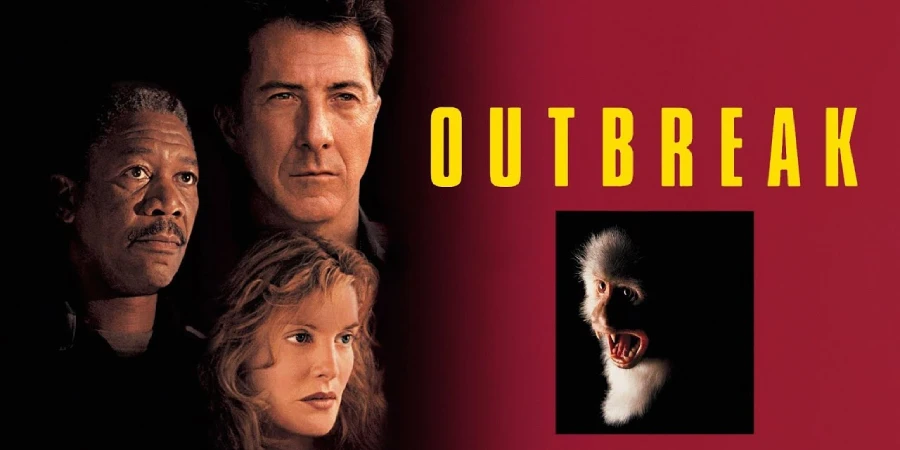

Outbreak (1995) proves that sometimes the most terrifying villain has no face, no motive, and no mercy. A fictional deadly virus tears through a small California town, and the American military’s darkest secret threatens to let it spread. Director Wolfgang Petersen cranks up the paranoia to uncomfortable levels, turning a medical thriller into a full-blown conspiracy nightmare. This film arrived before pandemic anxiety entered the mainstream conversation, which makes rewatching it today feel genuinely unsettling.
Detailed Summary
The African Jungle, 1967: Where It All Begins
A military operation in Motaba River Valley, Zaire, opens the film. American soldiers at a mercenary camp have fallen ill with a catastrophic hemorrhagic fever. Rather than evacuating or treating them, a US military aircraft drops a fuel-air bomb and obliterates the entire camp.
Two Army officers, General Donald McClintock and General Billy Ford, authorized that bombing. They knew about the virus, which they had secretly catalogued as a potential biological weapon. This moment plants the conspiracy at the heart of everything that follows.
Present Day: Colonel Sam Daniels Sounds the Alarm
Jump forward to present day. Colonel Sam Daniels, played by Dustin Hoffman, works for the United States Army Medical Research Institute of Infectious Diseases (USAMRIID). He travels to Zaire after reports of a new outbreak of the Motaba virus emerge.
Daniels witnesses horrifying hemorrhagic fever symptoms in infected villagers. He returns to the US and urges his superiors to classify Motaba at the highest biosafety level. His boss, General Ford, downplays the threat and dismisses Daniels’ recommendations.
The Virus Reaches America
A capuchin monkey carrying the virus gets smuggled into the United States by a dealer named Jimbo Scott. Jimbo sells the monkey to a pet shop in Cedar Creek, a small town in Northern California. This single animal becomes the source of the American outbreak.
Jimbo, now infected, flies to Boston, where he unknowingly spreads the virus to others. Meanwhile, the monkey ends up released into the California wilderness after the pet shop owner refuses to keep it. That loose animal becomes the critical missing piece of the entire crisis.
Cedar Creek Erupts
People in Cedar Creek start dying at a terrifying rate. Dr. Roberta “Robby” Keough, Daniels’ ex-wife and a CDC virologist, arrives to assess the situation. She quickly realizes this outbreak is unlike anything in standard medical literature.
Daniels and his team, including Major Salt and Major Casey Schuler, fly in to assist. The virus spreads through airborne transmission in its mutated form, which is a devastating escalation from the original contact-spread strain. Cedar Creek gets placed under military quarantine.
The Conspiracy Deepens
General McClintock, now in charge of the military response, has a hidden agenda. He wants the original Motaba strain preserved as a bioweapon, which means he has no interest in finding a cure or containing the mutation. Consequently, he actively obstructs Daniels at every turn.
Robby becomes infected during her work in the containment zone. This transforms the mission for Daniels from professional duty into a desperate personal race. His ex-wife’s life now hangs on his ability to find an antiserum before McClintock shuts him down.
The Hunt for the Host Animal
Daniels deduces that a host animal, specifically the original monkey, must exist somewhere near Cedar Creek. Without isolating that animal, producing an antiserum becomes impossible. He and Salt conduct a frantic aerial and ground search for the capuchin.
They eventually locate the monkey after tracing its movements through a combination of eyewitness accounts and sheer persistence. Capturing it alive gives them the antibodies they need. However, McClintock is simultaneously pushing for a more extreme solution to the outbreak entirely.
Movie Ending
McClintock receives authorization to deploy a fuel-air bomb over Cedar Creek, exactly as he did in Zaire in 1967. His justification: containing the virus by eliminating everyone infected. General Ford, initially complicit, begins to waver as he realizes McClintock intends to murder an entire American town.
Daniels learns about the bomb order and takes drastic action. He and Salt steal a helicopter and physically intercept the military aircraft carrying the bomb. Daniels broadcasts on open radio frequencies, exposing the classified 1967 Motaba coverup to anyone listening, which strips McClintock of the secrecy that made the bombing order possible.
Ford, pushed to the breaking point by Daniels’ broadcast and his own conscience, finally refuses to authorize the strike. He orders the bomber to stand down. McClintock’s plan collapses under the weight of its own exposure.
Meanwhile, Daniels and his team produce an antiserum using antibodies extracted from the captured monkey. They rush the serum into Cedar Creek and treat the infected population, including Robby. She survives, and the outbreak gets contained without the town being destroyed.
McClintock faces arrest for his crimes. Ford acknowledges his own complicity and accepts responsibility. The film ends with Daniels and Robby reconnecting, their relationship given a second chance in the wreckage of the crisis.
What makes the ending resonate is its pointed message: the virus was never the only threat. Institutional secrecy and military ambition nearly caused more deaths than the outbreak itself. The real horror was the willingness of powerful people to sacrifice civilians to protect a weapons program.
Are There Post-Credits Scenes?
Outbreak contains no post-credits scenes whatsoever. Once the story concludes, the film ends cleanly. There is nothing to wait for after the credits roll.
Type of Movie
Outbreak blends medical thriller with action and conspiracy drama. Its tone sits in tense, urgent territory for most of its runtime, occasionally tipping into blockbuster action during the helicopter confrontation sequences. The film treats its science with more seriousness than most mainstream thrillers of its era.
It also carries an undercurrent of political paranoia, particularly in its portrayal of military institutions covering up catastrophic mistakes. In contrast to pure escapist fare, it asks uncomfortable questions about government accountability.
Cast
- Dustin Hoffman – Colonel Sam Daniels
- Rene Russo – Dr. Roberta “Robby” Keough
- Morgan Freeman – General Billy Ford
- Donald Sutherland – General Donald McClintock
- Cuba Gooding Jr. – Major Salt
- Kevin Spacey – Major Casey Schuler
- Patrick Dempsey – Jimbo Scott
Film Music and Composer
James Newton Howard composed the score for Outbreak. His work here leans heavily into tension-building orchestral arrangements, with propulsive rhythms that mirror the film’s escalating urgency. Howard was already an established Hollywood composer by this point, with credits including The Fugitive (1993).
Notable cues underscore the military sequences and the climactic helicopter chase with a sweeping, forceful quality. The score avoids sentimental excess, which suits the film’s clinical anxieties well. Howard keeps the music functional and effective rather than showy.


Filming Locations
Production used Ferndale, California as the primary stand-in for Cedar Creek. Ferndale is a small, well-preserved Victorian town in Humboldt County, and its genuine small-town character gave the quarantine sequences a convincing sense of place. Seeing such a picturesque community under military lockdown amplifies the horror considerably.
Additional filming took place at various locations in California to represent military facilities and research labs. The jungle sequences set in Zaire were filmed in controlled environments and appropriate tropical stand-ins. Petersen and his team grounded the film visually to reinforce its pseudo-documentary credibility.
Awards and Nominations
Outbreak did not receive major awards recognition during its release cycle. It performed strongly at the box office but largely missed the awards conversation that year.
Behind the Scenes Insights
- Wolfgang Petersen was drawn to the project partly because of his experience directing confined, high-stakes thrillers, most notably Das Boot (1981).
- Dustin Hoffman reportedly did extensive research into virology and infectious disease protocols to prepare for his role.
- Training real capuchin monkeys for their on-screen roles required significant coordination with animal handlers throughout production.
- The production consulted with actual military medical personnel to add procedural authenticity to the USAMRIID sequences.
- Cuba Gooding Jr. filmed his role shortly after rising to greater public attention, and the film helped cement his status as a bankable supporting presence.
- The aerial sequences involving the helicopter intercepting the bomber required careful coordination with aviation authorities and stunt teams.
Inspirations and References
Richard Preston’s nonfiction book The Hot Zone (1994) served as a major cultural catalyst for Outbreak. Preston’s account of the Ebola virus reaching a US facility outside Washington DC terrified readers and ignited Hollywood interest in viral outbreak narratives. However, Outbreak itself is not a direct adaptation of that book.
Real-world hemorrhagic fever outbreaks, particularly those involving Ebola and Marburg virus, informed the film’s depiction of symptoms and containment procedures. The US military’s genuine research into potential biological agents also shadowed the screenplay’s conspiracy elements. Screenwriters Laurence Dworet and Robert Roy Pool drew on public reporting and scientific literature to shape the story.
Alternate Endings and Deleted Scenes
No widely documented alternate endings for Outbreak appear in the public record with enough confirmed detail to report here. The film’s theatrical cut represents the version Petersen and the studio settled on for release. Some general trimming of procedural sequences likely occurred during post-production editing, as is standard for films of this length and pace.
Book Adaptations and Differences
Outbreak is not based on any single book. It is an original screenplay, though it shares thematic DNA with The Hot Zone by Richard Preston and draws broadly from the emerging public conversation about infectious disease in the early 1990s. No direct source novel exists for comparison.

Memorable Scenes and Quotes
Key Scenes
- The 1967 opening bombing of the Motaba camp, which sets the entire moral framework of the film in its first five minutes.
- The movie theater airborne transmission sequence, where a single cough in a crowded cinema spreads the mutated virus to dozens of people in one devastating visual.
- Robby’s infection, which shifts the film from a procedural thriller into something far more personal and emotionally urgent.
- Daniels broadcasting classified information over open radio channels while flying directly into the path of the bomber, forcing accountability in real time.
- The climactic antiserum delivery, which contrasts sharply with the military’s preferred solution of simply bombing the town out of existence.
Iconic Quotes
- “Motaba. Same virus, different animal.” – Daniels, realizing the outbreak in California connects directly to the 1967 coverup.
- “You’re going to blow up the town.” / “We’re going to save the country.” – the exchange between Daniels and McClintock that crystallizes the film’s central moral conflict.
- “This is not the time to be right. This is the time to be smart.” – Ford, trying to manage Daniels before eventually siding with him.
Easter Eggs and Hidden Details
- The fictional Motaba virus shares several characteristics with real hemorrhagic fevers, specifically Ebola and Marburg, including its geographic origin in Central African river valleys.
- The 1967 bombing sequence deliberately mirrors documented historical concerns about US military biological weapons programs during the Vietnam era, grounding the fiction in recognizable historical anxiety.
- Background signage and equipment in the USAMRIID lab sequences reflect real biosafety level designations, adding a layer of procedural authenticity that rewards attentive viewers.
- The capuchin monkey, named Betsy in the film, functions as a quiet inversion of traditional movie animals: rather than a companion or hero, it is an unwitting carrier of catastrophe.
- McClintock’s uniform and bearing deliberately evoke a certain archetype of Cold War military villainy, a visual shorthand Petersen uses to signal his role before the plot fully reveals it.
Trivia
- Outbreak opened at number one at the US box office in March 1995 and performed strongly throughout its theatrical run.
- The film arrived at a moment of genuine public interest in infectious disease, partly fueled by the 1994 publication of The Hot Zone and ongoing news coverage of Ebola outbreaks in Africa.
- Wolfgang Petersen directed Outbreak between two other major American thrillers, demonstrating his versatility with high-concept material.
- Kevin Spacey’s character, Casey Schuler, provides much of the film’s dark humor, a deliberate tonal choice to prevent the relentless tension from becoming numbing.
- The production used real biosafety suits of the kind worn by actual infectious disease researchers, which created genuine physical challenges for the actors during filming.
- Many viewers and commentators revisited Outbreak during the COVID-19 pandemic, noting how accurately the film predicted public health system failures and institutional resistance to transparent communication.
- Donald Sutherland plays McClintock with a chilling restraint that several critics singled out as one of the more effective villain performances in mainstream 1990s cinema.
Why Watch?
Outbreak delivers a rare combination: genuine scientific tension, a morally complex conspiracy, and a cast that treats the material with complete seriousness. It rewards viewers who want their blockbusters to carry real weight alongside the action. Furthermore, its themes about institutional secrecy and public health feel more relevant today than they did in 1995.
Director’s Other Movies
- Das Boot (1981)
- The NeverEnding Story (1984)
- Enemy Mine (1985)
- In the Line of Fire (1993)
- Air Force One (1997)
- The Perfect Storm (2000)
- Troy (2004)
- Poseidon (2006)
Recommended Films for Fans
- The Andromeda Strain (1971)
- Contagion (2011)
- 12 Monkeys (1995)
- 28 Days Later (2002)
- The Hot Zone (2019)
- Panic in the Streets (1950)
- Virus (1980)
- In the Line of Fire (1993)