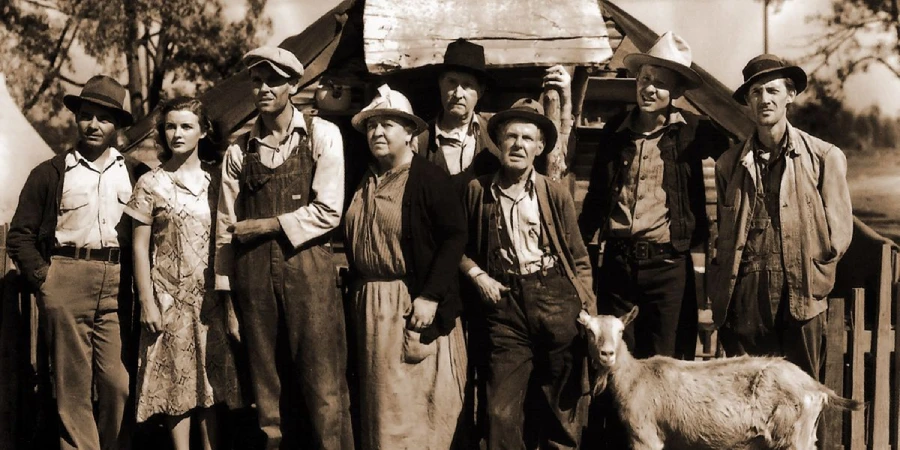

Dust storms and greedy banks strip a desperate family of their land in John Ford’s stark survival epic. This 1940 masterpiece captures the brutal collapse of the American Dream during the Great Depression. Survival requires more than hard work when the entire economic system turns against the poor.
Detailed Summary
The Return of Tom Joad
Tom Joad walks home after serving time for manslaughter. He meets a former preacher named Jim Casy on a dusty Oklahoma road. They find the Joad family home abandoned and skeletal. Neighbors explain that banks evicted the local farmers to make way for tractors.
Tom eventually finds his family at Uncle John’s house. They are packing a dilapidated truck to move westward toward California. Handbills promise plentiful fruit-picking jobs for high wages. Consequently, the family puts their faith in these bright yellow advertisements.
The Treacherous Journey West
Grampa Joad refuses to leave his land at the last minute. The family drugs him with syrup to get him onto the truck. Unfortunately, the elderly man dies of a stroke shortly after they begin their journey. They bury him secretly by the road to avoid legal fees.
Granma Joad follows shortly after, passing away as they cross the scorching desert. Ma Joad hides this death from the rest of the family to ensure they reach the border. She demonstrates incredible strength while keeping her grief private.
A Harsh Welcome to California
The Joads arrive at a squalid “Hooverville” camp filled with starving migrants. They realize the handbills were a cruel trick to drive down labor prices. Local deputies harass the workers and label them “Reds” for protesting low pay. Hunger and desperation permeate every corner of the camp.
A fight breaks out when a contractor refuses to show a license. Casy knocks out a deputy to save Tom from being arrested. As a result, the preacher goes to jail in Tom’s place. The family flees the camp before the authorities can burn it down.
Struggle at the Keene Ranch
The Joads find work picking peaches at the locked Keene Ranch. They soon discover they are acting as strikebreakers against other starving families. Tom sneaks out at night and finds Casy leading the labor strike. Police officers ambush the group and kill Casy with a pick handle.
Tom kills the man who struck Casy in a fit of rage. He receives a deep scar on his face during the struggle. The family hides the wounded Tom under the truck bed. Eventually, they escape the ranch to find a more peaceful environment.
Movie Ending
The family finds refuge in a clean, government-run camp at Weedpatch. Here, the migrants manage themselves and enjoy basic indoor plumbing. Peace remains temporary because Tom is still a wanted fugitive. He knows the authorities will eventually find him and endanger his family.
Tom decides to leave in the middle of the night to carry on Casy’s work. He delivers a powerful speech about being “everywhere” where there is a fight for justice. Ma observes his departure with a heavy heart but understands his newfound purpose. Specifically, he commits himself to organizing the poor against their oppressors.
Ma Joad watches the remaining family members pack the truck once again. She delivers the famous final monologue about the resilience of common people. While the men focus on individual battles, she focuses on the continuity of the human spirit. The film ends with the family driving toward an uncertain but hopeful future.
Are There Post-Credits Scenes?
No post-credits scenes exist for this production. Hollywood films from this era typically ended with a simple “The End” title card. Audiences were expected to leave the theater immediately after the final fade-out.
Type of Movie
This film is a quintessential social realist drama with a somber, gritty tone. It captures the essence of the Dust Bowl era through a lens of struggle and endurance. Although it features moments of hope, the overall atmosphere remains heavy and urgent.
Cast
- Henry Fonda – Tom Joad
- Jane Darwell – Ma Joad
- John Carradine – Jim Casy
- Charley Grapewin – Grampa Joad
- Dorris Bowdon – Rosasharn
- Russell Simpson – Pa Joad
- John Qualen – Muley Graves
Film Music and Composer
Alfred Newman composed the score for this cinematic landmark. He utilized the traditional folk song “Red River Valley” as a recurring melodic theme. This simple tune evokes a sense of nostalgia for the home the characters lost. Overall, the music remains sparse to allow the natural sounds of the journey to dominate.


Filming Locations
John Ford filmed many scenes on location in California and Arizona to replicate the Route 66 landscape. These dusty environments were essential for creating a sense of authentic hardship. In addition, the director used 20th Century Fox studio lots for more controlled exterior shots. The stark lighting enhances the feeling of a world drained of its resources.
Awards and Nominations
Academy voters awarded John Ford the Oscar for Best Director. Jane Darwell also won Best Supporting Actress for her portrayal of Ma Joad. Furthermore, the film received five other nominations, including a nod for Best Picture.
Behind the Scenes Insights
- Producer Darryl F. Zanuck kept the production secret to avoid interference from powerful agricultural groups.
- John Ford prohibited the actors from wearing makeup to maintain a raw, haggard appearance.
- The cinematographer used heavy shadows to mimic the documentary style of 1930s photography.
- Henry Fonda bought a used truck and drove it on his own time to understand the physical toll of the journey.
Inspirations and References
The screenplay draws directly from the Pulitzer Prize-winning novel by John Steinbeck. Steinbeck traveled with migrant families to gather firsthand accounts of their suffering. In contrast to fictional tropes, most events in the story reflect real conditions in 1930s labor camps. Public outcry following the book’s release spurred real-world political investigations into farm labor practices.
Alternate Endings and Deleted Scenes
The original book ends on a much darker note involving a flood and a controversial act of nursing. John Ford chose a more optimistic ending to please studio executives and general audiences. This change shifted the focus from total despair to the idea of communal strength. Consequently, the movie omits the novel’s final, haunting image of Rose of Sharon.
Book Adaptations and Differences
John Ford’s adaptation streamlines the travel sequences to keep the pacing tight. While the book contains long philosophical interludes, the film focuses on the Joad family’s direct interactions. Many of the novel’s secondary characters receive less screen time in the cinematic version. Nevertheless, the movie retains the core political message that Steinbeck intended.
Memorable Scenes and Quotes
Key Scenes
- The haunting arrival of the tractor as it destroys Muley’s farmhouse.
- The burial of Grampa Joad by the side of the road under the moonlight.
- Ma Joad burning her old keepsakes before leaving the Oklahoma farm.
- Tom’s final goodbye to his mother in the camp hideout.
Iconic Quotes
- “I’ll be all around in the dark. I’ll be everywhere.”
- “We’re the people that live. They can’t wipe us out.”
- “A fellow ain’t got a soul of his own, just a little piece of a great big soul.”
Easter Eggs and Hidden Details
- The license plate on the Joad truck changes slightly between certain shots.
- John Ford makes a very brief, uncredited cameo in one of the camp scenes.
- Authentic 1930s migrants served as extras in the background of the Hooverville sequences.
- The lighting in the final scene creates a halo effect around Ma Joad’s head.
Trivia
- Henry Fonda’s performance was so accurate that John Steinbeck felt the actor became the character.
- This film was one of the first 25 movies selected for the National Film Registry.
- The government camp depicted in the film was based on the actual Arvin Federal Labor Camp.
- Darryl F. Zanuck sent undercover investigators to verify the book’s claims before filming.
Why Watch?
This film remains a powerful testament to human dignity under pressure. Henry Fonda delivers a career-defining performance as a man radicalized by injustice. It serves as a vital historical record of a transformative American era. Ultimately, the story celebrates the unbreakable bonds of family.
Director’s Other Movies
- Stagecoach (1939)
- How Green Was My Valley (1941)
- The Searchers (1956)
- The Man Who Shot Liberty Valance (1962)
Recommended Films for Fans
- Of Mice and Men (1939)
- Heroes for Sale (1933)
- Sullivan’s Travels (1941)
- The Best Years of Our Lives (1946)
- Bicycle Thieves (1948)
- Bound for Glory (1976)
- On the Waterfront (1954)
- 12 Angry Men (1957)