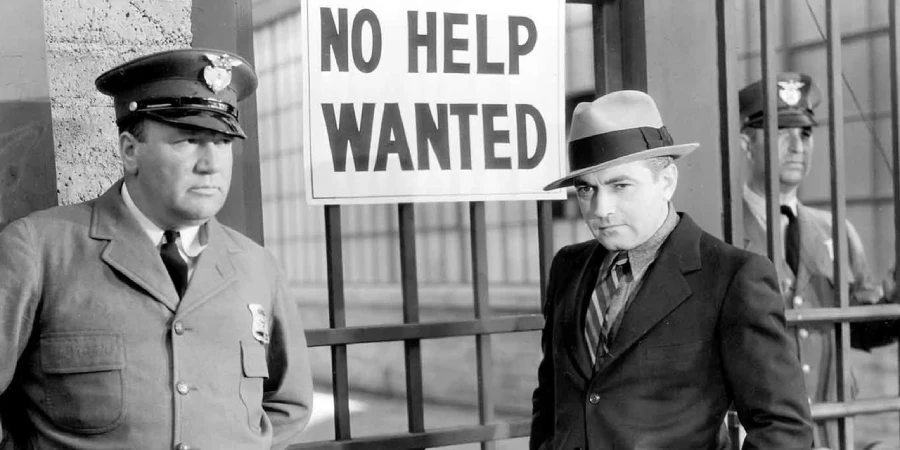

Heroes for Sale presents a brutal, unflinching look at the American Dream’s collapse. It tells the story of a man who does everything right for his country but receives only pain in return. This 1933 film remains a powerful indictment of a system that discards its heroes.
Detailed Summary
The Great War and a Great Betrayal
In the trenches of World War I, American soldier Tom Holmes (Richard Barthelmess) feels immense sympathy for his terrified fellow soldier, Roger Winston (Gordon Westcott). During a major assault, Tom single-handedly captures a German machine gun nest that was decimating their ranks. He is, however, seriously wounded and left for dead.
Roger, the son of a prominent banker, stumbles upon the scene. He takes credit for Tom’s heroic act, consequently receiving a medal and national acclaim. Meanwhile, medics transport Tom to a German hospital where they treat his constant pain with morphine, leading to a severe addiction.
A Bitter Homecoming
Tom eventually returns to America, but his homecoming is not heroic. He is a shell of his former self, secretly battling a debilitating morphine addiction. He discovers his mother has died, and his old job at Roger’s father’s bank is gone.
His addiction isolates him, making him an outcast in his own town. He finds brief solace with a kind neighbor, Mary (Aline MacMahon), who sees the good man beneath the struggle. Nonetheless, his dependency spirals out of control, costing him any chance at a normal life.
Invention and Incarceration
Before his addiction fully consumes him, Tom shares an idea with Roger for a mechanized laundry system. He later gets arrested for possessing narcotics and spends several years in a prison hospital. He endures a torturous withdrawal but emerges clean and determined to start over.
Upon his release, Tom discovers that Roger has stolen his invention. In fact, Roger has built a massive, successful laundry enterprise based entirely on Tom’s concept. He has become a titan of industry on the back of another man’s bravery and intellect.
A Fresh Start and a Red Scare
Tom moves to Chicago, not seeking revenge but simply a job. He coincidentally gets hired at Roger’s laundry factory, keeping his identity a secret. There, he meets and falls in love with Ruth Loring (Loretta Young); they marry and have a son.
His hard work earns him promotions, and he becomes a respected voice for the workers. Trouble arises, however, when Communist agitators incite a strike. Tom tries to mediate, but the police and rabid anti-Red activists brand him as a dangerous radical. Roger, knowing the truth about Tom, stands by and does nothing to help him.
Movie Ending
During a violent riot between workers and police, authorities arrest Tom. He tries to shield a child from the chaos but is accused of leading the insurrection. Roger Winston, his supposed friend, refuses to provide an alibi or vouch for his character. As a result, the court convicts Tom and sentences him to five years of hard labor on a prison farm.
After serving his time, a weary Tom returns to the city. He finds that his wife, Ruth, died while he was imprisoned. His son is being raised in an orphanage, and Tom believes the boy is better off without a disgraced ex-convict for a father.
Broken and alone, he drifts through the city, joining a long line of other forgotten men. He ends up at a soup kitchen run by Pop Dennis, a kindly cafe owner who had helped him years before. The final, devastating shot shows Tom, a decorated war hero and honest man, simply another anonymous face in a Depression-era breadline.
Are There Post-Credits Scenes?
No, there are no post-credits scenes in Heroes for Sale. The film ends definitively with its final shot, as was standard for movies from this era.
Type of Movie
Heroes for Sale is a quintessential pre-Code social problem drama. It directly confronts difficult subjects that the later Hays Code would severely restrict. Specifically, these include drug addiction, the unjust treatment of war veterans, the failures of capitalism, and the paranoia of the Red Scare.
The film’s tone is relentlessly grim and pessimistic. It functions as a powerful piece of social commentary, reflecting the widespread disillusionment of the Great Depression.
Cast
- Richard Barthelmess – Thomas “Tom” Holmes
- Loretta Young – Ruth Loring Holmes
- Aline MacMahon – Mary Dennis
- Gordon Westcott – Roger Winston
- Robert Barrat – Max
- Charley Grapewin – Pop Dennis
- Berton Churchill – Mr. Winston
Film Music and Composer
The musical score for Heroes for Sale was composed by Bernhard Kaun, although he was uncredited on the picture. As the head of the music department at Warner Bros., Leo F. Forbstein is credited as the musical director.
The music is typical of early 1930s dramas, using dramatic orchestral cues to heighten emotion and tension. It lacks a memorable central theme, instead serving a functional role to underscore Tom’s tragic journey.



Filming Locations
The film was shot primarily at the Warner Bros. Studios in Burbank, California. The World War I battle sequences were likely filmed on the studio’s expansive backlot, known as the Warner Bros. Ranch.
The generic cityscapes and factory settings were created on studio soundstages. This approach reinforces the film’s universal message, suggesting that this story could unfold in any American city during the Great Depression.
Awards and Nominations
Heroes for Sale did not receive any major awards or nominations from prestigious bodies like the Academy Awards. Its value is now recognized by film historians for its bold pre-Code themes and social commentary.
Behind the Scenes Insights
- Director William A. Wellman was a decorated pilot in the Lafayette Flying Corps during World War I. His personal combat experience lent a visceral authenticity to the film’s opening war scenes.
- The film’s frank and harrowing depiction of morphine addiction was incredibly daring for 1933. This was only possible because it was produced before the stringent enforcement of the Hays Code began in mid-1934.
- Heroes for Sale is a prime example of the socially conscious films Warner Bros. produced in the early 1930s, which often focused on gangsters, fallen women, and forgotten men to critique societal problems.
- Richard Barthelmess delivered a powerful performance, effectively conveying the physical and psychological agony of addiction and withdrawal.
Inspirations and References
The film was not based on a single true story but was heavily inspired by the social crises of its time. Its plot reflects the real-life plight of World War I veterans, many of whom faced unemployment and neglect upon returning home. This culminated in events like the 1932 Bonus Army march on Washington D.C.
Furthermore, the narrative taps into widespread anxieties about the Great Depression, labor unrest, and the anti-communist hysteria known as the First Red Scare.
Alternate Endings and Deleted Scenes
There are no known alternate endings or significant deleted scenes for Heroes for Sale. The film’s bleak, uncompromising conclusion is considered integral to its message and was the version released to the public.
Book Adaptations and Differences
Heroes for Sale is not based on a book. It is an original story written for the screen by Wilson Mizner and Robert Lord.

Memorable Scenes and Quotes
Key Scenes
- Capturing the Nest: Tom’s heroic but costly charge against the German machine gun position sets the entire tragedy in motion.
- Painful Withdrawal: The sequence showing Tom suffering through withdrawal in the prison hospital is raw and unflinching, a rarity for its time.
- The Riot: Tom’s attempt to act as a peacemaker backfires spectacularly, leading to his unjust arrest as a “Red” agitator.
- The Final Shot: The image of Tom, a war hero, standing anonymously in a soup line is one of the most powerful and iconic final shots of the pre-Code era.
Iconic Quotes
- Tom Holmes: “He got the medal. I got the dope.”
- Tom Holmes: (When accused of being a radical) “I’m not a Red! I’m a man that wants a job! That’s all!”
- Pop Dennis: “Heroes are a drug on the market.”
Easter Eggs and Hidden Details
As a direct social-problem film, Heroes for Sale is not known for containing hidden Easter eggs or subtle references. Director William A. Wellman’s focus was on crafting a straightforward, hard-hitting narrative rather than embedding hidden details for viewers to find.
Trivia
- The film was one of director William A. Wellman’s three major releases in 1933, alongside Wild Boys of the Road and Midnight Mary.
- Richard Barthelmess was a major silent film star whose career was waning by the 1930s. His role as Tom Holmes is considered one of his finest sound-era performances.
- The film’s original story was written by Wilson Mizner, a famous wit, playwright, and raconteur of the era who had a short but impactful career in Hollywood before his death in 1933.
Why Watch?
Watch this film for its raw, unfiltered look at the dark side of the American Dream. Its bold themes and devastating conclusion make it a landmark of pre-Code cinema and a story that, tragically, still feels relevant today.
Director’s Other Movies
- Wings (1927)
- The Public Enemy (1931)
- Wild Boys of the Road (1933)
- A Star Is Born (1937)
- Nothing Sacred (1937)
- The Ox-Bow Incident (1943)
Recommended Films for Fans
- I Am a Fugitive from a Chain Gang (1932)
- Wild Boys of the Road (1933)
- Gold Diggers of 1933 (1933)
- Our Daily Bread (1934)
- The Grapes of Wrath (1940)