Beneath its dazzling spectacle of giant coins and neon violins, Gold Diggers of 1933 hides a surprisingly cynical heart. This is a film born from the Great Depression, using Busby Berkeley’s surreal choreography to mask a story about survival, desperation, and economic anxiety. It is pure escapism with a conscience.
Detailed Summary
“We’re in the Money” Runs Out of Money
A Broadway show is in its final dress rehearsal. Led by Fay Fortune (Ginger Rogers), the performers sing “We’re in the Money,” dancing with oversized coins. However, their celebration is cut short when the sheriff arrives to shut everything down due to the producer’s unpaid bills.
Consequently, the showgirls, including the pragmatic Carol (Joan Blondell), the sharp-tongued Trixie (Aline MacMahon), and the innocent Polly (Ruby Keeler), are once again out of work. They return to their shared, humble apartment with little hope for the future.
A Mysterious Benefactor
Polly’s love interest, a struggling songwriter named Brad Roberts (Dick Powell), lives across the air shaft. He overhears their troubles and suddenly announces he has written a new show about the Depression. Furthermore, he offers to produce it himself, putting up $15,000 in cash.
Carol and Trixie are immediately suspicious of Brad’s newfound wealth. They logically conclude he must be a criminal, but they need the work and decide to play along for the time being.
Mistaken Identities and High-Society Intrigue
Brad’s wealthy Boston family gets wind of his theatrical pursuits. His older brother, J. Lawrence Bradford (Warren William), and the family lawyer, Fanuel “Fanny” Peabody (Guy Kibbee), travel to New York to stop him from marrying a “cheap showgirl.” They mistakenly assume Carol is Polly, Brad’s intended love interest.
Seeing an opportunity for mischief, Carol embraces the role of a vulgar gold digger to teach the snobbish J. Lawrence a lesson. Meanwhile, Trixie sets her sights on the stuffy but wealthy Mr. Peabody, using her wit to charm him.
Opening Night Success
The new show goes into production, featuring lavish musical numbers. A chaotic chase ensues as J. Lawrence tries to rein in Carol, who leads him on a wild goose chase while slowly falling for him. Trixie, in contrast, successfully corners and manipulates Peabody.
On opening night, Brad is forced to step into the lead male role when the juvenile lead suffers a bout of lumbago. The show is a smash hit, culminating in the powerful “Remember My Forgotten Man” number.


Movie Ending
Backstage, all the deceptions unravel. Brad finally reveals his true identity; he is a Bradford heir and a millionaire himself. The money he used to fund the show was his own, not stolen. Therefore, his family had no power to stop him.
J. Lawrence is initially furious about the ruse but admits he has fallen in love with Carol. He agrees to marry her despite her showgirl profession. At the same time, a flustered Mr. Peabody finds himself committed to marrying the tenacious Trixie.
The film concludes with its most famous and somber sequence, “Remember My Forgotten Man.” Led by Carol, this powerful number serves as a direct plea for the downtrodden veterans of World War I, who were suffering greatly during the Depression. This final scene transforms the movie from a lighthearted comedy into a poignant piece of social commentary, ending the film on a starkly serious note.
Are There Post-Credits Scenes?
No, there are no post-credits scenes in Gold Diggers of 1933. This filmmaking practice was not common in the 1930s.
Type of Movie
Gold Diggers of 1933 is a Pre-Code musical comedy-drama. Its tone brilliantly shifts between upbeat, escapist fantasy and a gritty acknowledgment of Great Depression realities.
The film uses comedy and romance to draw audiences in before confronting them with the era’s harsh economic truths. Notably, the musical numbers from choreographer Busby Berkeley are often surreal and exist outside the main plot, serving as pure spectacle.
Cast
- Warren William – J. Lawrence Bradford
- Joan Blondell – Carol King
- Aline MacMahon – Trixie Lorraine
- Ruby Keeler – Polly Parker
- Dick Powell – Brad Roberts
- Guy Kibbee – Fanuel H. Peabody
- Ned Sparks – Barney Hopkins
- Ginger Rogers – Fay Fortune
Film Music and Composer
The film’s iconic music was composed by Harry Warren, with lyrics by Al Dubin. This duo was one of Warner Bros.’ most valuable assets during the 1930s. The choreography by Busby Berkeley is as famous as the music itself.
Notable tracks include the optimistic opener “We’re in the Money,” the slightly risqué “Pettin’ in the Park,” the visually stunning “The Shadow Waltz,” and the socially conscious finale, “Remember My Forgotten Man.”


Filming Locations
Gold Diggers of 1933 was filmed almost exclusively at the Warner Bros. Studios in Burbank, California. The production required massive soundstages to accommodate Busby Berkeley’s elaborate and mechanically complex choreographic visions.
For instance, building the sets for numbers like “The Shadow Waltz,” with its tiers of dancers and neon-lit violins, would have been impossible on location. The entire film is a testament to the power of studio filmmaking in Hollywood’s Golden Age.
Awards and Nominations
The film received one Academy Award nomination at the 6th Academy Awards. Nathan Levinson was nominated for Best Sound Recording for his work on the picture.
Behind the Scenes Insights
- The film was made before the strict enforcement of the Motion Picture Production Code (or Hays Code). This allowed for suggestive dialogue, risqué costumes, and themes of sex and money that would be forbidden in Hollywood films just a year later.
- During the “Pettin’ in the Park” number, the mischievous “baby” who keeps annoying the women is played by dwarf actor Billy Barty.
- Ginger Rogers‘ famous opening performance of “We’re in the Money” includes a verse sung entirely in Pig Latin, a popular fad at the time.
- Choreographer Busby Berkeley revolutionized the movie musical. He used a single camera and favored overhead shots, kaleidoscopic patterns, and surreal imagery that had little to do with the plot but provided incredible spectacle.
Inspirations and References
The film is based on the 1919 play The Gold Diggers by Avery Hopwood. That play was a popular Broadway comedy and had already been adapted into a silent film in 1923 and an early sound film, Gold Diggers of Broadway, in 1929.
This 1933 version, however, heavily updated the story to reflect the ongoing Great Depression, adding the social commentary and large-scale musical numbers that make it so distinct.
Alternate Endings and Deleted Scenes
No official alternate endings or significant deleted scenes from Gold Diggers of 1933 are known to have survived or been released to the public. The finished film is believed to be director Mervyn LeRoy’s intended cut.
Book Adaptations and Differences
Gold Diggers of 1933 is not based on a book but rather the 1919 play The Gold Diggers. The film retains the play’s basic premise of showgirls being mistaken for gold diggers by wealthy, stuffy Bostonians.
The primary difference is the film’s tone and context. While the play was a light drawing-room farce, the film actively incorporates the desperation of the Great Depression. The addition of Busby Berkeley’s musical numbers and the somber “Remember My Forgotten Man” finale give the movie a depth and social purpose the original play lacked.


Memorable Scenes and Quotes
Key Scenes
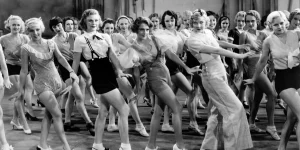
- “We’re in the Money”: The opening number, where Fay Fortune (Ginger Rogers) leads a chorus line of dancers dressed in coin-themed costumes before the show is abruptly shut down.
- “The Shadow Waltz”: A stunningly surreal sequence where dozens of women in hoop skirts appear to play violins outlined in glowing neon tubes, forming geometric patterns in the dark.
- “Remember My Forgotten Man”: The powerful finale. It transitions from a bluesy lament sung by Joan Blondell on a tenement stoop to a massive, militaristic procession of silhouetted soldiers marching to their uncertain futures.
Iconic Quotes
- Trixie Lorraine: “It’s the Depression, dearie. The writers have to eat, too. And they’ve got to write what the producers want to buy.”
- Carol King: (To J. Lawrence) “If you had a little money, you’d have a little charm.”
- Trixie Lorraine: “Let’s go, girls. The wolf is at the door, and he’s howling.”
Easter Eggs and Hidden Details
- The “Remember My Forgotten Man” number is a direct reference to the “Bonus Army” march of 1932. In this event, thousands of World War I veterans marched on Washington D.C. to demand early payment of a service bonus, only to be forcibly removed by the U.S. Army.
- When the women are changing behind a screen, their silhouettes are clearly visible. This was a classic Pre-Code trick to be titillating without showing actual nudity, a loophole that would be closed by censors a year later.
- The name of the stuffy lawyer, Fanuel, is an incredibly rare name, likely chosen to sound old-fashioned and humorous.
Trivia
- Gold Diggers of 1933 was one of Warner Bros.’ most profitable films of the year. Its success, along with other musicals like 42nd Street, is credited with saving the studio from bankruptcy during the height of the Great Depression.
- This was the second of nine films pairing the popular on-screen romantic couple Dick Powell and Ruby Keeler.
- The massive “dancing violin” props from “The Shadow Waltz” were reportedly very heavy and difficult for the dancers to handle during the complex choreography.
Why Watch?
Watch this film for the ultimate Great Depression cinematic experience. It is a stunning fusion of witty Pre-Code comedy, jaw-dropping Busby Berkeley spectacle, and surprisingly potent social commentary that remains relevant and powerful today.
Director’s Other Movies
- I Am a Fugitive from a Chain Gang (1932)
- Waterloo Bridge (1940)
- Random Harvest (1942)
- Quo Vadis (1951)
- Mister Roberts (1955)
- The Bad Seed (1956)
Recommended Films for Fans
- 42nd Street (1933)
- Footlight Parade (1933)
- Dames (1934)
- My Man Godfrey (1936)
- Stage Door (1937)