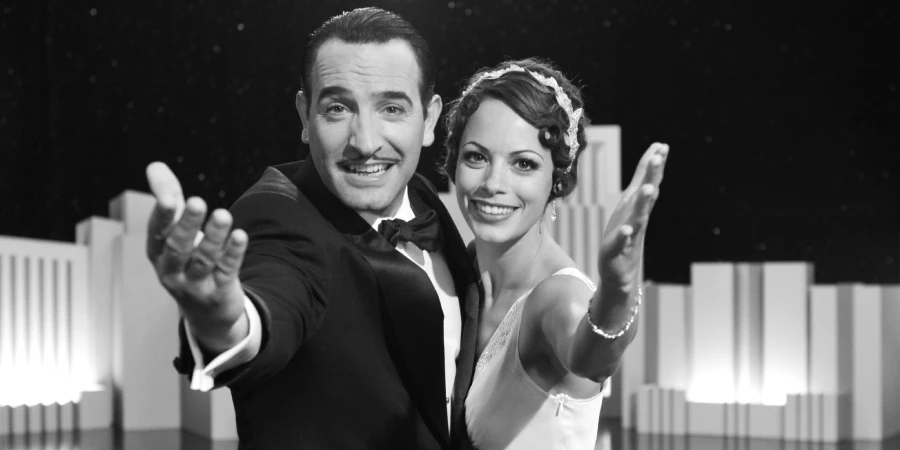

Silent films were supposed to be dead. The Artist arrived in 2011 and proved everyone wrong, sweeping award season with a black-and-white, largely dialogue-free love letter to Hollywood’s golden age. Director Michel Hazanavicius did not just pay homage to a forgotten era; he resurrected it, wrapped it in a genuinely moving story, and made modern audiences weep for characters they could not even hear speak. This film is a miracle of craft, confidence, and audacity.
Detailed Summary
George Valentin at the Peak of His Fame
We meet George Valentin in 1927, a charming, self-satisfied silent film star who owns Hollywood. He arrives at a premiere with his loyal Jack Russell Terrier, Uggie, mugs for photographers, and radiates the effortless magnetism of a man who has never questioned his own greatness. His marriage to Doris is cold and distant, though George barely seems to notice.
On the steps of the theater, he bumps into a bubbly young fan named Peppy Miller. Their accidental meeting generates a press photograph that catapults Peppy into the public eye. George, charmed by her energy, arranges a small role for her as an extra in his next film.
Peppy’s Rise and the Shadow of Sound
Peppy’s screen presence is undeniable. She climbs quickly from extra to supporting player, catching the eye of studio head Al Zimmer. Meanwhile, the film industry shifts violently beneath George’s feet when Zimmer announces a full pivot to talking pictures.
George dismisses sound films as a gimmick. He is arrogant, yes, but his fear also runs deep; his entire identity rests on the expressive physical performance that silent cinema demanded. In contrast, Peppy thrives precisely in the new format, her voice and personality perfectly suited for talkies.
George Goes It Alone
Zimmer drops George from his roster. Undeterred, George sinks his own money into a silent adventure film called Tears of Love, determined to prove that audiences still want what he offers. He directs himself, hires his loyal chauffeur Clifton, and produces the film independently.
On the same day in 1929, his film and Peppy’s first major talkie open in theaters. Peppy’s film is a smash; George’s is a commercial disaster. The stock market crash of that same year wipes out whatever financial cushion he had left. His world collapses from multiple directions at once.
The Fall
George loses everything. Doris throws him out of their mansion. He is forced to sell his costumes, his furniture, and almost every material possession he owns. Clifton, his chauffeur, stays loyal without pay for as long as he can before George finally dismisses him too, refusing charity with stubborn pride.
George retreats into a dingy apartment with only Uggie for company. He drinks heavily and spirals into depression. A fire, caused by his own carelessness while burning old film reels, destroys his remaining belongings and nearly kills him.
Peppy Watches from a Distance
Peppy never forgets George. She secretly purchases all his auctioned belongings, keeping them in storage at her mansion. Moreover, she instructs her contacts to quietly keep George employed in small film roles, shielding him from knowing she is the source of the work. Her affection for him has grown into something far deeper than admiration.
She also owns the coat George playfully draped over her shoulders during a wardrobe scene early in the film. That coat becomes a recurring symbol of their unspoken connection throughout the story.
Rock Bottom and Rescue
Uggie saves George’s life during the apartment fire by alerting a passing police officer. George, physically and emotionally broken, ends up hospitalized. Peppy rushes to the hospital and brings him to her mansion to recover, surrounding him with his own familiar belongings without initially revealing she bought them.
George, however, discovers the truth. His pride shatters further when he realizes the woman he once championed has been quietly subsidizing his survival. He cannot reconcile his gratitude with his shame.
Movie Ending
George reaches his lowest point and attempts suicide. He holds a gun to his head inside Peppy’s mansion, sitting among the very possessions she saved for him. Peppy arrives in time, the gun goes off but misses, and the shock of the moment forces both of them to finally confront what they mean to each other.
Peppy proposes a solution: she wants to co-star with George in a sound musical. George resists, terrified of exposing a voice he considers inadequate for the new era. His silence has always been his armor, and surrendering it feels like total defeat.
Consequently, the film’s most emotionally satisfying moment arrives when they rehearse a tap dancing sequence together. George is extraordinary. Joy floods back into his face, and for the first time, the film itself comes alive with sound in a full, exuberant way. Hazanavicius allows the score to swell and the tap rhythm to fill the theater.
At the very end, after their first take, a director calls “Cut!” and asks if George is ready to do it again. George leans into the microphone and says, in a thick French accent, “With pleasure.” It is the only moment of genuine diegetic dialogue George speaks in the entire film. Those two words carry everything: relief, rebirth, and a quiet admission that the world has moved on and he is finally ready to move with it.
Furthermore, the accent itself is a sly wink from Hazanavicius, since both director and star Jean Dujardin are French. George’s resistance to speaking was partly a fear of exposing an accent that marked him as foreign in Hollywood. In the end, that accent is simply part of who he is, and the world accepts it completely.
Are There Post-Credits Scenes?
The Artist contains no post-credits scenes. Once the final tap number ends and George delivers his two-word conclusion, the film closes. There is nothing additional after the credits roll.
Type of Movie
The Artist is a silent romantic comedy-drama, shot in black and white in the 4:3 aspect ratio of the classic era. Its tone balances warmth and melancholy with genuine wit. At its core, it is a love story set against the backdrop of Hollywood’s transition from silent film to sound.
In contrast to most modern films, it trusts visual storytelling almost entirely. Only two brief moments break from the silent format, and both carry enormous dramatic weight precisely because of their rarity within the film’s world.
Cast
- Jean Dujardin – George Valentin
- Berenice Bejo – Peppy Miller
- John Goodman – Al Zimmer
- James Cromwell – Clifton
- Penelope Ann Miller – Doris
- Missi Pyle – Constance
- Uggie – The Dog (himself)
Film Music and Composer
Ludovic Bource composed the score, and his work here is nothing short of extraordinary. Because dialogue is absent for most of the film, the music functions as the primary emotional voice of every scene. Bource drew heavily from the orchestral traditions of classic Hollywood film scoring.
One sequence borrows directly from Bernard Herrmann’s score for Vertigo, a choice that created some controversy but fits the film’s nightmare sequence perfectly. Notably, Bource won the Academy Award for Best Original Score for this work. His lush, sweeping arrangements were central to the film’s enormous emotional impact.
Filming Locations
Principal photography took place in Los Angeles, California, which was both practical and symbolically perfect. Many scenes filmed at authentic locations from Hollywood’s golden era, grounding the story in real geography. The production used the historic Bradbury Building in downtown Los Angeles for key interior scenes.
Shooting on location in Hollywood gave the film an additional layer of authenticity. Furthermore, the crew filmed portions at Paramount Pictures and used backlots that genuine silent-era productions once occupied. That physical connection to the real history of American cinema enriches every frame.
Awards and Nominations
The Artist dominated the 84th Academy Awards, winning five Oscars including Best Picture, Best Director for Hazanavicius, Best Actor for Dujardin, Best Costume Design, and Best Original Score. It became the first silent film to win Best Picture since Wings in 1927.
Additionally, it won the Palme d’Or at Cannes for Dujardin’s performance and swept the BAFTA Awards, taking home seven trophies. Its awards campaign was one of the most dominant in recent Hollywood history.
Behind the Scenes Insights
- Jean Dujardin studied silent film performances extensively, particularly the work of Douglas Fairbanks and Gene Kelly, to prepare his physicality for the role.
- Director Michel Hazanavicius shot the film in 35 days on a relatively modest budget.
- Berenice Bejo, who plays Peppy Miller, is Hazanavicius’s real-life partner; he wrote the role specifically with her in mind.
- Uggie the Jack Russell Terrier became a genuine celebrity after the film’s release, receiving enormous press attention during awards season.
- Hazanavicius wrote the original screenplay in French, even though the film was produced as an American-set story intended for an international audience.
- Several scenes required the actors to perform without any playback music on set, relying entirely on rhythm and physical performance for timing.
Inspirations and References
The Artist draws inspiration from the real history of Hollywood’s transition to sound in the late 1920s. The story of George Valentin echoes the career trajectory of real silent stars who struggled after the introduction of talkies. John Gilbert, a prominent silent star whose career declined sharply after sound arrived, is a clear parallel.
Hazanavicius also drew from classic Hollywood films, particularly the work of directors like Ernst Lubitsch and King Vidor. The film’s visual grammar consciously references silent-era techniques including iris wipes, intertitles, and exaggerated expressive performance. Moreover, Singin’ in the Rain (1952) casts a long shadow over the story’s premise, though Hazanavicius approaches the subject with far more melancholy.
Alternate Endings and Deleted Scenes
No officially released alternate endings or substantially discussed deleted scenes have been made public for The Artist. Hazanavicius has spoken about the tightness of the script and the efficiency of the production, suggesting relatively little material ended up on the cutting room floor. As a result, the film as released appears to be close to what the director originally intended.
Book Adaptations and Differences
The Artist is an original screenplay written by Michel Hazanavicius. It is not based on any book, novel, or previously published source material. No adaptation comparison therefore applies here.


Memorable Scenes and Quotes
Key Scenes
- The nightmare sequence: George dreams that the world around him has gained sound, objects clatter and voices speak, but he himself remains completely mute. It is a haunting, brilliantly constructed sequence that captures his deepest fear.
- The coat scene: During a wardrobe fitting early in the film, Peppy slips her arm into George’s hanging jacket and pretends to embrace herself. It is playful, tender, and quietly devastating in retrospect.
- The auction of George’s possessions: Watching familiar objects sold off to strangers as George’s career evaporates is one of the film’s most quietly heartbreaking sequences.
- Uggie saving George from the fire: Pure cinema; a dog performing with absolute conviction in a genuinely tense rescue scene.
- The final tap dance number: An explosion of joy and sound after nearly two hours of near-silence, releasing all the emotional tension the film has carefully built.
Iconic Quotes
- “With pleasure.” – George Valentin’s only spoken words, delivered at the very end of the film, carrying the full weight of his journey.
- “That’s the beauty of it, I don’t need it.” – George dismissing talking pictures, visible through an intertitle, capturing his fatal arrogance in five words.
Easter Eggs and Hidden Details
- The score borrows directly from Bernard Herrmann’s compositions for Vertigo during George’s nightmare sequence, a nod to classic Hollywood psychological cinema.
- George’s film within the film, A German Affair, uses visual tropes that directly mirror actual silent adventure serials of the 1920s.
- Peppy’s beauty mark, a small dot above her lip, is a deliberate callback to beauty marks favored by silent-era actresses. It becomes her trademark and her ticket to stardom.
- Several extras and background players in the film-within-a-film scenes wear costumes that closely match documented wardrobe from real 1920s productions.
- George’s dog Uggie performs a play-dead trick during the apartment fire scene, a genuine trained behavior that Uggie’s real-life trainers incorporated into the scripted action.
- The title cards used as intertitles throughout the film match the font styles and visual design of authentic late-1920s American silent films.
Trivia
- The Artist was the first silent film to win the Academy Award for Best Picture since Wings won the very first Best Picture Oscar in 1927.
- Jean Dujardin became the first French actor to win the Academy Award for Best Actor.
- Despite being set entirely in Hollywood, the film is a French production, financed primarily with French money.
- Uggie the dog received a special honorary Palme Dog award at the Cannes Film Festival.
- The film runs approximately 100 minutes and uses intertitle cards for dialogue in the traditional silent film manner.
- Hazanavicius shot in black and white on color film stock, then converted the footage in post-production to achieve the desired look.
- John Goodman’s role as studio boss Al Zimmer required almost no dialogue from him, yet his physical presence communicates the character’s power entirely through body language.
Why Watch?
The Artist proves that storytelling needs no gimmicks, no explosions, and no dialogue to reach inside a viewer and squeeze. Its performances are magnetic, its craft is immaculate, and its emotional payoff is genuinely earned. For anyone who loves cinema history or simply wants a film that trusts its audience completely, this one is essential.
Director’s Other Movies
- OSS 117: Cairo, Nest of Spies (2006)
- OSS 117: Lost in Rio (2009)
- The Search (2014)
- Le Prince oublie (2020)