
Love does not always win, and The Umbrellas of Cherbourg builds its entire emotional architecture on that brutal truth. Every single line of dialogue in this film is sung, making it one of cinema’s most radical formal experiments. Director Jacques Demy wraps a genuinely heartbreaking story inside saturated colors and gorgeous melodies, lulling you into a false sense of sweetness before gutting you completely. Few films have ever weaponized beauty quite so effectively.
Detailed Summary
A Love Story Begins in a Rain-Soaked Port Town
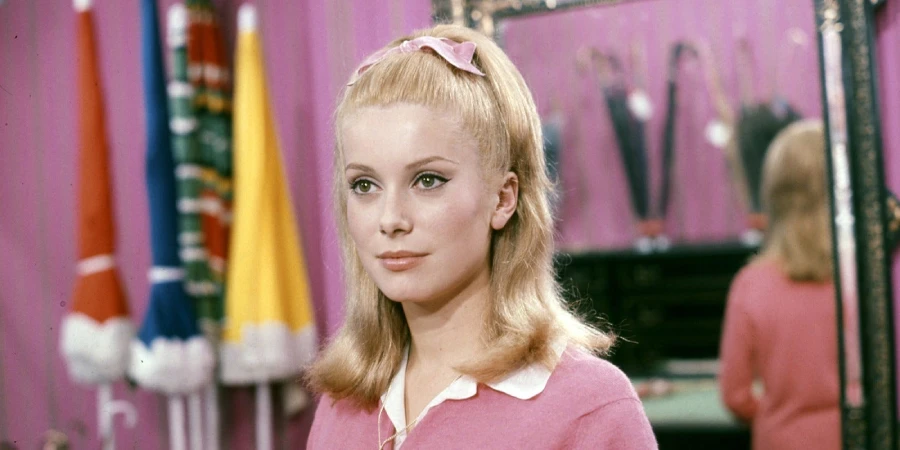
We meet Geneviève Emery (played by Catherine Deneuve), a sixteen-year-old girl who works in her widowed mother’s umbrella shop in Cherbourg. She is passionately in love with Guy Foucher, a young auto mechanic. Their relationship is tender, immediate, and totally consuming.
Her mother, Madame Emery, views Guy as a poor match. She tolerates the romance but makes her disapproval clear. Meanwhile, the shop faces serious financial difficulties.
The Night Before Conscription
Guy receives his conscription notice and must leave for military service in Algeria. On the eve of his departure, the couple spend the night together. Geneviève becomes pregnant as a result of that night.
Their farewell at the train station is one of the film’s most emotionally loaded moments. Guy promises to return and to marry her. Geneviève believes every word.
Letters, Silence, and a Wealthy Suitor
Guy’s letters arrive at first, then grow infrequent. Meanwhile, a wealthy diamond merchant named Roland Cassard enters the picture. He visits the umbrella shop and becomes quietly devoted to Geneviève.
Madame Emery actively encourages this match. She frames Roland’s interest as a practical lifeline, especially given the shop’s mounting debts. Geneviève, however, still waits for Guy.
As time passes and Guy’s communication fades, Geneviève’s resolve softens. She discovers she is pregnant, which adds enormous pressure to her situation. Roland, fully aware of the pregnancy, proposes marriage anyway.
Geneviève Makes Her Choice
Geneviève accepts Roland’s proposal. She marries him and moves away from Cherbourg. In contrast to the film’s opening bursts of romantic energy, this section carries a quiet, almost numb grief.
Demy does not frame Geneviève as a villain for this choice. Consequently, the audience understands her decision as a survival act, not a betrayal. She names her daughter Françoise.
Guy Returns to an Empty Town
Guy comes back from Algeria, wounded in spirit if not visibly in body. He discovers Geneviève has married someone else. His devastation registers in every sung phrase.
He inherits money from his godmother, Tante Élise, who has since died. Furthermore, he reconnects with Madeleine, a young woman who had been quietly caring for Élise. Guy and Madeleine fall in love and eventually marry.
Guy opens his own gas station with the inherited funds. He builds a stable, ordinary life. On the surface, everything looks fine.

Movie Ending
Years pass. It is Christmas Eve, and snow dusts the streets around Guy’s gas station. A sleek car pulls in for fuel, and the driver is Geneviève. She is elegant now, clearly comfortable in her prosperous life with Roland.
Guy goes out to serve her. Both of them know exactly who the other is. Neither pretends otherwise, yet neither falls apart either.
Geneviève mentions their daughter, Françoise. She offers to introduce the child to Guy. He quietly declines. That refusal carries enormous weight; it signals that Guy has fully accepted the life he has built and has no desire to reopen what closed years ago.
Inside the station, Madeleine plays with their young son. Guy returns to her warmly. Geneviève drives away into the snowy night, and the film ends there. No dramatic reconciliation, no tearful breakdown, just two people who once loved each other completely, choosing their separate futures without cruelty.
Demy insists on this restraint deliberately. The final scene is devastating precisely because of how undramatic it is. Audiences who expect a Hollywood resolution find instead something closer to real life: love that was genuine, lost not through malice but through circumstance, and mourned quietly rather than loudly.
The use of Michel Legrand’s main theme during this final encounter intensifies the ache. You have heard that melody before, full of hope and longing. Hearing it again here, in this context, is a masterclass in musical emotional manipulation.
Are There Post-Credits Scenes?
The Umbrellas of Cherbourg contains no post-credits scenes whatsoever. The film ends with Geneviève’s car disappearing into the night. Nothing follows the credits. You simply sit with what you have just witnessed.
Type of Movie
This film is a sung-through musical drama, sometimes described as a chanteroman (a sung novel). Every line of dialogue is delivered in song, with no spoken words at all. The tone blends romance, melodrama, and a piercing realism about how life erodes youthful idealism.
In contrast to the typical Hollywood musical, there are no big dance numbers or comic relief. Demy uses the musical form to heighten emotional sincerity rather than to entertain in a conventional sense. The genre classification sits somewhere between operetta and art-house melodrama.
Cast
- Catherine Deneuve – Geneviève Emery
- Nino Castelnuovo – Guy Foucher
- Anne Vernon – Madame Emery
- Marc Michel – Roland Cassard
- Ellen Farner – Madeleine
- Mireille Perrey – Tante Élise
Film Music and Composer
Michel Legrand composed the score, and it ranks among the most celebrated film music of the 1960s. His work here is entirely song-based; because every word is sung, the score effectively is the film. Legrand was already an accomplished jazz musician and arranger before this collaboration with Demy.
The central melody, often called “I Will Wait for You“ (drawn from the theme Je ne pourrai jamais vivre sans toi), became an international standard. Notably, it earned significant recognition far beyond France. Legrand’s orchestrations are lush but never overwrought, matching Demy’s visual palette perfectly.
The score functions as emotional shorthand throughout. When familiar themes return in new contexts, the callback carries the entire history of the characters with it. That structural choice is part of what makes the ending so quietly devastating.

Filming Locations
Principal photography took place in Cherbourg, a port city in Normandy, France. Using the actual city was essential to Demy’s vision; he wanted a real, working-class industrial town, not a stylized studio version of one. The grittiness of Cherbourg’s docks and streets creates a productive tension with the film’s saturated color design.
Interior sets were designed with extraordinarily vivid, almost hallucinatory color schemes. Walls were painted in pinks, blues, and yellows that no real shop would actually use. This deliberate artificiality signals from the start that Demy is telling an emotional truth rather than a documentary one.
The gas station in the final scene was constructed for the film. Its neon glow against the Christmas snow makes it one of the most visually arresting settings in French cinema. Location and emotion fuse completely in that final shot.
Awards and Nominations
The Umbrellas of Cherbourg won the Palme d’Or at the Cannes Film Festival in 1964, one of the most prestigious prizes in world cinema. It received five Academy Award nominations, including Best Foreign Language Film, Best Original Screenplay, and Best Original Score for Michel Legrand. The film also earned nominations for Best Original Song and Best Cinematography at the Oscars.
Michel Legrand’s international profile grew enormously on the strength of this film’s success. Moreover, the Palme d’Or win gave Demy a global platform he used effectively throughout the rest of his career.
Behind the Scenes Insights
- Jacques Demy and Michel Legrand recorded the entire score before filming began; actors lip-synced to pre-recorded tracks on set, which was highly unusual for the era.
- Catherine Deneuve was only nineteen years old during production, and this film became one of her defining early roles.
- Demy reportedly had to fight hard to convince producers that a film with entirely sung dialogue could work commercially.
- The vivid interior color palette was a deliberate collaboration between Demy and his costume and production design teams; each set was color-coordinated with the costumes worn in that space.
- Nino Castelnuovo’s singing voice was dubbed by a professional singer for the French release, as was Deneuve’s; this was standard practice for the production.
- Demy drew on his own experience growing up in a modest French household to ground the film’s working-class details.
Inspirations and References
Demy cited the tradition of French operetta as a foundational influence. He wanted to apply the operetta’s total-song structure to a contemporary, realist setting. That friction between form and content is central to the film’s identity.
He also acknowledged the influence of Hollywood musicals, particularly the work of directors who used color and song expressively rather than realistically. However, his treatment is distinctly French in its emotional pragmatism and refusal of happy resolutions.
The Algerian War serves as the film’s political backdrop, grounding it in a specific and painful moment in French history. Demy does not make the war his subject directly, but its presence shapes everything that happens. It separates the lovers and returns Guy as a changed man.
Alternate Endings and Deleted Scenes
No widely documented alternate ending exists for The Umbrellas of Cherbourg. Demy’s vision for the final scene appears to have been consistent from early drafts onward. The restraint of that ending feels intentional and non-negotiable to the film’s entire argument.
No significant deleted scenes have entered the public record or appeared in major retrospective releases of the film. The final cut reflects Demy’s intentions closely.
Book Adaptations and Differences
The Umbrellas of Cherbourg is not based on a book, a play, or any pre-existing literary work. Jacques Demy wrote the original screenplay himself. The story, the characters, and the sung-through structure all originated with Demy and Legrand’s collaboration.


Memorable Scenes and Quotes
Key Scenes
- The opening overhead tracking shot following umbrellas through rain-slicked streets, immediately establishing the film’s visual style.
- Guy and Geneviève’s final night together before his departure, intimate and suffused with unspoken dread.
- The train station farewell, where melody and image combine to form one of cinema’s great goodbye sequences.
- Geneviève’s quiet acceptance of Roland’s proposal, played without theatrical emotion, which makes it more devastating than any outburst would.
- The Christmas Eve gas station reunion, where two former lovers exchange polite pleasantries over a fuel pump and then part forever.
Iconic Quotes
- “Je ne pourrai jamais vivre sans toi” (“I will never be able to live without you”), the central emotional declaration that the film ultimately contradicts.
- Geneviève’s sung confession to her mother that she cannot live without Guy, followed shortly by the reality that she does exactly that.
- Guy’s quiet refusal to meet his daughter with Geneviève during their final encounter, delivered with a calm finality that speaks volumes.
Easter Eggs and Hidden Details
- Roland Cassard appears as a character in another Jacques Demy film, Lola (1961), linking the two films into a loose shared universe.
- The color of Geneviève’s costumes subtly shifts across the three acts, moving from warmer, more vivid tones in youth toward cooler, more composed palettes as she ages.
- The gas station Guy eventually owns echoes a visual motif of transience and departure, given that its entire purpose is to fuel vehicles leaving for elsewhere.
- Demy’s own hometown of Nantes (not Cherbourg) shaped many of the film’s working-class textures; Cherbourg was chosen partly for its port symbolism of departure.
- The names painted on storefronts and background signage in Cherbourg are real local businesses, grounding the hyper-saturated visuals in actual geography.
Trivia
- This was Catherine Deneuve’s breakthrough role; it launched her into international stardom almost immediately.
- The film’s Palme d’Or win at Cannes in 1964 surprised many critics who doubted a fully sung drama could compete with more conventional prestige pictures.
- Michel Legrand’s melody from this film became a jazz standard performed and recorded by numerous artists worldwide.
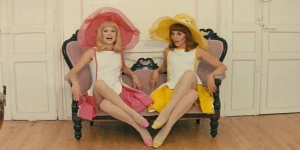
- Demy made a spiritual companion piece, The Young Girls of Rochefort (1967), which features a more overtly joyful musical style; the two films are often discussed together.
- Despite its French setting and language, the film found a substantial audience in the United States and United Kingdom, unusual for a foreign-language musical at the time.
- The film’s three-part structure is explicitly titled in the film itself: “The Departure,” “The Absence,” and “The Return.”
Why Watch?
The Umbrellas of Cherbourg proves that beauty and heartbreak are not opposites but collaborators. Legrand’s score alone justifies the runtime, and Deneuve’s performance communicates entire emotional worlds through a face and a melody. For anyone who has ever loved something they could not keep, this film feels uncomfortably personal. Few movies earn their sadness this honestly.
Director’s Other Movies
- Lola (1961)
- Bay of Angels (1963)
- The Young Girls of Rochefort (1967)
- Donkey Skin (1970)
- A Slightly Pregnant Man (1973)
- Lady Oscar (1979)
- Une chambre en ville (1982)
- Three Seats for the 26th (1988)