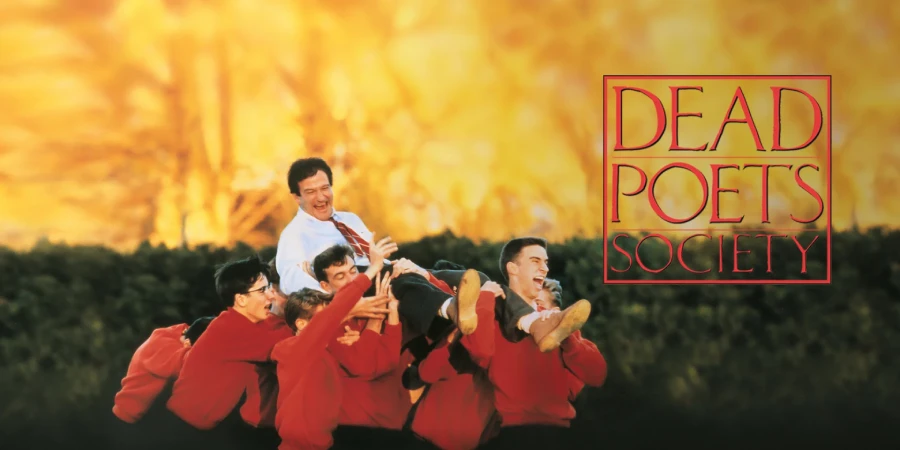

Robin Williams walks into a classroom, asks his students to rip pages out of their textbooks, and somehow makes it feel like a revolutionary act. That single scene tells you everything about what Dead Poets Society (1989) wants to do to you.
Peter Weir’s film uses a 1950s New England prep school as a pressure cooker, piling conformity and parental expectation on top of teenage longing until something breaks. What breaks is not just a character; it is your composure.
Detailed Summary
Welton Academy and the Weight of Tradition
We open at Welton Academy, an elite boarding school in Vermont where four pillars rule: tradition, honor, discipline, and excellence. Students file in wearing blazers, parents beam with pride, and the whole atmosphere reeks of polished wood and suppressed ambition. This place does not nurture boys; it processes them into doctors, lawyers, and bankers.
Neil Perry and Todd Anderson are our anchors. Neil is bright, eager, and strangled by a father who has already written his future in ink. Todd is painfully shy, arriving under the shadow of an overachieving older brother.
John Keating Arrives
John Keating, an English teacher and Welton alumnus, makes an entrance unlike anything these boys have seen. He walks into class whistling and leads them out into the hallway to look at old photographs of former students. “Carpe diem,” he tells them. “Seize the day, boys. Make your lives extraordinary.” Williams delivers this quietly, without theatrical inflation, and it lands harder for that restraint.
Keating instructs the students to rip out the introduction of their poetry textbooks, a pompous essay by one J. Evans Pritchard that reduces poetry to a mathematical graph. It is a deliberate provocation, and the boys feel the electricity of it.
The Discovery of the Dead Poets Society
Neil discovers that Keating was once a member of a secret club called the Dead Poets Society, which met in an old cave near the school to read poetry and literature aloud. He rallies his friends: Todd, Knox Overstreet, Charlie Dalton, Richard Cameron, Steven Meeks, and Gerard Pitts. They sneak out at night and the cave becomes their sanctuary.
These scenes carry a specific warmth. Watch how the candlelight catches each boy’s face as he reads. The cave is where they are allowed to be uncertain, loud, romantic, and alive, qualities Welton’s classrooms actively suppress.
Knox, Neil, and Separate Desires
Each boy’s subplot branches outward from these cave meetings. Knox becomes obsessed with Chris, a girl already dating a football player. His pursuit is passionate to the point of recklessness, and the film treats it with a kind of indulgent warmth that modern viewers might find more complicated.
Neil discovers acting and auditions secretly for a local production of A Midsummer Night’s Dream. He lands the role of Puck. His face in that audition scene is pure joy, unguarded and specific. Neil has found the thing that makes him feel real.
Charlie Dalton Pushes Too Far
Charlie Dalton, the most reckless of the group, publishes a fake letter in the school newspaper claiming the Dead Poets Society demands that girls be admitted to Welton. He signs it from the club. Headmaster Nolan hauls the boys into his office, and Charlie gets paddled.
Keating privately warns Charlie that recklessness without purpose will destroy everything they have built. Charlie grins. He is the boy who mistakes rebellion for freedom, and the film knows the difference even if he does not.
Neil’s Father Finds Out
Neil’s father, Mr. Perry, discovers the play rehearsals and forbids Neil from performing. He appears backstage on opening night, and Neil begs to be allowed to go on. Mr. Perry relents, briefly, sitting stone-faced in the audience while his son commands the stage in a crown of leaves.
Neil as Puck is the film’s most visually tender image. He is lit warmly, surrounded by applause, and for three minutes he gets to be exactly who he is. That the film frames this as precious and fleeting is not an accident.
The Night That Changes Everything
After the play, Mr. Perry takes Neil home and tells him he will be withdrawn from Welton and sent to military school to prepare for Harvard and medicine. Neil tries to speak. His father refuses to hear it.
Late that night, Neil puts on his Puck crown. He goes downstairs, takes his father’s pistol from the desk drawer, and shoots himself. Weir does not show the gunshot directly. We hear it from upstairs, and Mr. Perry’s face collapses into something past grief and into devastation. It is a choice that respects the horror by not spectacularizing it.
Movie Ending
Neil’s death detonates through the school like a slow-burning charge. Nolan and the board need someone to blame, and Keating is the obvious target. Cameron, always the pragmatist, tells the administration everything about the Dead Poets Society and signs a statement implicating Keating in encouraging reckless behavior. The other boys, under enormous adult pressure, sign as well.
Keating is dismissed. Before he can collect his belongings, Nolan takes over his classroom and begins reading poetry in exactly the flat, clinical way Keating spent the semester dismantling. It is a quiet act of institutional cruelty, and Weir frames it without melodrama.
Keating returns to retrieve his coat. He thanks the boys and turns to leave. Then Todd Anderson, the shyest boy in the room, the one who could barely speak at the start of the film, stands on his desk. He calls out “O Captain! My Captain!” It is the Walt Whitman salute Keating taught them. One by one, most of the boys stand on their desks.
Nolan orders them down. Some comply. Most do not. Keating pauses at the door, looks back, says “Thank you, boys,” and walks out. The camera holds on his face, which Williams plays with restrained emotion, and then cuts to black.
What the ending refuses to do is redeem anyone. Neil is still dead. Keating is still fired. The institution wins on paper. But the boys who remain standing have made a private, irrevocable choice to honor something beyond compliance, and the film trusts you to understand what that costs without spelling it out.
The question audiences ask most is whether Keating is morally responsible for Neil’s death. The film does not answer this cleanly, and that ambiguity is a feature. Keating taught Neil to want more. He did not teach him what to do when wanting more gets walled off. That gap between inspiration and practical courage is where the tragedy lives.
Are There Post-Credits Scenes?
Dead Poets Society has no post-credits scene. The film ends as Keating walks out the door, and the credits roll over silence. Weir was not interested in softening the landing.
Type of Movie
This is a coming-of-age drama with strong elements of tragedy. Its tone begins warm and idealistic, then methodically darkens as the third act approaches. There is almost no genre hybridity here; Weir plays it completely straight, which is precisely why the tragedy lands so hard.
Calling it an “inspirational teacher film” undersells it. Those films tend to end with the teacher winning. This one does not.
Cast
- Robin Williams – John Keating
- Robert Sean Leonard – Neil Perry
- Ethan Hawke – Todd Anderson
- Josh Charles – Knox Overstreet
- Gale Hansen – Charlie Dalton
- Dylan Kussman – Richard Cameron
- Allelon Ruggiero – Steven Meeks
- James Waterston – Gerard Pitts
- Norman Lloyd – Mr. Nolan
- Kurtwood Smith – Mr. Perry
- Alexandra Powers – Chris
Film Music and Composer
Maurice Jarre composed the score. Jarre was a veteran of large-scale prestige films, and he brings a restrained elegiac quality to this one rather than reaching for grandeur. The music mostly stays beneath the scenes rather than announcing them.
The cave sequences use atmospheric, low-key orchestration that feels deliberately ancient, as if these boys are performing rituals older than Welton. When the score swells during Neil’s stage performance, it earns it precisely because it held back so long before that moment.

Filming Locations
Principal photography took place in Delaware, primarily at St. Andrew’s School in Middletown. The school’s Gothic stone buildings and manicured grounds provided exactly the visual language of institutional permanence the story required.
Exterior cave scenes were shot at nearby natural locations. The contrast between the school’s rigid architecture and the loose, rocky, candlelit cave environment is not subtle, but it is effective. Weir used geography as character commentary throughout.
Awards and Nominations
Dead Poets Society received four Academy Award nominations, including Best Picture, Best Director for Peter Weir, and Best Actor for Robin Williams. Tom Schulman won the Oscar for Best Original Screenplay, the film’s only win on that night.
It also received BAFTA nominations and was a significant commercial success, which made the awards shutout in most categories a surprise to many observers at the time.
Behind the Scenes Insights
- Robin Williams was given significant room to improvise, and many of Keating’s classroom riffs came from Williams himself rather than Schulman’s script.
- Ethan Hawke was 17 during filming. His discomfort during early scenes was reportedly genuine, which Weir encouraged rather than directing away from.
- Peter Weir insisted on shooting the film chronologically so the cast could experience the emotional arc in sequence, an unusual and expensive choice.
- Robert Sean Leonard has said that filming the final night scenes was deeply emotional for the young cast, and that the weight of that sequence took time to shake off.
- Kurtwood Smith, best known for comedic roles, was cast deliberately against type as the rigid Mr. Perry, and Weir asked him to play every scene with complete sincerity, never as a villain.
- Williams chose to underplay Keating’s more emotional moments specifically because he felt the student performances needed the space and he did not want to overwhelm them.
Inspirations and References
Screenwriter Tom Schulman drew from his own experiences at Montgomery Bell Academy in Nashville, Tennessee, where he had a teacher who ran an informal literary circle. The character of Keating is a composite rather than a direct portrait of any single person.
Walt Whitman’s poetry, particularly Leaves of Grass and the Whitman poems addressed directly in the film, is woven into the story structurally, not just decoratively. “O Captain! My Captain!” functions as both classroom material and the film’s emotional payoff simultaneously. Henry David Thoreau’s Walden, specifically the “sucking the marrow out of life” passage, anchors Keating’s philosophy and recurs throughout the film.
Alternate Endings and Deleted Scenes
No alternate ending has been made publicly available or officially documented for this film. Weir appears to have committed to his ending early in the process, and no significant alternate conclusion has surfaced in any home media release or press account.
Some scenes with the Dead Poets Society cave meetings were reportedly longer in earlier cuts, with more poetry readings included. These were trimmed to keep the pacing from sagging in the middle section, which is a defensible call even if losing more Whitman would have hurt.
Book Adaptations and Differences
Dead Poets Society is not based on a book. Tom Schulman wrote an original screenplay. A novelization was published after the film’s release, but the film came first and the book is a derivative work, not a source text.

Memorable Scenes and Quotes
Key Scenes
- The textbook ripping scene: Keating instructs the boys to tear out Pritchard’s introduction. The sound of pages being ripped in a school that worships print is genuinely transgressive.
- Standing on the desks: Keating asks students to stand on their desks to see the world from a different vantage point. He does it first, calmly, before asking them to follow. The visual of boys above the eyeline of institutional authority is sharp and simple.
- Todd’s spontaneous poem: Keating pushes the terrified Todd to improvise a poem in front of the class, guiding him with prompts. Hawke’s visible panic giving way to something almost trance-like is the finest acting moment in the film.
- Neil on stage as Puck: Warmly lit, crowned with leaves, receiving applause. Weir holds this long enough that you feel what is about to be taken away.
- The final desk scene: Todd stands first. Boys climb their desks one by one. Nolan orders them down in mounting fury. Keating watches from the doorway, and Williams lets the moment register on his face without performing it.
Iconic Quotes
- “Carpe diem. Seize the day, boys. Make your lives extraordinary.”
- “We don’t read and write poetry because it’s cute. We read and write poetry because we are members of the human race.”
- “I went to the woods because I wanted to live deliberately. I wanted to live deep and suck all the marrow out of life.” (Thoreau, read by Keating)
- “O Captain! My Captain!”
- “No matter what anybody tells you, words and ideas can change the world.”
Easter Eggs and Hidden Details
- The four pillars of Welton recited at the opening ceremony reappear visually in framed mottos on the school walls throughout the film. Watch how often they appear just before a scene of suppression or punishment.
- Neil’s Puck crown, made of leaves, appears briefly on his head in his final scene. He puts it on in his father’s study before his death. It connects his last act to his truest self.
- Todd Anderson’s desk scene at the end mirrors his failed attempt to read in class at the start of the film. His physical posture in both scenes is worth comparing: hunched at the beginning, upright at the end.
- The cave the boys use is introduced with a point-of-view shot from inside looking out, framing the boys as they discover it. Weir reverses this angle later in the film to frame them looking inward, a quiet compositional rhyme.
- Keating’s name echoes John Keats, the Romantic poet who died young and believed in living fully. The naming is deliberate and fits the film’s literary texture.
Trivia
- Tom Schulman wrote the screenplay based partly on his teenage years, and the film marked his first major Hollywood credit.
- Robin Williams was not the first choice for Keating. Several other actors were reportedly considered before Williams came aboard.
- Ethan Hawke has cited this film as the formative experience of his acting career in multiple interviews.
- Peter Weir is Australian, and Dead Poets Society was among his earliest American studio productions after his success with Witness (1985).
- The film was a major box-office hit, grossing well beyond its production budget in its theatrical run.
- Norman Lloyd, who played Headmaster Nolan, was in his mid-70s during filming and had worked with Alfred Hitchcock decades earlier.
- St. Andrew’s School in Delaware was so suitable as a location that production required very little set dressing to make it look period-appropriate.
Why Watch?
Watch it for Ethan Hawke’s performance alone. His Todd Anderson improvisation scene, where a visibly trembling teenager finds a poem hiding inside his own panic, is a master class in screen acting from someone who was barely old enough to drive. Williams earns his reputation here by getting out of the younger cast’s way at exactly the right moments.
Director’s Other Movies
- Picnic at Hanging Rock (1975)
- The Last Wave (1977)
- Gallipoli (1981)
- The Year of Living Dangerously (1982)
- Witness (1985)
- The Mosquito Coast (1986)
- Green Card (1990)
- Fearless (1993)
- The Truman Show (1998)
- Master and Commander: The Far Side of the World (2003)
Recommended Films for Fans
- Good Will Hunting (1997)
- The Emperor’s Club (2002)
- Rushmore (1998)
- Scent of a Woman (1992)
- Pay It Forward (2000)
- Good Morning, Vietnam (1987)
- October Sky (1999)
- Stand and Deliver (1988)
- A Separate Peace (1972)
- The Perks of Being a Wallflower (2012)