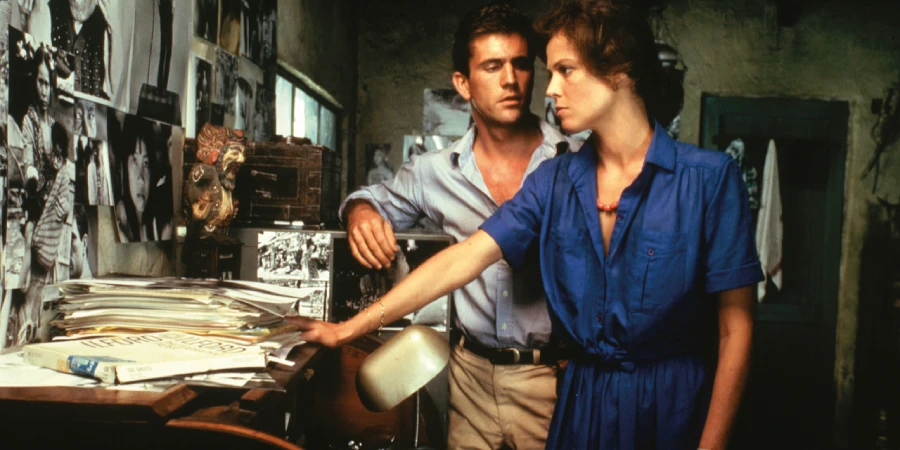

Peter Weir’s The Year of Living Dangerously drops you into Jakarta in 1965 and never lets you breathe easy. A foreign correspondent, a mysterious photographer, and a beautiful attaché collide against the backdrop of one of the twentieth century’s most volatile political moments. Mel Gibson, Sigourney Weaver, and Linda Hunt give performances that crackle with tension, ambiguity, and unexpected warmth. This film earns every frame of its reputation.
Detailed Summary
Arrival in Jakarta: Guy Hamilton Enters a World on Fire
Australian journalist Guy Hamilton, played by Mel Gibson, arrives in Jakarta as a rookie foreign correspondent for an Australian radio network. Indonesia in 1965 sits on a knife’s edge, with President Sukarno balancing the powerful Indonesian Communist Party against the military. Guy quickly discovers that covering this story means navigating webs of loyalty, danger, and corruption.
Guy struggles to find sources and make his mark. His colleagues at the press corps treat him as an outsider. However, everything changes when he meets Billy Kwan, a half-Chinese, half-Australian photographer played with extraordinary depth by Linda Hunt.
Billy Kwan: The Puppet Master at the Center of Everything
Billy Kwan is, without question, the film’s moral and emotional heart. He keeps meticulous files on everyone around him, including their flaws and their potential for goodness. Moreover, he operates with an almost messianic sense of purpose, believing that individuals can change the world through small, deliberate acts of compassion.
Billy takes Guy under his wing and introduces him to Jakarta’s hidden layers. He connects Guy to sources, gives him access to stories no other correspondent can reach, and genuinely invests in Guy’s character as much as his career. Billy also introduces Guy to Jill Bryant, a British Embassy attaché played by Sigourney Weaver.
The Romance Between Guy and Jill
Guy and Jill begin a cautious, charged courtship against the increasingly unstable political backdrop. Jill initially keeps her distance, aware that embassy staff forming attachments to journalists is a risky business. Nevertheless, their attraction proves impossible to suppress.
Their romance deepens quickly and intensely. Jill, however, holds a significant secret: she has obtained intelligence suggesting a communist arms shipment is heading for Indonesia, information that could reshape the entire political situation. She shares this with Guy, trusting him personally, but she makes clear he must not report it.
Guy Betrays Jill’s Trust
Guy faces the central moral test of the film when he decides to file the story about the arms shipment. He knows Jill gave him that information in confidence. In contrast to Billy’s idealism, Guy acts with a journalist’s ruthless pragmatism.
Jill feels profoundly betrayed. She breaks off their relationship and cuts all contact with him. Consequently, Guy loses both the woman he loves and the moral high ground he briefly held.
Billy’s Disillusionment and Desperate Act
Billy’s faith in Guy shatters when he witnesses Guy’s betrayal of Jill. He had believed Guy was different, someone capable of genuine compassion and integrity. For Billy, this is the final blow in a series of disappointments.
Billy has already experienced a devastating personal loss: a young boy he had been caring for and supporting dies from poverty-related illness. That death fractures Billy’s belief that small acts of goodness can make a meaningful difference. In addition, his disillusionment with Sukarno, whom he had once admired, deepens his despair.
Billy reaches his breaking point and unfurls a banner from a Jakarta hotel window reading “Sukarno, Feed Your People.” It is a public, defiant, almost suicidal gesture. Government agents seize and beat him severely, and he dies from his injuries.
The Coup Attempt and the Chaos of October 1965
Jakarta erupts as factions within the military launch a coup attempt against army leadership, an event historically tied to the real events of October 1, 1965. The city descends into violence and paranoia. Foreign nationals scramble for safety and evacuation.
Guy, meanwhile, is physically compromised. Earlier in the film, a government thug had struck him in the face, partially blinding him in one eye. He now navigates the chaos of a collapsing city while barely able to see.

Movie Ending
Guy receives word that Jill is leaving on an evacuation flight out of Jakarta. He has one chance to reach her before she departs, but the city between him and the airport is violent, chaotic, and actively hostile to foreign journalists. His partial blindness makes every step genuinely dangerous.
Guy pushes through the mayhem with single-minded determination. He passes roadblocks, navigates streets filled with armed soldiers, and refuses to turn back. His physical journey through the burning city mirrors his internal journey: this is the first moment in the film where he acts on love rather than ambition.
He reaches the airport and finds Jill. Despite everything, despite his betrayal and the weeks of silence, she does not turn him away. They board the plane together and leave Indonesia behind. The final image places them together, airborne, escaping a country that has consumed Billy entirely.
What makes the ending resonate so powerfully is its moral complexity. Guy does not fully redeem himself. He broke Jill’s trust, he filed the story, and Billy died in part because of disillusionment rooted in Guy’s failure. However, Weir refuses to punish Guy with a tidy tragic conclusion. Instead, the film asks an uncomfortable question: can someone be genuinely flawed, even culpable, and still find love and survival? The answer, quietly and without comfort, appears to be yes.
Billy’s absence haunts every frame of the finale. His files, his puppets, his relentless moral accounting: all of it ends without resolution or vindication. Billy is the one who truly lived dangerously, and Billy is the one who does not escape.
Are There Post-Credits Scenes?
The Year of Living Dangerously contains no post-credits scenes whatsoever. Peter Weir ends the film on his own terms, with no additional footage after the credits roll. Audiences can leave once the screen goes dark.
Type of Movie
This film occupies a genuinely unusual tonal space. It combines political thriller, romantic drama, and journalistic procedural into something that resists easy genre labeling. Weir shoots it with an almost dreamlike atmosphere that softens and intensifies the danger simultaneously.
In contrast to standard Hollywood thrillers, the film prizes ambiguity over resolution. Its tone is melancholic, morally serious, and occasionally poetic. Viewers expecting clean action or a straightforward love story may find it demands more patience than they expected.
Cast
- Mel Gibson – Guy Hamilton
- Sigourney Weaver – Jill Bryant
- Linda Hunt – Billy Kwan
- Michael Murphy – Pete Curtis
- Bill Kerr – Colonel Henderson
- Noel Ferrier – Wally O’Sullivan
- Paul Sonkkila – Kevin Condon
- Bembol Roco – Kumar
Film Music and Composer
Maurice Jarre composed the score for The Year of Living Dangerously. Jarre was a French composer with enormous Hollywood credentials, including his iconic work on Lawrence of Arabia and Doctor Zhivago. His score here blends Western orchestration with textures that evoke Southeast Asian musical traditions without resorting to pastiche.
The music reinforces the film’s dreamy, uneasy atmosphere. It swells during romantic sequences without becoming saccharine, and it underscores the political tension without tipping into melodrama. Jarre’s contribution is subtle enough that many viewers absorb it without consciously noticing how much work it does.

Filming Locations
Production took place primarily in the Philippines, specifically in and around Manila, rather than in Indonesia itself. The Indonesian government declined to cooperate with the production, making filming on location impossible. As a result, the Filipino landscape and architecture substituted convincingly for 1960s Jakarta.
Some additional photography happened in Australia. The Philippine locations brought their own logistical challenges, including local opposition from groups who objected to certain aspects of the production. Notably, threats against the cast and crew cut the Filipino shoot short, forcing the production to relocate to complete filming in Australia.
Awards and Nominations
Linda Hunt won the Academy Award for Best Supporting Actress for her performance as Billy Kwan, making history as the first actor to win an Oscar for playing a character of the opposite sex. The film also received a nomination from the Australian Film Institute. Hunt’s win remains one of the most celebrated and discussed in Oscar history.
Behind the Scenes Insights
- Peter Weir cast Linda Hunt, a woman, as the male character Billy Kwan after struggling to find a male actor who could bring the necessary emotional complexity to the role.
- Threats from a Filipino Muslim group, who objected to the film’s content, forced the production to abandon its Philippine shoot prematurely and relocate to Sydney, Australia.
- Mel Gibson had already starred in Weir’s Gallipoli before this film, cementing a productive director-actor relationship.
- Sigourney Weaver took on the role of Jill partly because of the opportunity to work with Weir, whose reputation for atmospheric, character-driven filmmaking attracted serious actors.
- The production team worked extensively with cinematographer Russell Boyd, whose visuals gave the film its distinctive, heat-soaked, slightly overexposed look.
- Linda Hunt reportedly stayed in character as Billy Kwan throughout much of the production, deeply researching the psychology and physicality of the role.
Inspirations and References
The film adapts C.J. Koch’s novel of the same name, published in 1978. Koch, an Australian author, drew on his own experiences and extensive research into Indonesia’s political upheaval of the mid-1960s. His novel uses the device of Billy Kwan’s files as a structural framework for exploring the story.
The title references the Indonesian phrase vivere pericolosamente, a concept associated with living boldly and recklessly in the face of danger, which Sukarno himself reportedly invoked. Furthermore, the historical backdrop of the 1965 Indonesian coup attempt and its catastrophic aftermath ground the fiction in one of the twentieth century’s most consequential and underreported political events.
Alternate Endings and Deleted Scenes
No widely documented alternate endings or officially released deleted scenes exist for The Year of Living Dangerously. Peter Weir is known for delivering focused, intentional cuts, and the film’s theatrical version reflects his complete vision. No major alternate version has surfaced in home video releases or official retrospectives.
Book Adaptations and Differences
The film adapts C.J. Koch’s 1978 novel closely in its broad strokes but makes notable adjustments. In Koch’s novel, Billy Kwan’s files and narration provide a more layered, literary framework that the film partially preserves through Billy’s voiceover. However, the novel develops the Indonesian political landscape in considerably more detail than a feature film can accommodate.
Koch himself collaborated on the screenplay alongside Weir and David Williamson. Despite that collaboration, some readers of the novel feel the film simplifies the political dimensions in favor of the romance. The character of Billy Kwan translates remarkably well to screen, arguably gaining additional impact through Linda Hunt’s physical and emotional performance.



Memorable Scenes and Quotes
Key Scenes
- Billy’s banner protest: Billy unfurls his handmade sign from the hotel window in a moment that is simultaneously heartbreaking and quietly magnificent, the action of a man with nothing left to lose.
- The wayang puppet sequence: Billy uses traditional Indonesian shadow puppets to explain his worldview and his relationship to the people around him, a visually and thematically rich scene that defines his character.
- Guy’s dash to the airport: Half-blind, terrified, and desperate, Guy pushes through the coup’s chaos to reach Jill, the film’s most viscerally urgent sequence.
- The slum visit: Billy takes Guy into Jakarta’s poorest neighborhoods, forcing him to confront the human cost of the political drama he is trying to package into radio reports.
- Jill’s revelation about the arms shipment: A quiet, intimate scene in which Jill trusts Guy with intelligence that will ultimately destroy their relationship.
Iconic Quotes
- “I shall light a candle of understanding in thine heart, which shall not be put out.” Billy Kwan, quoting the Apocrypha, which serves as one of the film’s central thematic anchors.
- “What then must we do?” Billy’s recurring question, drawn from Tolstoy, which he applies to the suffering he witnesses in Jakarta.
- “You have a friend at court, Hamilton.” Billy, announcing his decision to take Guy under his protection in the early scenes.
Easter Eggs and Hidden Details
- Billy’s puppet figures, which he uses as metaphors for the people in his life, are specifically wayang kulit shadow puppets, a traditional Javanese art form with deep cultural and spiritual significance in Indonesian society.
- The film’s title appears as a direct reference to Sukarno’s political rhetoric, embedding the protagonist’s personal story within the actual language of Indonesian political history.
- Billy’s meticulous files on everyone he knows mirror the surveillance and documentation culture of the era’s intelligence agencies, a quiet visual irony given the political climate surrounding the characters.
- Russell Boyd’s cinematography deliberately uses a warm, slightly washed-out palette to evoke the oppressive heat of Jakarta and the hazy moral atmosphere of the story simultaneously.
- The wayang puppet sequences visually echo traditional Indonesian theatrical performances in which a single puppeteer controls multiple characters, reflecting Billy’s role as the unseen manipulator of events around him.
Trivia
- Linda Hunt became the first performer in Oscar history to win an Academy Award for playing a character of the opposite biological sex.
- Peter Weir and Mel Gibson had already worked together on Gallipoli in 1981, giving their collaboration on this film an established creative shorthand.
- The production’s early departure from the Philippines due to security threats is one of the more dramatic behind-the-scenes stories in Australian cinema history.
- C.J. Koch co-wrote the screenplay, an unusual level of authorial involvement that helped preserve the novel’s philosophical depth on screen.
- Sigourney Weaver filmed her role shortly after the massive success of Alien, bringing significant star power to what was otherwise an Australian-led production.
- The historical events depicted, specifically the October 1965 coup attempt and its aftermath, led to the rise of General Suharto and one of the deadliest mass killings of the twentieth century, context the film gestures toward without depicting directly.
Why Watch?
The Year of Living Dangerously offers a rare combination of political intelligence, romantic tension, and genuine moral weight. Linda Hunt’s performance alone justifies the viewing, but every element earns its place. Few films balance personal intimacy with historical catastrophe this gracefully.
Director’s Other Movies
- Picnic at Hanging Rock (1975)
- The Last Wave (1977)
- Gallipoli (1981)
- Witness (1985)
- The Mosquito Coast (1986)
- Dead Poets Society (1989)
- Green Card (1990)
- Fearless (1993)
- The Truman Show (1998)
- Master and Commander: The Far Side of the World (2003)
Recommended Films for Fans
- The Killing Fields (1984)
- Salvador (1986)
- Under Fire (1983)
- The Quiet American (2002)
- Gallipoli (1981)
- Witness (1985)
- Missing (1982)
- The Constant Gardener (2005)