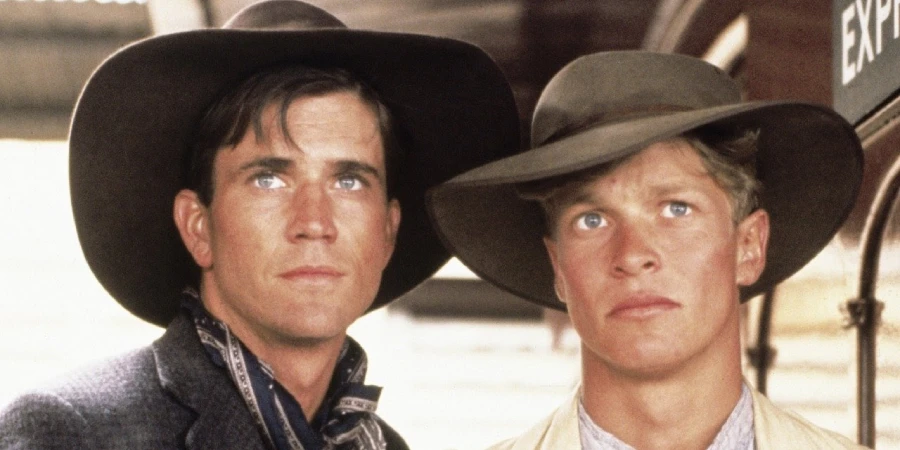

Two young men sprint toward destiny, and only one of them will make it back alive. Peter Weir’s Gallipoli (1981) stands as one of cinema’s most devastating anti-war statements, disguised brilliantly as a sun-drenched coming-of-age story. It seduces you with friendship, humor, and Australian swagger before gutting you in its final frames. Few war films earn their tragedy as honestly as this one does.
Detailed Summary
Two Runners, One Dream
Gallipoli opens in the vast Western Australian outback, where Archy Hamilton trains as a sprinter under the watchful eye of his uncle. Archy is fast, idealistic, and fiercely patriotic. His world is clean, golden, and full of promise.
At a bush race meeting, Archy crosses paths with Frank Dunne, a street-smart city kid who also runs competitively. Frank is skeptical about the war and more interested in personal survival than national glory. However, the two form an immediate, unlikely bond.
The Road to Enlistment
Archy burns to enlist, inspired by romanticized posters of cavalry glory and a deep sense of duty. Frank resists at first, preferring to see the war as someone else’s problem. Nonetheless, the pull of adventure and friendship gradually wears him down.
Together they trek across the outback on foot and by camel toward Perth, a journey that cements their friendship in sweat and laughter. Frank attempts to enlist in the infantry while Archy tries the light horse. In contrast, both initially face obstacles: Frank gets in, Archy does not because he is too young.
Archy borrows Frank’s birth certificate and lies about his age, successfully joining the Australian Light Horse. The two friends reunite and ship out together, carrying their youthful excitement across the ocean toward something neither fully understands.
Cairo and the Weight of War
Before reaching the front, the men spend time in Cairo, and Weir lingers here deliberately. They visit the pyramids, chase women, brawl, and play tourist. It is a deliberate breath of life before the film starts suffocating it.
Frank signs on with the 8th Light Horse to stay with Archy. Meanwhile, the men around them begin to sense that the campaign ahead is not the heroic cavalry charge they imagined. Rumors and unease start to creep in at the edges of their camaraderie.
Arriving at Gallipoli
When the regiment reaches the Gallipoli peninsula, the romantic illusion collapses fast. Trenches, dust, flies, and the constant sound of artillery replace the open skies of Australia. Weir shows the men compressed into narrow, brutal spaces, a sharp visual contrast to the film’s earlier wide-open landscapes.
Frank lands an administrative role at headquarters, keeping him slightly removed from the front line. Archy, consequently, stays with his unit closer to the deadly action. The film uses this separation to build unbearable dramatic irony.
The Battle of the Nek
Command orders a diversionary attack at the Nek, a narrow strip of land between Australian and Ottoman trenches. British forces were supposed to launch a simultaneous naval bombardment to draw enemy fire. However, the bombardment ends early, and Ottoman defenders return fully to their positions before the Australians charge.
Four waves of men receive orders to go over the top in successive charges, each one a near-certain death sentence. Commanding officers on the spot recognize the catastrophe unfolding but cannot halt the orders coming from above. The institutional momentum of military command crushes individual reason completely.
Movie Ending
Frank, realizing the attack is suicidal, sprints back to headquarters to get the orders stopped or delayed. He runs as fast as his legs will carry him, and Weir frames these moments with agonizing urgency, cutting between Frank’s desperate dash and the men preparing to charge. Every second Frank loses on that run costs lives.
Frank reaches a senior officer and pleads for a halt. The officer makes contact with higher command, and for a breathless moment it seems as if the orders might change. Then word comes back: the attack proceeds as planned. Frank sprints back toward the trenches, but he already knows he will be too late.
Archy and his comrades fix bayonets and prepare for the final wave. Frank arrives at the trench just as the whistle sounds. He cannot stop it. Archy launches himself over the parapet with full, terrifying conviction, his face resolute and almost joyful, because he still believes in what he is doing.
Weir freezes the frame on Archy mid-stride, arms thrown back, body arching forward as bullets tear into him. It is one of the most famous freeze-frames in film history, and its power comes from context rather than spectacle. We have spent nearly two hours loving this young man, and the film refuses to let us look away from what institutional failure and romantic nationalism do to people like him.
Frank lives, Archy dies, and neither outcome feels fair. That asymmetry is precisely the point. The film argues that the men who died at Gallipoli were not sacrificed for a noble cause; they were consumed by a machine that neither valued nor truly saw them. The freeze-frame denies us the comfort of a death scene. It simply stops, because for Archy, everything simply stops.
Are There Post-Credits Scenes?
Gallipoli contains no post-credits scenes whatsoever. After the freeze-frame ending, the film offers no coda, no epilogue, and no relief. Weir made that choice deliberately, and adding anything after that image would have been a profound artistic mistake.
Type of Movie
Gallipoli operates as a war drama with strong coming-of-age and buddy film elements. Its tone shifts from sun-bleached adventure and warm humor in its first half to creeping dread and outright tragedy in its second. Weir never lets either register feel false.
In contrast to many war films, this one is not interested in combat choreography. It treats war as a bureaucratic and ideological catastrophe, not a theater of heroism. That choice makes it far more devastating than most films in the genre.
Cast
- Mel Gibson – Frank Dunne
- Mark Lee – Archy Hamilton
- Bill Kerr – Jack, Archy’s uncle
- Robert Grubb – Billy
- Tim McKenzie – Barney
- David Argue – Snowy
- Harold Hopkins – Les McCann
Film Music and Composer
Brian May, the Australian composer (not the guitarist from Queen), handled portions of the score. However, Gallipoli is perhaps most famous for its use of Giorgio Moroder’s instrumental piece from the Foxlight album, alongside Jean-Michel Jarre’s synthesizer music from Oxygene. Weir’s decision to pair electronic, almost otherworldly music with scenes of nineteenth-century-style warfare creates a haunting, dreamlike dissonance.
The use of Adagio in G Minor, attributed to Tomaso Albinoni, during the film’s most painful sequences gives those moments a weight that traditional orchestral scoring might have sentimentalized. Weir trusted the music to heighten emotion without manipulating it. That restraint pays off enormously.
Filming Locations
Principal photography took place across South Australia, using its vast, sun-scorched desert landscapes to represent the Australian outback sequences. Port Augusta and surrounding areas provided the stark, isolating terrain that makes Archy and Frank’s early journey feel genuinely epic. Those wide, empty spaces communicate freedom, and their absence later in the film hurts all the more.
Scenes set in Cairo filmed in Egypt, giving those sequences an authentic grandeur and weight. The production also built elaborate trench systems in South Australia to recreate the Gallipoli peninsula. Notably, the actual Gallipoli peninsula in Turkey was not used for filming.
Awards and Nominations
Gallipoli performed strongly at the Australian Film Institute Awards, winning Best Film, Best Director for Peter Weir, Best Actor for Mel Gibson, and Best Screenplay for David Williamson. It received broad recognition within Australia as a landmark national film. Moreover, it earned international attention and helped launch both Weir and Gibson toward major Hollywood careers.
Behind the Scenes Insights
- Peter Weir conducted extensive historical research before production, studying photographs, diaries, and accounts from Gallipoli veterans to ensure authenticity in the details of daily life at the front.
- Mel Gibson was already known in Australia for Mad Max (1979) when he took the role of Frank, but Gallipoli demonstrated his dramatic range to international audiences for the first time.
- Mark Lee had minimal film experience before landing the role of Archy. Weir cast him partly because his face projected an openness and innocence that felt essential to the character’s arc.
- Weir reportedly ran the final charge sequence multiple times with cast members to exhaust them physically, so the emotional and physical strain visible on screen was genuinely felt rather than performed.
- Screenwriter David Williamson collaborated closely with Weir on the script, and the two had significant creative discussions about how explicitly to apportion blame for the disaster at the Nek.
- The camel-riding sequence during the outback journey used real camels and presented considerable logistical challenges for the production team and actors alike.
Inspirations and References
Weir and Williamson drew heavily on the historical record of the Battle of the Nek, which took place on August 7, 1915, during the broader Gallipoli campaign. Accounts from Australian war historian C.E.W. Bean informed much of the film’s depiction of command failures and the specific sequencing of the fatal attack. Bean’s writing gave the filmmakers a factual skeleton they could dramatize.
The film also engages with the broader mythology of Anzac Day and Australian national identity, interrogating rather than simply celebrating the legend. For many Australians, Gallipoli represents the moment of national birth, and Weir approached that myth with both respect and critical intelligence. He honored the soldiers while indicting the systems that killed them.
Alternate Endings and Deleted Scenes
No formally documented alternate endings or significant deleted scenes for Gallipoli are widely confirmed in public record. Weir has discussed that the freeze-frame ending was always central to his vision for the film. He never seriously considered showing Archy’s death in a more conventional way.
Some production accounts suggest that earlier cuts of the Cairo sequence ran longer, but specific details about excised material are not part of the confirmed public record. Therefore, no reliable account of deleted scenes exists to analyze here.
Book Adaptations and Differences
Gallipoli is not based on a single source novel or book. David Williamson wrote the original screenplay drawing from historical accounts rather than adapting a specific literary work. Consequently, there is no book-to-film comparison to be made in the traditional sense.

Memorable Scenes and Quotes
Key Scenes
- Archy’s opening sprint across the outback, establishing his speed and his uncle’s almost mythological belief in him as a runner destined for greatness
- Frank and Archy’s first meeting at the bush race, where competition immediately turns into mutual respect and the beginning of a genuine friendship
- The camel trek across the desert, equal parts absurd and arduous, perfectly capturing the film’s early tone of youthful adventure
- The men standing at the base of the pyramids in Cairo, small figures against ancient stone, a quietly powerful visual about human scale and mortality
- Frank’s desperate final sprint back to the trenches, scored with Giorgio Moroder’s music, one of the most viscerally tense sequences in Australian cinema
- The freeze-frame of Archy mid-charge, arms back, body open, the film’s devastating and iconic final image
Iconic Quotes
- “What are your legs? Steel springs. What are they going to do? Hurl me down the track. How fast can you run? As fast as a leopard. How fast are you going to run? As fast as a leopard. Then let’s see you do it.” – Jack to Archy
- “What are we doing here, Frank?” – a quiet question that carries enormous weight as the men wait in the trenches
Easter Eggs and Hidden Details
- Weir uses visual symmetry between the film’s opening sprint and the final charge, suggesting that Archy’s whole life has been a run toward this moment without ever knowing it.
- Frank’s survival versus Archy’s death partly reflects their respective relationships to the war: Frank always questioned it, while Archy embraced it completely. Weir makes survival an act of skepticism rather than luck.
- In the Cairo sequences, the men swim in bright, open water, one of the film’s last images of genuine freedom before the claustrophobia of the trenches swallows everything.
- Throughout the Gallipoli sequences, Weir subtly reduces the color palette, making the images dustier and more muted as the film moves toward its conclusion.
- Jack’s training mantra, repeated at the beginning, echoes structurally in how Archy approaches the final charge: he runs as he was always taught to run, without hesitation.
Trivia
- Gallipoli was one of the first major Australian films to receive significant international theatrical distribution, helping establish Australia as a serious force in world cinema during the early 1980s.
- Peter Weir directed the film between Picnic at Hanging Rock (1975) and The Year of Living Dangerously (1982), a remarkable stretch of critically acclaimed work.
- Mel Gibson took a substantial pay cut to appear in the film, prioritizing the project’s creative ambitions over commercial considerations.
- The film’s depiction of British command incompetence was controversial in some circles, with critics debating how fairly it represented the historical chain of responsibility for the disaster at the Nek.
- Weir has cited the film as one of the most personally significant projects of his career, describing it as a story about innocence and its destruction rather than a war film in any conventional sense.
- Mark Lee never achieved the same international profile as Gibson after this film, which carries its own quiet irony given that his character is the film’s moral and emotional center.
Why Watch?
Gallipoli earns its place among cinema’s essential war films by refusing to glorify what it depicts. It builds two characters you genuinely love, then shows you exactly what systems of power do to people like them. Furthermore, its final image lodges in the memory permanently. Few films argue for peace as powerfully as this one does.
Director’s Other Movies
- Picnic at Hanging Rock (1975)
- The Last Wave (1977)
- The Year of Living Dangerously (1982)
- Witness (1985)
- The Mosquito Coast (1986)
- Dead Poets Society (1989)
- Green Card (1990)
- Fearless (1993)
- The Truman Show (1998)
- Master and Commander: The Far Side of the World (2003)
Recommended Films for Fans
- Paths of Glory (1957)
- All Quiet on the Western Front (1930)
- Breaker Morant (1980)
- Ataturk I 1881-1919 (2023)
- Ataturk II 1881-1919 (2024)
- The Lighthorsemen (1987)
- 1917 (2019)
- Anzacs (1985)
- Dead Poets Society (1989)
- Platoon (1986)