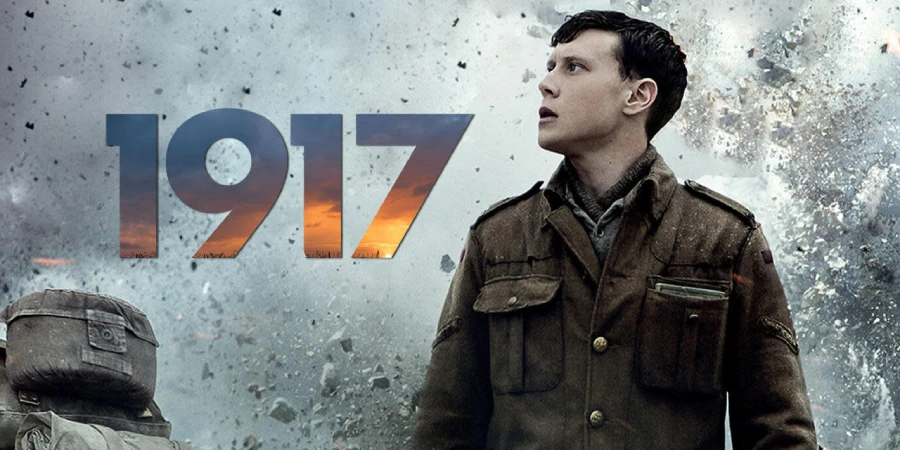

Two young soldiers, one impossible errand, and a camera that refuses to blink. 1917 turns a simple message delivery into two hours of sustained dread. Sam Mendes stages the whole thing as one apparently unbroken shot, so you never get a chance to breathe. By the end, you will feel like you crossed France on foot yourself.
Detailed Summary
A Nap Interrupted
It is April 6, 1917, in northern France. Lance Corporals Tom Blake and William Schofield doze beside a tree behind the British lines. A sergeant wakes Blake and tells him to pick a man. Blake picks his friend, which Schofield will soon regret.
General Erinmore explains the stakes in a dim dugout. German forces have pulled back to the Hindenburg Line, and the retreat is a trap. Colonel Mackenzie’s 2nd Battalion of the Devonshire Regiment plans to attack at dawn, and 1,600 men will walk into a slaughter.
Field telephone lines are down, so someone must carry the order by hand. Blake’s older brother, Lieutenant Joseph Blake, serves in that battalion. Consequently, Blake wants to leave immediately, while the more seasoned Schofield begs him to wait for dark.
Crossing No Man’s Land
A weary, sardonic Lieutenant Leslie points them toward a gap in the wire. He clearly expects never to see them again. Schofield tears his hand on barbed wire almost at once, then plunges it into a rotting corpse.
They crawl past dead horses, craters, and swarms of flies. However, no shots come. When they reach the German front line, they find it empty.
The Tripwire in the Bunker
Inside the abandoned German dugout, the pair notice how solid the enemy’s quarters are. Blake spots a tripwire just in time. A large rat, sadly, does not share his caution.
An explosion buries Schofield under rubble and fills his eyes with dust. Blake digs him out and leads him, half blind, through the collapsing tunnels. They leap across a mine shaft and escape seconds before the whole structure caves in.
Afterward, a shaken Schofield snaps at Blake for choosing him. He also admits he traded his Somme medal to a French captain for a bottle of wine. To him, it was only “a bit of bloody tin.”
The Farmhouse and the Fallen Pilot
Beyond the lines, the men find an orchard of cherry trees that retreating Germans have chopped down. Blake, whose mother keeps an orchard, notes that the trees will grow back stronger. Schofield fills his canteen with fresh milk from a pail at the abandoned farm.
A dogfight unfolds overhead, and a German plane crashes straight into the barn. Both soldiers drag the burning pilot from the wreck. Schofield suggests a mercy killing, but Blake asks him to fetch water.
In that brief moment, the pilot stabs Blake in the stomach. Schofield shoots the German, but the damage is done. Blake bleeds out in his friend’s arms, asking Schofield to write to his mother and to finish the mission.
A Lift from Captain Smith
Schofield takes Blake’s rings and identity tag. A passing British convoy finds him, and Captain Smith offers him a ride. Smith also offers advice: deliver the order in front of witnesses, because some commanders simply want the fight.
In the truck, Schofield sits in stunned silence while other soldiers joke around him. Eventually the convoy halts at a destroyed bridge near Écoust-Saint-Mein. Schofield continues alone on foot.
The Sniper and the Blackout
A German sniper fires at him as he crosses the broken bridge. Schofield works his way to the sniper’s building and kicks open the door. Both men fire at once.
His shot kills the sniper. In return, a ricochet strikes his helmet and throws him down the stairs. Here the screen cuts to black, the film’s one openly acknowledged cut.
Écoust by Flare Light
Schofield wakes hours later with a bleeding head. Night has fallen, and flares drift over the ruined town, throwing long moving shadows across the walls. A church burns in the distance like a vision of hell.
A German soldier chases him through the rubble. He ducks into a cellar and meets Lauri, a young French woman hiding with an orphaned baby. Schofield gives her his food and, notably, the milk from the farm.
He recites lines from Edward Lear’s The Jumblies to the infant. For a few minutes, the war stops. Then the church bells signal that dawn is close, and he forces himself back outside.
The River and the Singing in the Woods
Back on the streets, Schofield strangles a young German soldier to stay hidden. Another gives chase, and he leaps from a wall into the river. Rapids hurl him downstream and over a waterfall.
Cherry blossom petals float around him as he drifts, exhausted. He must then climb over bloated corpses jammed against a fallen tree to reach the bank. On land at last, he finally breaks down and sobs.
A lone voice draws him into the trees. There, a soldier sings “I Am a Poor Wayfaring Stranger” to a silent company of men. Schofield slumps against a trunk, then learns these are the Devons, and the attack has already begun.
Movie Ending
Schofield pushes through a trench packed with soldiers waiting to go over the top. Nobody moves aside fast enough. Therefore, he makes a reckless choice: he climbs out and sprints across open ground, parallel to the line, as the first wave charges.
Shells burst around him, and charging men knock him flat twice. He gets up each time. It is the film’s signature image, and it works because the mission has shrunk to one man running.
He bursts into Colonel Mackenzie’s dugout and shouts that the attack must stop. Mackenzie resists at first, convinced he has the Germans on the run. After reading the letter, he calls off the assault.
Does the mission succeed? Mostly. Schofield saves the bulk of the battalion, yet the first wave has already gone over, and many of those men are dead or wounded.
Mackenzie offers no thanks, only bitterness. He hoped today might be a good day, he says, and calls hope a dangerous thing. Next week, command will send a different order, and this war will end only with the last man standing.
Schofield then searches the casualty station for Joseph Blake. He finds him alive and tells him that Tom died saving his life. Joseph takes the rings, holds back tears, and agrees that Schofield should write to their mother.
In the last moments, Schofield walks to a lone tree and sits against it. He pulls out photographs of his wife and two daughters. On the back, someone has written “Come back to us.”
This final beat answers a question the film raises early. Schofield told Blake he hated going home because he knew he had to leave again. As a result, we finally see what he has been guarding all along.
Notice the symmetry, too. Mendes opens on Schofield resting against a tree and closes the same way. Nothing has changed in the war, but everything has changed in him.
Are There Post-Credits Scenes?
No. 1917 has no mid-credits or post-credits scenes. Before the credits roll, a dedication appears to Lance Corporal Alfred H. Mendes, the director’s grandfather, “who told us the stories.”
Type of Movie
1917 is a war drama with the pulse of a survival thriller. Its tone is tense, immersive, and mournful, with brief flashes of dry soldier humor. In contrast to many combat epics, it focuses on endurance and duty rather than battlefield heroics.
Cast
- George MacKay – Lance Corporal William Schofield
- Dean-Charles Chapman – Lance Corporal Tom Blake
- Colin Firth – General Erinmore
- Andrew Scott – Lieutenant Leslie
- Mark Strong – Captain Smith
- Benedict Cumberbatch – Colonel Mackenzie
- Richard Madden – Lieutenant Joseph Blake
- Claire Duburcq – Lauri
- Daniel Mays – Sergeant Sanders
- Adrian Scarborough – Major Hepburn
- Nabhaan Rizwan – Sepoy Jondalar
Film Music and Composer
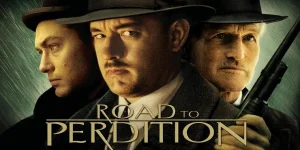
Thomas Newman composed the score. He is a longtime Mendes collaborator, with credits on American Beauty, Road to Perdition, Skyfall, and Spectre. His work here earned an Academy Award nomination for Best Original Score.
Newman favors low, pulsing electronics for long stretches, which keeps the tension humming under the continuous shot. He saves the big orchestral swells for key moments. “The Night Window,” for instance, accompanies the flare-lit ruins of Écoust.
“Sixteen Hundred Men” drives the final sprint, and “Come Back to Us” closes the film on a gentle note. In addition, the folk hymn “I Am a Poor Wayfaring Stranger,” sung on screen by Jos Slovick, provides the story’s quietest and most haunting passage.


Filming Locations
Mendes shot the film entirely in the United Kingdom. Because the camera never appears to cut, each location had to match the exact distance the actors would travel.
- Salisbury Plain, Wiltshire: Its open, rolling fields doubled for the French countryside and the final battlefield. That emptiness leaves Schofield exposed with nowhere to hide.
- Bovingdon Airfield, Hertfordshire: The crew dug extensive trench systems here. These sets establish the cramped, muddy world the men are desperate to leave.
- Low Force, River Tees, Teesdale: This waterfall provides Schofield’s plunge. Meanwhile, the Tees Barrage white-water course supplied the rapids.
- Govan Docks, Glasgow: The derelict docks became the canal and broken bridge where the sniper pins Schofield down.
- Shepperton Studios, Surrey: Builders constructed the ruined town of Écoust here, which allowed precise control of the flare lighting.
Awards and Nominations
1917 received ten Academy Award nominations, including Best Picture, Best Director, and Best Original Screenplay. It won three: Best Cinematography for Roger Deakins, Best Visual Effects, and Best Sound Mixing. However, Best Picture went to Parasite.
At the Golden Globes, it won Best Motion Picture (Drama) and Best Director. It also dominated the BAFTAs with seven wins, including Best Film, Outstanding British Film, and Best Director. Furthermore, Mendes took top honors from both the Producers Guild and the Directors Guild.
Behind the Scenes Insights
- Roger Deakins shot the film on the ARRI Alexa Mini LF, a compact large-format camera that suited the constant movement.
- The cast and crew rehearsed for roughly six months before filming. They measured every scene so each set matched the length of its dialogue.
- Editor Lee Smith stitched long takes together with hidden cuts. The longest takes run for several minutes at a time.
- Daylight scenes relied on overcast skies for consistent lighting. As a result, the crew often waited for clouds and rehearsed whenever the sun came out.
- George MacKay’s collisions with charging soldiers during the final run were unplanned. He got up and kept going, and Mendes kept the take.
- Mendes co-wrote the script with Krysty Wilson-Cairns. It marked his first screenwriting credit on a feature.
Inspirations and References
Stories from Mendes’s grandfather, Alfred H. Mendes, inspired the film. Alfred served as a messenger on the Western Front and later recalled carrying messages across dangerous ground. Schofield and Blake, nonetheless, are fictional characters.
History supplies the backdrop. In early 1917, German forces really did withdraw to the Hindenburg Line in a planned retreat known as Operation Alberich. They destroyed villages, roads, and orchards as they went, just as the film shows.
Literature leaves its mark as well. General Erinmore quotes Rudyard Kipling, and Schofield recites Edward Lear.
Alternate Endings and Deleted Scenes
No alternate ending has surfaced, and none seems likely to exist. The one-shot design required the team to lock the story before filming began. Therefore, the usual trimming in the edit room was never really an option.
Similarly, the home release contains no notable deleted scenes. What you see is essentially what Mendes planned.
Book Adaptations and Differences
1917 is not based on a book. Mendes and Wilson-Cairns wrote an original screenplay, drawing loosely on Alfred Mendes’s wartime memories and on historical research.
Memorable Scenes and Quotes
Key Scenes
- The bunker collapse: A rat, a tripwire, and a blinded Schofield stumbling through falling rubble.
- Blake’s death: An act of kindness turns fatal, and the camera stays with every painful second.
- Écoust at night: Flares sweep across the ruins in a sequence that looks like a moving painting.
- The cellar: Schofield shares milk and a nonsense poem with a baby who has no idea a war exists.
- The wayfaring stranger: Exhausted soldiers sit in silence while one voice fills the woods.
- The final run: Schofield sprints across the battlefield as men charge past him in the other direction.
Iconic Quotes
- “Down to Gehenna or up to the Throne, he travels the fastest who travels alone.” (General Erinmore, quoting Kipling)
- “I hoped today might be a good day. Hope is a dangerous thing.” (Colonel Mackenzie)
- “There is only one way this war ends. Last man standing.” (Colonel Mackenzie)
- “Some men just want the fight.” (Captain Smith)
- “Am I dying?” “Yes. Yes, I think you are.” (Blake and Schofield)
Easter Eggs and Hidden Details
- Erinmore’s Kipling line foreshadows the plot. Schofield does end up traveling alone, and he does travel faster.
- Cherry blossoms return in the river after Blake’s death. Specifically, they echo his orchard speech about trees growing back stronger.
- Schofield’s canteen of milk seems like a throwaway detail at the farm. Hours later, it feeds a starving baby.
- The Jumblies describes travelers who go to sea in a sieve against all advice. It is a fitting poem for a man on a near-hopeless journey.
- Schofield begins and ends the film resting against a tree, which frames the entire story as one brutal day between two quiet moments.
- April 6, 1917, is the date the United States declared war on Germany.
Trivia
- Dean-Charles Chapman and Richard Madden play brothers here. Interestingly, both previously appeared in Game of Thrones, as Tommen Baratheon and Robb Stark.
- Roger Deakins won his second Oscar for this film, following his win for Blade Runner 2049.
- Big names such as Firth, Cumberbatch, Strong, and Scott each appear for only a few minutes.
- The film earned more than $380 million worldwide.
- It opened in limited release on December 25, 2019, before expanding widely in January 2020.
Why Watch?
Few war films put you this close to the mud. 1917 pairs astonishing craft with a simple, human story about keeping a promise. Moreover, Deakins’s images alone justify the ticket. Watch it on the biggest screen you can find, and bring someone whose hand you can squeeze.
Director’s Other Movies
- American Beauty (1999)
- Road to Perdition (2002)
- Jarhead (2005)
- Revolutionary Road (2008)
- Away We Go (2009)
- Skyfall (2012)
- Spectre (2015)
- Empire of Light (2022)
Recommended Films for Fans
- Dunkirk (2017)
- Saving Private Ryan (1998)
- All Quiet on the Western Front (2022)
- Paths of Glory (1957)
- They Shall Not Grow Old (2018)
- Gallipoli (1981)
- Journey’s End (2017)
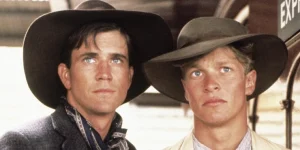
- Ataturk I 1881-1919 (2023)
- War Horse (2011)
- The Thin Red Line (1998)
- Hacksaw Ridge (2016)