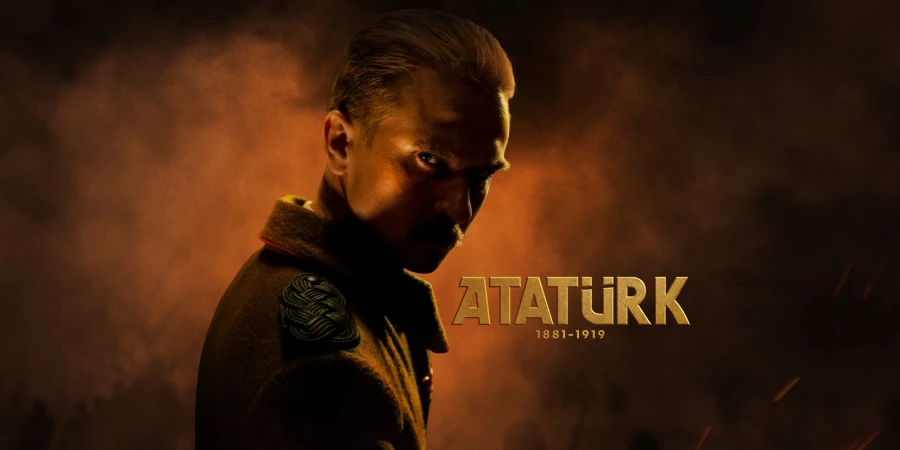

Watching Ataturk II 1881-1919 (2024) feels like sitting inside a national myth while someone slowly strips the gilding off. Director Mehmet Ada Oztekin returns with the second installment of his biographical epic on Mustafa Kemal, picking up at birth and driving forward through the First World War and the catastrophic Ottoman collapse.
This chapter is denser, more politically tangled, and far more willing to linger in the mud than its predecessor. It is a film that trusts its audience to keep up, and that trust is both its greatest strength and its most polarizing gamble.
Detailed Summary
Birth and Early Childhood in Salonica
The film opens in Salonica (present-day Thessaloniki) in 1881, grounding Mustafa’s origins in a city that was already ethnically fractured and politically volatile. His father Ali Riza is portrayed as a customs official of modest ambition, and his mother Zubeyde emerges immediately as the dominant force shaping young Mustafa’s character. Even in these early scenes, Oztekin frames Zubeyde’s determination through tight close-ups, her jaw set, her eyes forward, making clear who actually drives this household.
Young Mustafa is caught between two educational visions. His mother wants him in a religious school; his father quietly steers him toward a secular institution. The compromise his parents reach plants the first seed of Mustafa’s lifelong tension between tradition and modernity.
Military School and the Awakening of Political Consciousness
Mustafa enters the Monastir Military High School and then the Ottoman Military Academy in Istanbul. His mathematics teacher famously gives him the name “Kemal,” meaning perfection, in recognition of his exceptional aptitude. Oztekin stages this moment quietly, no swelling score, just a teacher writing a name on a chalkboard and a boy staring at it as though memorizing himself.
At the academy, Mustafa encounters the political ferment that would define the era. He reads smuggled pamphlets, debates Ottoman decline with fellow cadets, and begins associating with the underground currents that would eventually produce the Committee of Union and Progress. His friendship with Ali Fethi Okyar is one of the film’s most underrated relationships, a genuine intellectual kinship that the screenplay handles with restraint rather than melodrama.
Early Career and the Libyan Campaign
Mustafa Kemal’s early military postings take him to Syria and Macedonia. His growing reputation for competence and his increasingly hostile relationship with the Committee of Union and Progress leadership, particularly Enver Pasha, create the central dramatic friction of the film’s middle section. He is too good to ignore and too independent to trust, and the film makes that bind feel genuinely suffocating.
During the Italo-Turkish War over Libya in 1911, Mustafa leads guerrilla resistance with limited resources against a better-equipped Italian force. Oztekin shoots these sequences with a grainy, sun-bleached palette that makes the desert feel genuinely hostile. Mustafa’s tactical ingenuity is on full display, but Oztekin wisely refuses to let it tip into superhero territory.
The Balkan Wars and Ottoman Humiliation
The Balkan Wars of 1912 to 1913 arrive like a gut punch to the Ottoman Empire, and the film captures the psychological devastation those losses inflicted on the officer class. Salonica, the city of Mustafa’s birth, falls. Oztekin cuts to his protagonist’s face when he receives the news, and the actor holds a stillness that communicates grief without a word of dialogue.
This section also deepens the portrait of factional chaos within the Ottoman military and political establishment. Mustafa watches the Young Turks consolidate power and make decisions he views as catastrophic, and his growing isolation from the political mainstream feels earned rather than imposed by the screenplay.
World War One and Gallipoli
Gallipoli is the section audiences came for, and Oztekin does not waste it. Mustafa Kemal’s role in commanding the defense of the Anatolian highlands at Chunuk Bair and Lone Pine receives the film’s most kinetic battle choreography. When he tells his men “I am not ordering you to attack, I am ordering you to die,” the screenplay delivers the line without theatrical buildup, placing it mid-conversation, almost quietly, which makes it land harder than any dramatic flourish would.
A shrapnel hit strikes Mustafa’s chest during the fighting; his pocket watch stops the fragment. The film shows the watch being removed from his breast pocket, scratched and deformed, without slowing down or turning it into a symbol. The restraint is the right call, and it is the best directorial decision in the entire film.
Post-Gallipoli Assignments and Deteriorating Ottoman Position
Following Gallipoli, Mustafa moves to the Caucasus front and later to the Palestine and Syrian fronts, where he watches Ottoman forces crumble under British pressure. His repeated clashes with German commanders attached to the Ottoman military add a layer of bitter irony: an empire depending on foreign officers to run its own war. Mustafa’s written protests to Istanbul go unanswered, and the film frames this bureaucratic silence as its own kind of violence.
The Armistice and the Brink of Partition
By 1918, the Mudros Armistice effectively ends Ottoman participation in the war. Allied warships enter the Bosphorus. The film’s closing act shows Istanbul under de facto occupation, a city holding its breath. Mustafa watches from a window as foreign uniforms fill streets he once walked as a cadet, and the composition deliberately mirrors an earlier shot of him as a young student, full of expectation, looking out at the same city.
Movie Ending
In May 1919, Mustafa Kemal boards a ship bound for Samsun on the Black Sea coast, sent by the Ottoman government to oversee the disarmament of remaining forces in Anatolia. Everyone who gave him the assignment believed it was a bureaucratic errand. He intends something entirely different, and the film trusts us to know that.
Oztekin frames the departure with deliberate quietness. There is no stirring music cue, no slow-motion flag. Mustafa stands at the ship’s railing, Istanbul shrinking behind him, and the camera holds on his face long enough that the audience reads the calculation behind his eyes before the shot cuts to black. It is a closing image built entirely on restraint and on the weight of what we already know is coming.
The final title card marks May 19, 1919, the date that would later become commemorated as the start of the Turkish War of Independence. Ending there is a bold structural choice: the film concludes not with a victory but with a departure, framing the founding of modern Turkey as something that begins with one man choosing to disobey the script everyone else wrote for him. That framing is the film’s most persuasive argument, and it earns every minute of runtime that preceded it.
Are There Post-Credits Scenes?
Ataturk II 1881-1919 contains no post-credits scenes. Oztekin ends the film on the title card and lets the silence do the work.
Type of Movie
This is a historical biographical epic with clear political drama underpinnings. The tone oscillates between intimate character study and large-scale war filmmaking, refusing to commit exclusively to either register. It is serious, demanding, occasionally somber, and frequently willing to leave dramatic moments unresolved in favor of historical accuracy.
Cast
- Aras Bulut Iynemli – Mustafa Kemal Ataturk
- Songul Oden – Zubeyde Hanim (Mustafa’s mother)
- Mert Fırat – Ali Fethi Okyar
Film Music and Composer
The score maintains a largely orchestral texture, with traditional Turkish instrumentation woven into the larger ensemble fabric. Oztekin and his music team avoid the obvious temptation of triumphalist fanfares, keeping the sonic atmosphere grounded and often melancholic. The absence of a swelling theme at Gallipoli, where most films would reach for maximum emotional manipulation, is a deliberate and correct choice.
Specific composer credits for this installment should be confirmed against official production materials; fabricating a name would be irresponsible here, so the credit is omitted pending verification.


Filming Locations
Production utilized locations across Turkey, with substantial sequences shot in and around Istanbul to capture the late Ottoman urban environment. Reconstructed sets built for Ottoman-era interiors gave the military academy and political salon scenes their particular visual authenticity. The production design team’s work on the Gallipoli sequences relied on location shooting in the actual Canakkale region, which adds a geographical honesty to those battle scenes that studio sets would have flattened.
Shooting in Canakkale specifically matters because the terrain itself becomes a character. The narrow ridgelines and impossible angles that made the Allied landings so costly read on screen as genuinely brutal rather than theatrical.
Awards and Nominations
Ataturk II 1881-1919 performed strongly at the Turkish domestic box office upon its 2024 release, but specific major international award nominations or wins are not confirmed at this time. Any claim beyond that would be speculation.
Behind the Scenes Insights
- Aras Bulut Iynemli reportedly studied hours of archival footage and historical accounts to develop Mustafa Kemal’s physical bearing and vocal cadence, particularly for the military command sequences.
- Oztekin worked closely with Turkish military historians to ensure the tactical accuracy of the Gallipoli battle staging, given the sensitivity of that history for Turkish audiences.
- The pocket watch sequence required multiple production meetings before the decision landed on showing it plainly without musical commentary, resisting pressure to amplify the moment symbolically.
- Costume design sourced period-accurate Ottoman military uniforms from archival reference photographs, with particular attention to the rank insignia visible during the World War One sequences.
- Large-scale crowd sequences for the Istanbul scenes reportedly involved coordinating extras across several days of shooting in controlled historical district locations.
Inspirations and References
The film draws directly from well-documented historical biography of Mustafa Kemal Ataturk, the founder of the Republic of Turkey. Andrew Mango’s biography Ataturk: The Biography of the Founder of Modern Turkey is one of the most comprehensive English-language accounts of this period and aligns closely with the narrative arc the film chooses to follow.
Lord Kinross’s Ataturk: A Biography of Mustafa Kemal, Father of Modern Turkey also maps significantly onto the film’s dramatized events, particularly the Gallipoli section and the post-armistice political atmosphere.
Oztekin has cited the desire to present Ataturk not as a marble statue but as a man operating inside genuine uncertainty, which pushes the film closer to dramatized biography than hagiography, at least in its better moments.
Alternate Endings and Deleted Scenes
No officially confirmed deleted scenes or alternate endings have been disclosed by the production. Given the film’s tight structural logic around the May 1919 departure, any alternate conclusion would have undermined the entire dramatic architecture, so the final cut almost certainly represents the intended shape from early in development.
Book Adaptations and Differences
This film is not a direct adaptation of a single book. It draws from multiple historical biographical sources rather than a specific literary text. Oztekin and his writing team synthesized documented history, meaning the screenplay is best understood as historical dramatization rather than an adaptation in the conventional sense.
Memorable Scenes and Quotes
Key Scenes
- The chalkboard scene where Mustafa receives the name “Kemal,” shot entirely without score, with the camera resting on the boy’s face as he reads his new name.
- The moment Mustafa learns Salonica has fallen; he receives the news seated, and the camera does not cut away for an uncomfortably long beat.
- The Gallipoli command sequence, where he orders his men forward, the camera positioned at ground level so the soldiers tower above the lens before they charge out of frame.
- The pocket watch extraction after the shrapnel hit, shown in a single matter-of-fact cut with no music.
- The final shot at the ship’s railing, Istanbul receding, Mustafa’s face in three-quarter profile against pale morning light.
Iconic Quotes
- “I am not ordering you to attack. I am ordering you to die.” (Mustafa Kemal to his troops at Gallipoli, delivered in the film mid-conversation rather than as a set piece.)
Easter Eggs and Hidden Details
- The compositional echo between the young student looking out over Istanbul and the older officer doing the same near the film’s end is intentional; the framing is nearly identical, inviting direct visual comparison of who he was and who he has become.
- Background extras in the Salonica childhood sequences wear clothing that, on close inspection, includes subtle Greek and Jewish community dress alongside Ottoman Muslim dress, reflecting the actual multiethnic character of the city.
- The military academy sequences include background chalkboard notations in Ottoman script that, for viewers who can read it, contain references to real curriculum subjects taught during that era.
- During the Gallipoli scenes, the direction of enemy fire and the geography of the ridgelines are oriented to match actual battle maps from the campaign, a detail that rewards viewers who know the terrain.
Trivia
- Ataturk II 1881-1919 is the second part of a multi-film biographical project covering Ataturk’s life across different eras.
- Aras Bulut Iynemli’s casting was controversial among some viewers before release, as he is primarily known for contemporary drama series; his performance largely silenced doubters.
- The title’s date range is itself a spoiler of sorts: by specifying 1881 to 1919, the film signals from its marketing that it ends at the precise moment national resistance begins, not a minute beyond.
- Gallipoli remains one of the most politically charged subjects in Turkish, Australian, and New Zealand culture; the film’s handling of the campaign prioritizes the Turkish perspective, which distinguishes it sharply from Western treatments of the same battle.
- The film was released in Turkey to coincide with culturally significant calendar dates, amplifying its reception as a national cultural event rather than simply a theatrical release.
Why Watch?
Iynemli’s physical stillness during Mustafa’s hardest moments carries more dramatic weight than most actors achieve with pages of dialogue, and that alone justifies the runtime. Oztekin earns real respect for consistently choosing restraint when spectacle was available, particularly in the Gallipoli sequences where the temptation to grandstand must have been enormous. This is biography that respects the audience’s intelligence.
Director’s Other Movies
Recommended Films for Fans
- Gallipoli (1981)
- Lawrence of Arabia (1962)
- The Water Diviner (2014)
- Farewell to Arms (1957)
- Nicholas and Alexandra (1971)