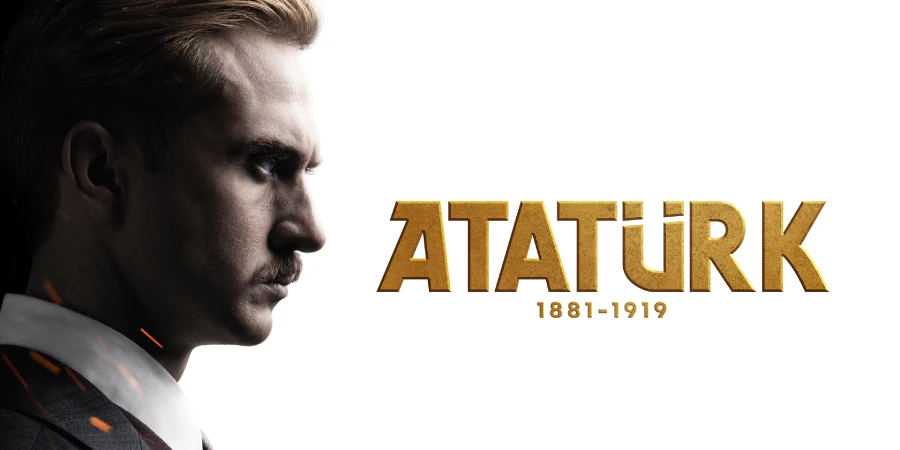

Turkey produced a film in 2023 that opens with a boy standing barefoot on the Aegean coast, squinting at a horizon he will one day remake. Ataturk I 1881-1919 is the first installment of a two-part biographical epic covering the early life and military career of Mustafa Kemal Ataturk, the soldier who would eventually found the Turkish Republic.
Director Mehmet Ada Oztekin shoots this origin story with the visual seriousness of a state monument and the dramatic urgency of a war film. Every frame announces that this subject deserves your full attention.
Detailed Summary
Childhood in Thessaloniki
The film begins in Thessaloniki, then part of the Ottoman Empire, in 1881. Young Mustafa grows up in a household shaped by tension between his secular-leaning father Ali Riza and his devoutly traditional mother Zubeyde. His father’s early death leaves a permanent mark on the boy’s sense of independence and self-determination.
Mustafa’s intelligence singles him out quickly. A teacher gives him the secondary name Kemal, meaning “perfection,” in recognition of the boy’s exceptional aptitude for mathematics. This moment, small on screen but enormous in historical weight, gets the careful, quiet treatment it deserves.
Military Education and Early Ambitions
Mustafa Kemal enters military school, where he distinguishes himself and simultaneously develops his first political frustrations with Ottoman decline. He watches an empire losing ground on every front while its leadership clings to old certainties. His ambition is never portrayed as vanity; the film frames it as a response to a dying order.
At the Ottoman Military Academy in Istanbul, Kemal forms crucial relationships and begins engaging with Western philosophical and political ideas. His interest in Enlightenment thought sets him apart from many peers and quietly foreshadows the secular republic he will later build.
Political Awakening and Early Activism
Kemal becomes involved with reformist circles critical of Sultan Abdulhamid II’s authoritarian rule. His association with opposition networks earns him surveillance, suspicion, and eventually posting to distant assignments meant to neutralize his influence. The film does not shy away from showing how the Ottoman state treated its own ambitious young officers as threats.
His posting to Damascus and later other regions gives him direct exposure to the empire’s fractures. Arab nationalist sentiment is rising, administrative corruption is obvious, and Kemal grows more convinced that fundamental structural change is the only path forward.
The Balkan Wars and Personal Loss
Ottoman defeats in the Balkan Wars hit Kemal on a personal level, since Thessaloniki, his birthplace, falls to Greece. The film handles this with a restraint that actually makes it hit harder. No melodrama, just a quiet scene of Kemal receiving the news and absorbing what it means for the empire and for himself.
This section is arguably the most emotionally precise part of the film. The loss of Thessaloniki functions as a symbolic wound that the screenplay returns to without overworking it.
Gallipoli: The Crucible
The centerpiece of the film is the Battle of Gallipoli in 1915. Allied forces, including ANZAC troops, attempt a massive amphibious landing on the Gallipoli Peninsula, and Kemal commands Ottoman defenses at Chunuk Bair and Conkbayiri with a ferocity that borders on mythic in Turkish national memory. The film earns this reputation carefully rather than cheaply.
Kemal’s battlefield order, telling his men they are not commanded to attack but to die, buying time for reinforcements to arrive, lands with full dramatic weight. Aras Bulut Iynemli delivers it with his jaw set and his eyes fixed somewhere past the camera. It is the film’s single best performance moment.
Gallipoli’s battle sequences are large-scale and viscerally staged. Trenches, smoke, close-quarters combat, and sheer logistical chaos fill the screen. What distinguishes these sequences from generic war spectacle is how often the camera cuts back to Kemal’s face mid-battle, registering calculation rather than panic.
Rising Military Star and Political Friction
After Gallipoli, Kemal’s national stature rises while his friction with Enver Pasha and the Committee of Union and Progress deepens. He sees the Ottoman leadership making catastrophic strategic errors in alliance with Germany. His warnings go unheeded. The film frames this as a pattern: the right man shouting into institutional deafness.
Kemal fights on multiple fronts, including in the Caucasus and later in Palestine and Syria, as the empire’s military position collapses. Each campaign adds layers of exhaustion and resolve to Iynemli’s performance without becoming repetitive.
Ottoman Defeat and Occupation of Istanbul
World War One ends in Ottoman defeat. Allied forces occupy Istanbul, and the empire signs the Armistice of Mudros. What was already a broken structure now faces outright dismemberment under the Treaty of Sevres. Kemal watches this humiliation from within a military institution that has lost all political leverage.
The occupation sequences are shot with deliberate visual coldness. Foreign flags over familiar skylines. Ottoman officers disarmed. The film makes the audience feel the indignity without leaning on score cues to do the emotional work for them.
The Decision to Go to Anatolia
In 1919, Kemal accepts an appointment as Inspector of the Ninth Army in Samsun, a posting the Ottoman government intends to use to distance him from Istanbul’s politics. The authorities see the move as a political dismissal; Kemal sees a beginning. For him, it is the passage out of a dying empire and into a future he will have to forge himself.
He lands in Samsun on May 19, 1919. This date becomes the founding moment of the Turkish War of Independence. The film frames his departure from Istanbul not as an escape but as a deliberate act of choosing a harder road.
Movie Ending
Kemal stands on the dock at Samsun as the first part closes. He has arrived in Anatolia with minimal resources, unclear authority, and an empire formally capitulating behind him. What he carries is a conviction that resistance is still possible, and that the Anatolian heartland will be where that resistance takes shape.
He issues the Amasya Circular, a proclamation declaring that the nation’s independence must be won by the nation itself, not by any surviving Ottoman institution. This is Kemal stepping definitively outside the old system and calling for a popular national movement. The film renders this moment with ceremony but not bombast.
The final image holds on Kemal’s face, lit by early morning light, looking east across Anatolia. No voiceover explains what comes next. The film trusts that its audience either knows the history or will feel the weight of a man deciding, at this exact moment, what kind of country his people deserve. It is a clean, confident ending for a first installment, and it earns its “to be continued” without feeling like a commercial cliffhanger.
Are There Post-Credits Scenes?
No post-credits scenes appear in Ataturk I 1881-1919. Once the final frame fades, the film is done. No teasers, no setup for Part Two beyond what the narrative itself implies.
Type of Movie
Ataturk I 1881-1919 is a historical biographical epic with strong elements of war drama. Its tone is serious and reverential without becoming hagiographic, at least for most of its runtime. Moments of genuine political cynicism and personal vulnerability keep it from becoming pure propaganda.
Pacing is deliberate. This is a film that prioritizes scope and historical fidelity over propulsive momentum, which will reward patient viewers and occasionally try the patience of those who want a tighter edit.
Cast
- Aras Bulut Iynemli – Mustafa Kemal Ataturk
- Songul Oden – Zubeyde Hanim (Ataturk’s mother)
Film Music and Composer
The score favors orchestral weight appropriate to the material. Strings carry the emotional register of the Gallipoli sequences, while quieter passages lean on solo instrumentation to underscore Kemal’s moments of private doubt. The music avoids triumphalist bluster in the film’s better scenes, pulling back where a lesser production would swell.
Rather than overwhelming key dramatic beats, the score often drops to near-silence at the most important moments, letting the actors and the visual composition do the work. That restraint is one of the production’s smarter recurring choices.

Filming Locations
Production took place across Turkey, with significant shooting in regions that carry direct historical connection to the events depicted. Recreations of Gallipoli’s terrain required extensive location scouting to find landscapes that could plausibly double for the peninsula’s ridgelines and coves.
Istanbul’s older districts provided backdrops for the Ottoman capital sequences. Shooting in actual historical geography rather than relying entirely on studio sets gives the film a textural authenticity that matters, particularly in the war sequences where the land itself is a character.
Awards and Nominations
Ataturk I 1881-1919 performed strongly at the Turkish box office and generated significant cultural discussion domestically. Specific major international award nominations are not confirmed, so this section stays honest: it was a commercial and cultural event in Turkey first and foremost.
Behind the Scenes Insights
- Director Mehmet Ada Oztekin and his team worked for several years on the project, coordinating large-scale battle recreations that required hundreds of extras and extensive period-accurate costuming.
- Aras Bulut Iynemli underwent significant physical preparation for the role and worked with historical consultants to study Ataturk’s documented mannerisms, speech cadences, and bearing.
- Gallipoli battle sequences involved practical effects alongside digital enhancement, with the production prioritizing physical set construction for close-quarters trench combat.
- The film was conceived as a two-part project from the beginning, with Part Two covering the Turkish War of Independence and the founding of the Republic.
- The production received support as part of broader centennial commemorations of the Turkish Republic, founded in 1923, adding institutional weight to the undertaking.
Inspirations and References
The film draws on extensive documented historical record. Ataturk’s own writings and speeches, including his massive six-day speech known as Nutuk, provided primary source material for characterization. Scholarly biographies of Ataturk also shaped the screenplay’s approach to his psychology and motivations.
Andrew Mango’s biography Ataturk is among the most rigorous English-language accounts of the subject and likely informed background research, though the film’s primary orientation is toward Turkish national historical narrative rather than revisionist scholarship.
Alternate Endings and Deleted Scenes
No officially confirmed deleted scenes or alternate ending versions have been released or publicly documented. Given the film’s status as a prestige national production, it is unlikely that significant alternate cuts exist in public-facing form.
Book Adaptations and Differences
Ataturk I 1881-1919 is not a direct adaptation of any single book. It draws from multiple historical sources and from Ataturk’s documented record. Comparisons to specific biographies are possible in terms of emphasis, but no source novel or single text underlies the screenplay.

Memorable Scenes and Quotes
Key Scenes
- Young Mustafa receiving the name Kemal from his teacher, a quiet scene that carries enormous retrospective weight.
- Kemal learning that Thessaloniki has fallen, receiving the news in silence without the film reaching for easy sentiment.
- The Gallipoli command sequence, where Kemal orders his men to die rather than retreat, with Iynemli delivering the line looking directly toward the enemy positions.
- Kemal watching Allied ships enter Istanbul’s harbor after the armistice, the camera staying on his stillness rather than cutting to spectacle.
- The departure from Istanbul for Samsun, shot as a deliberate farewell rather than an escape.
- The Samsun landing sequence, early morning light, minimal dialogue, and a man stepping onto ground he intends to fight for.
Iconic Quotes
- “I am not ordering you to attack. I am ordering you to die.” (Kemal’s battlefield command at Gallipoli, rendered in the film with its full historical force.)
- Kemal addressing a superior officer about Ottoman military strategy with blunt precision: the line establishes his refusal to subordinate honest analysis to institutional comfort.
Easter Eggs and Hidden Details
- Background soldiers at Gallipoli carry period-accurate equipment sourced from Turkish military museum collections, details that most viewers will miss but that signal the production’s commitment to authenticity.
- The color palette shifts subtly warmer in scenes set in Thessaloniki compared to Istanbul sequences, a visual shorthand connecting Kemal’s homeland to his warmth and the capital to its political coldness.
- Kemal’s characteristic blue eyes receive specific attention from the cinematographer in close-up compositions, a detail with historical significance since his eye color was frequently remarked upon by contemporaries.
- Dates appear on screen at key transitions but are styled in Ottoman script alongside modern numerals, a small gesture toward the dual identity of the transitional period.
Trivia
- Ataturk I 1881-1919 was among the highest-grossing Turkish films of 2023, demonstrating that domestic biographical epics can compete commercially with international releases in the Turkish market.
- Aras Bulut Iynemli is one of Turkey’s most recognized actors, known widely for television drama before taking on this role, and his casting generated significant public debate before release.
- May 19, where the film ends, is a public holiday in Turkey: Commemoration of Ataturk, Youth and Sports Day, marking exactly the Samsun landing depicted in the film’s closing sequence.
- The Gallipoli campaign depicted in the film involved combatants from Australia, New Zealand, Britain, France, and the Ottoman Empire, and the film’s production engaged with the sensitivities of depicting that multinational conflict.
- Part Two of the project was planned to cover 1919 through 1923, culminating in the proclamation of the Turkish Republic.
Why Watch?
Watch this film specifically for the Gallipoli sequences, where Iynemli makes you believe a single man’s stillness could hold a defensive line. His Kemal never performs greatness; he just makes decisions faster and clearer than everyone around him, and that plainness is more compelling than any heroic flourish. For viewers outside Turkey who know Ataturk only as a name on a building, this film gives him back his specific, argumentative, irreplaceable human weight.
Director’s Other Movies
Recommended Films for Fans
- Lawrence of Arabia (1962)
- Gallipoli (1981)
- The Water Diviner (2014)
- Lincoln (2012)
- 1917 (2019)
- Dunkirk (2017)