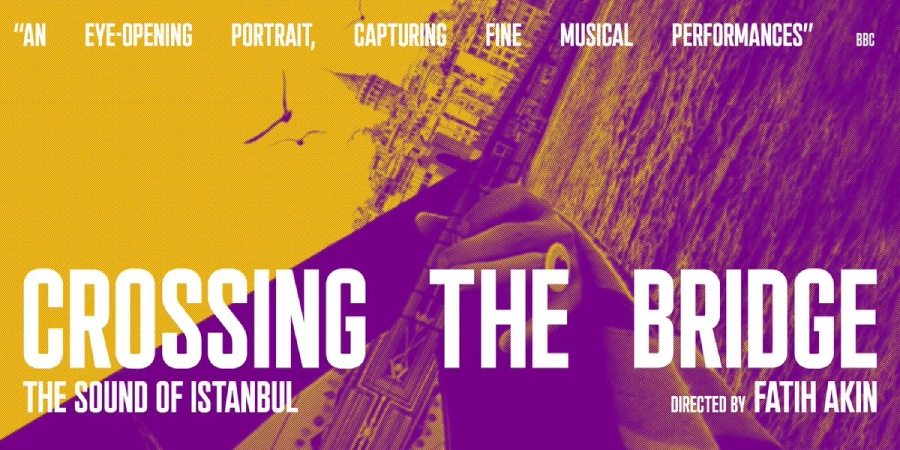

Istanbul does not perform for cameras; it simply exists, and that raw existence is exactly what makes Crossing the Bridge: The Sound of Istanbul one of the most compelling music documentaries ever made. Directed by Fatih Akin, this 2005 film sends musician Alexander Hacke into the city’s streets, studios, and soul to capture a musical tradition that refuses easy categorization. It is part travelogue, part concert film, part cultural manifesto.
Detailed Summary
Alexander Hacke Arrives in Istanbul
Alexander Hacke, bassist of the legendary German industrial band Einsturzende Neubauten, arrives in Istanbul as both an outsider and a willing student. Akin gives him a simple mission: record the city’s music. Hacke sets up a mobile recording rig and begins walking into whatever musical world will have him.
His presence as a foreigner is deliberate. Akin uses Hacke’s outsider status to frame discoveries that a local filmmaker might take for granted, letting audiences experience Istanbul’s sonic landscape with fresh ears.
The Street Musicians and Underground Scenes
Hacke moves through the city’s layers with striking curiosity. He encounters street performers, Roma musicians, and underground rock bands, all sharing the same restless urban energy. Istanbul, the film argues, is a city where musical genres do not compete; they coexist and collide.
Notably, these early encounters establish the documentary’s loose, improvisational rhythm. Akin never rushes from one act to the next; instead, he lets scenes breathe, giving musicians space to explain their art in their own words.
Orhan Gencebay and the Arabesk Tradition
Orhan Gencebay, one of Turkey’s most iconic musicians, appears as a towering figure in the arabesk tradition. Arabesk blends Arabic musical scales with Turkish folk roots and Western pop instrumentation, and Gencebay helped define its emotional register for generations. His segment gives the film its first genuine sense of historical weight.
Gencebay speaks candidly about the cultural politics surrounding arabesk, a genre that Turkish cultural elites long dismissed as lowbrow. His defiant pride in the music adds a fascinating layer of class and identity tension to the documentary.
Ceza and the Istanbul Hip-Hop Scene
Rapper Ceza represents Istanbul’s younger, urban voice. His segment crackles with energy, and his rapid-fire Turkish delivery stuns Hacke visibly on screen. In addition, Ceza articulates how Turkish hip-hop is not simply an import from American culture but a genuinely local response to Istanbul’s social pressures and youth frustrations.
This section reframes the entire documentary’s argument. Istanbul does not merely absorb outside influences; it transforms them into something new and distinctly its own.
Sezen Aksu and Turkish Pop Royalty
Sezen Aksu, arguably the most beloved pop star in Turkish musical history, delivers one of the film’s most emotionally resonant performances. She performs with effortless authority, and Hacke’s admiration is visible throughout their interaction. Her presence lends the film serious commercial and cultural credibility within the Turkish context.
Aksu’s segment also functions as a quiet thesis statement. She bridges folk, pop, and political song in a way that mirrors Istanbul’s own position as a bridge between continents and cultures.
Roma Musicians and the Sulukule Community
Some of the documentary’s most viscerally joyful footage comes from its time with Istanbul’s Roma community, particularly musicians connected to the historic Sulukule neighborhood. Percussion, clarinet, and communal celebration fill the screen with a warmth that contrasts sharply with the urban alienation visible elsewhere in the film.
Consequently, these scenes carry a melancholic undertone. Sulukule faced demolition and forced relocation in subsequent years, and the film inadvertently preserved a community on the edge of displacement.
Duman and the Turkish Rock Underground
Rock band Duman represents Istanbul’s alternative scene, blending distorted guitars with distinctly Turkish melodic sensibilities. Their segment is raw and loud, a deliberate tonal shift that Akin uses to demonstrate range. Moreover, Duman’s music complicates any romantic notion that Istanbul’s musical identity is purely rooted in tradition.
Akin frames their rehearsal space and performance with an intimacy that feels almost documentary-within-a-documentary. These are young Turks wrestling with both global influences and local roots simultaneously.
Mercan Dede and Electronic Mysticism
Mercan Dede fuses Sufi spiritual music with electronic production in a segment that feels genuinely otherworldly. His work as a DJ and composer positions Istanbul’s musical identity as something that reaches backward into Ottoman mysticism while simultaneously reaching forward into contemporary club culture. This duality sits at the heart of Akin’s entire project.
Furthermore, Mercan Dede’s appearance signals that Istanbul’s musical evolution is not finished. It is ongoing, constantly negotiating between the sacred and the synthetic.
Orient Expressions and Political Hip-Hop
Group Orient Expressions adds a politically charged dimension to the hip-hop thread Ceza introduced earlier. Their music engages directly with questions of Turkish identity, globalization, and social justice. As a result, the documentary accumulates genuine intellectual weight beyond its surface appeal as a concert film.
The Bosphorus as Constant Presence

Throughout the film, Akin returns repeatedly to images of the Bosphorus Strait. Ships crossing between Europe and Asia, water reflecting city lights, ferries carrying commuters: these images function as a visual metaphor that the film never states aloud but allows to accumulate meaning. Istanbul’s geography is its identity, and the music reflects that divided, doubled nature.


Movie Ending
Hacke does not leave Istanbul with tidy conclusions. Instead, the film builds to a loose, celebratory final act where multiple threads converge in a spirit of collaborative performance rather than narrative resolution. Musicians from different scenes, genres, and generations appear in shared spaces, playing together without grand ceremony.
Akin resists the temptation to deliver a definitive statement about what Istanbul’s music “means.” On the other hand, this refusal feels entirely appropriate. The city defies summarization, and so the film simply lets the music keep moving, keep crossing boundaries, keep resisting easy definition.
Hacke’s final appearances on screen show a man genuinely changed by what he has heard and witnessed. He does not deliver a closing monologue or neat summation. His silence, and the music filling that silence, carries all the meaning the film needs.
Ultimately, the ending functions as an argument for process over conclusion. Crossing Istanbul musically is not something you finish; it is something you keep doing. The bridge, both literal and metaphorical, never really ends.
Are There Post-Credits Scenes?
No, Crossing the Bridge: The Sound of Istanbul does not include any post-credits scenes. The film closes without additional footage after the credits begin. Given the documentary format and the film’s contemplative tone, a post-credits sequence would feel entirely out of place.
Type of Movie
This is a music documentary with strong elements of cultural journalism and travelogue filmmaking. Its tone balances genuine curiosity with deep respect for its subjects. However, it never tips into hagiography; Akin maintains an observer’s eye even when clearly moved by what he films.
In contrast to conventional concert documentaries, the film prioritizes conversation, context, and city texture over performance footage alone. It sits comfortably alongside landmark music docs while carving out its own unique identity.
Cast
- Alexander Hacke – Himself (Guide and Recording Musician)
- Orhan Gencebay – Himself
- Sezen Aksu – Herself
- Ceza – Himself
- Duman – Themselves
- Mercan Dede – Himself
- Orient Expressions – Themselves
- Fatih Akin – Himself (brief appearances)
Film Music and Composer
Rather than a traditional composed score, the film’s music is its subject matter. Every track in the documentary was recorded live or in-studio during Hacke’s time in Istanbul, giving the soundtrack an organic, unrepeatable quality. Alexander Hacke himself served as the primary recording and production presence on the ground.
The accompanying soundtrack album released alongside the film became a significant document in its own right. It captured performances from all the featured artists and introduced Turkish music to international audiences who might never otherwise have encountered these voices.
Notably, Fatih Akin has always treated music as central to his filmmaking, not supplementary. His background as a music enthusiast directly shaped how he structured the documentary’s rhythm and pacing.



Filming Locations
Almost all filming took place in Istanbul, Turkey, across a wide range of neighborhoods and settings. Hacke recorded in professional studios, cramped rehearsal rooms, open courtyards, and street corners. This geographic variety reflects the documentary’s core argument about musical diversity within a single city.
The Bosphorus Strait and its surrounding waterfront areas appear repeatedly as visual anchors. Akin’s camera treats the strait as more than scenery; it becomes the film’s recurring symbolic image of connection and crossing.
Specific neighborhoods including areas associated with the Roma community provided irreplaceable footage. These locations carry social and historical meaning that a generic studio setting could never replicate.
Awards and Nominations
The film received strong critical acclaim and performed well at international film festivals, particularly in Europe. Specific major award nominations and wins for this documentary are not something I can confirm with full certainty, so rather than risk inaccuracy, I will note that the film’s reputation rests firmly on its critical legacy rather than a trophy shelf.
Behind the Scenes Insights
- Fatih Akin conceived the project as a personal love letter to Istanbul, a city that had fascinated him for years before the film began production.
- Alexander Hacke spent an extended period in Istanbul before filming began, building relationships with musicians organically rather than through formal pre-production arrangements.
- Akin deliberately kept the crew small to allow access to intimate spaces and to avoid intimidating musicians with a large production presence.
- The mobile recording setup Hacke used was central to the film’s production philosophy: capture music as it actually sounds in its natural environment, not in a controlled studio built for the camera.
- Several musical encounters in the film arose spontaneously during production rather than through scheduled interviews, which accounts for much of the documentary’s unscripted energy.
- Akin shot the film in the same period he was developing other major projects, demonstrating his remarkable productivity during the mid-2000s.
Inspirations and References
Fatih Akin has cited his longstanding personal connection to Turkish culture as the primary inspiration for the project. As the son of Turkish immigrants in Germany, he approached Istanbul not as an exotic subject but as a cultural homeland he wanted to understand more deeply through music.
The film belongs to a loose tradition of city-as-musical-subject documentaries. Works like Buena Vista Social Club (1999), directed by Wim Wenders, clearly share DNA with Akin’s approach: send an outsider musician into a culturally rich city and let genuine connection drive the narrative.
Akin has also spoken about his broader interest in migration, identity, and cultural hybridity, themes that run through much of his fictional filmmaking and find their most direct expression here.
Alternate Endings and Deleted Scenes
No officially confirmed deleted scenes or alternate cuts of Crossing the Bridge have entered public record. Given the documentary format and the film’s improvisational production approach, a large amount of raw footage almost certainly exists beyond what appears in the final cut.
However, Akin has not publicly released extended editions or alternate versions of the film. The theatrical cut remains the definitive version for audiences.
Book Adaptations and Differences
Crossing the Bridge: The Sound of Istanbul is not based on any book or pre-existing literary source. It originated entirely as an original documentary concept developed by Fatih Akin. No companion book or novelization of the film exists in the public record.

Memorable Scenes and Quotes
Key Scenes
- Ceza’s rapid-fire rap performance, which visibly stuns Hacke and functions as one of the film’s most electrifying single moments.
- Sezen Aksu’s performance, quiet in its authority yet overwhelming in emotional impact, arguably the film’s most affecting musical moment.
- The Roma community celebration in Sulukule, bursting with percussion and communal joy that makes it impossible to watch passively.
- Mercan Dede’s electronic Sufi session, which creates a genuinely hypnotic atmosphere unlike anything else in the documentary.
- Hacke walking the Bosphorus waterfront in the film’s recurring transitional sequences, which accumulate emotional resonance across the runtime.
- Orhan Gencebay’s candid discussion of arabesk’s cultural stigma, which reframes the film’s exploration of music as a conversation about class and identity.
Iconic Quotes
- “Istanbul is a city that never sleeps, and its music never sleeps either.” (paraphrased from Hacke’s observations throughout the film)
- Gencebay’s assertion that arabesk speaks for people whose voices cultural institutions refused to hear remains one of the film’s most politically resonant statements.
- Ceza articulating that Turkish hip-hop belongs to Istanbul’s streets, not to any imported American template, captures the film’s central argument in a single breath.
Easter Eggs and Hidden Details
- Akin’s recurring use of bridge imagery, both the famous bridges crossing the Bosphorus and smaller urban bridges, subtly reinforces the film’s title on a visual level throughout.
- Hacke’s recording equipment is often visible in frame, reminding viewers that they are watching an act of documentation, not a seamless performance showcase.
- The film’s color grading shifts subtly between the European and Asian sides of Istanbul, a detail that rewards viewers paying close attention to visual continuity.
- Several background figures in street scenes appear to be local musicians who recognized Hacke and Akin’s crew, drawn in by the filming rather than recruited as subjects.
- Akin frames certain musical performances so that architectural details of Istanbul, minarets, historic facades, modern construction, appear simultaneously in the background, layering the city’s time periods visually.
Trivia
- Fatih Akin made this documentary between major fictional features, demonstrating his belief that documentary and narrative filmmaking require equally serious creative investment.
- Alexander Hacke is primarily known as the bassist of Einsturzende Neubauten, one of Germany’s most influential experimental rock bands, making his role as a guide to Turkish music an inherently cross-cultural casting choice.
- The soundtrack album released alongside the film introduced several featured artists to significant international audiences for the first time.
- Sezen Aksu has been described as the single most influential figure in modern Turkish pop music, giving her segment an importance within the Turkish cultural context that international audiences may initially underestimate.
- The Sulukule neighborhood featured in the Roma music segments faced major demolition and urban renewal in subsequent years, making the film an inadvertent historical document of a community under threat.
- Akin grew up in Hamburg, Germany, in a Turkish immigrant family, and his bicultural identity directly informs the film’s perspective on cultural hybridity and belonging.
- The film runs approximately 90 minutes, a tight runtime for a documentary covering such an expansive musical landscape.
Why Watch?
Few documentaries manage to make an entire city feel like a living, breathing musical instrument, but this one does exactly that. For anyone curious about world music, cultural identity, or simply great filmmaking, it offers an experience that lingers long after the screen goes dark. Furthermore, its accidental role as a historical record of Istanbul communities now altered or displaced gives it a poignancy that only deepens with time.
Director’s Other Movies
- Short Sharp Shock (1998)
- In July (2000)
- Solino (2002)
- Head-On (2004)
- The Edge of Heaven (2007)
- Soul Kitchen (2009)
- The Cut (2014)
- In the Fade (2017)
Recommended Films for Fans
- Buena Vista Social Club (1999)
- Genghis Blues (1999)
- Amandla! A Revolution in Four-Part Harmony (2002)
- DiG! (2004)
- The Devil and Daniel Johnston (2005)
- Searching for the Wrong-Eyed Jesus (2003)
- Head-On (2004)
- Latcho Drom (1993)