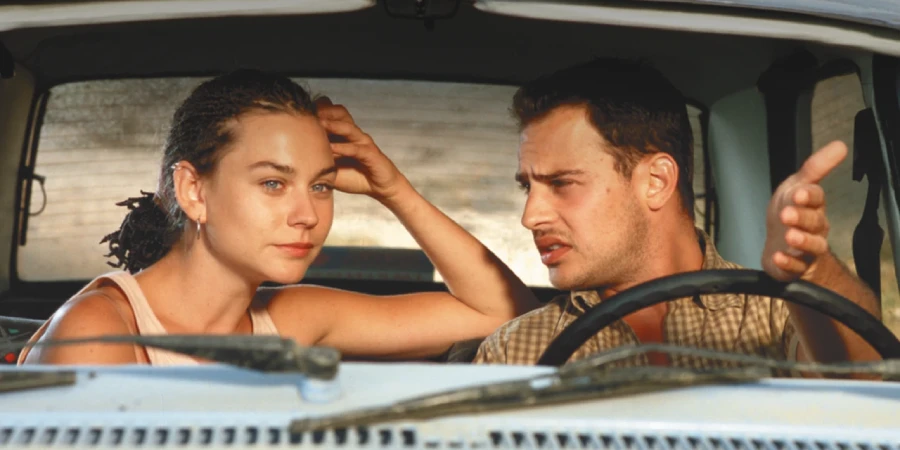

Fate, coincidence, and a sun-shaped ring set a hapless Hamburg student on a wildly improbable journey across half of Europe, and somehow it all feels completely believable. Fatih Akin made In July before he became internationally celebrated, and this early road movie captures something rare: pure, breathless romantic momentum that never lets up. It is funny, tender, and occasionally absurd in the best possible way.
Detailed Summary
Daniel Meets Juli and Melek
Daniel Loader is a reserved, bookish physics teacher-in-training living in Hamburg. He has no romantic confidence and no particular plans beyond the ordinary. Meanwhile, Juli, a street vendor with a gift for reading people, spots him immediately as someone she can charm.
Juli sells Daniel a ring bearing a sun symbol, telling him it means he will meet the love of his life. She fully intends to be that person herself. However, Daniel walks away and almost immediately meets Melek, a Turkish woman wearing a sun-shaped pendant that matches the ring perfectly.
Daniel is instantly smitten with Melek. She is heading to Istanbul, and before Daniel fully processes what he is doing, he impulsively decides to follow her. That snap decision launches the entire adventure.
The Road Trip Begins
Daniel sets off from Hamburg heading southeast toward Istanbul. His plan is loose and his preparation is minimal. As a result, things go wrong almost immediately, and the journey becomes a cascade of comic misadventures.
Juli, it turns out, is also heading in the same direction. Circumstances keep throwing them together on the road, and their reluctant companionship slowly deepens. Daniel still believes he is chasing Melek, but the audience can read the situation more clearly than he can.
Crossing Borders and Meeting Strangers
The film moves through Germany, Hungary, Romania, and Bulgaria before reaching Turkey. Each country brings a new complication, a new stranger, and a new test of Daniel’s resourcefulness. Akin films each location with genuine affection, making the landscape feel alive rather than merely scenic.
Along the way, Daniel and Juli encounter a smuggler who offers them a lift, a situation that creates both danger and unexpected humor. Their chemistry sharpens under pressure. Moreover, each shared obstacle chips away at the emotional wall Daniel has built around himself.
Luna, the Stolen Car, and Border Complications
A significant subplot involves a young woman named Luna, whom Daniel encounters and tries to help. Their interaction creates complications that delay the journey and force Daniel to confront his own instincts and values.
A stolen car enters the picture, adding a layer of genuine tension to what had been a largely comedic road trip. Crossing borders becomes increasingly fraught. Consequently, what started as a lighthearted chase transforms into something with real stakes.
Juli’s Feelings Come Into Focus
Somewhere between the border crossings and the mishaps, Juli stops pretending she is just along for the ride. Her feelings for Daniel are real and have been real from the very beginning. In contrast, Daniel remains oblivious, still focused on reaching Melek.
Akin gives Juli strong, funny, emotionally intelligent scenes that make her the most compelling figure in the film. She is never a passive love interest waiting to be chosen. She acts, decides, and pushes the story forward on her own terms.
Arriving in Istanbul
Daniel finally reaches Istanbul, the city he has been racing toward the entire film. He finds Melek, and their reunion is warm but reveals something important: the connection he imagined is not as deep as what he has built with Juli on the road.
Istanbul itself functions almost as a character, vibrant and chaotic and beautiful. Akin shoots the city with obvious love, drawing on his own Turkish heritage. The destination, therefore, becomes less about Melek and more about what Daniel has learned getting there.

Movie Ending
Daniel finally sees what has been in front of him for hundreds of kilometers. He chooses Juli. It is not a dramatic, tortured decision; it is the most natural conclusion to everything the road trip has been building toward. He runs to find her, and the film lets that momentum carry straight through to the final frames.
Juli and Daniel reunite in Istanbul with genuine warmth and relief on both sides. The sun-shaped ring and pendant, those two symbols Juli used to engineer a meeting, complete their meaning. What began as Juli’s playful manipulation becomes something honestly earned.
Melek exits graciously, and the film never turns her into a villain or a disappointment. She simply belongs to a different part of Daniel’s story. Furthermore, her presence made him brave enough to cross a continent, which is exactly what he needed to become someone capable of real love.
The ending works because Akin never cheats the audience with false conflict in the final act. Daniel and Juli simply find each other, and the film closes on that warmth without overstaying its welcome. It is, ultimately, a deeply satisfying payoff for two characters the audience has genuinely come to root for.
Are There Post-Credits Scenes?
In July does not include any post-credits scenes. Once the story closes, it closes cleanly. You can safely leave when the credits roll.
Type of Movie
In July is a romantic road movie comedy. Its tone sits comfortably between warm-hearted humor and genuine romantic feeling, never tipping into cynicism or melodrama. Akin keeps the energy light even when the situations become complicated.
In contrast to his later, more intense work, this film shows Akin operating in a purely joyful register. It is accessible, fast-moving, and emotionally generous throughout.
Cast
- Moritz Bleibtreu – Daniel Loader
- Christiane Paul – Juli
- Idil Üner – Melek
- Mehmet Kurtulus – Isa
- Jochen Nickel – the truck driver
Film Music and Composer
Akin assembled an eclectic, energetic soundtrack for In July rather than relying on a single traditional score. Music plays a major role in establishing the film’s momentum and its multicultural road-trip spirit. Songs from across Europe and Turkey color each segment of the journey distinctly.
Notably, the soundtrack blends genres in ways that mirror the film’s movement across borders and cultures. It reflects Akin’s consistent interest in music as a storytelling tool, something he would later develop even more explicitly in his documentary work on music.

Filming Locations
Production took the cast and crew through Germany, Hungary, Romania, Bulgaria, and Turkey. Akin shot on location throughout, which gives the film an authentic, grounded feel that a studio production could never replicate. Each country registers as genuinely different.
Istanbul serves as the emotional and geographical destination of the entire film. Akin, who has Turkish roots, films the city with particular warmth and specificity. Consequently, arriving there feels like a genuine arrival rather than a generic backdrop.
Hamburg bookends the story and grounds Daniel’s character. His ordinary Hamburg life makes the adventure that follows feel all the more extraordinary by comparison.
Awards and Nominations
In July performed well commercially in Germany and helped raise Fatih Akin’s profile significantly, though it did not collect major international awards. Its success was largely critical and audience-driven rather than ceremony-driven.
Behind the Scenes Insights
- Fatih Akin wrote and directed In July when he was still a relatively young filmmaker building his reputation in German cinema.
- The production actually traveled the route depicted in the film, shooting across multiple countries in sequence.
- Moritz Bleibtreu, already known from Run Lola Run, brought significant star power to the project and helped attract attention to the film.
- Akin drew on his own experiences navigating between German and Turkish cultural identities when shaping the Istanbul sequences.
- The logistics of filming across several countries with different languages and regulations made production genuinely challenging.
Inspirations and References
Akin cited classic Hollywood screwball comedies and American road movies as broad influences on the film’s energy and structure. The tradition of characters discovering themselves through travel runs through decades of cinema, and Akin plugs consciously into that lineage.
His Turkish heritage directly informed the choice of Istanbul as the destination. Furthermore, the cross-cultural journey reflects Akin’s personal understanding of existing between two worlds, a theme that recurs throughout his career.
Alternate Endings and Deleted Scenes
No widely documented alternate endings or notable deleted scenes from In July have entered public record. Akin has not discussed significant cut content in interviews available for verification. What appears on screen represents the film as it was intended.
Book Adaptations and Differences
In July is an original screenplay written by Fatih Akin himself. It is not based on a novel, short story, or any previously existing source material. Akin conceived the story specifically for cinema.



Memorable Scenes and Quotes
Key Scenes
- Juli selling Daniel the sun ring and weaving an elaborate destiny story around a complete stranger.
- Daniel spotting Melek’s matching sun pendant and genuinely believing fate has intervened.
- Daniel and Juli crossing a border in increasingly desperate and comedic circumstances.
- The moment Juli’s real feelings break through the surface, stopping the comedy cold with unexpected emotional weight.
- Daniel’s arrival in Istanbul and his gradual realization that the journey itself mattered more than the destination.
- The final reunion between Daniel and Juli, warm and earned and satisfyingly unforced.
Iconic Quotes
- “Whoever wears this ring will meet the love of their life.” (Juli, setting the entire plot in motion with cheerful dishonesty.)
- Daniel’s repeated, increasingly frantic declarations that he simply needs to reach Istanbul capture his single-minded absurdity beautifully.
Easter Eggs and Hidden Details
- The sun symbol appears in multiple forms throughout the film beyond just the ring and pendant, quietly reinforcing the theme of fate.
- Akin includes small visual details in the Istanbul sequences that reflect authentic neighborhood specifics rather than tourist-friendly postcard imagery.
- The progression of languages heard in the background shifts naturally as the characters move through each country, rewarding attentive viewers.
- Juli’s vendor setup at the start of the film contains small visual clues about her character that become more meaningful on a second viewing.
Trivia
- In July was released in Germany in 2000 and became a notable commercial success for Akin early in his career.
- Moritz Bleibtreu was one of the most recognizable young German actors at the time, following his breakout in Run Lola Run.
- Fatih Akin went on to win the Golden Bear at the Berlin International Film Festival for Head-On just a few years after completing this film.
- The film’s light tone stands as something of an anomaly in Akin’s catalog, which often deals with heavier themes of identity, violence, and displacement.
- Real border crossings and real roads feature throughout, giving the film a documentary texture beneath its comic surface.
- In July is sometimes cited as a gateway film for audiences new to German cinema, given its accessible, crowd-pleasing energy.
Why Watch?
In July offers two hours of genuinely joyful cinema without sacrificing wit or character depth. Bleibtreu and Paul generate real chemistry, and Akin directs with a light hand and sharp comedic timing. For anyone who loves road movies that actually go somewhere emotionally, this film delivers fully.
Director’s Other Movies
- Short Sharp Shock (1998)
- Head-On (2004)
- Crossing the Bridge: The Sound of Istanbul (2005)
- The Edge of Heaven (2007)
- Soul Kitchen (2009)
- The Cut (2014)
- In the Fade (2017)
Recommended Films for Fans
- Run Lola Run (1998)
- Before Sunrise (1995)
- Head-On (2004)
- L’Auberge Espagnole (2002)
- The Sure Thing (1985)
- Amelie (2001)
- Eurotrip (2004)