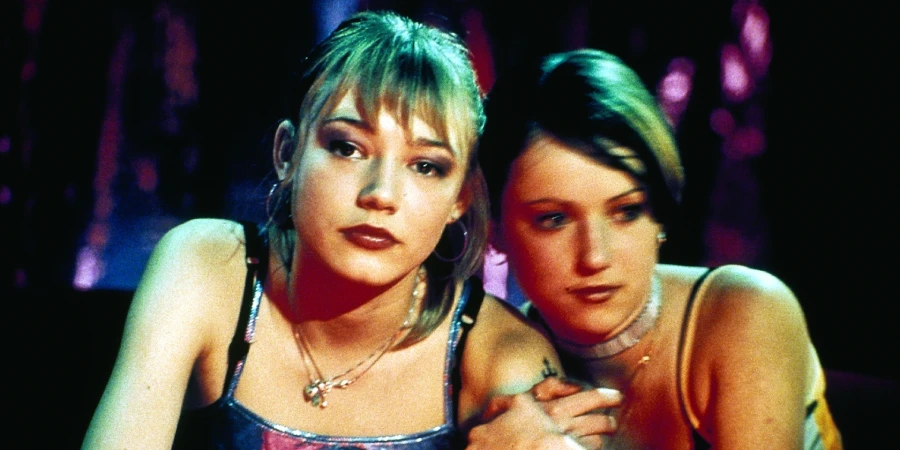

Few films dare to follow a teenager into hell and refuse to look away. Lilya 4-Ever is one of them. Swedish director Lukas Moodysson crafted a brutal, compassionate portrait of child trafficking that hit European audiences like a sledgehammer in 2002. Its power comes not from shock tactics alone, but from making you care deeply about Lilya before systematically destroying everything around her.
Detailed Summary
Abandoned in a Post-Soviet Wasteland
Lilya is a sixteen-year-old girl living in a decaying town in a former Soviet republic. Her mother, Natasha, has met a new man and plans to emigrate to the United States. Lilya assumes she will go too.
Her mother leaves without her. In a devastating early scene, Natasha hands guardianship to a neglectful aunt, Lilya’s relatives, and simply walks out of her daughter’s life forever. Consequently, Lilya finds herself alone in a crumbling apartment with no money, no support, and no future.
Volodya and the Only Friendship That Matters
Lilya befriends Volodya, a younger boy who has also been abandoned, specifically by a father who beats him and shows no interest in keeping him. The two form a tender, sibling-like bond built on mutual survival. They sniff glue together, share food when they can, and sleep in the same apartment for warmth and safety.
Volodya is the emotional heart of the film. His presence signals that even inside this misery, genuine human connection is still possible. However, that connection alone cannot protect either of them from what is coming.
Forced Into Prostitution
A classmate named Anna falsely tells their social circle that Lilya is working as a prostitute for money. Lilya initially denies it furiously. Eventually, facing starvation and eviction, she accepts money from a man who approaches her on the street, and the lie becomes reality.
She starts surviving through sex work, a grim transaction she endures rather than chooses. Moodysson shoots these scenes with clinical discomfort, refusing to aestheticize the abuse. Each encounter reinforces how completely the world has failed this girl.
Andrei and the Promise of Sweden
A young man named Andrei enters Lilya’s life with warmth, gifts, and apparent kindness. He tells her he can take her to Sweden for a better life and a real job. Lilya, starved for affection and desperate for escape, falls for him completely.
Volodya begs her not to go. He has a bad dream about her, a vivid nightmare that functions as a direct warning the film makes explicit. Lilya dismisses his fears and boards a plane with Andrei, hoping this is finally her rescue.
Trafficking and Imprisonment in Sweden
Upon arrival in Sweden, Andrei takes Lilya to a flat and essentially locks her inside. He takes her passport, leaves, and never returns. A man named Witek arrives and informs her she owes a debt for the travel and accommodation.
From that point forward, men visit the apartment and rape her repeatedly. She has no documents, no language, no allies, and no way out. The film depicts her imprisonment with horrifying steadiness, never cutting away at convenient moments.
Lilya Tries to Escape
Lilya eventually manages to slip outside and runs through the streets. She finds a church and briefly experiences something close to spiritual solace. In addition, she encounters a kind man who gives her food, a fleeting gesture of decency in a story largely stripped of it.
Witek finds her and brings her back. Any hope viewers had allowed themselves disappears in that moment. The trap is total, and Moodysson makes sure the audience feels every wall closing in.

Movie Ending
Lilya eventually cannot endure any more. She escapes the apartment one final time, climbs to the top of a highway overpass, and jumps. The film does not flinch. She dies on the road below.
What follows is the sequence Moodysson uses to reframe everything. The film opens with Lilya already running across that same bridge, bloodied and desperate. We see this again now with full context. The structure forces viewers to carry the weight of her entire story in that final image.
In a brief, bittersweet epilogue, we see Lilya and Volodya together in what appears to be an afterlife or dream space. They are free, laughing, and running. Volodya has angel wings, a visual callback to an earlier scene where he drew wings on a photograph of himself and Lilya. It is the only moment of peace the film allows.
This ending matters because it refuses false comfort while simultaneously insisting on the humanity of both children. Lilya does not survive, and the film makes no apology for that fact. Meanwhile, the epilogue suggests that Volodya also died, having taken his own life after Lilya left, which a brief scene in the Swedish section implies. Both children were destroyed by the same systemic indifference.
The ending implicates everyone: the absent mother, the neglectful relatives, the buyers of sex, the traffickers, and the societies that made these children disposable. Moodysson refuses to let the audience feel relieved by any single villain. The guilt is distributed widely, and it lands on the viewer too.
Are There Post-Credits Scenes?
No. Lilya 4-Ever contains no post-credits scenes of any kind. After the epilogue sequence, the film ends with a dedication and statistics about child trafficking. Sitting through those final moments is part of the experience Moodysson intends.
Type of Movie
Lilya 4-Ever is a social realist drama with elements of tragedy. Its tone is unflinching, bleak, and compassionate in equal measure. Moodysson shoots in a raw, handheld style that pulls the film closer to documentary than traditional narrative cinema.
It belongs alongside films like Requiem for a Dream and Rosetta in a tradition of European social cinema that prioritizes emotional truth over audience comfort. Notably, it also functions as a political film, using one girl’s story to indict an entire global system.
Cast
- Oksana Akinshina – Lilya
- Artyom Bogucharsky – Volodya
- Lyubov Agapova – Lilya’s mother, Natasha
- Liliya Shinkaryova – Aunt Anna
- Pavel Ponomaryov – Andrei
- Tomas Neumann – Witek
Film Music and Composer
Nathan Larson composed the original score for Lilya 4-Ever. His music blends sparse, melancholic instrumentation with moments of grinding electronic texture. The score never overplays its hand; it sits underneath the action and amplifies dread rather than announcing it.
The film also uses licensed tracks to powerful effect. Rammstein’s “Mein Herz Brennt” appears during key scenes, its aggressive industrial sound amplifying the violence done to Lilya’s world. Furthermore, pop and dance music from the early 2000s plays throughout Lilya’s daily life, creating a painful contrast between the sounds of ordinary teenage joy and her actual circumstances.

Filming Locations
Moodysson filmed the first half of the movie primarily in Estonia, specifically in the town of Narva and surrounding post-Soviet environments. These locations were chosen for their authentically decayed Soviet-era architecture, which mirrors Lilya’s entrapment in a world that history left behind.
The Swedish sequences were shot in Malmo, Sweden. In contrast to the crumbling Russian-speaking world Lilya came from, Sweden appears clean and modern but utterly cold and indifferent. The visual contrast between the two settings is a deliberate part of Moodysson’s argument about Western complicity in trafficking.
Awards and Nominations
Lilya 4-Ever received significant recognition at the Guldbagge Awards, the Swedish national film awards, where it won multiple prizes including Best Film and Best Director for Moodysson. Young lead Oksana Akinshina received considerable critical praise for her performance, though major international acting nominations for films in this category were limited at the time.
The film gained wider recognition through festival circuits across Europe and earned Moodysson a reputation as one of the most important voices in contemporary Scandinavian cinema.
Behind the Scenes Insights
- Moodysson conducted extensive research into sex trafficking networks before writing the script, consulting with organizations working with trafficking survivors.
- Oksana Akinshina was around fifteen years old during production, which required Moodysson and his crew to handle the more disturbing material with careful, protective direction.
- Moodysson has spoken about how difficult the filmmaking process was emotionally, describing it as one of the darkest periods of his professional life.
- The film was shot on a relatively modest budget, which contributed to the raw, unpolished visual style that gives it documentary-like intensity.
- Akinshina reportedly prepared for the role by visiting the locations and spending time understanding the social conditions Moodysson was depicting.
- The angel wings motif was something Moodysson developed early in the scripting process as a way to give Volodya symbolic weight beyond his limited screen time.
Inspirations and References
Moodysson based Lilya 4-Ever on the real case of Danguole Rasalaite, a Lithuanian teenager who was trafficked to Sweden and died after jumping from a bridge in 2000. The real-world case provided the film’s narrative skeleton and its closing dedication.
He also drew on broader reporting about the explosion of human trafficking in post-Soviet Eastern Europe following the collapse of the USSR. The film is therefore both a specific tribute to one girl and a systemic critique of the conditions that made her vulnerable.
Alternate Endings and Deleted Scenes
No officially documented alternate endings or significant deleted scenes from Lilya 4-Ever have been made publicly available. Moodysson has not discussed alternative versions of the film’s conclusion in widely available interviews. The ending that exists appears to have been his intent from early in the process, given how structurally it connects to the film’s opening.
Book Adaptations and Differences
Lilya 4-Ever is not based on a book. Moodysson wrote an original screenplay inspired by real events and journalistic research into trafficking. No novelization of the film exists as far as documented sources confirm.


Memorable Scenes and Quotes
Key Scenes
- Lilya’s mother leaving for America without her, seen from Lilya’s perspective on the street below as the car pulls away.
- Volodya drawing angel wings on a photograph of himself and Lilya, an image that returns with devastating force in the final epilogue.
- Lilya’s first encounter with prostitution, shot with static, uncomfortable framing that refuses to protect the viewer.
- Andrei gifting Lilya a basketball and spending time with her in a sequence that feels almost like a normal teenage date, making his betrayal even harder to watch.
- Lilya finding the church in Sweden and sitting quietly inside, the one moment of stillness and something close to grace.
- The bridge jump, presented without dramatic buildup, sudden and irreversible.
- The final epilogue, Lilya and Volodya together, running and laughing, with Volodya’s wings visible against a pale sky.
Iconic Quotes
- “God doesn’t care about us.” (Lilya, reflecting on her abandonment and abuse.)
- “I had a dream about you. A bad dream.” (Volodya, warning Lilya not to leave with Andrei.)
- The dedication at the film’s end: “For all the Lilyas in the world.”
Easter Eggs and Hidden Details
- The photograph with angel wings that Volodya creates mid-film reappears visually in the epilogue, suggesting the afterlife sequence is drawn directly from his imagination and love for Lilya.
- Rammstein’s music choice is not random; the band’s lyrics and sound frequently address violence, power, and dehumanization, themes that parallel Lilya’s story directly.
- The film opens at its conclusion: Lilya running bloodied across the bridge. Viewers only understand the full weight of this image on a second viewing, after experiencing everything that brought her there.
- Sweden is filmed to look deliberately clean and ordered, a visual irony given that it is the location of Lilya’s worst suffering. Moodysson uses the contrast to implicate prosperous societies in trafficking.
- Volodya’s apartment scenes consistently show him in smaller, more confined spaces than Lilya, a visual language that reflects his even greater powerlessness and isolation.
Trivia
- Oksana Akinshina went on to appear in several notable European and Russian productions after this film, establishing a career built on her extraordinary work here.
- Moodysson’s previous film, Fucking Amal (also known as Show Me Love), was a warm coming-of-age story; the tonal shift to Lilya 4-Ever shocked many of his existing fans.
- The film’s Swedish title is Lilja 4-ever, a slight spelling variation that matches the Russian-language pronunciation of the protagonist’s name.
- Child welfare and anti-trafficking organizations across Europe used the film as an advocacy tool after its release, screening it at events and conferences.
- Moodysson wrote the script relatively quickly once he encountered the real case that inspired it, reportedly driven by an urgent need to tell the story before the momentum of grief faded.
- The film’s runtime of approximately 109 minutes is densely packed; very little screen time is wasted on anything that does not serve Lilya’s emotional or narrative journey.
Why Watch?
Lilya 4-Ever is one of the most morally serious films ever made about the trafficking of children, and it earns that seriousness through exceptional performance and rigorous, compassionate filmmaking. Akinshina’s work is simply stunning, carrying every scene with raw authenticity. For viewers who can handle its unflinching honesty, this film changes how you see the world.
Director’s Other Movies
- Fucking Amal (1998)
- Together (2000)
- A Hole in My Heart (2004)
- Container (2006)
- Mammoth (2009)
- We Are the Best! (2013)
Recommended Films for Fans
- Requiem for a Dream (2000)
- Rosetta (1999)
- Beasts of the Southern Wild (2012)
- 4 Months, 3 Weeks and 2 Days (2007)
- Tangerines (2013)
- Girlhood (2014)
- Frozen River (2008)
- Winter’s Bone (2010)