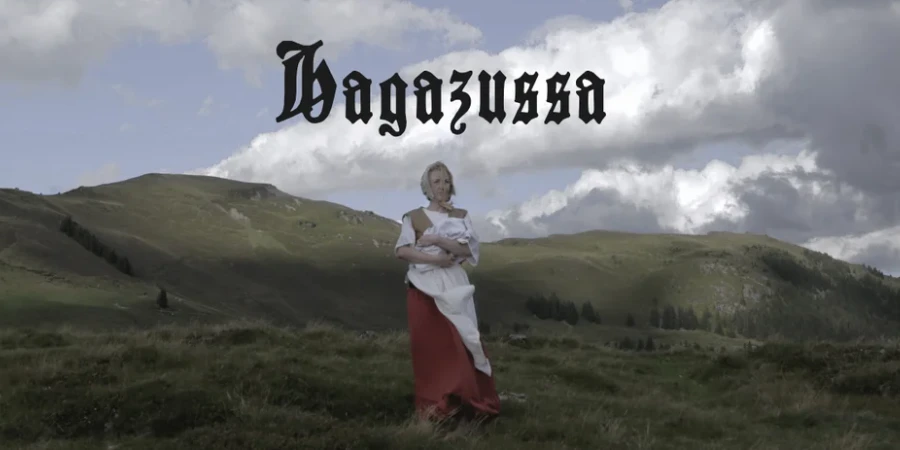

Hagazussa: A Heathen’s Curse (2017), directed by Lukas Feigelfeld, is a haunting exploration of isolation, superstition, and inherited trauma. Set in the Austrian Alps during the 15th century, the film blurs the line between psychological horror and dark folklore, offering a slow-burning, unsettling descent into madness.
Detailed Summary
Childhood and the Seeds of Fear
The film opens with a chilling image: a young girl named Albrun living with her mother in a remote alpine cabin. The villagers already suspect her mother of witchcraft, and the sense of alienation is immediate. When her mother falls ill with what appears to be a plague or possession, she dies violently—leaving Albrun completely alone in the vast, unforgiving wilderness. This traumatic event lays the foundation for Albrun’s fragile psyche and her connection to nature and dark spiritual forces.
Isolation and Motherhood
Years later, Albrun (now played by Aleksandra Cwen) lives as a goat herder in the same isolated location. She has grown into a reclusive woman, still ostracized by the nearby villagers who call her a witch. Her only companion is her infant daughter. The film spends long, quiet stretches depicting her daily life—tending goats, walking through fog-laden forests, and existing in eerie solitude.
When Albrun meets Swinda, a seemingly friendly villager, a faint hope for human connection flickers. But that hope quickly turns sinister. Swinda betrays her trust in a shocking and disturbing scene involving cruelty and humiliation, pushing Albrun further into paranoia and delusion.
The Descent into Madness
After being further isolated, Albrun begins to experience visions and hallucinations that blend pagan imagery, death, and sexuality. The boundary between reality and nightmare dissolves completely. Her mind becomes a battleground of grief, guilt, and spiritual possession.
The Goat and the Curse
As the film progresses, Albrun performs strange rituals involving her goats and her deceased mother’s skull. She begins to believe she has inherited her mother’s curse—or perhaps her power. The film’s pacing is glacial, almost trance-like, building dread through silence, darkness, and disturbing imagery rather than jump scares.

Movie Ending
In the film’s harrowing climax, Albrun’s delusions consume her entirely. She feeds her baby a potion made from her own corrupted milk—heavily implied to be poisoned. The infant dies in agony, and Albrun, in a state of trance-like despair, covers herself in ashes and carries her child’s body deep into the mountains.
There, under the moonlight, she enacts a final, grotesque ritual: she places the baby’s corpse in the forest, seemingly offering it to the spirits or nature itself. Then, in the film’s final, haunting moments, she walks into the mist—naked, broken, and possibly transcendent. Whether she becomes one with the dark pagan forces that haunted her or simply dies from exposure is left ambiguous.
The closing imagery—mist swirling through the trees, echoes of distant chants—suggests that Albrun has finally merged with the ancient, cursed forces surrounding her. The cycle of isolation, fear, and superstition continues.
Are There Post-Credits Scenes?
No, Hagazussa has no post-credits scene. The film ends abruptly and hauntingly, leaving viewers to sit in silence as the credits roll—an intentional choice to preserve its oppressive and meditative tone.
Type of Movie
Hagazussa is a folk horror and psychological horror film deeply rooted in atmosphere rather than plot. It’s closer in spirit to The Witch (2015) or Antichrist (2009) than to traditional horror movies.
Cast
- Aleksandra Cwen as Albrun
- Célina Peter as Young Albrun
- Claudia Martini as Albrun’s Mother
- Tanja Petrovsky as Swinda
- Sam Louwyck as Swinda’s Husband
Film Music and Composer
The eerie and minimalist score was composed by MMMD (Mohammad), an experimental Greek duo known for their use of drones and deep ambient tones. Their music amplifies the film’s sense of timeless dread, often blending seamlessly with natural sounds—wind, animal noises, and whispers—to create a sonic hallucination.

Filming Locations
The movie was filmed primarily in the Austrian Alps, particularly around Salzburg and Upper Austria. The remote, foggy landscapes and decaying wooden huts play a crucial role in the film’s storytelling. The oppressive wilderness mirrors Albrun’s inner turmoil, making the setting almost a character in itself.
Awards and Nominations
While not a mainstream hit, Hagazussa received critical acclaim at independent film festivals. It won:
- Best Feature Film at the Brooklyn Horror Film Festival (2017)
- Best Director at the Fantaspoa Film Festival
- Multiple nominations for cinematography and sound design at European indie festivals
Behind the Scenes Insights
- Lukas Feigelfeld developed Hagazussa as his film school thesis project, which later expanded into a full feature.
- The film was shot on a tiny budget, with a skeleton crew enduring freezing conditions in the Alps.
- Many scenes were shot with natural light only, to enhance realism and atmosphere.
- The goat scenes were notoriously difficult to film—apparently, the animals were “uncooperative co-stars.”
- Feigelfeld has said the film was inspired by his fascination with how superstition and religion shape female identity in rural societies.
Inspirations and References
The film draws heavy inspiration from:
- European folklore and witch myths
- The German expressionist cinema tradition (Nosferatu, Häxan)
- Carl Jung’s theories of the shadow self
- Robert Eggers’ The Witch, which came out around the same time but shares similar themes of isolation and religious paranoia
Alternate Endings and Deleted Scenes
Feigelfeld revealed in interviews that early drafts included more overt supernatural elements—such as visible spirits or ghostly figures—but he decided to cut them, preferring ambiguity and psychological tension. Deleted scenes included longer sequences of Albrun’s rituals and an unused epilogue showing the villagers discovering her cabin.
Book Adaptations and Differences
Hagazussa is not based on a book but rather inspired by oral folklore and pagan legends from the Austrian region. The film feels literary in its pacing and imagery, but it’s an original screenplay.
Memorable Scenes and Quotes
Key Scenes
- The opening sequence with Albrun’s dying mother, establishing the cycle of fear and sickness
- The goat scene—intense and disturbing, symbolizing both corruption and transformation
- Albrun bathing in the misty river, symbolizing her descent into madness
- The final ritual with the infant, one of the most shocking and sorrowful climaxes in recent horror cinema
Iconic Quotes
- “The forest remembers.” (a recurring whisper heard in Albrun’s visions)
- “You carry her sin.” (the priest’s words that echo throughout the film)
Easter Eggs and Hidden Details
- The title Hagazussa is an Old High German word meaning “hedge rider”—a term for witches believed to straddle the line between the human and spirit world.
- The film’s four chapters—“Shadows,” “Horn,” “Blood,” and “Fire”—represent stages of decay and transformation.
- Albrun’s goats mirror her own psyche: as they sicken and die, so does her sanity.
- The recurring mist symbolizes the boundary between the living and the dead.
Trivia
- The film’s runtime (102 minutes) was designed around a four-act structure symbolizing the elements—Earth, Water, Fire, and Air.
- Lukas Feigelfeld used real animal remains for certain ritual scenes, though ethically sourced.
- The entire film uses almost no dialogue; less than 15 minutes of spoken words occur.
- Critics have called it “the Austrian answer to The Witch.”
Why Watch?
Watch Hagazussa if you appreciate slow, meditative horror that seeps into your bones rather than jumps out at you. It’s a study of madness, grief, and inherited trauma, wrapped in pagan imagery and hypnotic cinematography. It’s not a film to entertain—it’s a film to experience, to feel uneasy about, and to ponder long after the credits roll.
Director’s Other Works
- Interferenz (2014) – Short Film
- Hagazussa remains his most recognized feature, but Feigelfeld has expressed plans for another psychological horror set in modern times.
Recommended Films for Fans
- The Witch (2015)
- Antichrist (2009)
- The Lighthouse (2019)
- November (2017)
- Saint Maud (2019)
- The Wailing (2016)
- Possession (1981)