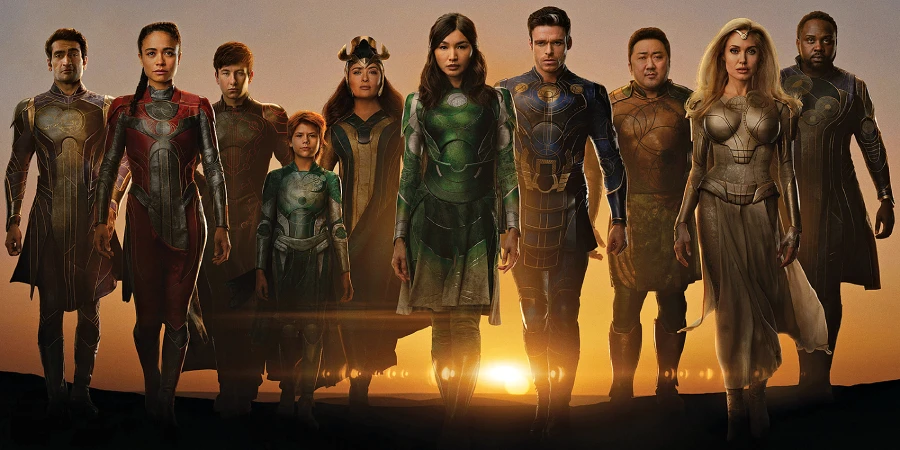

Marvel took a massive swing with Eternals, assembling ten immortal beings, a director fresh off an Oscar win, and a storyline that dares to ask whether humanity even deserves saving. Chloe Zhao brought her signature naturalistic filmmaking to the MCU, and the result is one of the franchise’s most divisive, ambitious, and genuinely strange entries. This film kills a Celestial, splits its heroes down the middle, and ends with half the team turned to marble. Buckle up, because nothing here is tidy.
Detailed Summary
Arrival on Earth and the Mission Explained
The film opens 7,000 years ago. A massive spacecraft called the Domo descends over Mesopotamia, and ten Eternals step onto Earth for the first time.
These beings, Sersi, Ikaris, Thena, Gilgamesh, Kingo, Sprite, Phastos, Makkari, Druig, and Ajak, believe they exist to protect humanity from apex predators called Deviants. Their instructions are clear: eliminate the Deviants, do not interfere with human conflict, and wait for further orders from the Celestials.
Ajak serves as the group’s leader and maintains a direct line of communication with the Celestial Arishem. However, the audience only learns the full weight of that communication much later.
Centuries of History, Fractures Begin
In a series of flashbacks spanning millennia, the film traces the Eternals’ journey through human civilizations. They appear in ancient Babylon, offer guidance, fight Deviants, and slowly grow attached to the humans they protect.
Cracks form within the group over time. Druig grows increasingly disillusioned, particularly after witnessing human beings wage war on each other in a South American civilization. He ultimately breaks ranks, using his mind-control powers to stop the slaughter against Ajak’s direct orders, and retreats to the Amazon with a community of people under his gentle influence.
Meanwhile, Thena begins experiencing Mahd Wy’ry, a condition that corrupts an Eternal’s memories and turns them violent. Gilgamesh volunteers to stay by her side and care for her, sacrificing his place in the group.
The Last Deviant is Killed, and the Team Disbands
In the 1500s, the Eternals hunt down what they believe is the last Deviant on the Tenochtitlan plain. With that mission apparently complete, Ajak disbands the group. Each Eternal scatters across the world to live among humans in isolation.
Sersi settles in modern-day London, working as a museum curator and dating a human named Dane Whitman. Ikaris, notably, has already separated from Sersi centuries earlier after their marriage, unable to reconcile his loyalty to Arishem’s true plan with his love for her.
The Deviants Return, and Everything Unravels
In present day, a Deviant attacks Sersi and her human companion Dane in London. Ikaris reappears to help fight it off, but this Deviant behaves differently from any they have encountered before: it heals itself and seems to be evolving.
Sersi and Ikaris visit Ajak in South Dakota to report the anomaly. They find her dead, killed by a Deviant. More surprisingly, Ajak’s golden communication sphere transfers itself to Sersi, making her the new leader and opening a direct channel to Arishem.
Arishem reveals the truth to Sersi, and consequently to the audience. The Eternals were never just protecting humans from Deviants.
The Emergence: The Real Mission Revealed
Arishem explains the concept of the Emergence. Earth hosts the dormant seed of a new Celestial named Tiamut, who has been growing inside the planet’s core, powered by the energy of billions of human lives. Once Tiamut reaches critical mass, the planet will be destroyed to allow the Celestial to be born.
Furthermore, the Eternals themselves are not unique. Arishem creates countless Eternals across the universe, sends them to populated planets, and uses them to help intelligent life thrive so that the Celestial growing inside can absorb enough energy. After each Emergence, the Eternals’ memories are wiped and they are redeployed elsewhere.
This revelation reframes everything. The Eternals were never heroes protecting humanity; they were farmers cultivating a crop.
Gathering the Team, Choosing Sides
Sersi reunites the scattered Eternals to confront this truth. Each member reacts differently, and those reactions drive the film’s second half.
Ikaris already knows. He has known for centuries, having discovered Ajak’s knowledge of the plan and choosing to remain loyal to Arishem. His decision to suppress this truth, and his indirect role in Ajak’s death by leading the Deviant to her after she revealed she intended to stop the Emergence, places him firmly in the antagonist role.
Sprite also sides with Ikaris. She has been in love with him for millennia and, moreover, she desperately wants the mortality that a completed Emergence might offer her: Arishem promised to grant Sprite a human life as reward for her loyalty.
The Plan to Stop Tiamut
Phastos, the inventor among the Eternals, devises a solution. He creates a device called the Uni-Mind amplifier, which allows the Eternals to pool their collective cosmic energy and channel it through one individual.
The plan involves using this combined power to put Tiamut to sleep before the Emergence completes. Sersi volunteers to channel the Uni-Mind, using her matter-transformation ability to turn the Celestial to marble mid-birth.
Druig nearly dies during an attack by the evolved Deviants, whose leader has absorbed Ajak’s healing powers. Gilgamesh sacrifices his life fighting this creature, and Thena finally kills it, avenging him.
The Final Confrontation with Ikaris
As the Emergence begins off the coast of India, the surviving Eternals race to execute Phastos’s plan. Ikaris attacks them directly, blasting Druig, fighting Sersi, and doing everything in his power to let Tiamut rise.
In a genuinely surprising moment, Sprite stabs Sersi from behind, nearly derailing everything. Dane Whitman, who has followed the group, pulls Sprite away long enough for the Uni-Mind to form.
Makkari fights Ikaris to buy time, and their battle across the emerging Celestial’s body is one of the film’s most visually spectacular sequences. Even so, Ikaris overpowers her.
Sersi Turns Tiamut to Stone
In the film’s climax, the Uni-Mind forms even as Ikaris looms over Sersi. Tiamut, somehow aware of what is happening, voluntarily contributes his own energy to the Uni-Mind. This act of apparent compassion tilts the balance.
Sersi channels the combined power and transforms Tiamut into marble. Half the Celestial’s body freezes mid-emergence from the Indian Ocean, a colossal stone figure jutting from the sea.
Ikaris, unable to bring himself to harm Sersi and overwhelmed by guilt, flies directly into the sun. He does not return.


Movie Ending
Sersi uses the last of the Uni-Mind’s energy to grant Sprite her wish: a human life, complete with mortality. It is an act of compassion that costs Sersi considerably, and it lands as one of the film’s most quietly emotional beats.
Arishem appears above Earth’s atmosphere, furious. He grabs Sersi, Kingo, and Phastos directly from the planet’s surface, pulling them into the cosmos. He informs them that he will review their memories to judge whether humanity’s worth justifies the loss of a Celestial. If he deems humanity insufficient, he will delete everything and start over.
Thena, Druig, and Makkari, who escape Arishem’s grasp because they are already aboard the Domo, set off to find other Eternals across the universe and warn them about the truth of their existence. Meanwhile, Dane Whitman remains on Earth, presumably waiting for Sersi’s return.
In the final moments, Dane reaches for an ancient sword in a wooden chest, the Ebony Blade, with an inscription warning against picking it up. A mysterious voice (confirmed to be Mahershala Ali‘s Blade) speaks to him from off-screen just before the credits roll.
This ending carries enormous weight for the MCU. Arishem’s judgment hangs over Earth like a death sentence. The surviving Eternals are cosmic prisoners. Moreover, the sheer scale of Tiamut’s stone body jutting from the ocean means the entire world now knows something catastrophic happened, setting up undeniable real-world implications for future Marvel stories.
Are There Post-Credits Scenes?
Eternals features two post-credits scenes. Both introduce significant new characters to the MCU.
In the mid-credits scene, Thena, Druig, and Makkari are aboard the Domo when they receive a surprise visitor: Eros, played by Harry Styles, accompanied by his companion Pip the Troll (voiced by Patton Oswalt). Eros is Thanos’s brother and an Eternal himself, and he offers to help them find Sersi and the others.
In the post-credits scene, Dane Whitman opens the chest containing the Ebony Blade. He reaches for it, and Blade’s voice warns him from off-screen. This scene directly sets up Dane Whitman’s eventual transformation into the Black Knight.
Type of Movie
Eternals operates primarily as a superhero epic with strong elements of cosmic science fiction and philosophical drama. Its tone sits noticeably apart from other MCU films: slower, more meditative, and willing to sit with moral ambiguity.
Zhao brings an art-house sensibility to the material. In contrast to the quippy, action-forward Marvel formula, this film prioritizes character introspection, romantic subplots, and existential questions about creation and sacrifice.
Cast
- Gemma Chan – Sersi
- Richard Madden – Ikaris
- Angelina Jolie – Thena
- Salma Hayek – Ajak
- Kumail Nanjiani – Kingo
- Brian Tyree Henry – Phastos
- Lauren Ridloff – Makkari
- Barry Keoghan – Druig
- Don Lee – Gilgamesh
- Lia McHugh – Sprite
- Kit Harington – Dane Whitman
- Harry Styles – Eros
- Patton Oswalt – Pip the Troll (voice)
Film Music and Composer
Ramin Djawadi composed the score for Eternals. Djawadi is best known for his work on Game of Thrones and Westworld, bringing a gift for large-scale, emotionally resonant orchestral work to the project.
His score leans heavily on sweeping strings and choir arrangements, reflecting the film’s cosmic scale and its melancholy undertones. Notably, the main Eternals theme carries a weight that feels ancient and sorrowful rather than triumphant, which suits the film’s overall mood perfectly.
The score differentiates itself from the typical MCU sound by avoiding bombastic superhero fanfare. In addition, Djawadi incorporates more intimate, quietly tragic passages during the film’s introspective flashback sequences.


Filming Locations
Eternals shot across multiple countries, and the location choices directly reinforce the film’s sense of deep time and geographic scope. Production took place in the United Kingdom, the Canary Islands (Spain), the United States, and the Khmer temples of Cambodia.
The Canary Islands provided the dramatic volcanic and coastal landscapes used to evoke ancient civilizations. Similarly, the Cambodian temple sequences grounded the film in genuine historical grandeur rather than studio artifice.
London served as the present-day setting for Sersi’s modern life, lending the film a grounded, European sensibility during its contemporary segments. Zhao’s preference for natural light and real locations is visible throughout, giving the film a texture unusual for Marvel productions.
Awards and Nominations
Eternals earned a nomination at the Academy Awards for Best Visual Effects, though it did not win in that category. At the same time, the film received recognition from various critics’ circles for its cinematography, courtesy of Ben Davis.
Behind the Scenes Insights
- Director Chloe Zhao became the first woman of color to direct a Marvel Cinematic Universe film with Eternals.
- Lauren Ridloff, who plays Makkari, is deaf in real life. Her casting made Makkari the MCU’s first deaf superhero.
- Zhao insisted on shooting with natural light as much as possible, a significant departure from Marvel’s typical heavily controlled studio lighting.
- The film features the MCU’s first same-sex relationship depicted on screen, involving Phastos and his husband Ben.
- Zhao worked closely with the cast to develop the interpersonal dynamics between characters, emphasizing their 7,000-year shared history.
- Angelina Jolie prepared for the role of Thena by studying movement and choreography specifically designed for the character’s spear-based combat style.
- Harry Styles reportedly beat out several other actors for the role of Eros, with Marvel specifically pursuing a high-profile casting choice for the character.
Inspirations and References
Jack Kirby created the Eternals comic book series for Marvel in 1976. His original concept drew heavily from Chariots of the Gods, Erich von Daniken’s book proposing that ancient civilizations were influenced by extraterrestrial visitors.
Kirby’s Eternals mythology shares thematic DNA with his New Gods work at DC Comics, exploring large-scale cosmological conflicts between god-like beings. Zhao’s film preserves this grand philosophical framework while grounding it in more contemporary questions about free will, purpose, and complicity.
The film also draws on creation mythology from multiple human cultures. Arishem’s role as a cosmic architect echoes figures from Gnostic cosmology and various ancient religious traditions.
Alternate Endings and Deleted Scenes
Marvel did not officially release details of significant alternate endings for Eternals. However, Zhao confirmed in interviews that early cuts of the film ran considerably longer, with additional scenes deepening individual character backstories.
Reportedly, sequences involving Kingo’s centuries-long career as a Bollywood actor contained more material that fleshed out his relationship with fame and identity. Some scenes showing the Eternals in additional historical periods were also cut to manage the film’s already substantial runtime.
No official deleted scenes package has been publicly detailed in full, so specific cut content remains largely unconfirmed beyond general references from the filmmakers.
Book Adaptations and Differences
Eternals is not based on a book. It draws from Jack Kirby’s comic book series of the same name, first published in 1976, along with subsequent runs by other writers including Neil Gaiman’s 2006 limited series.
The film diverges from the comics in several key ways. In the source material, the Deviants, Eternals, and baseline humans all originate from Celestial experimentation on early humanity rather than the Eternals being synthetic beings sent from space. Consequently, the film’s core mythology is a significant reimagining rather than a direct adaptation.
Ikaris’s role as a clear antagonist is largely a film invention; his comic counterpart is straightforwardly heroic. Furthermore, the Emergence concept as depicted in the film is a more streamlined and emotionally targeted version of the Celestials’ complex activities in the source material.
Memorable Scenes and Quotes
Key Scenes
- The Eternals’ arrival in ancient Mesopotamia, shot on a beach at golden hour with no visible VFX environments, establishing the film’s visual philosophy immediately.
- Druig halting the massacre in the South American city by taking control of the soldiers, a scene that crystallizes the film’s central moral conflict about intervention and free will.
- Arishem revealing the truth of the Emergence to Sersi, a sequence combining cosmic horror with genuine tragedy as 7,000 years of purpose collapses.
- Makkari’s high-speed battle against Ikaris across Tiamut’s emerging body, the film’s most kinetically thrilling action sequence.
- Ikaris flying into the sun, a quiet, almost mythological exit for the film’s central tragic figure.
- Sersi granting Sprite a human life, one of the film’s most emotionally understated and effective moments.
Iconic Quotes
- “We have loved these people since the beginning. It’s not our call to end them.” (Ajak)
- “We watched, and we waited. And now… we’re going to help.” (Sersi)
- “I’m not a leader. I’m just the one who was chosen.” (Sersi)
- “You’ve loved humans for too long.” (Ikaris, to Ajak)
Easter Eggs and Hidden Details
- Kingo’s Bollywood film posters visible in his home show different “actors” across decades, all played by Kingo himself under different names, a clever visual gag about his centuries of fame-chasing.
- Phastos’s ancient blueprints, visible on cave walls in the Mesopotamia flashback, include schematics that resemble early agricultural and architectural innovations, subtly suggesting the Eternals accelerated human development.
- The constellation patterns visible on Arishem’s body correspond to actual star maps, reinforcing the idea that the Celestials predate human understanding of the cosmos.
- Dane Whitman’s surname is a direct reference to his comic book identity as the Black Knight, a legacy hero tied to Arthurian mythology in Marvel lore.
- The Ebony Blade’s inscription, “Death is my reward,” matches its cursed nature in the comic source material almost exactly.
- Thena’s armor design incorporates geometric patterns referencing ancient Greek iconography, consistent with her apparent connection to the goddess Athena.
- Arishem appears briefly in a post-credits scene of a different MCU project prior to Eternals, establishing the Celestials’ presence before this film.
Trivia
- Eternals holds the distinction of being one of the longest MCU theatrical releases, running approximately 157 minutes.
- Chloe Zhao won her Academy Award for Nomadland while Eternals was still in post-production, making her the first Oscar-winning director to helm an MCU film.
- Richard Madden and Kit Harington previously appeared together in Game of Thrones, and their reunion in Eternals generated considerable audience attention.
- Lauren Ridloff’s Makkari communicates entirely in American Sign Language throughout the film, with no vocalization, and the film never frames this as a weakness or limitation.
- Gemma Chan previously appeared in the MCU as Minn-Erva in Captain Marvel before being recast as Sersi in Eternals.
- The film features the first on-screen sex scene in MCU history, between Sersi and Ikaris.
- Harry Styles was cast as Eros despite having no prior MCU or major superhero film experience at the time.
- Don Lee (also known as Ma Dong-seok) is one of South Korea’s biggest film stars, and his casting as Gilgamesh represented a significant outreach to Asian markets.
Why Watch?
Eternals rewards viewers who want a Marvel film that genuinely wrestles with big ideas: the cost of loyalty, the ethics of creation, and whether love for humanity is reason enough to defy a god. Zhao’s naturalistic direction gives the film a visual richness rare in blockbuster filmmaking. Moreover, its willingness to end on an unresolved, genuinely ominous note makes it one of the MCU’s most daring installments.
Director’s Other Movies
- Songs My Brothers Taught Me (2015)
- The Rider (2017)
- Nomadland (2020)