
Romania, 1987, and two college roommates are navigating a system designed to crush them. 4 Months, 3 Weeks and 2 Days drops you into the grey, suffocating reality of late Ceausescu-era communism with zero hand-holding and maximum dread. Director Cristian Mungiu won the Palme d’Or at Cannes for this film, and it is not hard to understand why. This is one of the most precise, uncompromising pieces of cinema produced anywhere in the world since 2000.
Detailed Summary
Otilia Prepares for Something Unspoken
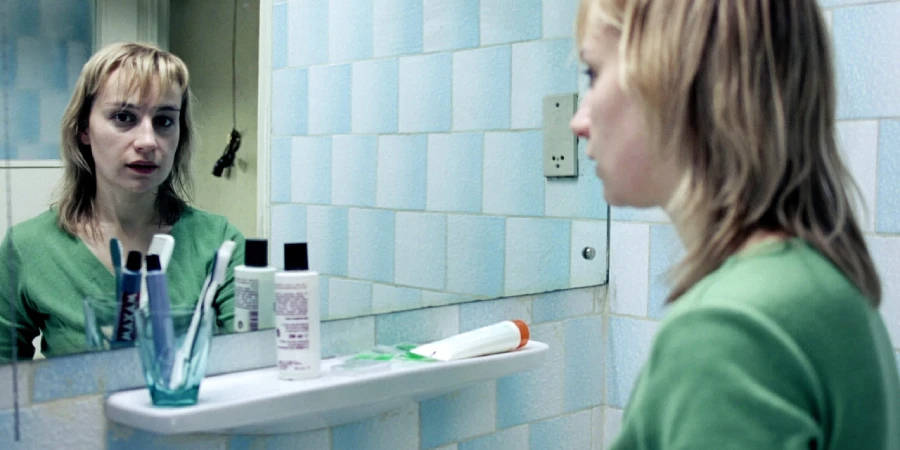
We meet Otilia (played by Anamaria Marinca) in her university dormitory. She moves through mundane tasks with quiet urgency, trading goods on the black market and gathering supplies. Something serious is about to happen, and the film refuses to explain it immediately.
Her roommate, Gabita (played by Laura Vasiliu), is pregnant. Abortion was illegal in communist Romania under Ceausescu’s pro-natalist policies. Gabita has arranged an illegal procedure, and Otilia has agreed to help her through it.
The Hotel Problem and Mr. Bebe
Otilia handles nearly every practical task because Gabita proves dangerously passive and disorganized. Gabita had promised to book a hotel room in advance and did not. As a result, Otilia scrambles to find a room at a different, more expensive hotel.
They meet Mr. Bebe (played by Vlad Ivanov), the man who will perform the abortion. He is calm, controlled, and quietly menacing from the first moment he appears. His manner is professional in a way that feels deeply wrong.
Bebe discovers that Gabita lied to him about how far along the pregnancy is. He also learns that the hotel room is not the one originally agreed upon. He uses both facts as leverage, insisting that the two women have sex with him before he proceeds. This scene is one of the most disturbing sequences in contemporary European cinema, precisely because of how it is framed: without music, without dramatic cuts, just the cold arithmetic of coercion.
The Procedure
Bebe performs the abortion on Gabita in the hotel room using a probe. He instructs them on what to do once the fetus is expelled, emphasizing that they must dispose of it carefully and illegally. He then leaves without ceremony.
Otilia attends her boyfriend Adi’s mother’s birthday dinner while Gabita waits alone in the room. This scene is one of the film’s most formally brilliant choices. Otilia sits at a table full of chattering, oblivious middle-class guests while her mind stays locked in that hotel room.
Otilia Carries the Weight
Otilia returns to the hotel to find that Gabita has expelled the fetus. It lies on the bathroom floor, and Mungiu holds the camera on it long enough to make the audience feel the full weight of what is happening. Gabita, meanwhile, remains emotionally and physically checked out.
Otilia wraps the fetus, leaves the hotel, and walks through the dark city alone. She crosses a deserted neighborhood, looking for a place to dispose of it discreetly. Every step feels terrifying, because a woman carrying what she is carrying in this society risks imprisonment or worse.
She eventually drops the package down a garbage chute in a residential building. The act itself takes seconds. The walk back is long and silent.


Movie Ending
Otilia returns to the hotel and finds Gabita sitting at the restaurant, having ordered food, seemingly composed. They sit across from each other at the table. Gabita attempts to make small talk about what she wants to eat, and Otilia shuts it down immediately.
Her line, delivered flatly, signals that some things between them are now permanently closed. Mungiu cuts to black before the viewer can process everything that has accumulated. There is no resolution, no catharsis, no assurance that either woman will be okay.
What makes this ending so powerful is precisely what it withholds. We do not see legal consequences. We do not see emotional reconciliation. Instead, Mungiu leaves the full burden of the film on the audience, forcing us to sit with the same exhaustion and moral weight that Otilia carries. The final frame feels less like a conclusion and more like a door slamming shut on a world where women were treated as state property.
Notably, the film never editorializes. It trusts the events to speak entirely for themselves, and that restraint is more devastating than any explicit statement could be.
Are There Post-Credits Scenes?
No. 4 Months, 3 Weeks and 2 Days contains no post-credits scene of any kind. Mungiu cuts to black at the end and the credits roll in silence. Sitting through them is, in its own way, part of the experience.
Type of Movie
This film sits firmly in social realist drama. It draws from the tradition of cinema verite and shares DNA with the Romanian New Wave, a movement defined by long takes, naturalistic performances, and a refusal to sentimentalize difficult subjects.
In terms of tone, the film is relentless and claustrophobic. It functions almost like a thriller in its second half, building suspense through mundane logistics rather than action sequences. However, its core is deeply humanist, anchored entirely in Otilia’s perspective.
Cast
- Anamaria Marinca – Otilia
- Laura Vasiliu – Gabriela “Gabita” Dragut
- Vlad Ivanov – Mr. Bebe
- Alexandru Potocean – Adi, Otilia’s boyfriend
- Ion Sapdaru – Room Service Waiter
- Luminita Gheorghiu – Adi’s Mother
Film Music and Composer
4 Months, 3 Weeks and 2 Days has no original score. Mungiu made a deliberate choice to strip the film of music entirely, and that decision is inseparable from the film’s impact. Silence and ambient sound do the work that a composer might otherwise handle.
By refusing a musical score, Mungiu denies the audience any emotional cuing. You cannot be told how to feel because nothing is nudging you. Consequently, every creak of a hotel floor, every muffled television through a wall, carries disproportionate weight.



Filming Locations
Principal photography took place in Bucharest, Romania. Mungiu and his team worked hard to recreate the visual texture of 1987 communist Romania, sourcing period-accurate props, signage, and clothing. The city’s surviving brutalist architecture required minimal dressing to feel authentically oppressive.
Specific locations, including the hotel interiors, dormitory spaces, and residential streets, were chosen because they retained the grey uniformity of the communist era. This was not nostalgia; it was forensic reconstruction. The locations function as a character in their own right, communicating the ideological suffocation of the regime through sheer visual weight.
Awards and Nominations
4 Months, 3 Weeks and 2 Days won the Palme d’Or at the 2007 Cannes Film Festival, the most prestigious prize in world cinema. This was a landmark achievement for Romanian cinema and for the Romanian New Wave as a whole.
Furthermore, it won numerous critics’ awards across Europe and North America. Notably, its exclusion from the Academy Award Foreign Language Film shortlist prompted significant controversy, as many critics considered it the best film of its year in any category or country.
Behind the Scenes Insights
- Cristian Mungiu rehearsed scenes extensively before filming, but he deliberately kept the actual shoot spontaneous to preserve naturalistic performances.
- Cinematographer Oleg Mutu used a handheld camera approach, keeping the frame close to the actors and refusing to cut away at difficult moments.
- Anamaria Marinca has spoken about the physical and emotional exhaustion of shooting the film, particularly the long takes that sometimes lasted many minutes without interruption.
- Mungiu chose to work primarily with non-star Romanian actors to avoid any association with glamour or celebrity that might undercut the film’s realism.
- Many scenes were shot in a single take or with very few takes, which contributed to the film’s unbroken, pressurized atmosphere.
- The dinner party sequence, in which Otilia sits at Adi’s family table, involved a locked-off camera and real-time performance with no editing cuts during the scene at the table.
Inspirations and References
Mungiu has cited the broader Romanian New Wave movement as a collective inspiration rather than a single source. Directors like Cristi Puiu and Corneliu Porumboiu shared a commitment to long takes and social realism that shaped the environment in which this film became possible.
The film also draws on documented historical reality. Under Decree 770, issued by Nicolae Ceausescu in 1966, abortion and most forms of contraception were banned in Romania. Thousands of women died from illegal procedures during this period, and Mungiu built the film’s emotional architecture on those real, largely unacknowledged tragedies.
In addition, the film’s unadorned visual style owes a clear debt to the Dardenne brothers of Belgium, whose socially urgent dramas similarly use following-shot cinematography and absent musical scores.
Alternate Endings and Deleted Scenes
No alternate endings or officially released deleted scenes exist for 4 Months, 3 Weeks and 2 Days. Mungiu has not released any extended cuts or home video bonus content that documents excised material.
Given the film’s commitment to economy and precision, this is entirely consistent with its production philosophy. Every scene serves a specific structural or emotional function, and the film feels fully considered rather than edited down from something larger.
Book Adaptations and Differences
4 Months, 3 Weeks and 2 Days is not based on a book or any single pre-existing source. Cristian Mungiu wrote the original screenplay himself. It is an entirely original work, though grounded in the documented historical and social realities of late communist Romania.


Memorable Scenes and Quotes
Key Scenes
- Mr. Bebe’s coercion scene: Bebe calmly, methodically uses Gabita’s lies and the changed hotel as justification for his assault on both women. The scene’s horror comes entirely from his composed tone and the total absence of dramatic signposting.
- The dinner party sequence: Otilia sits surrounded by mundane conversation about trivial things while Gabita waits alone in the hotel room. Mungiu holds the camera on Marinca’s face, and the audience reads everything she is not saying.
- Otilia walking alone at night: Carrying the fetus wrapped in a bag through dark Bucharest streets, Otilia passes through the city as though invisible. Every stranger who glances at her feels like a potential catastrophe.
- The fetus on the bathroom floor: Mungiu holds a static shot on the expelled fetus for a sustained, uncomfortable duration. It is not exploitative; it is documentary in its intention, forcing the viewer to register what the regime’s policies produced.
- The final restaurant scene: Otilia and Gabita sit opposite each other. Gabita’s attempt to return to normalcy through small talk about food is quietly devastating, and Otilia’s refusal to play along closes the film on a note of irreversible change.
Iconic Quotes
- “We agreed on something. You didn’t keep your part.” (Bebe, using agreement as a tool of control and threat)
- “Don’t ever ask me anything again.” (Otilia to Gabita, at the film’s conclusion, a line that carries the weight of everything that came before it)
Easter Eggs and Hidden Details
- The title refers to the gestational age of Gabita’s pregnancy, a detail the film never states explicitly in dialogue. Viewers must infer it.
- Mungiu includes several background details in the dormitory scenes that establish the black market economy of the era, including Western cigarettes and cosmetics traded as currency, which situates the world before a single word of plot is spoken.
- Mr. Bebe carries a medical bag that is never fully shown to the viewer. Its contents are implied rather than displayed, which makes its presence consistently unnerving throughout his scenes.
- During the dinner party scene, one of Adi’s relatives makes a brief comment about people “managing” under difficult circumstances. In context, it functions as an ironic counterpoint to what Otilia is actually managing elsewhere in the city.
- The hotel that Otilia books as a replacement is visually grander than the one Gabita originally arranged, which subtly underscores how Otilia continually overcompensates for Gabita’s failures throughout the film.
Trivia
- 4 Months, 3 Weeks and 2 Days was the second film in Mungiu’s informal “Tales from the Golden Age” project examining communist-era Romania.
- Vlad Ivanov became an internationally recognized actor almost entirely on the basis of his performance as Bebe in this film. His previous work was largely in Romanian theatre.
- The film was shot in sequence, which is unusual for film production and helped the actors build a genuine sense of cumulative pressure and fatigue.
- Romania submitted the film as its entry for the Academy Awards Foreign Language Film category, but it did not make the final shortlist, a decision that generated significant international press criticism.
- Mungiu had been developing the script for several years before production began, researching the period extensively through personal accounts and historical records.
- Anamaria Marinca won the Best Actress award at the BAFTA Awards for her performance as Otilia.
Why Watch?
Few films demand your full attention and then justify that demand so completely. This is a masterclass in restraint, in trusting an audience, and in using cinema to do what no other art form can: place you inside a specific fear at a specific time in history. Moreover, Marinca’s performance alone is worth the price of entry.
Director’s Other Movies
- Occident (2002)
- Tales from the Golden Age (2009)
- Beyond the Hills (2012)
- Graduation (2016)
- R.M.N. (2022)
Recommended Films for Fans
- The Death of Mr. Lazarescu (2005)
- Rosetta (1999)
- The Edge of Heaven (2007)
- Police, Adjective (2009)
- Lilya 4-Ever (2002)
- Son of Saul (2015)
- In the Fade (2017)
- Never Rarely Sometimes Always (2020)
- Leviathan (2014)
- The Child (2005)
- 12:08 East of Bucharest (2006)