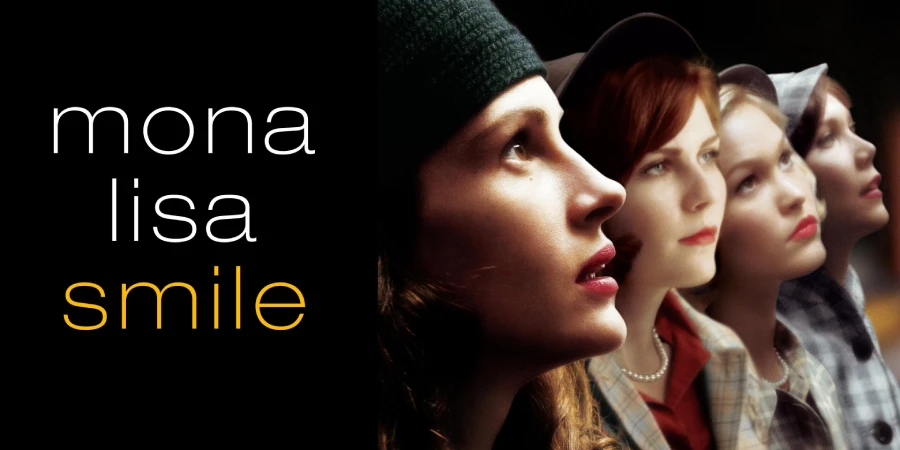

A woman walks into a classroom full of students who have already memorized the textbook before the first lesson. Katherine Watson arrives at Wellesley College in 1953 thinking she can change minds, and the film spends two hours proving how complicated that actually is. Mona Lisa Smile is sharper than its pastel-toned marketing suggested, hiding a genuinely thorny debate about feminism, choice, and institutional conformity beneath its glossy surface.
Detailed Summary
Katherine Watson Arrives at Wellesley
Katherine Watson, played by Julia Roberts, accepts a position teaching art history at the prestigious all-women Wellesley College in the fall of 1953. She arrives from California, optimistic and progressive, expecting to inspire a generation of young women. Instead, she walks into a room full of students who have memorized the entire course text before she has uttered a single word.
Her students rattle off slide identifications with robotic precision. Katherine realizes immediately that memorization and genuine engagement are two very different things. She has to rethink her entire approach on the spot.
Meeting the Core Group of Students
Betty Warren, played by Kirsten Dunst, is the social queen of campus, sharp-tongued, conservative, and deeply invested in maintaining the status quo. Joan Brandwyn, played by Julia Stiles, is the most academically gifted of the group, genuinely curious and quietly conflicted about her future. Giselle Levy, played by Maggie Gyllenhaal, is sexually liberated and openly provocative by the standards of the era.
Connie Baker, played by Ginnifer Goodwin, is the least confident of the four friends, eager to belong and deeply insecure about romance. Together, these four women form the emotional core of the film. Katherine’s relationship with each of them evolves in a different direction.
Katherine Pushes Back Against the Curriculum
After her humiliating first lecture, Katherine returns with slides of works not covered in any textbook. She shows her students contemporary and abstract pieces, asking them not what a painting is but what they think of it. This approach rattles students trained to produce correct answers rather than personal responses.
She shows them a Jackson Pollock and refuses to tell them whether it is good or bad. That single class session shifts something in students like Joan. Katherine begins building genuine momentum.
The Marriage Plot Takes Center Stage
Joan falls in love with Tommy Donegal and gets engaged, which delights her parents and satisfies every expectation Wellesley’s culture projects onto its students. Katherine, however, learns that Joan applied to Yale Law School and was accepted. She cannot hide her excitement and quietly encourages Joan to pursue law alongside marriage.
Joan ultimately chooses marriage over Yale. In a crucial scene, she confronts Katherine about this, insisting that the choice is genuinely hers and not a capitulation. This moment is one of the film’s most honest and uncomfortable beats.
Betty’s Hidden Misery
Betty appears to be the film’s antagonist for most of its runtime. She writes a scathing editorial in the school newspaper attacking Katherine’s teaching methods and perceived moral looseness. Her hostility feels personal in a way that goes beyond academic conservatism.
As the film progresses, Betty’s marriage to Spencer Jones reveals itself as a disaster. Spencer is emotionally distant and unfaithful. Betty, despite publicly championing the domestic ideal, is living proof that the ideal can be a trap.
Giselle, the Professor, and Complicated Desire
Giselle pursues an affair with Professor Bill Dunbar, a charming and manipulative Italian professor who cycles through students without consequence. Katherine herself becomes romantically involved with Dunbar briefly, not knowing about Giselle. When she finds out, she ends things cleanly and without drama.
Giselle also develops genuine feelings for Paul Moore, Connie’s eventual boyfriend, which creates a quiet rift between the two friends. Meanwhile, Connie finds confidence through her relationship with Paul, only to have that confidence tested when the Giselle complication surfaces.
Katherine’s Own Life Under Scrutiny
Katherine’s past relationship with a man named Paul back in California surfaces, and the college administration uses it to question her character. She also begins a relationship with Bill Dunbar before cutting it off, and later develops a more substantive connection with a Italian tutor named Paul Moore. Her personal life is messy in ways that mirror the messiness she asks her students to embrace intellectually.
Wellesley’s administration pressures her to sign a restrictive new contract that would govern her behavior and teaching content. She refuses to sign it. That refusal essentially ends her tenure at the college.

Movie Ending
Katherine announces she will not return to Wellesley for a second year. She has turned down the constrictive contract, choosing her own integrity over institutional security. It is a quiet act of defiance, but the film frames it with genuine weight.
Betty, in a turn that reframes her entire arc, has separated from Spencer. She is starting over, and the audience understands that Katherine’s presence, even when resisted furiously, planted something in her. Betty is not a villain who gets punished; she is a woman who finally chooses herself.
Joan leaves with Tommy as planned, committed to her marriage and her choice. She has heard everything Katherine said and still chosen domesticity, which the film refuses to code as failure. That refusal is arguably Mona Lisa Smile‘s most mature and underrated move.
In the film’s final sequence, Katherine rides away from campus on a bicycle as her students chase after her car. Giselle and Connie are there, waving her off with genuine affection. It is bittersweet rather than triumphant, because Katherine leaves without knowing for certain what, if anything, she changed.
The ending resists the comfortable resolution of a teacher-changes-lives narrative. No student has a dramatic epiphany. Instead, each woman moves forward carrying a slightly revised version of herself. That ambiguity is the film’s most honest statement.
Are There Post-Credits Scenes?
Mona Lisa Smile contains no post-credits scenes. Once Katherine rides away and the credits roll, that is the end. No hidden footage, no bonus moments, nothing to wait around for.
Type of Movie
This is a period drama with strong elements of coming-of-age storytelling and feminist social commentary. Its tone shifts between warm and melancholy, occasionally edging into light comedy during campus social scenes. On the whole, it is earnest and sincere rather than ironic or detached.
In contrast to films that package feminism as straightforward triumph, this one is genuinely ambivalent about its own conclusions. It sits comfortably alongside prestige dramas of the early 2000s, polished and emotionally intelligent.
Cast
- Julia Roberts – Katherine Watson
- Kirsten Dunst – Betty Warren
- Julia Stiles – Joan Brandwyn
- Maggie Gyllenhaal – Giselle Levy
- Ginnifer Goodwin – Connie Baker
- Dominic West – Bill Dunbar
- Juliet Stevenson – Amanda Armstrong
- Marcia Gay Harden – Nancy Abbey
- John Slattery – Paul Moore
- Marian Seldes – President Jocelyn Carr
Film Music and Composer
Rachel Portman composed the film’s score. Portman is one of the most accomplished composers working in Hollywood drama, and she was the first woman to win an Academy Award for Best Original Score, for Emma in 1996.
Her work on Mona Lisa Smile is characteristically warm and strings-led, matching the film’s nostalgic 1950s setting without tipping into parody. Period-appropriate pop songs also feature prominently throughout, grounding scenes in the era’s cultural atmosphere.

Filming Locations
Principal photography took place largely at Wellesley College in Massachusetts, the actual institution depicted in the story. Shooting on location gave the film an authenticity that studio sets rarely achieve, particularly in classroom and campus exterior scenes.
Additional scenes were filmed at other New England locations to supplement the Wellesley footage. The choice to film on-site matters thematically, because the physical environment of Wellesley, its architecture, its intimacy, actively shapes the sense of institutional pressure the characters experience.
Awards and Nominations
Mona Lisa Smile received a Golden Globe nomination for Best Original Song for “The Heart of Every Girl.” Rachel Portman’s score and the film’s costume design also attracted industry attention, though the film did not win major awards during its season.
Behind the Scenes Insights
- Director Mike Newell pushed for the film to avoid presenting a simple hero-versus-institution narrative, wanting genuine moral complexity on both sides.
- Julia Roberts took the role partly because she wanted to move away from romantic comedies and toward more substantive dramatic material at that point in her career.
- Kirsten Dunst reportedly found Betty Warren’s arc emotionally demanding, particularly the scenes depicting Betty’s failing marriage.
- The production worked closely with Wellesley College to ensure that period details, from dormitory layouts to classroom protocols, reflected the actual 1950s campus experience.
- Maggie Gyllenhaal has spoken about appreciating Giselle’s lack of shame around her own sexuality, which she found relatively rare for female characters of that era in mainstream studio films.
- Costume designer Michael Dennison used clothing deliberately to signal each character’s internal state, with Betty’s outfits becoming progressively more constrained as her marriage deteriorates.
Inspirations and References
The screenplay by Lawrence Konner and Mark Rosenthal draws on the real history of Wellesley College as a prestigious institution that educated generations of American women during the postwar period. Wellesley’s actual culture in the 1950s, which simultaneously prized academic excellence and domestic preparation, forms the film’s ideological backbone.
Broader cultural touchstones include the postwar American ideal of femininity as depicted in women’s magazines of the era, which the film references explicitly in classroom discussions. The Betty Friedan era of feminist critique hovers over the entire film, even if Friedan herself is never mentioned by name.
Alternate Endings and Deleted Scenes
No officially confirmed alternate endings or significant deleted scenes have been widely documented for Mona Lisa Smile. The DVD release included some supplementary material, but no dramatically different version of the story’s resolution appears to have been developed or tested.
Book Adaptations and Differences
Mona Lisa Smile is not based on a book. It is an original screenplay. A novelization was published alongside the film’s release, but that novelization was adapted from the screenplay rather than serving as its source.



Memorable Scenes and Quotes
Key Scenes
- Katherine shows her students the Jackson Pollock slide and refuses to validate or dismiss it, forcing them to form independent opinions for the first time.
- Joan tells Katherine that choosing marriage over Yale Law is her own genuine decision, directly challenging Katherine’s assumptions about what liberation looks like.
- Betty’s breakdown after her marriage visibly collapses, stripping away the composure she has maintained throughout nearly the entire film.
- Katherine rejects the college’s restrictive new contract, choosing to leave Wellesley on her own terms rather than compromise her teaching approach.
- The final bicycle chase, in which students run after Katherine’s departing car, providing a bittersweet rather than triumphant farewell.
- Giselle’s etiquette class scenes with Nancy Abbey, played by Marcia Gay Harden, which provide some of the film’s most pointed satirical moments about the era’s expectations for women.
Iconic Quotes
- “Not all who wander are aimless. Especially not those who seek truth beyond tradition, beyond definition, beyond the image.” – Katherine Watson
- “I didn’t come here to find a husband. I already have one.” – Betty Warren, encapsulating her arc in a single line
- “Do you think I’d let anything compromise my future?” – Joan Brandwyn, to Katherine
- “Fifty years from now, everyone will know their names: Picasso, Pollock, de Kooning. It’s not a revolution, Miss Watson. It’s a new tradition.” – paraphrased exchange in the art history classroom
Easter Eggs and Hidden Details
- Several of the paintings Katherine uses in her unconventional lessons are actual works from artists who were genuinely controversial in the early 1950s American art world, grounding her radicalism in historical accuracy.
- Betty’s increasingly rigid posture and formal clothing choices in later scenes appear to mirror the visual language of the 1950s women’s magazine imagery shown earlier in the film, a subtle costume callback.
- In background shots of the Wellesley dormitories, period-accurate textbooks and magazines can be spotted, some of which echo the ideological debates Katherine raises in class.
- Nancy Abbey’s etiquette lessons, often played for laughs, actually reflect documented curricula from elite women’s colleges of the era, making them simultaneously comic and historically sobering.
- The Mona Lisa painting itself appears in Katherine’s classroom materials, functioning as a quiet visual motif about being observed, interpreted, and misread by others, which mirrors every major character’s experience in the film.
Trivia
- Wellesley College is also the alma mater of notable real-world figures including Hillary Clinton, a fact that adds a layer of cultural resonance to the film’s setting.
- Julia Roberts received a reported salary that made her one of the highest-paid actresses in Hollywood at the time of production.
- Mike Newell directed Four Weddings and a Funeral before this film, which made him an interesting choice for a story again built around social rituals and romantic expectations.
- Ginnifer Goodwin’s role in this film was among her earliest significant screen appearances before she became widely known for television work.
- The film was released in December 2003 and positioned as awards-season prestige fare, though it performed modestly at the box office relative to its budget and star power.
- Period hairstyling and makeup required the cast to undergo extensive preparation each day, with the production team consulting archival Wellesley photographs from the 1950s.
Why Watch?
Mona Lisa Smile rewards patient viewers with a genuinely complicated argument about feminism, choice, and the difference between liberation and imposition. Its willingness to take Betty seriously, and to honor Joan’s decision without condescension, lifts it above the standard inspirational-teacher formula. Four strong central performances make it consistently engaging, and its period atmosphere is both beautiful and quietly suffocating in exactly the right measure.
Director’s Other Movies
Recommended Films for Fans
- Dead Poets Society (1989)
- Little Women (2019)
- Legally Blonde (2001)
- Far from Heaven (2002)
- The Hours (2002)
- Election (1999)
- Sylvia (2003)