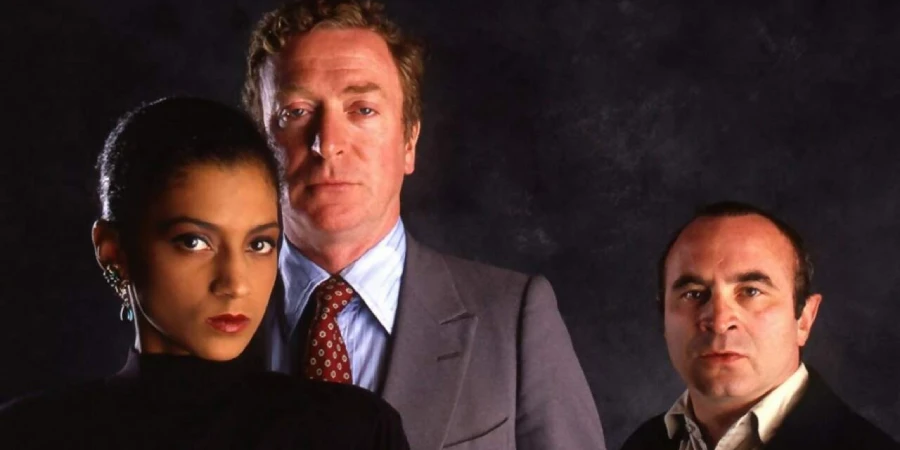

Neil Jordan’s Mona Lisa is a film that dresses itself up as a crime thriller and then quietly breaks your heart. Bob Hoskins delivers one of British cinema’s great performances as George, a small-time criminal thrust into the seedy world of London’s sex trade. The film moves between tenderness and brutality with unsettling ease. It is, at its core, a story about a man who falls in love with someone who will never love him back.
Detailed Summary
George Gets Out and Gets a Job
George walks out of prison after serving time for his boss, Denny Mortwell, a mid-level London gangster. He expects gratitude and a proper welcome; instead, Mortwell gives him a grudging, low-status job as a driver. George’s task is to chauffeur a high-end escort named Simone between hotel appointments in the West End.
George and Simone despise each other on sight. He is coarse, sentimental, and working-class; she is cool, guarded, and fiercely professional. However, a fragile working relationship slowly develops between them.
George Falls for Simone
As George drives Simone night after night, he grows deeply attached to her. He buys her gifts, defends her against clients, and begins to see himself as her protector. Simone, for her part, tolerates his affection without encouraging it.
Meanwhile, Simone asks George for a favour. She wants him to search the street prostitutes of King’s Cross for a young woman named Cathy, a girl she knew before her current life. George agrees, driven entirely by his feelings for Simone.
King’s Cross and the Search for Cathy
George plunges into the brutal world of King’s Cross, where very young women work under violent and exploitative conditions. He befriends a nervous, bookish young man named Thomas, who helps him navigate the area. George’s search is slow and dangerous.
He eventually finds Cathy, a teenage girl clearly traumatised and controlled by pimps connected to Mortwell’s operation. In addition, George discovers that the whole network of exploitation traces back to his own employer. This revelation forces him to confront the true nature of the world he has been loyally serving.
The Truth About Simone and Cathy
George arranges to get Cathy out of King’s Cross and brings her to Simone. At this point, the film delivers its gut-punch revelation: Simone and Cathy are lovers. Simone never wanted George romantically; she used his devotion as a tool to rescue the person she actually loves.
George is devastated. Everything he did, every risk he took, every tender feeling he nurtured, was built on a fantasy he constructed alone. Simone is not cold or cruel, but she is absolutely clear about what she wants, and it was never George.
Confrontation with Mortwell
Mortwell discovers that George has been working against his interests by helping Simone and extracting Cathy from his network. He sends men after George. The film escalates sharply into violence as George, Thomas, Simone, and Cathy try to stay ahead of Mortwell’s enforcers.
George confronts Mortwell directly. His anger is only partly about Mortwell’s crimes; it is also the rage of a man whose illusions have been destroyed. The confrontation is raw and physically brutal.



Movie Ending
George shoots Mortwell dead. It is a sudden, messy act of violence that feels more like emotional collapse than heroic justice. George has no real plan beyond stopping the man who threatened Simone and exposed the hollowness of his own loyalty.
Simone and Cathy escape together. George does not go with them; there is no place for him in their future. Consequently, the film ends on a quiet, aching note rather than a triumphant one. George is free from Mortwell, alive, and entirely alone.
He reconciles briefly with his teenage daughter, Jeannie, whom he had been estranged from since his imprisonment. His wife had moved on with another man, and his old life is gone. However, his relationship with Jeannie offers the smallest, most honest sliver of hope the film allows itself.
What makes this ending so powerful is its refusal to reward George for loving someone. He is a good man, in his flawed way, but goodness does not earn you the love you want. Jordan leaves him standing with almost nothing, except the one real relationship he had neglected all along: his daughter. It is heartbreaking and entirely honest.
Are There Post-Credits Scenes?
Mona Lisa contains no post-credits scenes. The film ends as it means to go on: quietly, without fanfare, and with no tidy resolution waiting around the corner.
Type of Movie
Mona Lisa is a neo-noir crime drama with strong romantic and tragic undertones. Its tone is melancholic and grounded, far closer to kitchen-sink realism than Hollywood glamour.
It belongs to a distinctly British tradition of crime films that prioritise character over plot mechanics. Notably, it also functions as a quiet tragedy about class, exploitation, and the pain of unrequited love.
Cast
- Bob Hoskins – George
- Michael Caine – Denny Mortwell
- Cathy Tyson – Simone
- Robbie Coltrane – Thomas
- Clarke Peters – Anderson
- Kate Hardie – Cathy
- Zoe Nathenson – Jeannie
Film Music and Composer
Michael Kamen composed the score for Mona Lisa. Kamen was a prolific composer who worked across film, rock, and orchestral music, and his work here is restrained and elegiac.
The film’s title song, the classic Mona Lisa as sung by Nat King Cole, plays a central thematic role. George is obsessed with the song, and it functions as an ironic mirror of his idealised, ultimately deluded view of Simone. In contrast, Kamen’s original underscore keeps things grounded and melancholic throughout.



Filming Locations
Mona Lisa shot primarily in London, using real locations across the city. King’s Cross, which in the mid-1980s was genuinely notorious for street prostitution and crime, features heavily and gives the film its raw, documentary-style credibility.
The West End hotel interiors and upscale London streets provide a stark visual contrast to King’s Cross. Jordan uses this geographic split deliberately, mapping the film’s class divisions directly onto London’s physical landscape. The city becomes a character in its own right.
Awards and Nominations
Bob Hoskins won the Best Actor award at the Cannes Film Festival in 1986 for his performance as George, sharing the prize. He also received an Academy Award nomination for Best Actor and a BAFTA nomination for Best Actor.
Cathy Tyson received a BAFTA nomination for Best Supporting Actress, a strong recognition for a remarkable debut performance. Michael Caine also received a BAFTA nomination for Best Supporting Actor. The film itself gained significant awards attention across the board.
Behind the Scenes Insights
- Bob Hoskins has spoken about how emotionally demanding the role of George was, describing the character’s loneliness as something he genuinely felt on set.
- Neil Jordan co-wrote the screenplay with novelist David Leland, and the two collaborated closely on developing George’s voice and emotional arc.
- Cathy Tyson made her film debut in Mona Lisa; Jordan cast her after seeing her stage work, and she more than justified his confidence.
- Michael Caine reportedly took the role of Mortwell partly because he wanted to work with Hoskins, whom he admired greatly.
- Jordan has described the film as a love story first and a crime film second, and that priority shows in every directorial decision he made.
- Shooting in King’s Cross at night required significant logistical coordination, given the area’s genuine dangers at the time.
Inspirations and References
Mona Lisa draws on the tradition of film noir, particularly the archetype of the male protagonist who projects romantic ideals onto a woman who neither shares nor wants them. George is, in many ways, a classic femme fatale victim, except Jordan treats him with genuine compassion rather than contempt.
The London criminal underworld depicted in the film connects to a broader tradition of British crime writing and filmmaking. David Leland brought his background as a playwright focused on working-class British life to the screenplay, grounding the story in social specificity. The Nat King Cole song provides a layer of popular cultural mythology that the film consciously subverts.
Alternate Endings and Deleted Scenes
No widely documented alternate endings or significant deleted scenes from Mona Lisa appear in the public record. Jordan and Leland’s screenplay was developed with a clear sense of where the story needed to land, and the final cut reflects that intention closely.
Book Adaptations and Differences
Mona Lisa is not based on a book. Neil Jordan and David Leland wrote the original screenplay specifically for the film. No source novel or prior literary property underlies the story.



Memorable Scenes and Quotes
Key Scenes
- George walking out of prison and receiving his tepid welcome from Mortwell, establishing immediately that nobody values his sacrifice.
- George and Simone’s first hostile car ride together, full of class friction and mutual contempt that slowly, quietly shifts.
- George searching King’s Cross at night, the film at its most uncomfortably realistic and visually stark.
- The revelation that Simone and Cathy are lovers, delivered with restraint, making it land harder than any dramatic outburst could.
- George shooting Mortwell, a sudden violent act that carries more grief than triumph.
- George’s final reconciliation with his daughter Jeannie, small and quiet and more emotionally resonant than anything else in the film.
Iconic Quotes
- “What kind of a man are you?” George asks this of himself as much as anyone else.
- Simone to George: “You don’t know anything about me.” A line that carries the whole tragedy of his delusion.
- George describing his feelings in his blunt, inarticulate way captures everything about a man who loves deeply but understands little.
Easter Eggs and Hidden Details
- The recurring use of the Nat King Cole song Mona Lisa mirrors the film’s central theme: a man obsessing over an image of a woman rather than the real person.
- George’s cheap, garish tie, which he wears with genuine pride, functions as a quiet visual symbol of his class position and his desperate desire for dignity.
- The contrast between the luxurious West End hotels and the King’s Cross streets is filmed with a deliberate color temperature shift, warmer tones for wealth, colder and harsher lighting for poverty.
- Thomas’s bookish, gentle nature and his genuine friendship with George stand as a subtle counterpoint to every other male relationship in the film, all of which involve exploitation or hierarchy.
Trivia
- Bob Hoskins won Best Actor at Cannes in 1986, one of the most celebrated performances in British film history.
- Cathy Tyson is the niece of Mersey-associated figures in Liverpool culture; her performance in this film launched her career.
- Robbie Coltrane, long before his Harry Potter fame as Hagrid, gives one of his warmest early film performances as Thomas.
- Neil Jordan had previously directed The Company of Wolves (1984); Mona Lisa marked a significant shift toward realism in his work.
- The film’s title was chosen partly for its ironic resonance: the Mona Lisa is a famous image of a woman whose inner life remains permanently unknowable, much like Simone to George.
- Michael Caine plays Mortwell with a quiet menace that makes him more frightening than any scenery-chewing villain; he reportedly kept his performance deliberately low-key.
Why Watch?
Bob Hoskins gives a performance here that stands among the finest in 1980s cinema, full of bruised tenderness and working-class dignity. Mona Lisa refuses easy resolutions and treats its subject matter, including exploitation, class, and longing, with unflinching honesty. Furthermore, it is a film that rewards repeat viewing, revealing new layers each time. Simply put, it is essential British cinema.
Director’s Other Movies
- Angel (1982)
- The Company of Wolves (1984)
- High Spirits (1988)
- We’re No Angels (1989)
- The Crying Game (1992)
- Interview with the Vampire (1994)
- Michael Collins (1996)
- The Butcher Boy (1997)
- In Dreams (1999)
- The End of the Affair (1999)
- Breakfast on Pluto (2005)
- Ondine (2009)
- Byzantium (2012)
Recommended Films for Fans
- The Long Good Friday (1980)
- Nil by Mouth (1997)
- Sexy Beast (2000)
- Croupier (1998)
- The Crying Game (1992)
- Chinatown (1974)
- Taxi Driver (1976)
- Klute (1971)
- Prick Up Your Ears (1987)