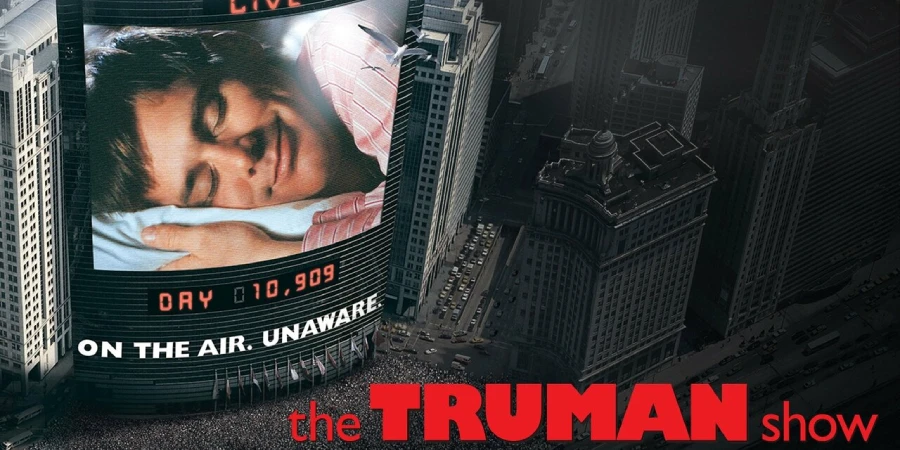

Every morning, Truman Burbank waves at his neighbors, buys his newspaper, and drives to work, all while 1.7 billion people watch him do it on live television. He has no idea.
Peter Weir’s 1998 film drops its audience into this absurdity from the very first frame, shooting Truman from hidden camera angles, letterboxed in odd aspect ratios, with light rigs visible above him in the sky. Jim Carrey plays it completely straight, and that choice is what makes the whole thing work.
Detailed Summary
Welcome to Seahaven
Truman Burbank lives in Seahaven Island, a picture-perfect coastal town full of cheerful neighbors, white picket fences, and suspiciously synchronized behavior. What he does not know is that Seahaven is an enormous television studio, the largest ever built, housed under a dome visible from space. Every person in his life, his wife, his best friend, his coworkers, are paid actors following scripts.
Christof, played by Ed Harris, created the show thirty years ago. He adopted Truman legally at birth, making him the first person in history to be adopted by a corporation. Christof watches from a control room built into an artificial moon hanging above the dome, directing the show in real time.
Cracks in the Facade
Strange things start happening. A studio light falls from the sky, labeled as an aircraft part in a phony radio bulletin. Truman notices that his street runs on a loop, the same jogger, the same dog, the same car passing every few minutes. Rain falls only on him, briefly, before the weather team corrects its targeting.
He also cannot leave Seahaven. A manufactured fear of water, implanted after the staged drowning death of his “father” in childhood, keeps him from sailing away. Every time Truman tries to travel, elaborate obstacles materialize: traffic jams, nuclear leak warnings, a sudden forest fire on the highway.
Sylvia and the Memory That Won’t Die
Years earlier, Truman fell for a woman named Lauren (later revealed as Sylvia, played by Natascha McElhone) before producers rushed her off the set. Before they dragged her away, she whispered the truth to him: everything is fake, everyone around him is an actor, and he is on television. Truman never fully forgot her.
His obsession with finding her drives much of the film’s emotional current. He collects magazine clippings and assembles her face from fragments. His real marriage to Meryl (Laura Linney) is hollow, a performance within a performance, and both Truman and the audience feel the deadness of it in every scene they share.
The Truth Breaks Through
Truman picks up radio interference in his car and hears the production crew narrating his own movements. He starts testing the world around him, taking unexpected routes, pretending to leave and doubling back, watching his neighbors scramble to reset. His friend Marlon (Noah Emmerich) delivers a tearful speech about the authenticity of their friendship, fed to him word for word through an earpiece by Christof.
That scene is one of the film’s most quietly devastating moments. Marlon weeps real-looking tears while lying through every syllable, and Truman hugs him, still half-trusting. Carrey plays the hug with visible tension in his shoulders, a man holding on to a friendship he already suspects is counterfeit.
The Escape Attempt
Truman fakes a breakdown, complete with a decoy lump under his bed blankets, and slips out during the night. Christof panics. For the first time in thirty years, Truman is off-camera, and the production loses him entirely. A full-scale search sweeps Seahaven, with actors playing concerned neighbors flooding the streets.
Truman is found on a small sailboat, pushing out toward the horizon despite his crippling fear. Christof orders the studio weather team to generate a violent storm, escalating it until the boat nearly capsizes. He comes close to killing Truman on live television before backing down. Truman keeps sailing.

Movie Ending
Truman’s boat punches through the painted sky at the edge of the dome. The bow of the sailboat literally breaks through the studio wall, a flat painted surface dressed to look like open ocean horizon. He climbs a set of stairs built into the dome’s interior edge and finds a door marked with a simple EXIT sign.
Christof speaks to him directly for the first time through the dome’s speaker system, his voice booming down from above like a god addressing a creation. He tells Truman he loves him, that the world outside is just as false as the one inside, and that Seahaven was built for Truman’s protection. Ed Harris delivers this monologue with genuine anguish, and it almost works as a defense. Almost.
Truman pauses. He gives his signature bow and his sign-off line, “Good morning, and in case I don’t see you, good afternoon, good evening, and good night,” then steps through the door and disappears into darkness. Audiences worldwide watching the show in the film cheer, then immediately reach for their remotes to find something else. It is a brutal little joke about the attention span of television viewers, and it lands perfectly.
What happens to Truman after he walks through that door? The film does not say, deliberately. Sylvia, watching from her apartment, bolts for the exit to find him in the real world. That image, a woman running toward a man she barely knows but chose to fight for, carries more weight than any dialogue could.
Are There Post-Credits Scenes?
No. The Truman Show has no post-credits scene. Weir closes on the image of that EXIT door swinging shut, and that is the end. Stay seated if you like, but the film has already said everything it wants to say.
Type of Movie
The Truman Show is a satirical drama with strong elements of science fiction and dark comedy. Its tone shifts constantly, sometimes deliberately funny in how absurdly fake Seahaven looks, sometimes genuinely sad as Truman realizes the depth of his imprisonment.
Genre labels feel slightly inadequate here. It is closer to a philosophical thriller than anything else: the suspense comes not from violence but from watching a man slowly piece together a reality-shattering truth.
Cast
- Jim Carrey – Truman Burbank
- Ed Harris – Christof
- Laura Linney – Meryl Burbank / Hannah Gill
- Noah Emmerich – Marlon / Louis
- Natascha McElhone – Sylvia / Lauren Garland
- Holland Taylor – Truman’s mother / Alanis Montclair
- Brian Delate – Truman’s father / Walter Moore
- Paul Giamatti – Simeon, a control room director
- Harry Shearer – Mike Michaelson, the show’s interviewer
Film Music and Composer
Burkhard Dallwitz composed the majority of the film’s score, working closely with Weir to find music that could pass as source music within the show-within-a-film conceit. Much of it sounds slightly too cheerful, too polished, which is exactly the point.
Weir also incorporated existing pieces by Philip Glass, pulling cues from Glass’s Powaqqatsi and other works. Glass’s minimalist, repetitive structures work brilliantly against Truman’s dawning awareness. Tracks like “The Truman Show: Overture” carry a rising, almost liturgical quality that matches the film’s themes of false worship and surveillance.
Casting Glass’s pre-existing work alongside Dallwitz’s new compositions was an inspired production decision. It gives the score a slightly fractured identity, which suits a film entirely about constructed realities.

Filming Locations
Almost all exterior shooting happened in Seaside, Florida, a planned community built in the 1980s on the Florida Panhandle. Seaside’s pastel-colored houses, identical front porches, and eerily clean streets were not dressed for the film; that is simply how the town looks. Weir chose it precisely because reality had already done the production designer’s job.
Seaside’s built-in unreality is the film’s sharpest casting decision, sharper than any actor choice. Walking through it feels faintly wrong even in photographs, which is exactly what the script needed. Since the film’s release, Seaside has become a tourist attraction partly because of The Truman Show.
Interior and control room scenes filmed on studio lots in Los Angeles. Christof’s moon-control room set, bathed in cool blue light, contrasts deliberately with Seahaven’s warm, golden color palette below.
Awards and Nominations
Ed Harris received an Academy Award nomination for Best Supporting Actor. Peter Weir received a nomination for Best Director. Andrew Niccol’s screenplay also received an Oscar nomination.
Jim Carrey won a Golden Globe Award for Best Actor in a Motion Picture Drama, one of the few times the Academy and the Globes pointed in very different directions on the same performance. The film also won a Saturn Award for Best Science Fiction Film.
Behind the Scenes Insights
- Jim Carrey lobbied hard for the role. At the time, studios were uncertain whether a comedian known for physical comedy could anchor a serious dramatic film, and his casting was considered a significant risk.
- Peter Weir insisted on shooting many scenes through surveillance-style camera angles, using long lenses from hidden positions to make Truman feel genuinely watched rather than simply described as watched.
- Ed Harris wore an earpiece throughout filming to receive direction from Weir in real time, a deliberate method choice that mirrored Christof directing his actors through earpieces on screen.
- Andrew Niccol wrote the original screenplay years before Weir came aboard, and earlier drafts were set in a much darker, more dystopian New York City rather than the sunny, sanitized Seahaven.
- Laura Linney prepared for her role by thinking of Meryl as an actor who has played the same character for so long she has forgotten where the role ends and she begins.
- The production had to negotiate with the actual residents of Seaside, Florida, many of whom continued living in their homes during filming.
Inspirations and References
Niccol and Weir have both cited reality television anxiety as a core inspiration, remarkable given that the film predates the modern reality TV explosion. Big Brother and Survivor both launched after 1998, making the film feel more prophetic than influenced.
Philosophical touchstones include Plato’s Allegory of the Cave, in which prisoners mistake shadows on a wall for reality, and Jean Baudrillard’s writing on simulacra and simulation. Baudrillard argued that modern media creates copies of reality with no original, a concept Seahaven literalizes completely.
Philip K. Dick’s paranoid fiction, particularly his recurring theme of characters discovering their world is manufactured, casts a long shadow over the film’s premise. Weir has acknowledged Dick’s influence on the broader cultural imagination that shaped the screenplay.
Alternate Endings and Deleted Scenes
Early drafts of Niccol’s screenplay reportedly contained a darker ending in which Truman’s fate after leaving the dome was shown more explicitly. Weir pushed for the ambiguous cut-to-black, believing that spelling out Truman’s next step would undermine the film’s central question about freedom.
Several deleted scenes expanded on the television audience’s relationship with the show, including extended sequences of viewers watching from bars, hospitals, and living rooms. Weir trimmed much of this material because he felt it lectured the audience about its own complicity rather than letting them feel it.
That editing choice was correct. The audience-watching sequences that survived in the final cut are brief and precise, and they sting more for their economy.
Book Adaptations and Differences
The Truman Show is not based on a book. Andrew Niccol wrote an original screenplay. No novelization of the film has been published in any form that holds significant cultural standing.


Memorable Scenes and Quotes
Key Scenes
- The studio light falling from the sky in the opening minutes, crashing onto the road in front of Truman as a radio announcer scrambles to explain it as aircraft debris.
- Truman catching his car radio accidentally broadcasting a crew member narrating his movements, with Carrey’s face shifting from confusion to cold, silent dread.
- Marlon’s scripted-but-tearful speech about friendship on the bridge at night, delivered into Truman’s ear by Christof while Truman stands on the verge of total breakdown.
- Truman walking into the ocean during a family trip, testing his fear of water while Christof watches in near-panic from the control room.
- The sailboat breaking through the painted horizon wall, one of the most quietly extraordinary images in 1990s studio filmmaking.
- Christof speaking to Truman through the dome speakers, his disembodied voice filling the sky like a deity addressing a mortal.
- Truman’s final bow and sign-off before stepping through the EXIT door.
Iconic Quotes
- “Good morning, and in case I don’t see you, good afternoon, good evening, and good night.” – Truman Burbank
- “We accept the reality of the world with which we are presented.” – Christof
- “You were real. That’s what made you so good to watch.” – Christof
- “Say something. Say something. You’re on television. You’re live to the whole world.” – Christof to Truman at the dome wall
Easter Eggs and Hidden Details
- Truman’s name is a portmanteau: True Man, the only genuine person in a world full of performers.
- His wife Meryl constantly performs product placement for items in their home, holding up packages toward unspecified cameras. It reads as a joke early in the film, then becomes sinister once the full picture is clear.
- Seahaven’s street names and layout reference classic American suburban idealism. Nothing is accidental; the set designers built the town’s fictional history as well as its physical appearance.
- Christof’s control room is shaped like an eye from certain overhead angles, a visual nod to constant surveillance.
- The film-within-the-film’s in-universe title card reads “The Truman Show: Episode 10,909,” which corresponds precisely to the number of days since Truman’s birth on the date the story takes place.
- Extras in Seahaven repeat the same behavioral loops. Sharp-eyed viewers can spot the same background characters reappearing on identical paths in different scenes set on the same street.
- The show’s logo features a stylized eye, reinforcing the Orwellian surveillance thread running through the film’s visual design.
Trivia
- Seaside, Florida was only about fifteen years old when filming began, so the town’s architecture was in pristine, almost unreal condition, requiring almost no dressing from the production design team.
- Jim Carrey’s performance shifted significantly during production. Early scenes shot later in the schedule reportedly show a more subdued Carrey than scenes shot earlier, as he settled deeper into the dramatic register.
- Peter Weir had previously directed Dead Poets Society and Witness, giving him a reputation for humanist dramas, which partly explains why he could extract a genuine dramatic performance from Carrey.
- The film’s release predated widespread public internet use and social media, yet its predictions about surveillance culture and public appetite for voyeuristic entertainment proved remarkably accurate.
- Paul Giamatti appears in a small role as a control room director, years before his own star-making dramatic work.
- Weir used over a hundred hidden camera setups throughout Seaside to achieve the surveillance aesthetic, making it one of the most technically complex location shoots of its era.
Why Watch?
Jim Carrey walks through this film with a tightness around his eyes that he never showed in his comedy work, a constant, low-grade alertness that slowly becomes recognizable as existential terror. Watching him piece together his own imprisonment one tiny clue at a time, without dialogue spelling it out, is a clinic in physical acting. That performance alone justifies two hours of your life.
Director’s Other Movies
- Picnic at Hanging Rock (1975)
- Gallipoli (1981)
- The Year of Living Dangerously (1982)
- Witness (1985)
- Dead Poets Society (1989)
- Green Card (1990)
- Fearless (1993)
- Master and Commander: The Far Side of the World (2003)