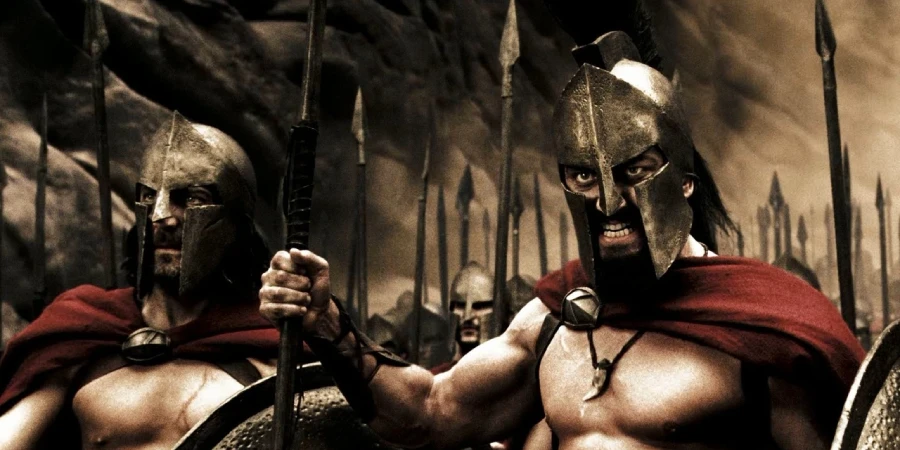

Three hundred Spartans held a mountain pass against an empire, and Zack Snyder shot every frame of it like a painting soaked in blood and gold. 300 arrived in 2006 with a visual style so committed to its own excess that critics either worshipped it or wrote it off as a two-hour cologne advertisement.
Snyder and cinematographer Larry Fong desaturated nearly everything except the reds, the flesh tones, and the fire, a choice that turns each battle scene into something closer to a stained-glass window than a war movie. This is a film worth arguing about, and arguing about it is half the fun.
Detailed Summary
The Birth and Childhood of Leonidas
We open on the agoge, Sparta’s brutal training system for male children. A narrator, Dilios, tells us that Leonidas was born into this world and shaped by it from infancy. He survives exposure as a newborn because Spartan elders judge him physically fit, and that single detail sets the film’s philosophy in motion: Sparta does not nurture weakness.
Young Leonidas trains alone in the wild, ultimately killing a giant wolf in the snow with nothing but a spear and a wall of rock to funnel the animal. He does not simply survive the trial; he exploits geography. That instinct becomes the core of his military strategy later in the film.
Xerxes Sends His Messenger
Leonidas, now king and played by Gerard Butler with a beard and a permanent scowl of joyful contempt, receives a Persian messenger at Sparta’s gates. Xerxes demands earth and water, the traditional tokens of submission. Leonidas and his queen, Gorgo, exchange a look that says everything: this conversation ends badly for the messenger.
Leonidas kicks the messenger into a massive pit, and several other soldiers follow suit with the rest of the Persian entourage. It is a wildly theatrical moment, and Butler delivers the “This is Sparta!” line with such complete physical commitment that the scene survives its own meme status. Kicking diplomats into a well is technically a war crime, and the film knows it; Dilios narrates it like Sparta scored a touchdown.
The Oracle and the Ephors
Leonidas wants to march to war, but Spartan law requires him to consult the Ephors first. These are grotesque, diseased old priests who interpret the Oracle’s prophecies. A beautiful young woman, drugged and swaying above a chasm, delivers an ambiguous message that the Ephors translate as: do not march during the Carneia festival.
Leonidas clearly suspects the Ephors are on Xerxes’ payroll, a suspicion the film later confirms through the character of Theron. He cannot legally march his army. So he takes three hundred of his personal bodyguard, frames it as a walk rather than a war campaign, and heads for Thermopylae anyway. It is a brilliant bit of political maneuvering dressed up as stubbornness.
The March to Thermopylae
On the road north, the Spartans encounter survivors from the village of Arcadia, a man named Daxos among them. These Arcadians join the march, swelling the numbers, though the film makes clear that Leonidas views their presence as supplementary at best. He surveys the pass at Thermopylae and recognizes the same wolf-funnel logic from his youth: narrow ground negates numerical advantage.
We also get our first real showcase of the Spartan phalanx. Bronze shields overlap, spears thrust in coordinated bursts, and the slow-motion photography makes each sequence feel rhythmic rather than chaotic. Snyder’s slow-then-fast editing style is at its most expressive here, and if you find it gimmicky, you will hate this movie; if it clicks for you, almost nothing else looks like it.
First Waves of Battle
Xerxes sends wave after wave of Persian soldiers into the Hot Gates, and the Spartans dismantle them methodically. Bodies pile into a wall. Captain, the father of a young Spartan named Astinos, fights alongside his son with quiet ferocity. The Arcadians contribute meaningfully, and the Greeks hold.
Xerxes then sends his Immortals, his elite troops behind golden masks. Leonidas’s men crack those masks and find mortal men underneath. The symbolic point is obvious but it lands anyway, because Butler’s face does most of the work: he grins at the Immortals like a man who just proved something he already knew.
Xerxes Meets Leonidas
Xerxes himself descends from his enormous golden throne-on-wheels to speak with Leonidas one-on-one. Rodrigo Santoro plays Xerxes as a nine-foot god-king draped in chains and gold body paint, whispering softly in a voice that sounds like it was recorded inside a cathedral. He offers Leonidas wealth, a kingdom, anything, in exchange for a simple bow of submission.
Leonidas refuses, of course. He even gets a small dig in about Xerxes’ throne requiring steps, while a Spartan king kneels for no one. It is the film’s sharpest political moment: two men with absolute power negotiating over the concept of dignity itself.
Ephialtes and the Betrayal
A deformed Spartan outcast named Ephialtes approaches Leonidas and offers his service. He wants to fight alongside his people. Leonidas gives him an honest and genuinely painful answer: Ephialtes cannot raise his shield high enough to maintain the integrity of the phalanx wall, and one gap kills everyone. He offers him a support role. Ephialtes refuses, bitter and humiliated.
Ephialtes goes straight to Xerxes and reveals the mountain goat path that bypasses Thermopylae entirely. In exchange, Xerxes dresses him in the armor of an Immortal and gives him access to the Persians’ pleasure tent. It is a grubby, human betrayal, motivated less by ideology than by wounded pride and desire for belonging.
The Death of Astinos and the Captain’s Grief
Astinos, the Captain’s son, dies in combat. His father holds the boy’s severed head and then returns to the battle line. David Wenham as Dilios narrates this moment with restrained weight, and the Captain’s grief is conveyed almost entirely through posture rather than dialogue. It is the film’s most emotionally honest beat, partly because it refuses to slow down for sentiment.
Gorgo’s Political Battle in Sparta
Back in Sparta, Queen Gorgo works to secure political support for Leonidas’s campaign. A councillor named Theron promises to speak on her behalf in the assembly, but demands sex as his price. Lena Headey plays Gorgo with a composure that makes the scene genuinely uncomfortable; she agrees, she endures it, and she gets nothing from him anyway. Theron stands before the council and advocates for Persian submission instead.
Gorgo takes action herself. She addresses the council directly, which is unusual for a Spartan woman. When Theron publicly accuses her of lying, she draws a hidden blade and kills him on the council floor. Persian gold coins spill from his robes, confirming his treachery to every witness in the room. It is a sharp piece of plotting, and Headey sells the quiet fury behind the act.
The Final Stand
Word reaches Leonidas that the Persians have taken the mountain path and now surround the Greeks. Leonidas dismisses most of the allied Greek forces, sending them home, because their survival serves Greece better than their deaths do. He keeps his three hundred Spartans and a small group of Thespians and Thebans who choose to remain.
Leonidas delivers no grand speech. He simply looks at his men, and they form up. The Persians close in from all directions. Xerxes watches from a hillside as his archers darken the sky with arrows. Leonidas takes several arrows to the chest and drops to one knee. In that kneeling position, he becomes the one thing Xerxes wanted: a Spartan on his knees. He then reaches back and hurls his spear toward Xerxes, cutting the god-king’s cheek.
That wound matters. It bleeds. Xerxes is not a god. Then the arrows come in their thousands, and Leonidas and his three hundred die together.

Movie Ending
Dilios delivers the ending as a speech, not as a scene, and that choice is genuinely smart. We are watching a war story told around a fire, told with embellishment and myth built in from the start. When the battle narration reaches its peak, we realize Dilios lost an eye at Thermopylae and Leonidas personally sent him home to carry the story to Sparta. His survival was always the point.
One year after Thermopylae, Dilios stands before a Greek army of thirty thousand at the Battle of Plataea. He finishes the story of the three hundred to the assembled soldiers. Their reaction is electric: roaring, weapon-beating, worked into a fury. Dilios then leads the charge himself, his narration becoming a battle cry.
Snyder cuts to slow-motion as the Greeks crash into the Persian lines. It mirrors the opening battles in composition and color, and the symmetry is entirely intentional. What Leonidas bought with three hundred lives was time, specifically the time for Greece to unite and field a real army. The film argues that the death was not a defeat but a recruitment tool.
Gorgo’s final moment is a quiet look directly into the camera before the credits roll. Headey holds it for just a second, and it communicates grief, satisfaction, and something else that resists labeling. It is the film’s most understated shot, and it earns everything that came before it.
Are There Post-Credits Scenes?
300 has no post-credits scene. Once the final images run and Gorgo’s face fades to black, it is done. There is nothing to wait for. You can leave when the credits start.
Type of Movie
300 is a historical action epic with heavy doses of fantasy. It is not a documentary-style war film; it openly embraces mythology and exaggeration as part of its storytelling DNA. The tone swings between battle euphoria and political tragedy, with enough stylized violence to push a hard R rating throughout.
Thematically, the film circles around sacrifice, political corruption, and the weaponization of a story after the fact. It is also, unavoidably, a film about bodies: who gets to have one, who gets to control one, and what it means when a society builds its entire culture around physical perfection.
Cast
- Gerard Butler – King Leonidas
- Lena Headey – Queen Gorgo
- David Wenham – Dilios
- Dominic West – Theron
- Rodrigo Santoro – Xerxes
- Vincent Regan – Captain
- Andrew Tiernan – Ephialtes
- Tom Wisdom – Astinos
- Michael Fassbender – Stelios
- Peter Mensah – Persian Messenger
Film Music and Composer
Tyler Bates composed the score for 300. His approach leans heavily on distorted electric guitar layered beneath orchestral percussion, a combination that gave the film a sound unlike any period epic before it. The result feels less like a classical score and more like a metal album that stumbled into ancient Greece.
Tracks like Returns a King became closely associated with the film’s aesthetic and appeared in countless trailers and sports broadcasts in the years that followed. Bates’s score was controversial partly because some cues shared similarities with earlier compositions by other artists, a matter that generated some legal discussion at the time, though the film’s commercial momentum was unstoppable regardless.


Filming Locations
300 was shot almost entirely on soundstages in Montreal, Canada, using extensive green screen and digital backgrounds. Very little of the film involved actual outdoor locations. That choice was not just a budget decision; it was a deliberate artistic one, because Snyder wanted the world to look like Frank Miller’s painted panels rather than a real landscape.
The digital environments gave the production total control over color and atmosphere. Skies could be perpetually stormy or blood-orange on command. Rock formations could be sculpted to exact compositions. A real location would have introduced naturalism the film was actively trying to avoid.
Awards and Nominations
300 was a massive commercial success but did not attract significant attention from major awards bodies like the Academy Awards. It picked up recognition primarily from the MTV Movie Awards and genre-focused ceremonies, where Butler and the film’s visual style were celebrated. The awards establishment largely ignored it, which tells you more about those institutions’ relationship with genre filmmaking than it does about the film’s craft.
Behind the Scenes Insights
- Gerard Butler and the cast underwent an intense physical training program for months before shooting began. The goal was not just aesthetics; Snyder wanted the soldiers to move with genuine physical authority on camera.
- Zack Snyder had previously directed the Dawn of the Dead remake and came to 300 as a relatively unknown director. This film launched him into the studio blockbuster world almost overnight.
- Rodrigo Santoro wore extensive prosthetic enhancements, gold body paint, and was digitally heightened in post-production to create Xerxes’s inhuman scale on screen.
- Michael Fassbender, playing Stelios, was still largely unknown at the time. His physicality and screen presence in 300 contributed to the wave of attention that eventually led to larger roles.
- Frank Miller visited the set during production and gave Snyder his approval of the adaptation approach, which was important to the director given how closely the film follows Miller’s visual compositions.
- The film shot almost entirely out of sequence because each battle scene was treated as a self-contained visual set piece rather than part of a continuous flow.
Inspirations and References
The film adapts Frank Miller and Lynn Varley’s 1998 graphic novel of the same name. Miller’s book was itself inspired by the 1962 film The 300 Spartans, which Miller saw as a child and credits as a formative influence on his visual storytelling. The comic’s painted color style, fragmented panel layouts, and mythologized retelling of the Battle of Thermopylae in 480 BC gave Snyder a complete visual and narrative blueprint.
Historically, the battle involved King Leonidas I of Sparta leading a coalition of Greek city-states against the Persian invasion of Xerxes I. The story of a small force holding a pass against a vastly larger army has existed in Greek historical accounts, primarily those of Herodotus. Miller and Snyder amplify the mythological dimensions considerably, trading historical accuracy for symbolic weight.
Alternate Endings and Deleted Scenes
No significantly documented alternate ending exists in the public record for 300. Snyder’s visual approach left relatively little room for tonal variation at the conclusion; the structure of the graphic novel kept the ending on a fixed track from early in production.
Some deleted and extended scenes appeared on home video releases, primarily involving additional material from the Spartan training sequences and extended glimpses of the Persian camp. None of these dramatically alter the film’s narrative or change character outcomes. They function as texture rather than revision.
Book Adaptations and Differences
300 adapts Frank Miller and Lynn Varley’s graphic novel 300, published by Dark Horse Comics in 1998. Snyder’s adaptation is notably faithful in its visual grammar: individual panels from the comic served as direct storyboards for specific shots in the film. The desaturated color palette, the silhouetted figures against orange skies, the muscular linework in the compositions, all of it maps directly onto Miller’s painted pages.
The most significant addition the film makes is the subplot involving Queen Gorgo and the political machinations in Sparta, including Theron’s treachery. This material does not appear in Miller’s original comic, which focuses almost entirely on the battle itself. Screenwriters Snyder, Kurt Johnstad, and Michael B. Gordon added Gorgo’s storyline to give the film a parallel narrative thread and some female presence in a story otherwise dominated by male warriors.
Miller’s comic is also somewhat more blunt in its idealization of Spartan values, without the slight political self-awareness the film occasionally deploys. The film’s framing device, Dilios as unreliable narrator constructing a myth, adds a layer of meta-commentary that the comic does not emphasize to the same degree.

Memorable Scenes and Quotes
Key Scenes
- The pit kick: Leonidas boots the Persian messenger into the well while delivering his most quoted line. Butler plants his foot, leans back, and lets his whole body generate the throw. The messenger falls in slow motion. Pure cinema spectacle with zero subtlety, and it works completely.
- Leonidas vs. the wolf: Young Leonidas traps the wolf in a rocky crevice and drives the spear home. Snow, silence, and a boy’s ragged breathing. It establishes everything about his tactical mind in under two minutes.
- Xerxes’s offer: The two kings face each other on open ground. Xerxes speaks softly and leans close, almost intimate. Leonidas stands rigid, smaller in frame but immovable. The scene carries more tension than any battle sequence in the film.
- The Immortals unmasked: Leonidas splits an Immortal’s golden mask with a sword stroke to reveal a scarred, mortal face beneath. His grin says the battle just changed psychologically.
- Gorgo kills Theron: In the Spartan council chamber, she draws a hidden blade and drives it into Theron. Persian coins scatter across the stone floor. The council goes silent. Headey does not look triumphant; she looks exhausted and correct.
- Leonidas takes the arrows: He kneels in the final barrage, bristling with Persian arrows, and with the last of his strength launches his spear toward Xerxes. The cut of the god-king’s cheek is a tiny wound that the film treats as a seismic event.
Iconic Quotes
- “This is Sparta!” (Leonidas, before kicking the messenger)
- “Spartans! Ready your breakfast and eat hearty, for tonight we dine in hell!” (Leonidas)
- “A Spartan’s true strength is the warrior next to him.” (Leonidas)
- “The world will know that free men stood against a tyrant.” (Leonidas)
- “Come back with your shield, or on it.” (Gorgo, to Leonidas before his departure)
- “Give them nothing! But take from them everything!” (Leonidas)
Easter Eggs and Hidden Details
- Snyder directly replicated specific panels from Miller’s comic as shot compositions. Viewers who own the graphic novel can pause the film and match frames almost exactly to Miller’s painted pages.
- The wolf Leonidas kills in the prologue reappears symbolically: the cloak he wears throughout the film is wolf fur, a visual callback that grounds his leadership in personal history rather than inherited title.
- Dilios is missing his eye for the final battle sequence. Leonidas ordered him home specifically because of that wound, making Dilios’s survival and storytelling ability the intended outcome of that injury rather than an unfortunate side effect.
- Ephialtes wears Immortal armor in the final battle, placing him visually among the enemy force in the wide shots. Sharp-eyed viewers can spot him before the film formally acknowledges his presence on the Persian side.
- The Persian army’s visual design includes war elephants, rhinos, and other exotic creatures pulled from the Miller comic. Their presence is a deliberate exaggeration of Persian military power as filtered through Greek oral tradition, not historical record.
Trivia
- 300 grossed over 450 million dollars worldwide against a production budget reported to be in the range of 65 million dollars, making it one of the most profitable films of 2007 relative to its cost.
- The film’s visual effects team processed nearly every frame through digital color grading, removing the natural green of the Montreal studio environments and replacing them with the film’s signature rust-and-gold palette.
- Butler trained so intensively for the role that cast and crew nicknamed the workout regimen the “300 workout.” It subsequently became a popular fitness program outside the film industry.
- Snyder pitched the project to Warner Bros. with footage from a test shoot, essentially a short proof-of-concept film demonstrating the visual approach. That footage convinced the studio to greenlight the full production.
- Andrew Tiernan, who plays Ephialtes, performed in extensive prosthetic makeup for every day of shooting. The transformation took several hours each morning.
- The film popularized the use of the speed ramping technique, the rapid shift between slow and normal motion during action sequences, to a degree that influenced action filmmaking for years after its release.
- A sequel, 300: Rise of an Empire, was released in 2014, directed by Noam Murro with Snyder as a producer. It focused on the naval Battle of Salamis and brought back Lena Headey as Gorgo.
Why Watch?
No film of this era committed so completely to a single aesthetic vision with so little apology for doing so. Snyder and Fong built every frame around the Frank Miller source material and refused to soften it for mainstream palatability. Butler’s physical performance carries genuine weight, especially in the quieter scenes opposite Headey, and the Gorgo storyline gives the film a political intelligence the trailers never advertised.
Director’s Other Movies
- Dawn of the Dead (2004)
- Watchmen (2009)
- Sucker Punch (2011)
- Man of Steel (2013)
- Batman v Superman: Dawn of Justice (2016)
- Justice League (2017)
- Army of the Dead (2021)
- Zack Snyder’s Justice League (2021)
- Rebel Moon (2023)
Recommended Films for Fans
- The Odyssey (2026)
- Gladiator (2000)
- Gladiator II (2024)
- Troy (2004)
- Sin City (2005)
- Alexander (2004)
- Braveheart (1995)
- The Last Samurai (2003)
- 300: Rise of an Empire (2014)
- Pathfinder (2007)