Black-and-white cinematography with sudden arterial sprays of red blood: that visual choice alone tells you exactly what Robert Rodriguez and Frank Miller were building with Sin City. Shot almost entirely against green screen on digital cameras, this 2005 anthology crime film pushed Hollywood into genuinely uncharted territory for mainstream releases. Four overlapping stories play out across Basin City, a place so corrupt that the cops, the politicians, and the priests are all on the same payroll. Nobody is innocent here, and Rodriguez never pretends otherwise.
Detailed Summary
The Salesman: The Prologue
A tuxedoed man identified only as “The Salesman,” played by Josh Hartnett, meets a beautiful woman on a rain-soaked balcony. He shoots her, tells her she is safe now, and cradles her as she dies. It is a cold, strange opening, and it works precisely because Rodriguez refuses to explain it immediately.
This short vignette returns at the film’s end, bookending the entire experience. Rodriguez uses it as a structural frame, a reminder that violence in Basin City can wear a tuxedo and speak softly.
The Hard Goodbye: Marv’s Story
Marv, played by Mickey Rourke under heavy prosthetics, wakes up next to a dead woman named Goldie. He did not kill her. Someone set him up, and now the police are coming. What follows is a brutal revenge odyssey driven entirely by the fact that, for one night, a beautiful woman was kind to Marv.
Marv tears through the city with single-minded ferocity. He brutalizes a corrupt cop named Bob, tracks down his parole officer Lucille (Carla Gugino), and pieces together a conspiracy leading to Cardinal Roark and a cannibal serial killer named Kevin.
Kevin, played by Elijah Wood in a genuinely unsettling piece of casting, never speaks. He moves like something that should not exist, and his silence makes him far more frightening than any screaming villain. Watching Elijah Wood eat a sandwich with dead eyes while Marv explains what he is going to do to him is the film’s most quietly disturbing beat.
Marv kills Kevin slowly, lets a wolf eat him piece by piece, then severs Cardinal Roark’s limbs before delivering a speech about God. He gets caught, survives an electric chair once because his body refuses to die, and goes back for a second round. Rourke plays the final execution with a resigned grin that lands harder than any heroic death speech could.
The Big Fat Kill: Dwight’s Story
Dwight McCarthy, played by Clive Owen, tries to protect Shellie from her abusive ex, a cop named Jackie Boy played by Benicio del Toro. Jackie Boy and his crew head into Old Town, the prostitute-controlled district of Basin City. Dwight follows them.
Gail, played by Rosario Dawson, and the women of Old Town kill Jackie Boy before Dwight can stop them. When Dwight discovers Jackie Boy’s police badge, the problem explodes: killing a cop, even a dirty one, would give the mob an excuse to retake Old Town.
Dwight dumps the heads in a tar pit, but a Rourke-voiced Jackie Boy keeps taunting him from the passenger seat during one of the film’s most darkly comic sequences. Del Toro clearly relished every second of playing a disembodied severed head delivering one-liners.
A mercenary named Manute (Michael Clarke Duncan) recovers the head from the tar pit. A firefight erupts. Miho, the silent assassin of Old Town played by Devon Aoki, dismantles soldiers with a speed that makes the action feel closer to ballet than gunfight. Old Town survives, the truce holds, and Dwight walks away alive.
That Yellow Bastard: Hartigan’s Story
John Hartigan, a cop with a bad heart played by Bruce Willis, saves an eight-year-old girl named Nancy Callahan from Roark Junior, a sadistic senator’s son. Hartigan shoots Roark Junior’s ear off and then removes something more significant. He saves Nancy. Then his corrupt partner shoots him in the back.
Eight years pass. Hartigan takes the fall and goes to prison to keep Nancy safe, sending her letters and receiving hers in return. When the letters stop, he makes a deal and leaves prison, intending to find her. He tracks her to a strip club where she performs.
Nancy Callahan, now played by Jessica Alba, has grown into a woman. She is alive and fierce, and Alba plays her warmth against the film’s relentless darkness with genuine conviction. The reunion between Hartigan and Nancy carries real weight, and it is one of the few moments in the film that feels emotionally unguarded.
Roark Junior returns, rebuilt by his father’s money into a grotesque yellow-skinned monster now called Yellow Bastard. He kidnaps Nancy, and Hartigan pursues. Hartigan kills the Yellow Bastard, tearing him apart with his bare hands in a scene shot in cold yellow tones against black that makes the violence feel like a fever dream.
Movie Ending
Hartigan knows Senator Roark will never stop coming for Nancy. His heart is failing. His options have collapsed to one. He shoots himself in the head beside Nancy’s car, making sure she cannot sacrifice herself or be used against him again. Willis plays the final scene with quiet exhaustion rather than melodrama, and it hits harder for that restraint.
The film cuts back to the Salesman prologue, completing the frame. That tuxedoed killer cradles his victim, and we understand now that Basin City offers no clean exits. Everyone who survives does so on borrowed time, and everyone who dies does so on their own terms or someone else’s.
Marv’s story also ends in execution, and that double death note gives Sin City a cumulative weight that a single narrative could not achieve. Both Hartigan and Marv choose their deaths. That detail separates them from every other character in the film, and Rodriguez lingers on it just long enough to register before cutting to black.
Are There Post-Credits Scenes?
Sin City has no post-credits scene. Rodriguez and Miller end the film cleanly on the final frame of the Salesman sequence. You can leave when the credits roll.
Type of Movie
Sin City is a neo-noir anthology crime film with heavy stylized action and horror elements. Its tone sits somewhere between hard-boiled pulp fiction and Grand Guignol nightmare, shot through with pitch-black humor.
Rodriguez leans fully into expressionism rather than realism. Colors carry meaning rather than depict reality. Rain always falls. Shadows eat half of every frame. Call it graphic novel noir and you are close.
Cast
- Bruce Willis – John Hartigan
- Mickey Rourke – Marv
- Clive Owen – Dwight McCarthy
- Jessica Alba – Nancy Callahan
- Rosario Dawson – Gail
- Benicio del Toro – Jackie Boy
- Elijah Wood – Kevin
- Nick Stahl – Roark Junior / Yellow Bastard
- Michael Clarke Duncan – Manute
- Brittany Murphy – Shellie
- Devon Aoki – Miho
- Carla Gugino – Lucille
- Michael Madsen – Bob
- Josh Hartnett – The Salesman
- Powers Boothe – Senator Roark
Film Music and Composer
Robert Rodriguez composed and produced the score himself, which is entirely consistent with his obsessive auteur approach to filmmaking. He has scored several of his own films, treating music as another instrument of directorial control rather than something to hand off.
The score blends jazz, blues, and percussive industrial noise. It suits the rain-drenched streets perfectly. Rodriguez also incorporated music from Graeme Revell, who contributed additional compositions to support specific sequences in the film.
Filming Locations
Sin City was shot almost entirely at Troublemaker Studios in Austin, Texas, against green screen and blue screen backdrops. Rodriguez used this controlled environment to digitally reconstruct Frank Miller’s panel compositions with precision impossible on location.
Shooting on digital rather than film gave Rodriguez direct control over contrast and color grading in real time. Basin City is not a real place, and shooting on a real street would have undermined the entire visual philosophy of the project.
A handful of practical location elements appear in specific scenes, but the overwhelming majority of what you see on screen is a digital construction. That artificiality is the point. Rodriguez wanted a city that could only exist in ink and pixels.
Awards and Nominations
Sin City won the Jury Prize at the 2005 Cannes Film Festival, a recognition that legitimized the film’s artistic ambition in circles beyond the genre crowd. Rodriguez and Miller accepted the honor together.
The film also received nominations from the Saturn Awards, the MTV Movie Awards, and various critics circles. Mickey Rourke’s performance as Marv drew particular attention, though major acting nominations from the top guilds did not follow.
Behind the Scenes Insights
- Rodriguez shot a test scene of Frank Miller’s work to convince him to sign over the rights. Miller had refused every prior adaptation offer and had never seen his graphic novels transferred to screen in a way he respected.
- Rodriguez resigned from the Directors Guild of America so he could give Miller a co-director credit. Guild rules prohibited sharing the directing credit with a non-member. Rodriguez considered Miller’s visual contribution too significant to bury in an “adapted from” line.
- Mickey Rourke wore heavy prosthetic makeup as Marv and worked closely with Rodriguez to physicalize the character beyond what the appliances alone could achieve. Rourke later called the role a turning point in his career comeback.
- Elijah Wood took the role of Kevin specifically because of how different it was from Frodo Baggins. He wanted silence, menace, and zero dialogue. He got all three.
- Rodriguez shot the entire film digitally, one of the earliest major mainstream productions to do so at that scale.
- Quentin Tarantino directed one scene as a guest director for a single day, receiving a “special guest director” credit rather than a standard co-director credit.
- Benicio del Toro improvised several of his Jackie Boy lines, particularly during the dead-head sequences in the car with Clive Owen.
Inspirations and References
Sin City draws directly from Frank Miller’s graphic novel series of the same name, published by Dark Horse Comics beginning in 1991. Miller’s books were themselves indebted to hard-boiled crime fiction, specifically the novels of Mickey Spillane and Raymond Chandler.
Film noir from the 1940s and 1950s sits underneath everything: the voiceover narration, the femme fatales, the corrupt institutions. Rodriguez and Miller pushed those conventions into grotesque exaggeration rather than restrained homage.
German Expressionist cinema influenced the extreme contrast between black and white, the menacing shadows, and the use of distorted space to reflect psychological states. Fritz Lang’s work is a reasonable reference point for the visual geometry Rodriguez constructed digitally.
Alternate Endings and Deleted Scenes
No widely documented alternate endings exist for Sin City. Rodriguez followed Miller’s source material closely enough that major structural divergences were unlikely from the start.
Some extended and deleted scenes appeared on home video releases. These scenes largely expand existing sequences rather than introduce new narrative threads. Nothing cut from the film contradicts or significantly alters any of the three main stories.
Book Adaptations and Differences
Sin City adapts three volumes of Frank Miller’s graphic novel series: The Hard Goodbye, The Big Fat Kill, and That Yellow Bastard. Rodriguez famously shot directly from Miller’s panels, using them as storyboards frame by frame.
The fidelity is extraordinary by adaptation standards. Most scenes, compositions, and even voiceover lines come straight from the page. Rodriguez added the Salesman prologue as a structural device, drawing from a shorter Miller piece to frame the anthology.
Miller’s original coloring choices were largely monochromatic with selective color highlights, and the film preserves this. Yellow Bastard’s yellow skin, Goldie’s golden hair, and the red arterial blood all appear in the books before they appeared on screen.

Memorable Scenes and Quotes
Key Scenes
- Marv’s second execution scene: the chair fails once, Marv cracks a joke, and the guards come back with more voltage. Rourke grins through the second attempt.
- Kevin’s death: Marv feeds him to a wolf piece by piece, then holds Kevin’s severed head up so he can watch the wolf finish the meal. Shot in near-silence, which makes it worse.
- Dwight driving with Jackie Boy’s severed head in the passenger seat, the head voiced by Benicio del Toro offering cheerful commentary on Dwight’s terrible decisions.
- Miho’s entrance during the Old Town firefight: Devon Aoki drops from above, cuts through a row of soldiers with a katana, and Rodriguez cuts the sequence in tight bursts of white-on-black impact frames.
- Hartigan’s suicide beside Nancy’s car: Willis turns away from the camera, the gunshot happens off-screen, and the film holds on the empty street before cutting away.
- The opening balcony scene: Hartnett’s Salesman cradles a dying woman in the rain and tells her she is safe, his white tuxedo catching the only warm light in the frame.
Iconic Quotes
- “I love hitmen. No matter what you do to them, you don’t feel bad.” (The Salesman)
- “Walk down the right back alley in Sin City and you can find anything.” (Dwight)
- “An old man dies, a young woman lives. Fair trade.” (Hartigan)
- “The night’s as dark as it gets, and I’m ankle deep in the soup.” (Marv)
Easter Eggs and Hidden Details
- The same Basin City geography connects all three stories. Characters from one segment appear briefly in the background of another, placing all the events in roughly the same timeframe and neighborhood.
- Frank Miller himself appears in a cameo as a priest who hears Marv’s confession, then gets shot for it.
- Dwight’s face in this film is explained as the result of plastic surgery, a nod to the graphic novel continuity where Dwight looks different in earlier stories because he changed his appearance to escape his past.
- Rodriguez’s selective color choices match Miller’s original ink choices almost exactly. The yellow of Roark Junior’s mutation, the red of specific blood splashes, and the gold of Goldie’s hair all carry through from page to screen without adjustment.
- Miho never speaks a single word in any scene, consistent with her characterization across the entire graphic novel series.
- The senator’s name “Roark” is a reference to Howard Roark, the protagonist of Ayn Rand’s The Fountainhead, which Miller has cited as an influence on his work.
Trivia
- Rodriguez shot the film at a remarkably fast pace compared to standard Hollywood productions. His Troublemaker Studios setup allowed him to move between setups quickly on digital.
- Frank Miller initially wanted nothing to do with Hollywood after what studios had done to his Batman: The Dark Knight Returns influence on films he was never properly credited for.
- Quentin Tarantino directed the dialogue scene between Clive Owen and Benicio del Toro in the car, the film’s most verbally stylized sequence.
- Mickey Rourke wore contact lenses as part of Marv’s look, adding to the unsettling blankness the prosthetics created.
- Jessica Alba’s Nancy Callahan became one of the actress’s most recognized performances despite Alba having no dialogue in several of her most striking scenes.
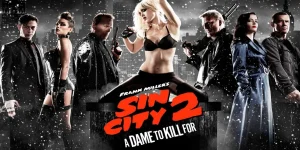
- The film spawned a sequel, Sin City: A Dame to Kill For, released in 2014, which performed significantly below the original’s box office numbers.
- Powers Boothe’s Senator Roark appears in both this film and the 2014 sequel, making him one of the most consistent throughlines in the franchise.
Why Watch?
Mickey Rourke’s Marv is the reason. Rodriguez built a technically extraordinary film, but Rourke’s physical commitment under pounds of prosthetics, that crooked grin before the second electric chair jolt, is what you actually remember. No other performance in the film, and few in the decade, carry that combination of pathos and pure danger.
Director’s Other Movies
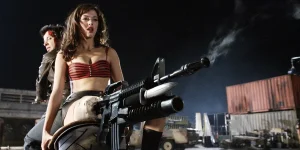
- El Mariachi (1992)
- Desperado (1995)
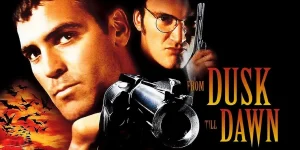
- From Dusk Till Dawn (1996)
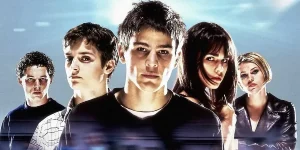
- The Faculty (1998)
- Spy Kids (2001)
- Once Upon a Time in Mexico (2003)
- Sin City: A Dame to Kill For (2014)
- Alita: Battle Angel (2019)