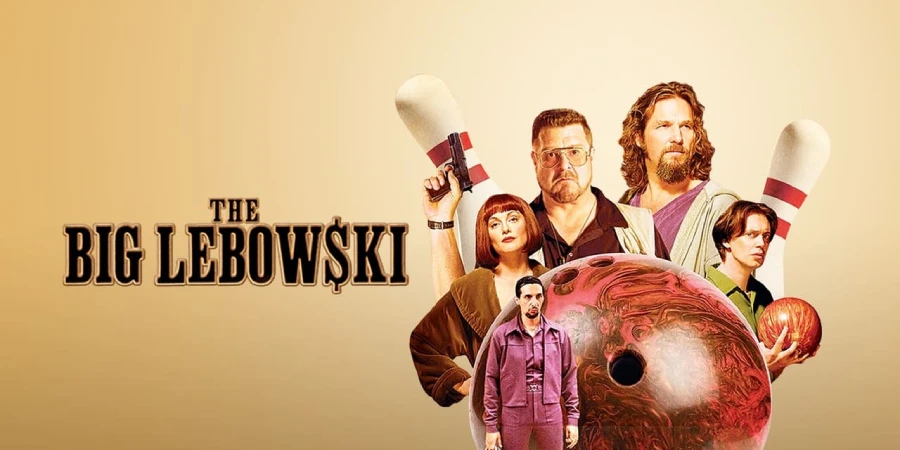

A case of mistaken identity sends a lazy, bowling-obsessed slacker on one of cinema’s most gloriously absurd journeys. The Big Lebowski is a film that rewards patience, repeated viewings, and a genuine tolerance for chaos. Joel and Ethan Coen built something genuinely strange here: a neo-noir mystery where the mystery almost doesn’t matter. What matters is the Dude.
Detailed Summary
Meet Jeffrey Lebowski, the Dude
Jeffrey “The Dude” Lebowski (Jeff Bridges) lives in Los Angeles and wants nothing from life except bowling, White Russians, and peace. Two thugs break into his apartment, rough him up, and urinate on his rug, all because they mistake him for a wealthy Pasadena man of the same name. This sets the entire absurd chain of events in motion.
The Dude, reasonably, decides he deserves compensation for the rug. His bowling buddy Walter Sobchak (John Goodman) immediately escalates the situation, as Walter does with everything.
The Other Lebowski and the Missing Wife
The Dude visits the wealthy Jeffrey Lebowski (David Huddleston) at his grand Pasadena estate. Big Lebowski dismisses him coldly, but his assistant Brandt later slips the Dude a rug as a parting gift. Soon after, Brandt contacts the Dude again with a more serious request.
Big Lebowski’s young trophy wife, Bunny (Tara Reid), has apparently been kidnapped. Big Lebowski asks the Dude to serve as a courier for the ransom, believing the kidnappers requested someone with no connection to law enforcement. The Dude, flattered and confused, agrees.
Walter Sabotages the Ransom Drop
Walter, characteristically, hatches a scheme. He convinces the Dude to substitute a briefcase full of dirty laundry for the actual ransom money, planning to keep the cash and hand the kidnappers nothing. This goes spectacularly wrong during the drop.
Three nihilists, led by Karl Hungus (Peter Stormare), intercept the exchange. Without real money to hand over, the drop collapses. The Dude also loses control of the car carrying the supposed kidnappers’ instructions, and with it any hope of a clean resolution.
Maude Lebowski Enters the Picture
Big Lebowski’s eccentric artist daughter, Maude Lebowski (Julianne Moore), contacts the Dude. She wants her father’s rug back (the one Brandt gave the Dude) and is far more interesting than anyone else in the story. Maude is sharp, sexually forward, and has her own agenda entirely.
She explains that her father is not actually wealthy on his own; the family fortune belongs to her, via a charitable foundation. This detail quietly reframes everything the audience thinks they know about Big Lebowski’s motives.
Jackie Treehorn and More Complications
Meanwhile, Jackie Treehorn (Ben Gazzara), a pornography producer and loan shark, is also looking for Bunny. Bunny, it turns out, owed Treehorn money before her supposed kidnapping. Treehorn has his men rough up the Dude, then invites him to his Malibu home for a drink that turns out to be drugged.
The Dude hallucinates a surreal Busby Berkeley-style dream sequence involving bowling and Maude. He then wakes up in a police car, getting tossed out onto a Malibu street by a dismissive sheriff.
Donny, Walter, and the Bowling Tournament
Woven throughout all of this is the trio’s bowling rivalry against a team led by Jesus Quintana (John Turturro), a flamboyant and menacing competitor. Walter constantly references his Vietnam service at every possible opportunity. Donny Kerabatsos (Steve Buscemi) quietly follows along, largely ignored by Walter.
Their regional bowling tournament looms in the background as a kind of ironic counterpoint to the increasingly chaotic main plot.
Unraveling the Conspiracy
Maude eventually explains her suspicion: her father took money from the charitable foundation and staged the kidnapping himself, using Bunny as a convenient excuse. In other words, Big Lebowski stole from his own charity and planned to pocket the ransom money the Dude was supposedly delivering.
Consequently, there was never a real kidnapping. Bunny had simply gone on an unannounced road trip. She returns on her own, oblivious to the chaos surrounding her absence.
Movie Ending
Big Lebowski’s scam falls apart completely when Bunny drives up to the estate, very much alive. He loses his composure and attacks the Dude from his wheelchair, then falls to the floor in a rage. The Dude and Walter simply walk out, leaving the old man humiliated on the ground. No arrests, no dramatic confrontation, just quiet deflation.
Outside, the three nihilists ambush the Dude, Walter, and Donny, demanding money they feel they are owed for playing along with the fake kidnapping. Walter, in a burst of violent energy, bites off Karl Hungus’s ear and beats the group back. However, the triumph comes at a cost: Donny, who suffers a heart attack during the fight, collapses and dies.
Walter and the Dude carry Donny’s ashes to the Pacific coast to scatter them. Walter delivers an impromptu eulogy that veers into Vietnam references almost immediately. He then opens the urn and hurls the ashes into the wind, which blows them directly into the Dude’s face. It is simultaneously absurd and oddly touching.
The film closes with The Stranger (Sam Elliott), the film’s narrator, offering a final philosophical musing at the bowling alley bar. He tells the Dude to take it easy. The Dude, heading back for one more game, says he will. That simple exchange is the film’s thesis: sometimes the world is chaos, and the only sane response is to keep bowling.
Notably, the ending resists any conventional resolution. No one is punished meaningfully, no money is recovered, and nothing is truly solved. Yet the film feels complete. Donny’s death is the only real consequence, and it lands with a quiet weight that contrasts sharply with everything else. It reminds the audience that even in absurdist comedies, something real can be lost.
Are There Post-Credits Scenes?
The Big Lebowski contains no post-credits scenes. Once The Stranger finishes his narration and the credits roll, the film is over. There are no hidden extras, bonus footage, or sequel teases waiting at the end.
Type of Movie
The Big Lebowski is a neo-noir comedy with strong elements of absurdism and surrealism. It uses the structure of a classic Raymond Chandler-style detective story but fills that structure with characters who are entirely unsuited to the genre. In contrast to traditional noir heroes, the Dude is passive, confused, and largely ineffective.
Its tone is consistently comedic but never dismissive of its characters. Moreover, it carries genuine warmth beneath all the strangeness, which is a big part of why it endures.
Cast
- Jeff Bridges – Jeffrey “The Dude” Lebowski
- John Goodman – Walter Sobchak
- Julianne Moore – Maude Lebowski
- Steve Buscemi – Donny Kerabatsos
- David Huddleston – The Big Lebowski
- Philip Seymour Hoffman – Brandt
- John Turturro – Jesus Quintana
- Tara Reid – Bunny Lebowski
- Sam Elliott – The Stranger
- Ben Gazzara – Jackie Treehorn
- Peter Stormare – Karl Hungus
- Flea – Nihilist
Film Music and Composer
Carter Burwell composed the film’s score, continuing his longstanding collaboration with the Coen Brothers. His contributions here are subtle, often deferring to an eclectic soundtrack of licensed tracks that do much of the heavy lifting.
The film features an extraordinary range of music, from Bob Dylan’s “The Man in Me” to Kenny Rogers and the First Edition’s “Just Dropped In (To See What Condition My Condition Was In),” which plays over the Dude’s hallucinatory bowling dream sequence. Creedence Clearwater Revival songs appear repeatedly, tied to Walter’s car and the film’s overall vibe of faded American cool. In addition, Townes Van Zandt’s cover of “Dead Flowers” plays over the end credits, a perfect, melancholy sendoff.
Filming Locations
Principal photography took place in and around Los Angeles, California. The film leans heavily into LA’s geography, using real bowling alleys, canyons, and coastal roads to ground its surreal story in an authentic sense of place.
Hollywood Star Lanes, the bowling alley central to the film, was a real venue in Hollywood. It has since been demolished, making those scenes a kind of accidental historical record. The Dude’s apartment scenes were shot in a real residential building in Los Feliz, a neighborhood that fits the character’s shabby but genuine LA lifestyle perfectly.
Treehorn’s Malibu home exteriors used a striking modernist property along the coast. The choice of real Malibu real estate reinforces the contrast between Treehorn’s slick world and the Dude’s chaos.
Awards and Nominations
The Big Lebowski received relatively little major awards attention upon its initial release. However, it earned a BAFTA nomination for Best Original Screenplay for Joel and Ethan Coen, which recognized the script’s genuine wit and craft.
Behind the Scenes Insights
- Jeff Bridges based the Dude partly on Jeff Dowd, a film producer and activist he knew, who shared many of the character’s mannerisms and tastes.
- John Goodman reportedly based much of Walter’s intensity on the Coen Brothers’ directorial style, specifically their tendency to be certain and uncompromising on set.
- The Coens wrote the role of the Dude specifically with Jeff Bridges in mind from the very beginning.
- John Turturro asked to wear a hairnet as Jesus Quintana; the Coens agreed immediately and it became one of the character’s most iconic visual details.
- The dream sequences required elaborate practical set construction and were among the most technically complex parts of the shoot.
- Sam Elliott’s narration was added as a framing device to give the film its storytelling structure; his casting as a classic Western figure was very deliberate.
- Steve Buscemi’s character Donny is largely ignored or talked over by Walter throughout the film, a running joke the cast played with great consistency.
Inspirations and References
The Coen Brothers drew heavily from the tradition of Raymond Chandler’s Los Angeles detective fiction, particularly The Big Sleep. Like Chandler’s plots, the mystery in The Big Lebowski is deliberately convoluted and ultimately secondary to character.
The film also references real people: Jeff Dowd, the inspiration for the Dude, was a genuine figure in 1970s radical politics and later in independent film distribution. Furthermore, the film draws from the screwball comedies of classic Hollywood, where mismatched characters stumble through plots bigger than themselves.
The surreal bowling sequences owe a clear visual debt to the elaborate musical numbers of director Busby Berkeley, a nod the Coens made quite openly.
Alternate Endings and Deleted Scenes
No widely documented alternate ending exists for The Big Lebowski. The Coens are famously protective of their creative process and rarely discuss cut material in detail.
Some scenes were trimmed for pacing, but no significant deleted scenes have received an official release. For instance, no major character arcs were reported to have been substantially altered from script to final cut.
Book Adaptations and Differences
The Big Lebowski is not based on any book, novel, or pre-existing source material. Joel and Ethan Coen wrote the original screenplay themselves. Therefore, there are no source text comparisons to draw.
Memorable Scenes and Quotes
Key Scenes
- The opening rug-urination scene establishes the film’s tone instantly: petty crime meets cosmic injustice, played entirely straight by the thugs and with weary disbelief by the Dude.
- The Dude’s hallucinatory bowling dream sequence, set to “Just Dropped In,” is a full-blown Busby Berkeley parody and one of the most visually inventive moments in Coen Brothers filmmaking.
- Walter pulling a gun on Smokey at the bowling alley over a disputed foul is a perfect encapsulation of Walter’s character: disproportionate, righteous, and utterly sincere.
- Donny’s ash scattering scene, where the ashes blow back into the Dude’s face, walks the line between comedy and genuine pathos in a way very few films manage.
- Jesus Quintana’s introduction, rolling a bowling ball in slow motion while “Hotel California” plays, remains one of cinema’s great character entrances for such a minor role.
Iconic Quotes
- “The Dude abides.”
- “This aggression will not stand, man.”
- “Over the line!”
- “I’m the Dude. So that’s what you call me. You know, that or, uh, His Dudeness, or uh, Duder, or El Duderino if you’re not into the whole brevity thing.”
- “Nobody calls me Lebowski. You got the wrong guy. I’m the Dude, man.”
- “Donny, you’re out of your element!”
Easter Eggs and Hidden Details
- Every scene where the Dude drinks a White Russian is carefully staged; he holds one in an almost unbroken visual gag throughout the entire film.
- The bowling ball’s point-of-view shot during the dream sequence mimics the perspective of the film’s overall storytelling: rolling forward with no clear destination.
- Treehorn’s notepad, from which the Dude tries to recover a written impression, features a doodle of a man with an erect phallus, a visual joke easy to miss at full speed.
- The Stranger’s boots are prominently featured in his bar scenes, a subtle visual nod to classic Western iconography and his role as a mythic narrator figure.
- Walter’s bowling bag, which he carries everywhere, parallels his constant need to be prepared for conflict in a world where his skills are entirely inappropriate.
- Several background extras in the bowling alley scenes appear in multiple scenes without acknowledgment, suggesting the alley exists in its own self-contained universe.
Trivia
- Jeff Bridges reportedly kept his bowling ball from the production and has mentioned it in multiple interviews over the years.
- The film was a modest box office performer on release but grew into a massive cult phenomenon throughout the 2000s, eventually inspiring an annual fan festival called Lebowski Fest.
- John Turturro’s Jesus Quintana became so beloved that Turturro eventually directed and starred in a spinoff film centered on the character, released decades later.
- The Coen Brothers have said in interviews that the Dude is one of the most moral characters they have ever written, despite his apparent laziness.
- Roger Ebert initially gave the film a mixed review; he later reconsidered and came to appreciate it far more warmly.
- Julianne Moore performed many of her scenes while suspended by a harness rig to achieve Maude’s aerial art-making sequences.
- The film contains over 260 uses of the word frequently associated with the Dude’s vocabulary, making it one of the more memorably profane films of its decade.
Why Watch?
The Big Lebowski is one of those rare films that gets richer every time you watch it. Its comedy operates on multiple levels simultaneously, rewarding casual viewers and obsessive rewatchers equally. Moreover, Jeff Bridges delivers one of American cinema’s most effortlessly likable performances. Simply put, no other film feels quite like this one.
Director’s Other Movies
- Blood Simple (1984)
- Raising Arizona (1987)
- Miller’s Crossing (1990)
- Barton Fink (1991)
- Fargo (1996)
- O Brother, Where Art Thou? (2000)
- The Man Who Wasn’t There (2001)
- No Country for Old Men (2007)
- Burn After Reading (2008)
- A Serious Man (2009)
- True Grit (2010)
- Inside Llewyn Davis (2013)
- Hail, Caesar! (2016)
- The Ballad of Buster Scruggs (2018)
Recommended Films for Fans
- Fargo (1996)
- Burn After Reading (2008)
- Inherent Vice (2014)
- The Long Goodbye (1973)
- Raising Arizona (1987)
- O Brother, Where Art Thou? (2000)
- Adaptation (2002)
- Fletch (1985)